Coinbase and Ripple CEOs Join CFTC Advisory Panel Overseeing Digital Assets

TheNewsCryptoPublished on 2026-02-13Last updated on 2026-02-13

Abstract

The U.S. Commodity Futures Trading Commission (CFTC) has formed a new advisory committee focused on digital assets, appointing key industry leaders including Coinbase CEO Brian Armstrong and Ripple CEO Brad Garlinghouse. The committee, established under the Digital Commodities Consumer Protection Act, will provide expertise on regulatory and market developments. It includes representatives from crypto exchanges, stablecoin issuers, derivatives desks, and blockchain firms. The group will meet at least four times in 2026 to address issues like compliance, risk management, market transparency, and regulatory coordination. Their input will help shape future CFTC rules and oversight approaches for digital asset markets.

The United States Commodity Futures Trading Commission announced appointments to a new committee that would provide advice on regulatory and industry developments regarding digital assets. Coinbase CEO Brian Armstrong confirmed his position as a member of the committee representing crypto exchange interests. The advisory committee also has Ripple CEO Brad Garlinghouse as a member, offering information from a prominent payments blockchain company. The committee has various members representing companies in digital assets, finance, and blockchain technology. The committee also has members from a company that issues a stablecoin and a derivatives desk manager.

CFTC Chairman Rostin Behnam stated the committee would assist in helping regulators grasp the intricacies of the digital market. The members would contribute their expertise and knowledge from the digital asset marketplace. This advisory committee would meet at least four times in 2026 to discuss the problems regulators face in their work. The CFTC formed the committee through the Digital Commodities Consumer Protection Act’s powers. They would concentrate their focus on market issues such as compliance and risk management.
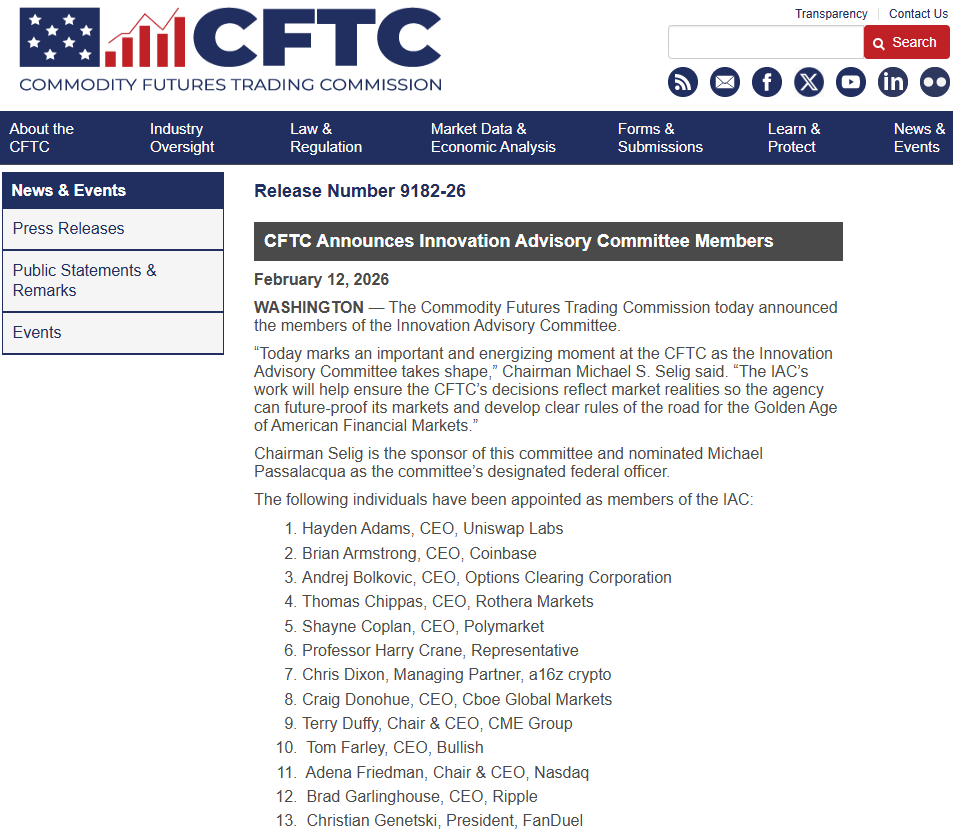
The committee has executives from companies such as Paxos, Cumberland, Galaxy Digital, among other companies. A representative of the stablecoin issuer has knowledge of liquidity and a framework for redemption. The diversity of the group is evident since there is knowledge on trading platforms, derivatives exchanges, and blockchain operations. The members of the CFTC’s advisory panel are compliance experts and know legal issues. The committee has experts from fintech and blockchain-based think tanks. The experts know derivatives exchanges, clearing operations, and blockchain operations.

Committee Aims and Regulatory Role

The Advisory Group will review options for enhancing digital asset markets under U.S. laws. The members will be able to review the risk issues faced by participants in the digital markets, whether retail or institutional. The members will also give opinions on compliance issues faced and law enforcement. The panel may also discuss transparency issues in digital markets in the U.S. The issue of coordination between U.S. regulatory authorities may also come up.

The committee members may assist the CFTC in oversight roles for new technologies. These could involve data infrastructures and market settlement systems. The contributions from the members to the CFTC may shape the proposals for future rules set forth by the agency.

Highlighted Crypto News:

U.S. Bankers Urge OCC to Slow Crypto Trust Bank Charters

TagsBlockchainBrad GarlinghouseCFTCCoinbaseCryptocurrencyexchangePaxosRipple

Related Questions

QWho are the two prominent CEOs appointed to the CFTC's new advisory committee for digital assets?

ACoinbase CEO Brian Armstrong and Ripple CEO Brad Garlinghouse.

QWhat is the primary purpose of the CFTC's newly formed advisory committee?

ATo provide advice on regulatory and industry developments regarding digital assets and assist regulators in grasping the intricacies of the digital market.

QHow many times is the advisory committee scheduled to meet in 2026?

AAt least four times.

QWhich act granted the CFTC the power to form this digital assets advisory committee?

AThe Digital Commodities Consumer Protection Act.

QBesides crypto exchanges, what other types of companies are represented on the committee?

AA stablecoin issuer, a derivatives desk manager, fintech companies, blockchain-based think tanks, and companies like Paxos, Cumberland, and Galaxy Digital.

Related Reads

Analysis of the Latest Portfolio Adjustment by the "Top Player" in the U.S. Stock Market: $9 Billion Short on NVIDIA, Shifting Focus to Power and Memory Sectors

AI investor Leopold Aschenbrenner has made a significant portfolio shift, taking a $9 billion nominal short position against top AI infrastructure stocks like NVIDIA, ASML, and Oracle. Simultaneously, he is redirecting capital towards what he sees as the next critical bottlenecks in the AI boom: power, memory, and data center networking, alongside private investments in AI model companies like Anthropic. This move is interpreted not as a call that the AI bubble has burst, but as a rotation within the infrastructure stack. The analysis highlights NVIDIA's recent $25 billion bond issuance as a potential signal, questioning why a cash-rich company would seek external debt despite high profits and increased dividends/buybacks. The core investment thesis is that the initial, crowded "picks and shovels" trade in semiconductors is maturing. The next wave of capital is expected to flow into the physical and logistical constraints of AI expansion: electricity supply, memory chip capacity, data center construction, and enabling technologies like optical networking (fiber) for high-bandwidth communication, where copper remains crucial for short distances. Aschenbrenner's substantial (approx. 20% of fund) private stake in Anthropic is noted as a key part of his strategy—investing directly in the "mine" (AI models) rather than just the "shovels." The discussion concludes that while certain segments may be overvalued, the overarching AI infrastructure demand driven by real product usage remains robust. The most promising long-term investments are seen in essential, non-sexy infrastructure—particularly energy and power companies—whose demand is viewed as a global constant irrespective of AI's cyclicality.

marsbit21m ago

Analysis of the Latest Portfolio Adjustment by the "Top Player" in the U.S. Stock Market: $9 Billion Short on NVIDIA, Shifting Focus to Power and Memory Sectors

marsbit21m ago

BIT Research: Liquidity is Disappearing, Will Bitcoin Replay the Bottoming Pattern of 2022?

The crypto market is currently in an adjustment phase driven by policy expectations and liquidity shifts. Despite a brief rebound fueled by geopolitical easing and SpaceX's strong IPO performance, unexpectedly hawkish signals from new Fed Chair Kevin Warsh have removed anticipated easing support. Concurrently, stablecoin liquidity is shrinking, with insufficient new capital inflows, pushing the market into a typically quiet summer period. Pricing lacks catalysts for a sustained rally. Daily trading volume has significantly contracted, stablecoin growth has slowed markedly, and the supportive effect of Strategy's (formerly MicroStrategy) STRC preferred stock-financed Bitcoin purchases is fading. Amid policy uncertainty, seasonal weakness, and liquidity contraction, Bitcoin faces near-term downward pressure. Warsh's hawkish pivot and refusal to provide a clear policy outlook have increased risk premiums, historically unfavorable for Bitcoin. Technically, the trend remains bearish below $73,700, with $62,446 as critical support. A break below could accelerate declines, though a prolonged consolidation phase, similar to 2022's bottoming process, is possible. Liquidity is a core constraint. Current daily volume is around $500 billion, roughly 25% of the peak during the July-Oct 2025 rally. The 12-month growth rates for USDT and USDC have fallen to ~20%, with 6-month growth near zero, indicating weak new inflows. Bitcoin ETF and Strategy-driven inflows have also weakened, with a 30-day rolling net outflow. With inflation at 4.2% above the Fed's target, combined hawkish policy, seasonal factors, and liquidity shortages challenge Bitcoin's ability to hold above $60,000. However, this adjustment phase may be forming a cyclical low this summer, potentially setting the stage for the next bull cycle.

marsbit50m ago

BIT Research: Liquidity is Disappearing, Will Bitcoin Replay the Bottoming Pattern of 2022?

marsbit50m ago

Who Makes the Best Use of Claude Code? The Answer Might Not Be Programmers

Claude Code Usage Report Summary (Based on ~400k sessions) Core Finding: In agentic programming with Claude Code, a clear division of labor has emerged: humans primarily decide *what* to build (planning decisions), while Claude decides *how* to build it (execution decisions). Key Insights: 1. **Effectiveness is not limited to programmers.** In code-generation tasks, success rates for users in non-technical fields (law, finance, management, research) are nearing those of software engineers. What matters most is the user's domain expertise and understanding of the problem to be solved. 2. **Domain expertise drives success and efficiency.** Sessions where users exhibited "expert" proficiency in the task's domain saw verified success rates double compared to "novice" sessions. Experts also delegated more work per instruction, with Claude executing more actions and producing more output. 3. **AI is amplifying, not replacing, domain knowledge.** Claude Code lowers the *implementation* barrier, not the *judgment* barrier. The value of knowing the "what" and "why" is increasing relative to just knowing the "how" to code. 4. **Usage is evolving.** Over a 7-month period (Oct '25 - Apr '26), the share of sessions for debugging halved, while use for software operations, data analysis, and non-code writing roughly doubled. The estimated economic value of typical tasks increased by ~25%. Conclusion: The data suggests coding agents are making programming background less critical for completing technical tasks. However, they reward and amplify deep domain understanding. The ability to successfully direct an AI agent stems more from mastery of a specific field than from coding skill itself. The primary gains come from being competent in a domain; deep specialization adds only marginal additional advantage. This may signal a shift where software creation becomes integrated into various professions.

marsbit1h ago

Who Makes the Best Use of Claude Code? The Answer Might Not Be Programmers

marsbit1h ago

Trading

Spot
Futures
活动图片