Claude Crashes Three Times a Day, API, App, Cowork All Down, Workers Left in the Dark

marsbitPublished on 2026-08-26Last updated on 2026-08-26

Abstract

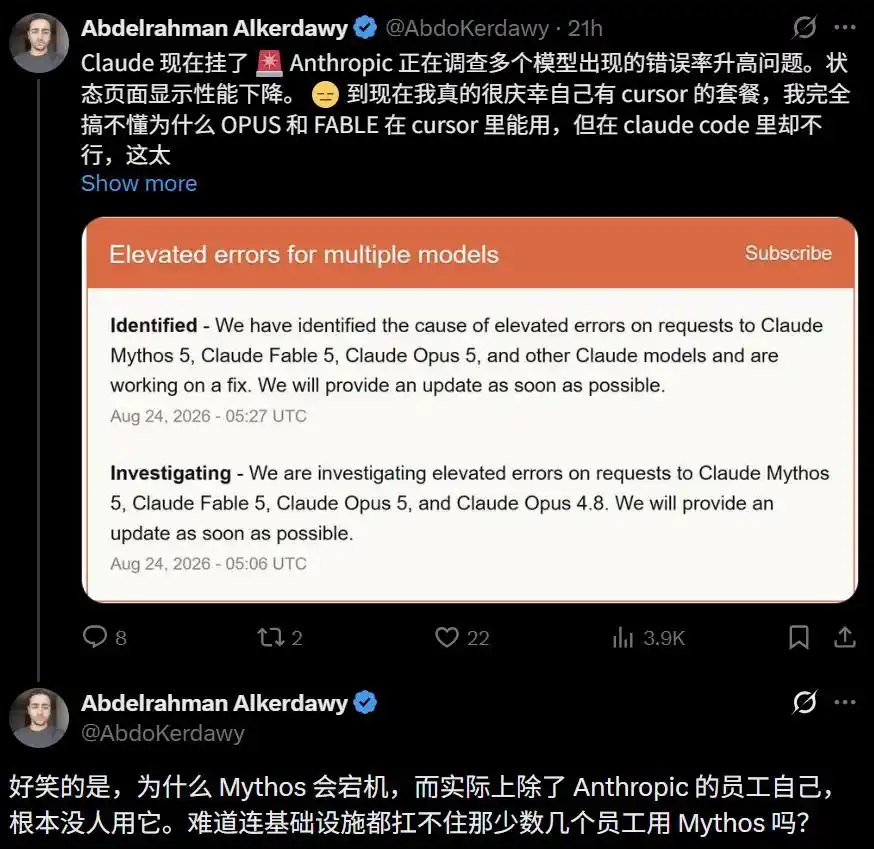
On August 24th, Anthropic's AI assistant Claude experienced three major outages, crippling its API, web app (claude.ai), Claude Code, and Cowork features for users. The main failure, lasting nearly three hours, displayed a "529 Overloaded" error, indicating a systemic overload rather than simple throttling. This was the 13th day in August with recorded incidents for Claude. Following the initial repair, the login system failed again twice in the early hours of August 25th. Despite official status pages showing recovery, many users reported persistent issues like white screens on key pages. A monitoring service noted Claude has accumulated 184 incidents since January 2026. The outages disrupted workflows significantly, with one user reporting a nine-hour automated process being lost. Beyond reliability, users and developers express concerns about a perceived decline in Claude's performance ("ran out of compute"), citing slower task completion and reduced reasoning depth in models like Opus 5 compared to earlier versions or competitors. AMD's AI director shared data showing a 75% drop in Claude Code's "thinking" character count from January to March, coinciding with the feature hiding its reasoning process from users entirely. While Anthropic claims 90-day availability rates above 99.3% for its services, this falls short of the 99.9% enterprise standard. More critically, for users running long AI agent tasks, an interruption means losing all prior processing time and context...

Sigh, who can handle this?

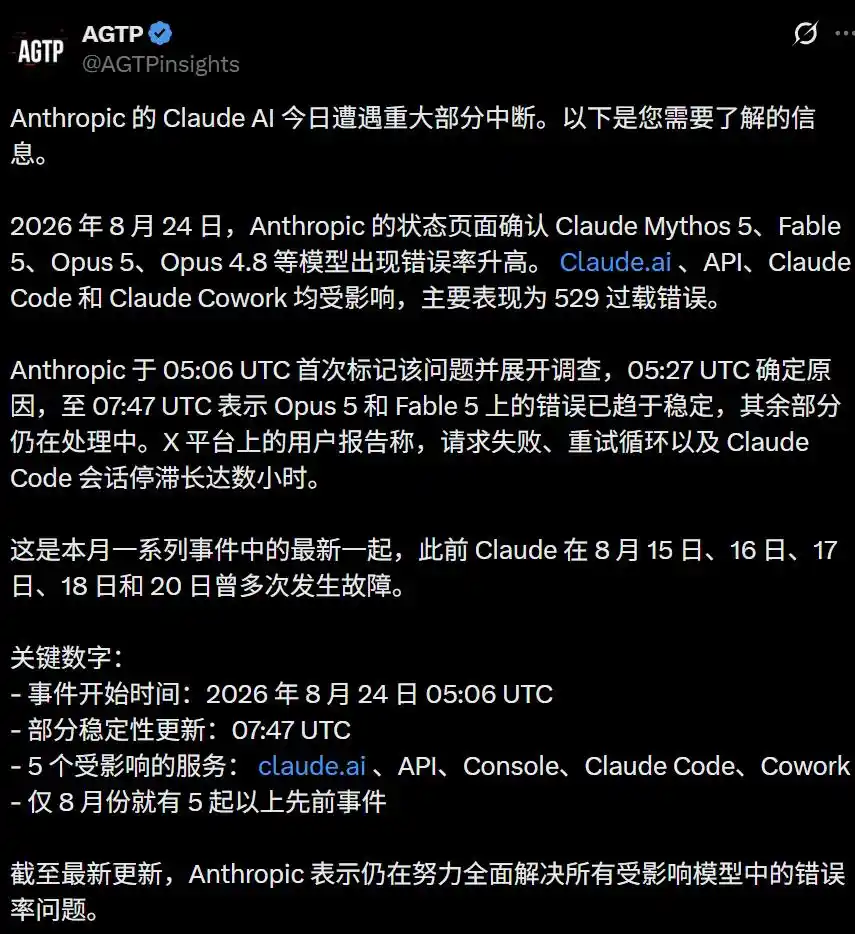
On August 24, Claude crashed three times in a row.

Anthropic's status page lit up with three glaring red lights that day, and the official account jumped out three times to announce that service had been fully restored.

But each time the page just turned green, cries of agony were still all over X, with a large number of users still shouting that they couldn't open it on their end.
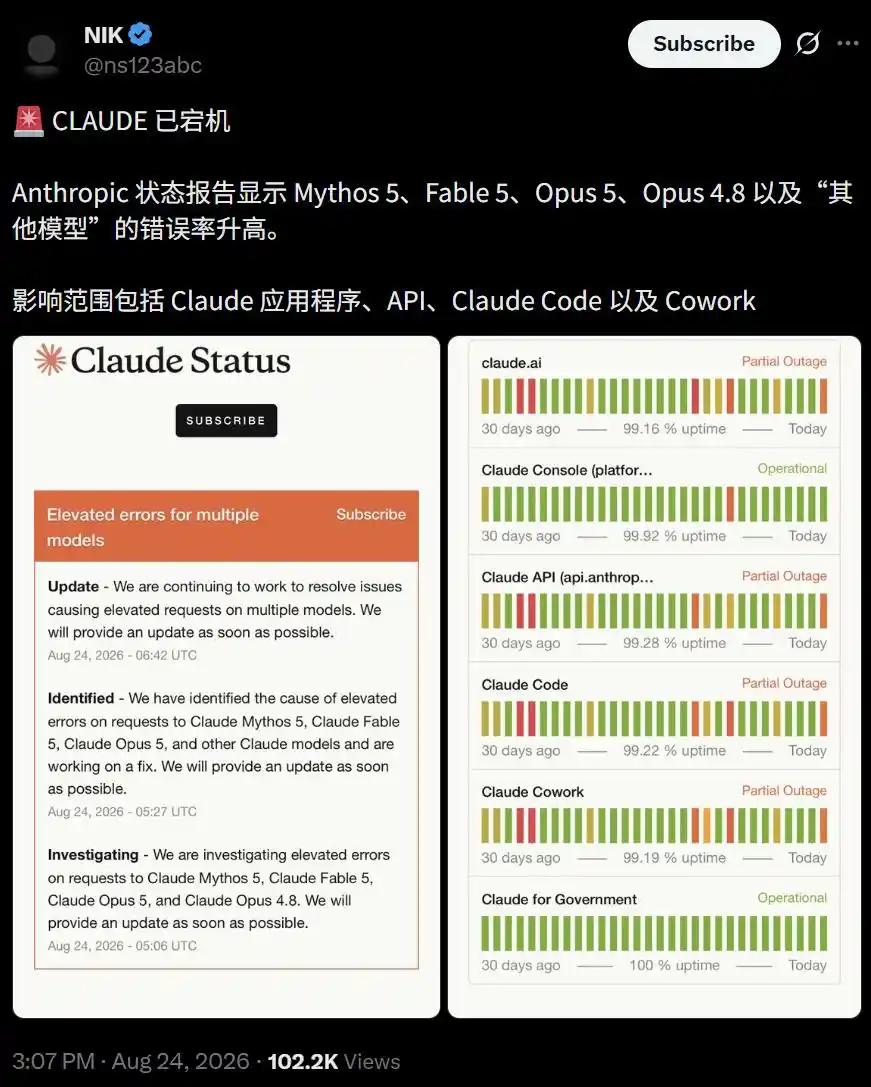
This was the 13th day in August that Anthropic left an incident record.

Goodness, only 24 days have passed this month.

And you're telling me Claude has been lying in bed for more than half of them.

One Reddit user even complained that he had an automated process that ran hard for nine hours, only to be completely cut off during this major outage, rendering all the work wasted.

529, the Kitchen Caught Fire

When the failure fully erupted, the error code 529 Overloaded popped up on users' screens in unison.

Those familiar with APIs know 429, which is rate limiting, akin to a restaurant telling you to order slower, please wait.

Whereas 529 represents the entire system being completely overloaded, equivalent to the restaurant directly coming out to notify you, "Sorry, our kitchen is on fire."

According to the status page records, this fire burned from 12:50 PM Beijing Time on August 24 all the way to 3:36 PM, tormenting for nearly three hours.

Twenty-one minutes after the alarm sounded, the officials were still quite confident, saying the root cause had been identified.

And then? Then there was no more. Anthropic neither disclosed the technical reason nor provided an estimated time for full recovery.
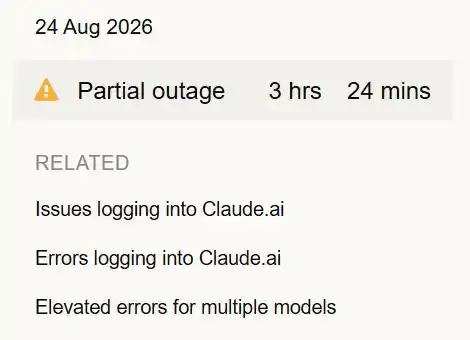
The list of affected victims stretched long.

Mythos 5, Fable 5, Opus 5, and Opus 4.8 all went down together; claude.ai, API, Claude Code, and Cowork all sounded the alarm.

In the end, only Console and Claude for Government managed to escape unscathed.

Basically, the entire Claude tech stack was breached in this wave.
Repeated Sit-ups, Red Then Green Then Red

The more absurd plot was still to come. Each time the official announcement said repairs were complete, it could turn around and die on you again.

The model-wide errors lasted for nearly three hours, then recovered.

But holding on until just past midnight on the 25th, the login system crashed again, claude.ai and Claude Code subscriptions were all severely affected, struggling for six minutes before catching their breath.

Before things could quiet down for a few hours, it crashed again at 4 AM sharp, this time for a solid eight minutes.
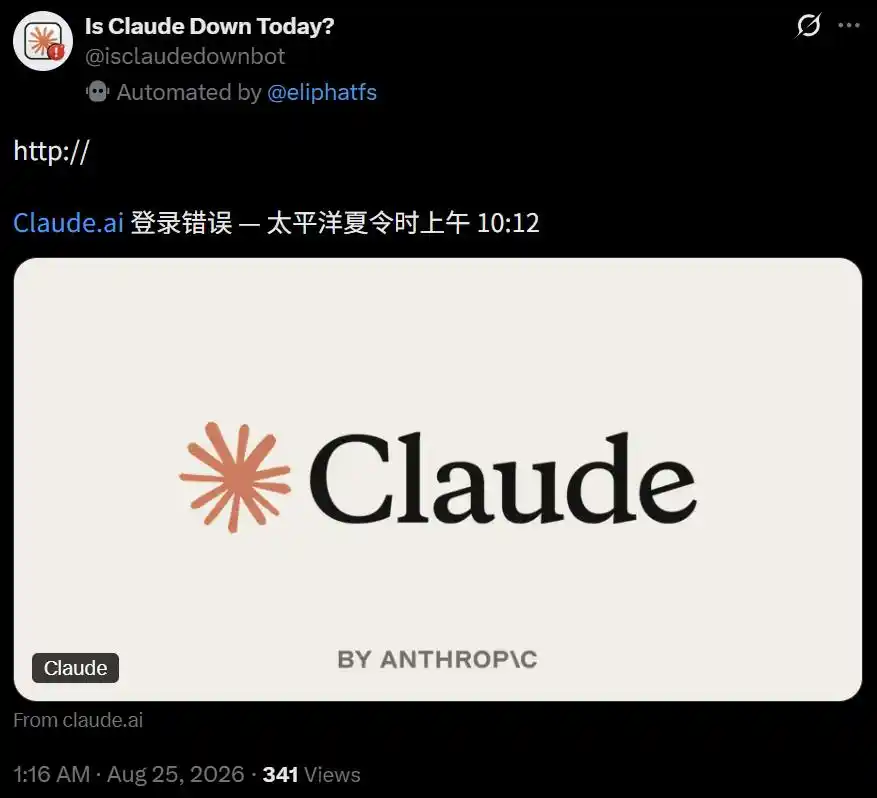
A monitoring bot specifically watching Claude's login status, isclaudedownbot, posted a tweet at 4:11 AM. The entire tweet had no nonsense, just one word.

Yes.

You really can't say this emotionless broadcast wasn't precise to the extreme.
Anthropic's official statement was written with the usual grace, saying service had been fully restored on Claude.ai, Claude Code, and Claude API, that the company knew how much everyone relied on Claude, and thanked everyone for their patience while the team investigated.

Despite such words, a green status page absolutely does not mean your account is usable.

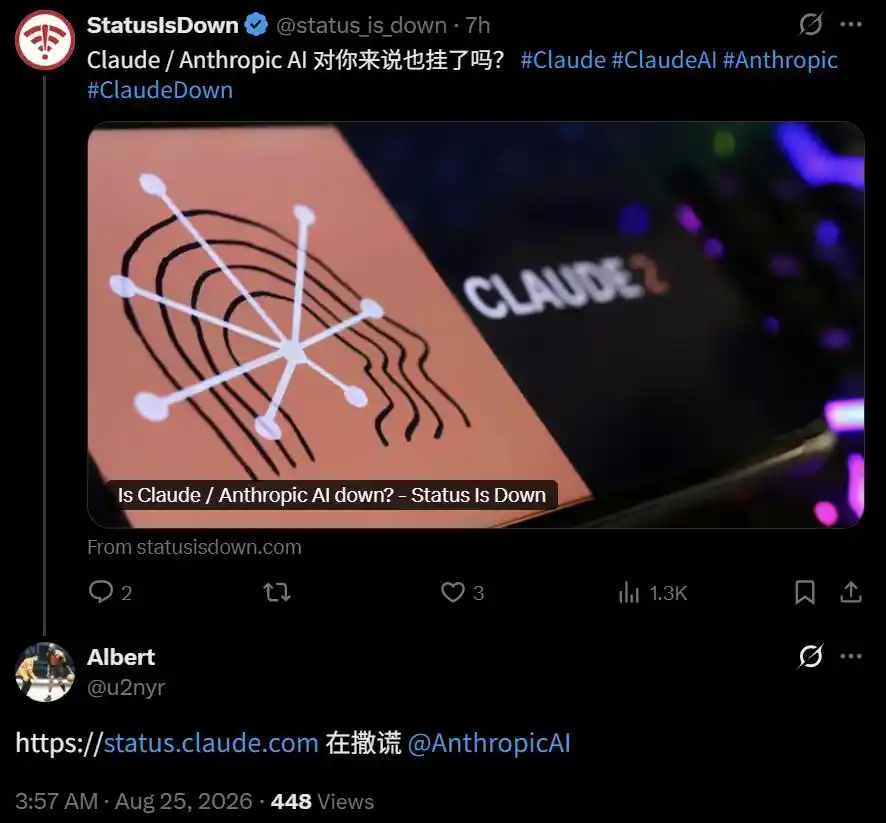
The tweet posted by user elstar that day, reading between the lines, no longer sounded like a complaint, but more like a cry for help.

But the actual situation was that the official status did indeed show everything was normal at that moment, yet residual authentication and frontend issues were causing some unlucky users' settings, usage, and skills pages to turn directly into glaring white screens.

Everything normal and white-screened pages, these two contradictory things, coexisted at this very moment.

Until late at night, there were still unlucky souls roaring online, "Claude down again."
Outages Are Clocking In Like Crazy

And this day was not at all lonely.

Third-party monitoring service StatusGator shows that from January 2026 to now, Claude has accumulated 184 outage records.

Keep in mind, it's only August.

And scrolling back through the status page, the outage logs for the entire month of August are densely packed like a schedule.

Two incidents exploded on the 20th, one each day without fail from the 19th to the 16th, Fable 5 directly crashed for about four hours on the 15th, and on the 14th, it went completely wild with three incidents in one day, followed unsurprisingly by one each on the 13th and 12th.

The most severe among these was the one on August 5th, crashing for a pitch-dark 7.5 hours.

The error message users saw on their screens at that time read: "Due to unexpected capacity constraints."

Compute Depletion, Who Took My Reasoning IQ

The phrase "capacity constraints" appeared in error messages more than once this month.

And on X, another phrase was repeatedly mentioned: "ran out of compute."

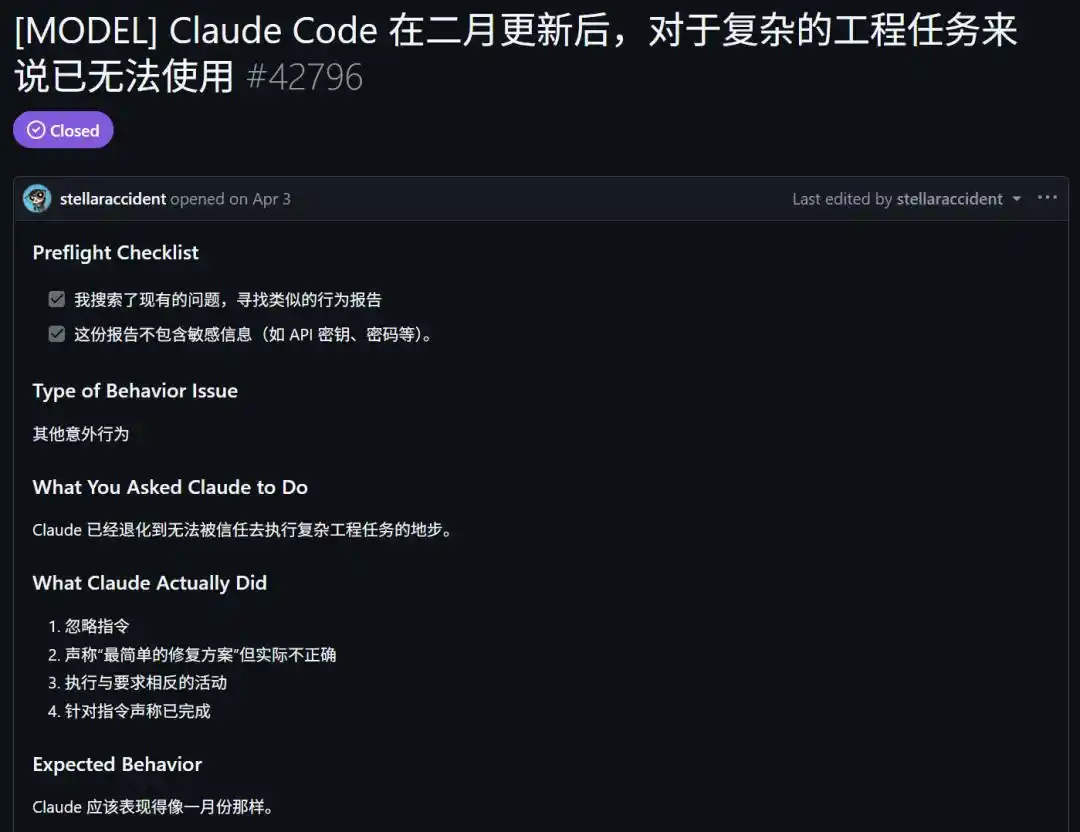
One developer put it bluntly: Opus 4.6 used to be so smart it made your scalp tingle. Later, it seemed they completely ran out of compute power and then nerfed everything.

User Eason also felt that Claude was experiencing an unprecedented, most severe intellectual degradation. Opus 5 was basically unusable, and they had even reverted to using Opus 4.8.

Actively reverting to an older version—such an operation is indeed rare in the fiercely competitive AI circle.

Of course, these are at best just users' metaphysical feelings, lacking ironclad proof.

So someone ran a comparative test pitting the two against each other.

For the same challenging task, Opus 5 on xHigh setting took a full hour to slog through, while switching to another company's comparable model on the same setting finished in 15 minutes.

A whole 4x difference, making one gasp in shock.

Even AMD's AI Director, Stella Laurenzo, personally got involved, pulling out all 6,852 Claude Code sessions from her team.

The resulting chart revealed a cliff-like drop in the curve.

In late January, the model's thinking depth was still about 2,200 characters. By early March, it had dwindled to a pitiful 560 characters, a plunge of 75%.

An even more thought-provoking coincidence was that during this same period, Claude Code's thinking content began to be quietly hidden from users. Within just one week, the proportion hidden went from 1.5% all the way to 100%.

In other words, while the model visibly became dumber, you couldn't even see how exactly it became dumber anymore.
Agent Burned Nine Hours, Status Page Logged a Few Minutes

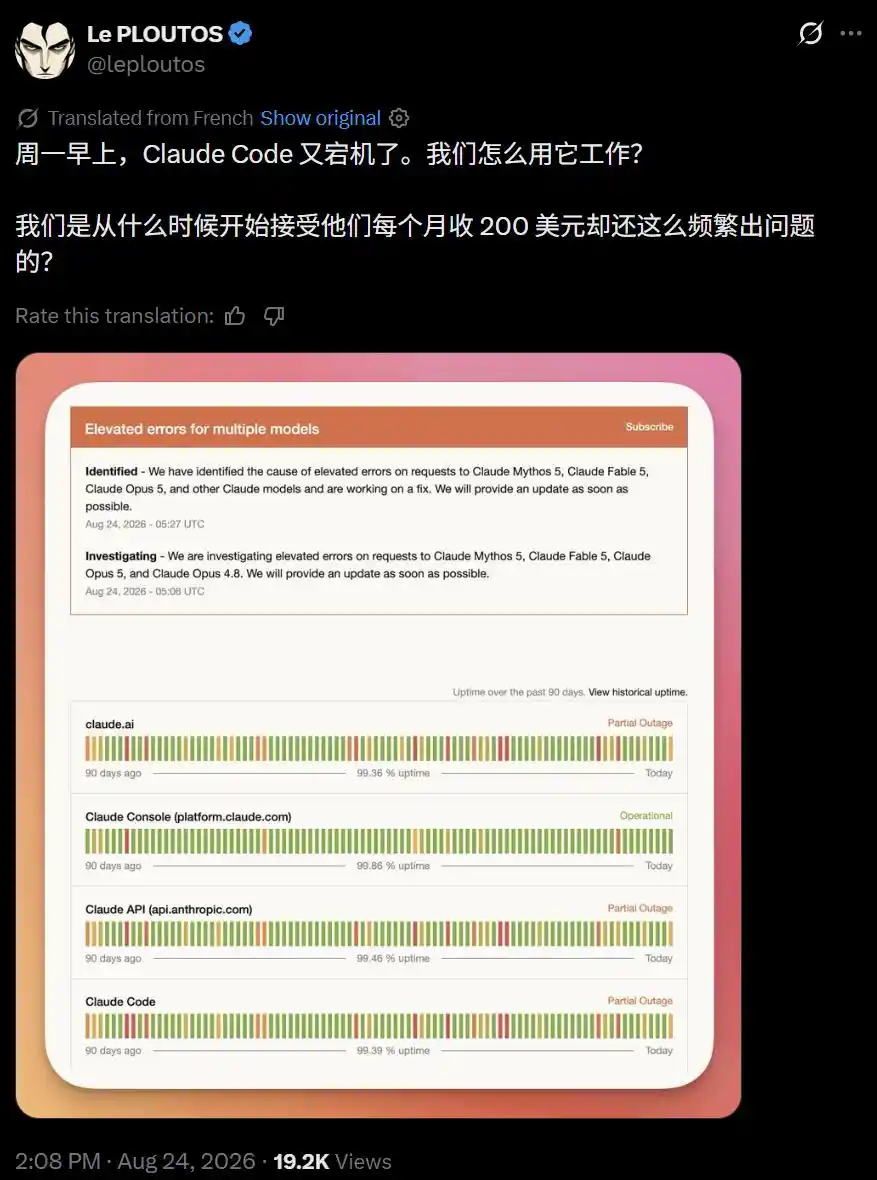
Anthropic's own 90-day availability rates posted on its official website read: claude.ai 99.33%, API 99.43%, Claude Code 99.35%.

At first glance, it looks like a perfect report card. But the passing grade for enterprise-level services is 99.9%.

What's more, in the classical internet era when the metric of availability was born, a service interruption only meant a webpage wouldn't open; you could just refresh and get back to work, losing only those few seconds of refreshing.

However, for an Agent, once a long task is interrupted, what's lost is never just the minutes of the interruption itself, but also all the time, context, and compute it had already burned through before. This ledger, the status page simply cannot record, nor can it.

To this day, Anthropic still hasn't explained what exactly happened during those three hours on August 24.

And this August, which has been red for 13 days, still has seven days left.

References:

https://x.com/ns123abc/status/2091784366519193852

This article is from the WeChat public account "新智元", author: ASI启示录, editor: 摩西

Related Questions

QWhat was the main issue with Claude on August 24th according to the article?

AOn August 24th, Claude experienced three major outages. The primary failure involved the entire model lineup (Mythos 5, Fable 5, Opus 5, Opus 4.8) and platforms (claude.ai, API, Claude Code, Cowork) returning a '529 Overloaded' error for nearly three hours, indicating a full system overload.

QWhat evidence does the article provide to suggest that Claude's performance or 'intelligence' has degraded?

AThe article cites several pieces of evidence: users' perceptions of severe 'intelligence degradation' in Opus 5; a benchmark showing Opus 5 took 4x longer than a competitor's model for the same task; and data from AMD's AI director showing a 75% drop in Claude Code's reasoning depth (from ~2200 to 560 characters) between late January and early March, coinciding with the tool hiding its 'thinking' process.

QHow does the article describe the frequency of Claude's service disruptions in August 2026?

AThe article describes the disruptions as extremely frequent. It states that August 24th was the 13th day with an incident record in a month that had only passed 24 days, meaning Claude was down on more than half of the days. A third-party monitor also recorded 184 incidents from January to August 2026.

QWhat is the difference between a '429' and a '529' error code as explained in the article?

AThe article uses a restaurant analogy: a '429' error is like rate-limiting, equivalent to a restaurant asking you to slow down your ordering. A '529' error represents a complete system overload, equivalent to the restaurant announcing the kitchen is on fire.

QWhy does the article argue that the traditional 'uptime percentage' metric is inadequate for modern AI Agents like Claude?

AThe article argues that while Claude's uptime percentages (e.g., 99.33%) look good, they are below the enterprise standard of 99.9%. More importantly, for a long-running AI Agent, an interruption doesn't just cost the minutes of downtime. It also wastes all the time, computational resources, and context the Agent had built up over potentially hours of work, a loss the uptime metric cannot capture.

Related Reads

a16z Deep Dive: Stop Chasing the 'AI Smell', Here's a Practical Guide to Writing with AI

"Don't Obsess Over AI Detection: A Practical Guide to Writing Alongside AI" by Steph Zinn (a16z Crypto) This guide moves beyond the flawed premise that AI-generated text can be easily spotted by a set of "tells" and that these features automatically mean poor quality. Instead, it focuses on how writers and founders can use LLMs effectively by understanding, controlling, and editing the common stylistic tendencies of AI-assisted prose. The article breaks down AI writing "tells" into four key dimensions: **1. Rhetorical Features (Insight-Shaped Writing):** AI often produces semantically empty, "corporate-sounding" filler language—vague profundities, hedging phrases, excessive parallelism, and summary statements. The advice is to ruthlessly edit these out, using prompts to make language more specific and direct. **2. Voice Features (The Alexa Voice):** Default AI writing relies on a narrow, fungible vocabulary of low-friction, abstract words and cliché phrases that lack personality. While this generic voice is acceptable for support docs or mass communications, founders should preserve their unique voice for impactful writing. Use LLMs to identify and replace jargon, aiming for concrete, distinctive word choices. **3. Structural Features (Form Without Function):** AI tends towards over-structured text with excessive subheadings, lists, roadmaps, and the rigid "three-point" framework. While clear structure is good for readability and SEO, it shouldn't force ideas into unnatural containers. Choose a structure that serves the format and purpose, borrowing from effective examples. **4. Punctuation Features (Dash Panic):** The overuse of em dashes and colons has become a hallmark, but writers shouldn't avoid useful punctuation just to seem "human." The key is avoiding repetitive, distracting patterns. Use punctuation that is grammatically correct and supports the flow of your argument. The core argument is that many so-called AI flaws are just amplified versions of existing bad writing habits. The goal isn't to eliminate AI's role but to use it as a tool while maintaining editorial control. The final question shouldn't be "Can this be detected as AI?" but "Does this writing effectively do its job?"

marsbit29m ago

a16z Deep Dive: Stop Chasing the 'AI Smell', Here's a Practical Guide to Writing with AI

marsbit29m ago

Podcast Notes | Conversation with Tom Lee: Bitmine Acquiring Nearly 5% of Total ETH Supply Is Not the End Goal, ETH Price Target Set at $10,000

In a podcast interview, Tom Lee, Chairman of BitMine Immersion Technologies, discusses the company's strategy to accumulate nearly 5% of the total Ethereum supply within 14 months, using equity financing and avoiding debt. BitMine has consistently purchased ETH for over 60 consecutive weeks, with recent weeks combining buybacks with purchases. The company's substantial ETH holdings generate approximately $300 million in annual staking rewards, covering operational costs like the dividends for its 9.5% perpetual preferred stock (BMNP). Lee positions ETH as a store-of-value asset, likening it to stocks or land, rather than a pure cash-flow instrument. Looking ahead, Lee suggests BitMine may continue buying beyond the 5% target if institutional adoption grows. He outlines a bullish price target for ETH: surpassing $5,000 in a new crypto bull cycle and potentially exceeding $10,000 within 1-2 years, driven by Wall Street tokenization and AI-related demand. The discussion also covers BitMine's evolution into an ecosystem player, funding Ethereum Foundation spin-offs and developing its Maven staking platform. Lee acknowledges his significant financial interests are tied to ETH's price and BitMine's performance. The interview provides a framework for evaluating ETH as a long-term asset, emphasizing staking yield sustainability and future institutional demand, while noting the uncertainties surrounding macro cycles and real-world adoption.

marsbit29m ago

Podcast Notes | Conversation with Tom Lee: Bitmine Acquiring Nearly 5% of Total ETH Supply Is Not the End Goal, ETH Price Target Set at $10,000

marsbit29m ago

Pricing Risk Assets in 8 Hours: Tonight's PCE to Set the Discount Rate, Nvidia to Test Earnings Tomorrow Morning

"Pricing Risk Assets in 8 Hours: PCE to Set the Discount Rate Tonight, NVIDIA to Test Profits Tomorrow Morning" Risk asset prices hinge on two variables: the numerator (earnings expectations) and the denominator (the discount rate). Both will be recalibrated within eight hours. First, at 20:30 Beijing time, the US Bureau of Economic Analysis releases July PCE inflation data and the second estimate of Q2 GDP. Consensus expects mild core PCE growth, but a surge in key PPI components poses an upside risk. A hotter-than-expected print could push Treasury yields and the dollar higher, threatening the recent rally in Bitcoin (BTC) above $80K, which was fueled by falling yields. A benign reading would support risk assets. Market sentiment is already "greedy" (Fear & Greed Index at 74), making it vulnerable to disappointment. Second, around 04:20, NVIDIA reports its Q2 FY27 earnings. While consensus revenue of ~$91.85B slightly exceeds company guidance, the market has priced in a beat. The key will be the magnitude of the beat and, crucially, the Q3 guidance. As a bellwether for tech and AI narratives, NVIDIA's results will significantly impact overall risk appetite and AI-related crypto tokens. The combination creates four scenarios: 1) Benign PCE & strong NVIDIA guidance confirms the bullish trend. 2) Hot PCE & strong NVIDIA leads to conflicted signals and likely volatility for BTC. 3) Benign PCE & weak NVIDIA guidance pressures tech but offers some macro support for BTC. 4) Hot PCE & weak NVIDIA guidance presents a "double whammy," risking a sharp pullback in BTC toward the $75K-$76K support zone. The outcomes will set the tone for markets ahead of the upcoming Jackson Hole symposium.

marsbit1h ago

Pricing Risk Assets in 8 Hours: Tonight's PCE to Set the Discount Rate, Nvidia to Test Earnings Tomorrow Morning

marsbit1h ago

Trading

Spot
活动图片