Circle to acquire Interop Labs team and IP as Axelar remains independent

cointelegraphPublished on 2025-12-15Last updated on 2025-12-15

Abstract

Circle has signed an agreement to acquire the Interop Labs team and its proprietary technology, a core contributor to the Axelar Network. The deal, expected to close in early 2026, will integrate Interop’s technology into Circle’s Arc blockchain and Cross-Chain Transfer Protocol (CCTP) to enhance interoperability and developer tools. The Axelar Network, its foundation, and the AXL token will remain independent and community-governed. Another contributor, Common Prefix, will take over Interop’s development duties. Circle, the issuer of the USDC stablecoin, has been expanding through acquisitions, including Hashnote earlier in 2025. The terms of the deal were not disclosed.

Stablecoin issuer Circle has signed an agreement to acquire the Interop Labs team and its proprietary technology, bringing a core contributor to the Axelar Network into its infrastructure business.

The deal, expected to close in early 2026, covers Interop Labs’ personnel and proprietary intellectual property, while the Axelar Network, its foundation and the AXL token will remain independent and governed by the community.

Interop Labs is the initial developer of the Axelar Network, a decentralized interoperability network that supports crosschain messaging and asset transfers between blockchains. Circle said the team’s technology will be integrated into Circle’s Arc blockchain and Cross-Chain Transfer Protocol (CCTP).

Another Axelar contributor, Common Prefix, will take over Interop Labs’ previous development responsibilities to maintain continuity on the open-source network.

According to Circle, the acquisition is expected to speed up interoperability for assets issued on Arc, enhance developer tools for multichain applications, and support the development of Circle-built products. The terms of the deal were not disclosed.

Circle issues USDC (USDC), the second-largest stablecoin by market capitalization, accounting for roughly 25% of the $310 billion global stablecoin market, according to DefiLlama data.
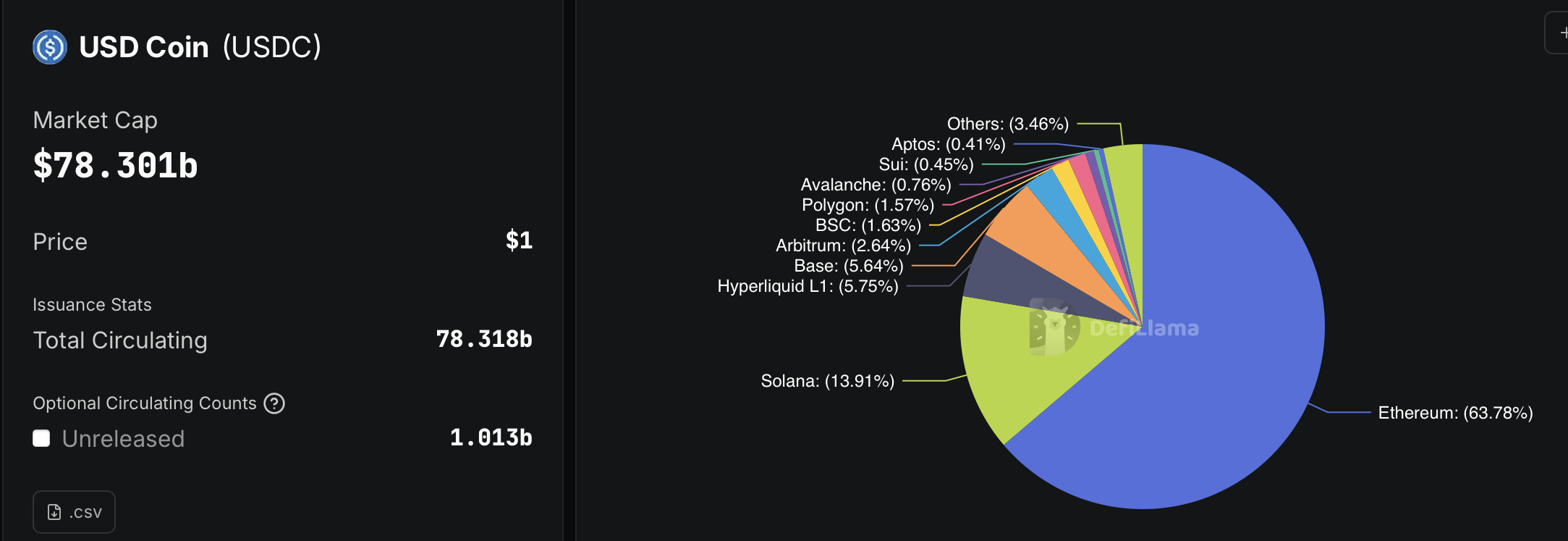
USDC market capitalization and blockchains. Source: DefiLlama

In January, Circle acquired Hashnote, the issuer of the tokenized money market fund US Yield Coin, bringing one of the largest yield-bearing real-world asset products into its stablecoin and infrastructure business.

Related: Paxos, Ripple, Circle and others secure US trust bank approvals

Stablecoin issuers make acquisitions in 2025

Stablecoin issuers have increasingly used acquisitions in 2025 to expand their businesses.

In November, Paxos acquired institutional crypto wallet provider Fordefi in a deal valued at more than $100 million, according to Fortune. Paxos, the issuer of Pax Dollar (USDP) and PayPal’s USD (PYUSD) stablecoin, said the acquisition strengthens its custody and transaction infrastructure for stablecoin issuance, asset tokenization and onchain payments.
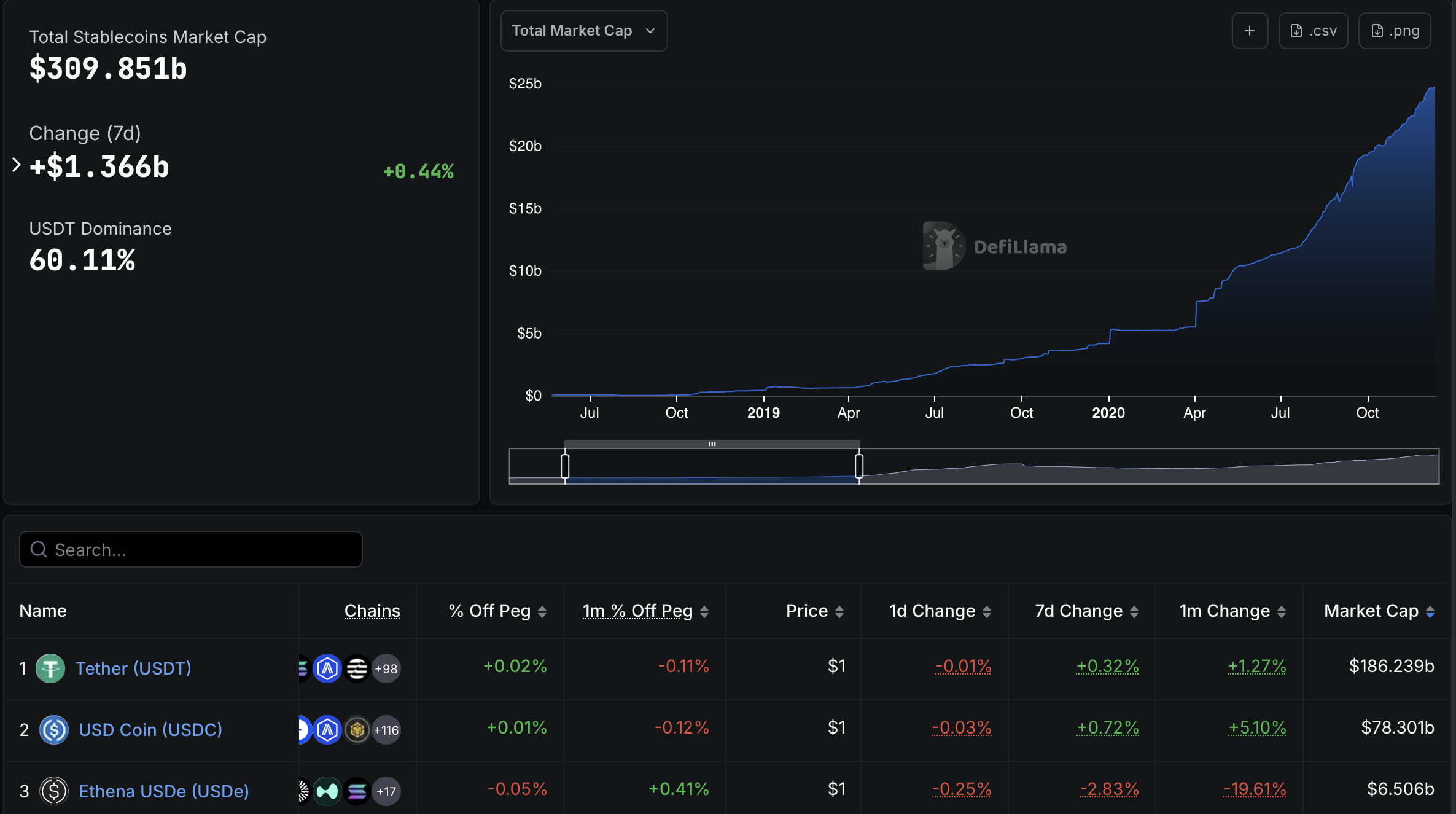
Stablecoin market cap. Source: DefiLlama

Tether, the dominant stablecoin issuer behind the USDt (USDT) token, has used its balance sheet to acquire minority stakes and strategic positions across traditional asset businesses.

In June, it acquired a roughly 32% stake in Canada-listed gold royalty company Elemental Altus Royalties for about $89 million. In November, Tether Investments acquired a minority stake in precious metals company Versamet Royalties, purchasing about 11.8 million common shares through a private agreement with an existing shareholder.

Tether has tried to push beyond finance into sports, submitting a binding all-cash offer on Dec. 12 to acquire Exor’s 65.4% controlling stake in Italy’s Juventus Football Club, a bid that the Agnelli family’s holding company later said its board unanimously rejected.

Magazine: Meet the onchain crypto detectives fighting crime better than the cops

Related Reads

$292 Million KelpDAO Cross-Chain Bridge Hack: Who Should Foot the Bill?

On April 18, 2026, an attacker stole 116,500 rsETH (worth ~$292M) from KelpDAO’s cross-chain bridge in 46 minutes—the largest DeFi exploit of 2026. The stolen assets were deposited into Aave V3 as collateral, causing $177–200M in bad debt and triggering a cascade of losses across nine DeFi protocols. Aave’s TVL dropped by ~$6B overnight. This legal analysis argues that KelpDAO and LayerZero Labs share concurrent liability, with fault apportioned 60%/40%. KelpDAO negligently configured its bridge with a 1-of-1 decentralized verifier network (DVN)—a single point of failure—despite LayerZero’s explicit recommendation of a 2-of-3 setup. LayerZero, which operated the compromised DVN, failed to secure its RPC infrastructure against a known poisoning attack vector. Both protocols’ terms of service cap liability at $200 (KelpDAO) or $50 (LayerZero), but these limits are likely unenforceable due to unconscionability, gross negligence exceptions, and potential securities law invalidation (if rsETH is deemed a security under the Howey test). Aave’s governance also faces fiduciary duty claims for raising rsETH’s loan-to-value ratio to 93%—far above competitors’ 72–75%—without adequately assessing bridge risks, amplifying the systemic fallout. Practical recovery targets include LayerZero Labs (a registered Canadian entity), KelpDAO’s founders, auditors, and identifiable Aave governance delegates. The incident underscores escalating legal risks for DeFi protocols, infrastructure providers, and governance participants.

marsbit17m ago

$292 Million KelpDAO Cross-Chain Bridge Hack: Who Should Foot the Bill?

marsbit17m ago

Insider Trading in War: 5 People Involved, the Highest Earner Was Arrested

On April 24, the U.S. Department of Justice arrested U.S. Army Special Forces Staff Sergeant Gannon Ken Van Dyke for insider trading related to the capture of Venezuelan President Nicolás Maduro on January 3. Van Dyke allegedly profited over $400,000 by placing bets on a prediction market, Polymarket, using insider knowledge of the covert operation. According to the indictment, Van Dyke registered an account (0x31a5) on December 26 and made a series of bets predicting Maduro’s capture and U.S. military involvement in Venezuela. He withdrew most of his funds on the day of the operation and attempted to obscure his tracks by transferring assets through crypto and brokerage accounts. This case marks the first time the DOJ has prosecuted insider trading on Polymarket. PolyBeats had previously identified five suspicious accounts, including Van Dyke’s—the highest earner—in January. The other accounts, with profits ranging from $34,000 to $145,000, remain under unofficial scrutiny but have not been charged. Their lower profits, indirect access to information, and unclear legal boundaries may complicate prosecution. Polymarket has since strengthened its market integrity rules, explicitly prohibiting trading based on confidential or insider information. Van Dyke’s arrest, nearly four months after his trades, signals increased regulatory attention and the persistent traceability of blockchain-based transactions.

marsbit19m ago

Insider Trading in War: 5 People Involved, the Highest Earner Was Arrested

marsbit19m ago

Bitwise: Bullish on Bitcoin's Performance in the Second Half of the Year, AI and Regulation Will Spark a New Altcoin Season

Bitwise CIO Matt Hougan and Research Lead Ryan Rasmussen express strong bullish sentiment on Bitcoin's long-term prospects, suggesting that its $1 million price target may be too conservative. They argue Bitcoin serves a dual role: as digital gold and a potential global settlement asset, especially amid declining trust in traditional monetary systems. Despite a weak Q1 2026 where nearly all crypto assets and prices saw double-digit declines, the analysts remain optimistic due to strong forward-looking catalysts, including institutional adoption via Bitcoin ETFs from major firms like Morgan Stanley and Goldman Sachs. Geopolitical instability, such as Iran’s mention of using Bitcoin for international payments, increases the value of Bitcoin’s “out-of-the-money call option” as a non-political, global settlement currency. This enhances its appeal beyond a mere store of value. . Additionally, Hougan highlights that a clearer regulatory token framework under current SEC leadership, combined with AI efficiency gains and high-performance blockchains, could fuel a new “altseason” by late 2026. This may lead to a wave of legitimate, value-capturing token projects, unlike the earlier ICO boom. . Bitwise also announced an Avalanche ETF, citing its unique architecture and rapid growth in real-world asset (RWA) tokenization, which has surged 10x to nearly $30 billion in two years. The firm believes Layer 1 blockchains are still early in their growth cycle, with significant potential ahead.

marsbit1h ago

Bitwise: Bullish on Bitcoin's Performance in the Second Half of the Year, AI and Regulation Will Spark a New Altcoin Season

marsbit1h ago

Trading

Spot
Futures

Hot Articles

What is STORY

Understanding Story Protocol: Pioneering a New Era in Intellectual Property Management Introduction to Story Protocol In the rapidly evolving world of blockchain technology, Story Protocol emerges as an innovative solution aimed at transforming the landscape of intellectual property (IP) management. Designed to empower creators, Story Protocol is paving the way for a digital ecosystem that promotes transparency, creativity, and legal empowerment. The protocol operates on the principles of web3, introducing a decentralized framework that allows creators to not only protect but also monetize their works efficiently. In an age where content can easily be reproduced and shared, Story Protocol aims to establish a mechanism that respects creators’ rights and fosters a culture of collaboration. What is Story Protocol? At its core, Story Protocol is an advanced blockchain-based IP management tool that strives to revolutionize how intellectual property is created, managed, and licensed. The aim of the project is to disrupt traditional methods by leveraging the decentralized nature of blockchain technology. This offers a global and scalable library of intellectual property assets, allowing creators to engage with their audience in a more direct manner. Creators can easily register their works using the platform, setting customizable guidelines for how their content may be used. This process not only protects their legal rights but also facilitates the monetization of their creations in a manner that is both transparent and efficient. As a result, Story Protocol caters to a diverse range of creators—from writers and artists to musicians and programmers—by fostering an inclusive and accessible environment. Who is the Creator of Story Protocol? The vision for Story Protocol is brought to life by Seung Yoon Lee, known as SY Lee, and Jason Zhao. SY Lee serves as the CEO and co-founder, bringing with him a wealth of experience from his background in journalism and entrepreneurship. His previous ventures, including Byline and Radish Fiction—subsequently sold to Kakao—have positioned him as a pioneering figure in digital content platforms. Co-founder Jason Zhao complements SY Lee's vision with his robust technical expertise. A graduate in Computer Science from Stanford University and a former employee of DeepMind, Jason's experience in advanced technologies empowers Story Protocol's capabilities in the digital ecosystem. Who are the Investors of Story Protocol? Story Protocol has garnered substantial financial backing from a range of reputable investors known for their keen eye for transformative technologies. This vital support reflects confidence in the project’s potential to reshape the IP market. Among the notable investors is A16z Crypto, which led both the seed round and Series B financing, further demonstrating its commitment to the future of digital economies. Other significant investors contributing to the project include: Polychain Capital: A recognized leader in blockchain investment that participated in the Series B round. Hashed Endeavor Samsung Next Foresight Ventures Dao5 Insignia Venture Partners Alliance DAO Mirana Ventures The breadth of this investment network not only provides funding but also adds credibility and strategic insight to the platform, positioning Story Protocol as a leader in its field. How Does Story Protocol Work? Story Protocol offers a comprehensive framework that allows creators to manage their intellectual property seamlessly. The platform is underpinned by several unique and innovative features that distinguish it from traditional IP management systems. Key Features: Programmable IP: This feature allows creators to define the terms of how their IP can be utilized, including guidelines for remixing and collaboration. By establishing clear and programmable parameters, creators can ensure their works are used in ways that align with their vision. Decentralized Ecosystem: The protocol enables creators to operate independently, without the need for intermediaries often found in traditional licensing arrangements. This decentralized approach not only empowers creators but also reduces the friction typically associated with IP management. Transparent Licensing: By simplifying the licensing process, Story Protocol makes it easier for creators to track how their works are being used. This manual transparency is essential for establishing trust and fostering collaboration in a digital landscape where IP rights are often contested. Together, these features create a robust environment that encourages innovation, cooperation, and respect for creators’ rights while simplifying the complexities of intellectual property law in the digital age. Timeline of Story Protocol Understanding the developmental milestones of Story Protocol can provide insights into its strategic growth and vision for the future. Below is a timeline highlighting significant events in the project's history: 2021: Foundation laid for the concept of Story Protocol while formulating its objectives. 2023: The project successfully raised $29.3 million in a seed funding round led by A16z Crypto, marking its official entry into the competitive landscape of blockchain innovations. 2024: Following the success of its initial funding, Story Protocol announced an $80 million Series B financing round at a substantial $2.25 billion valuation, further solidifying its position in the market. This timeline illustrates not only the rapid growth of Story Protocol but also the increasing interest and investment it has attracted from prominent players in the industry. The Future of Story Protocol As the digital content landscape continues to evolve, Story Protocol stands at the forefront of a revolution in IP management. By leveraging blockchain technology for creator empowerment and transparency, the protocol offers a compelling vision for a sustainable intellectual property ecosystem. In a world that demands creativity and innovation, Story Protocol enables creators to maintain ownership and control over their assets, ultimately fostering an environment where creativity can flourish. The extensive backing from seasoned investors further underscores the potential for this platform to redefine how intellectual property operates in the rapidly changing digital economy. In conclusion, Story Protocol is not just a project; it is a movement towards a more equitable and accessible IP landscape. As the digital world expands, Story Protocol promises to lead the charge, ensuring that creators are acknowledged and compensated fairly for their contributions to culture and society. The journey has just begun, and the implications of such an initiative are profound—not only for creators but for the future of digital content itself.

404 Total ViewsPublished 2024.04.04Updated 2024.12.03

What is STORY

Discussions

Welcome to the HTX Community. Here, you can stay informed about the latest platform developments and gain access to professional market insights. Users' opinions on the price of IP (IP) are presented below.

活动图片




