Cipher enters US wholesale power market with Ohio data center acquisition

cointelegraphPublished on 2025-12-23Last updated on 2025-12-23

Abstract

Cipher Mining has acquired a 200-megawatt power site in Ohio, marking its first expansion outside Texas and entry into the PJM wholesale electricity market. The site, expected to be operational by Q4 2027, is suitable for Bitcoin mining, high-performance computing, and data center use. This move addresses growing demand from hyperscalers like Amazon Web Services and Google Cloud. The acquisition reflects a broader trend of Bitcoin miners diversifying into power, data center, and infrastructure ventures amid ongoing pressure on mining profitability. Despite low hash prices, mining stocks have surged in 2025, with investors focusing on long-term strategic positioning rather than short-term Bitcoin production.

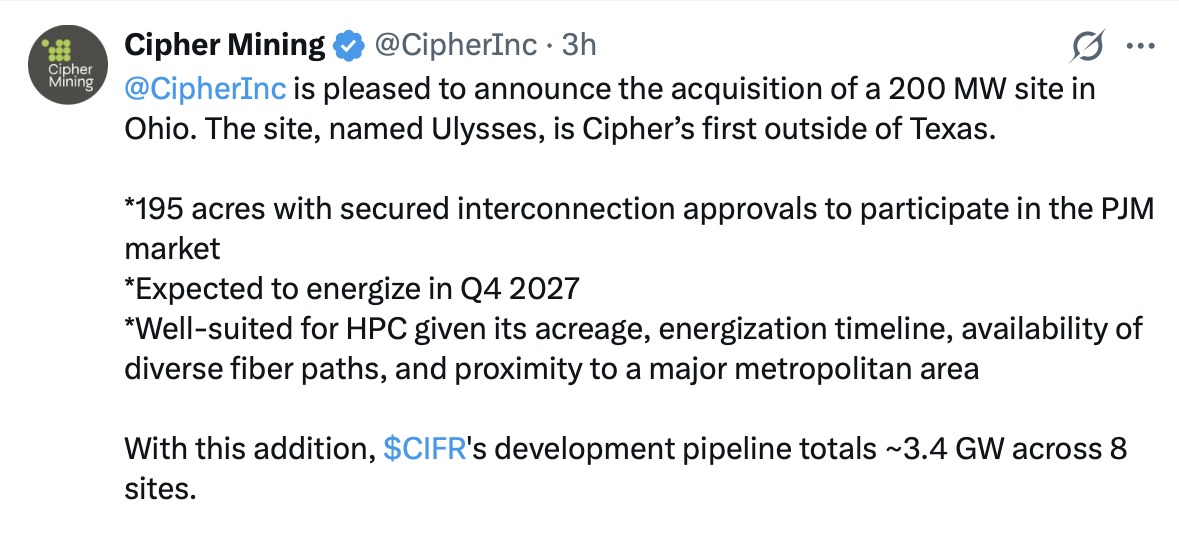
Cipher Mining has acquired a 200-megawatt power site in Ohio called “Ulysses,” marking its first expansion outside of Texas and entry into the PJM wholesale electricity market, the largest power market in the United States.

According to Tuesday’s announcement, the 195-acre site has secured power capacity from AEP Ohio, with all required utility agreements in place, and is expected to be energized in the fourth quarter of 2027.

Cipher said the facility is suitable for high-performance computing and data center use in addition to Bitcoin (BTC) mining. Financial terms of the transaction were not disclosed.

The move aims to meet growing demand from hyperscalers, large cloud computing companies such as Amazon Web Services and Google Cloud, for data centers. “Hyperscalers are driving unprecedented demand for large-scale sites,” said Cipher CEO Tyler Page, adding that the company's new site will give it additional capacity to expand its high-performance computing (HPC) hosting business.
Source: Cipher Mining

The deal follows a broader push by publicly listed Bitcoin miners into power, data center and manufacturing infrastructure beyond traditional mining.

Hut 8, for instance, recently signed a 15-year lease worth about $7 billion to supply 245 megawatts of AI data center capacity at its River Bend campus in Louisiana, with infrastructure provider Fluidstack as the tenant and Google backing lease payments.

A few days later, Bitdeer leased about 188,000 square feet at a logistics facility in Sparks, Nevada, to expand its US manufacturing footprint, according to The Miner Mag.

Related: How Bhutan is building a green Bitcoin economy from the ground up

Bitcoin mining hashprice puts pressure on miners

The Bitcoin mining hash price, a key measure of miner revenue per unit of computing power, has been below $40 since mid-November, a level many operators view as breakeven. The slump has forced mining companies to reassess their operating models as margins across the sector remain under pressure.
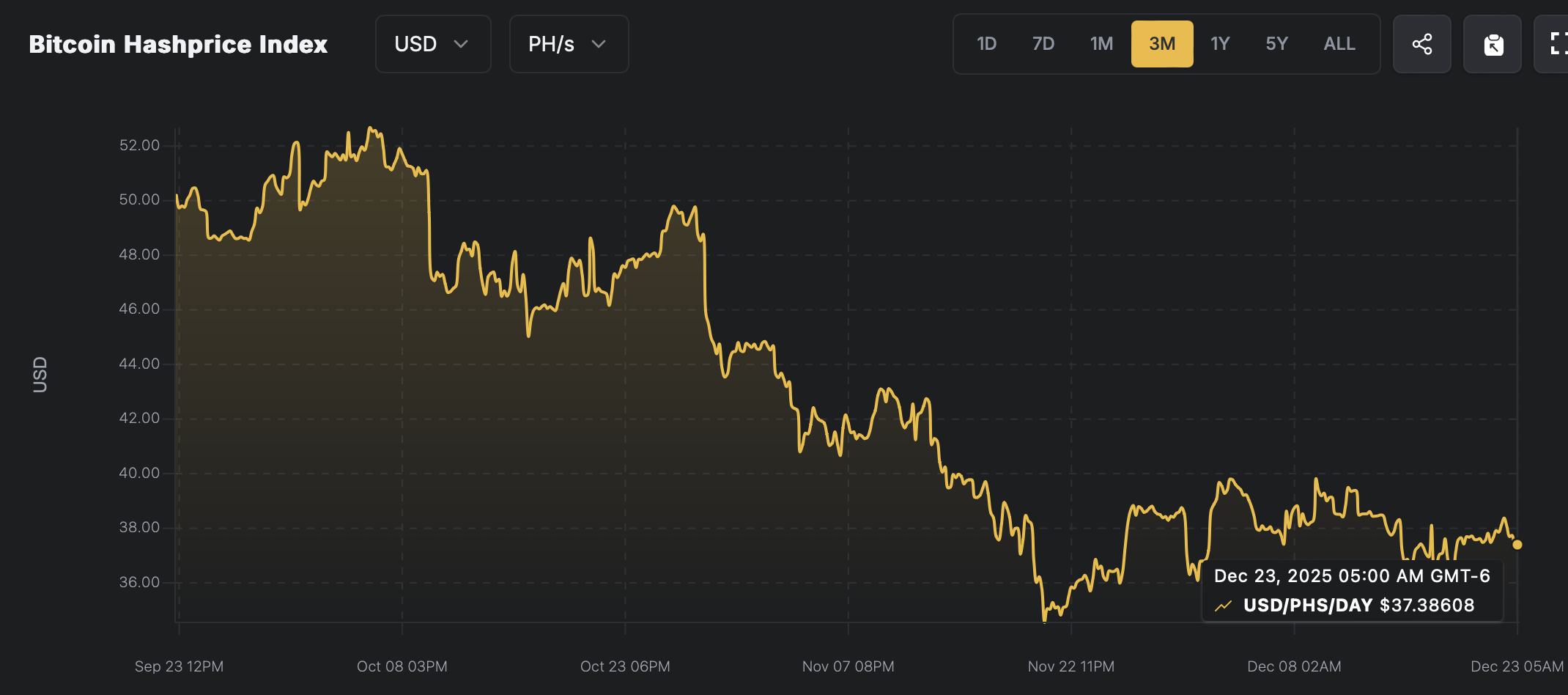
Bitcoin hash price over the past three months. Source: Hashrate Index

While many miners have sought diversification through AI and HPC demand, some are also turning to renewable energy as a way to lower costs and stabilize profitability.

Sangha Renewables recently brought a 20-megawatt solar-powered mining facility online in Ector County, Texas, while Phoenix Group launched a 30-megawatt hydro-powered operation in Ethiopia in November.

Separately, Canaan partnered with Soluna in September to deploy mining capacity at a wind-powered site in Texas and is developing adaptive mining rigs that use AI to optimize energy efficiency.

Despite the mounting pressure on mining economics, Bitcoin mining stocks have rallied sharply in 2025, signaling that public markets are increasingly focused on miners’ long-term strategic positioning rather than near-term Bitcoin production alone.

Among the top five publicly traded miners, IREN Limited is up roughly 331% year-to-date, followed by Applied Digital (246%), Cipher Mining (250%), Hut 8 (160%), and Riot Platforms (36%), according to data from Google Finance.
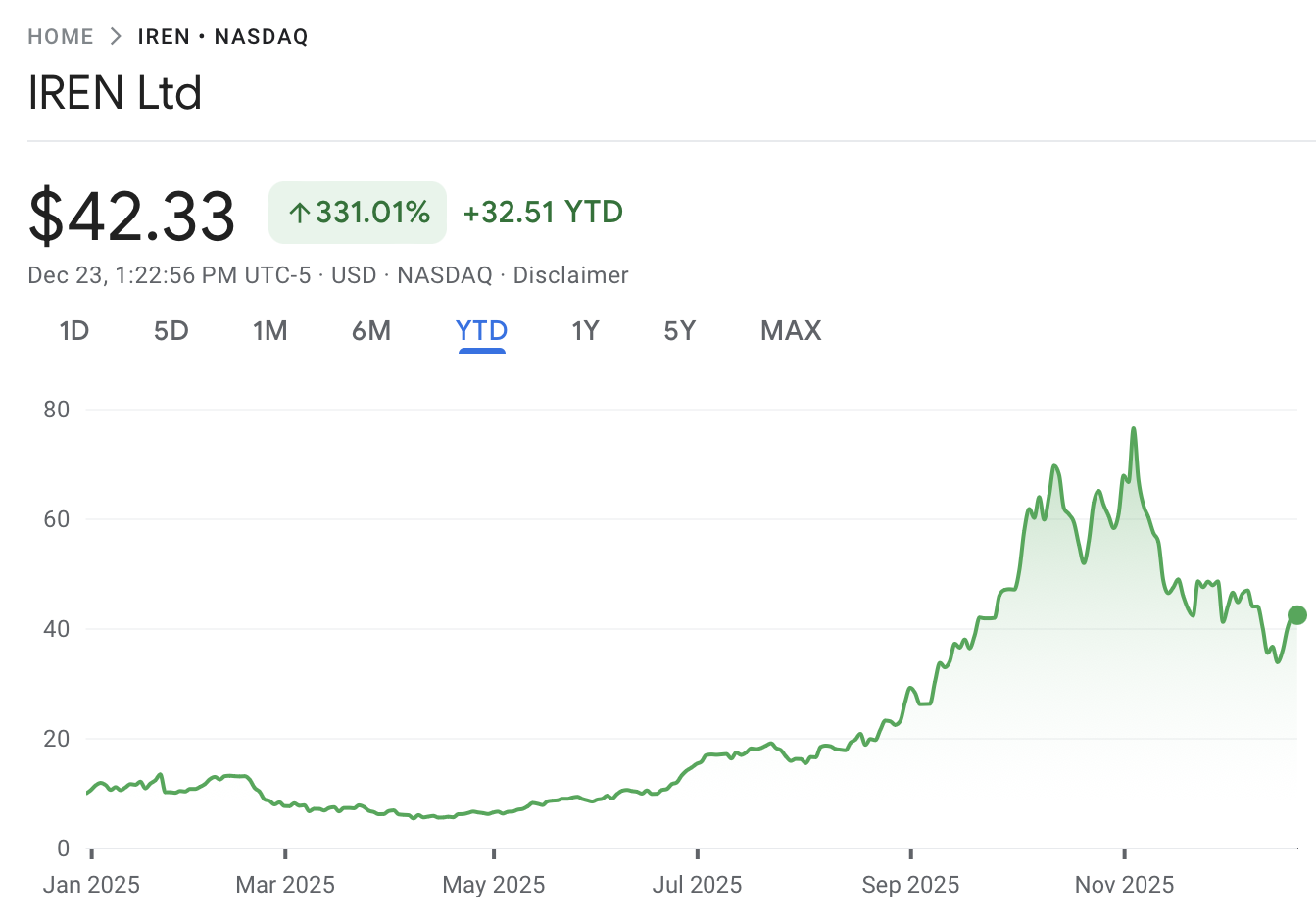
Iren Limited YTD stock price. Source: Google Finance

Magazine: Big questions: Would Bitcoin survive a 10-year power outage?

Related Questions

QWhat is the significance of Cipher Mining's acquisition of the Ulysses site in Ohio?

AThe acquisition marks Cipher Mining's first expansion outside of Texas and its entry into the PJM wholesale electricity market, the largest power market in the United States. It is a 200-megawatt power site suitable for Bitcoin mining, high-performance computing, and data center use.

QWhat is the expected timeline for the Ulysses site to become operational, and what key utility agreement is in place?

AThe Ulysses site is expected to be energized in the fourth quarter of 2027. It has secured power capacity from AEP Ohio, with all required utility agreements in place.

QAccording to Cipher's CEO, what is driving unprecedented demand for large-scale sites like Ulysses?

ACipher CEO Tyler Page stated that hyperscalers, which are large cloud computing companies such as Amazon Web Services and Google Cloud, are driving unprecedented demand for large-scale data center sites.

QHow has the low Bitcoin mining hashprice since mid-November affected mining companies?

AThe Bitcoin mining hashprice has been below $40, a level many operators view as breakeven. This slump has forced mining companies to reassess their operating models as margins across the sector remain under pressure.

QWhat are some strategies Bitcoin miners are using to diversify and stabilize profitability amid economic pressures?

AMiners are diversifying through AI and high-performance computing (HPC) demand. They are also turning to renewable energy to lower costs, with examples including solar-powered facilities in Texas, hydro-powered operations in Ethiopia, and wind-powered sites.

Related Reads

AI "Transfer Station" Earning Millions Monthly? Five Questions Uncover the Truth of Token Arbitrage

The article "AI 'Transfer Station' Earns Millions Monthly? Five Questions Uncover the Truth of Token Arbitrage" explores the emerging business of API token transfer stations, which profit from global AI service price disparities and access barriers. These intermediaries purchase low-cost tokens from overseas AI providers (e.g., OpenAI, Claude) through grey-market methods—such as exploiting enterprise credits, bulk accounts, or subscription benefits—and resell them to Chinese users at a markup. Key drivers include the high cost of using top AI models (e.g., Claude Code costs ~$5 per million tokens), the performance gap between domestic and foreign models, and mismatches between subscription and API pricing. However, the practice carries significant risks: upstream token sources may be unstable or illegal; user data passing through intermediaries can be harvested or injected with hidden prompts; and models might be downgraded without disclosure. The market is evolving, with some operators now exporting cheaper Chinese models (e.g., Qwen3.5 at ~$0.11 per million tokens) to overseas users, leveraging price gaps. Yet, sustainability is low due to compliance crackdowns, instability, and reputational risks. Users are advised to employ detection methods (e.g., prompt adherence tests) and avoid sensitive data usage. The authors caution that while transfer stations offer short-term arbitrage, they lack long-term reliability and security compared to official APIs.

marsbit10m ago

AI "Transfer Station" Earning Millions Monthly? Five Questions Uncover the Truth of Token Arbitrage

marsbit10m ago

The Cost of an 11.5% Annualized Return: Will MicroStrategy's STRC Face a Moment of Reckoning?

This article analyzes the potential risks associated with MicroStrategy's (MSTR) use of structured financial products like STRC to leverage its BTC exposure. While these tools have enabled impressive returns (e.g., 11.5% annualized) and fueled significant capital inflows ($13.5B outstanding), they also create substantial annual dividend obligations (~$400M). The author argues that this structure, while effective in a bull market, could become a liability if BTC price stagnates or declines. The core risk is a potential negative feedback loop: the growing dividend burden from continued STRC issuance may eventually outweigh the benefits of increased BTC holdings. To meet these obligations, MicroStrategy might need to use new issuance proceeds for dividends instead of buying more BTC, which could disappoint equity investors. If the market capitalization (mNAV) falls below the value of its BTC holdings, the company could be forced to sell BTC instead of issuing new shares, potentially triggering a panic. The author estimates a potential inflection point in 6 months, where annual dividend costs reach $3-4B. At that stage, CEO Michael Saylor might face a difficult choice: sell BTC to meet obligations or sacrifice the credibility of the preferred shares by halting dividends. The article concludes that this financial engineering, while powerful, could ultimately "backfire" on MicroStrategy if market conditions turn.

marsbit1h ago

The Cost of an 11.5% Annualized Return: Will MicroStrategy's STRC Face a Moment of Reckoning?

marsbit1h ago

Trading

Spot
Futures

Hot Articles

How to Buy US

Welcome to HTX.com! We've made purchasing Talus Network (US) simple and convenient. Follow our step-by-step guide to embark on your crypto journey.Step 1: Create Your HTX AccountUse your email or phone number to sign up for a free account on HTX. Experience a hassle-free registration journey and unlock all features.Get My AccountStep 2: Go to Buy Crypto and Choose Your Payment MethodCredit/Debit Card: Use your Visa or Mastercard to buy Talus Network (US) instantly.Balance: Use funds from your HTX account balance to trade seamlessly.Third Parties: We've added popular payment methods such as Google Pay and Apple Pay to enhance convenience.P2P: Trade directly with other users on HTX.Over-the-Counter (OTC): We offer tailor-made services and competitive exchange rates for traders.Step 3: Store Your Talus Network (US)After purchasing your Talus Network (US), store it in your HTX account. Alternatively, you can send it elsewhere via blockchain transfer or use it to trade other cryptocurrencies.Step 4: Trade Talus Network (US)Easily trade Talus Network (US) on HTX's spot market. Simply access your account, select your trading pair, execute your trades, and monitor in real-time. We offer a user-friendly experience for both beginners and seasoned traders.

4.4k Total ViewsPublished 2025.12.11Updated 2025.12.11

How to Buy US

Discussions

Welcome to the HTX Community. Here, you can stay informed about the latest platform developments and gain access to professional market insights. Users' opinions on the price of US (US) are presented below.

活动图片