Chinese Bitcoin Miners in Russia Receive Military Enlistment Notices

marsbitPublished on 2026-02-27Last updated on 2026-02-27

Abstract

"Chinese Bitcoin Miners in Russia Face Military Conscription Dilemma" Following President Putin's Executive Order No. 821, Chinese miners in Russia are confronted with a stark choice: either abandon their residency status or enlist in the Russian military. The order mandates that foreign males aged 18 to 65 must agree to serve at least one year in a military unit to be eligible for long-term residency permits—a critical requirement for legally registering large-scale mining operations. Russia had previously legalized cryptocurrency mining in 2024, luring miners with cheap electricity, particularly in Siberia. However, the new regulations have created a "deadly loop": to mine legally, individuals must register; to register, they need long-term residency; and to obtain residency, they must be prepared for military service. This effectively turns foreign miners into potential conscripts. Alternative strategies, such as using business visas or local proxies, are also becoming unviable. Russia has tightened immigration controls, criminalized illegal mining with penalties of up to five years in prison, and granted courts the power to confiscate mining equipment and Bitcoin assets. Enhanced surveillance, including drones and AI monitoring of electricity usage, makes it nearly impossible to operate undetected. Additionally, energy shortages have led to power restrictions in key mining regions like Siberia and the North Caucasus, further squeezing miners. With mounting legal, oper...

Source: Hashrate Heart

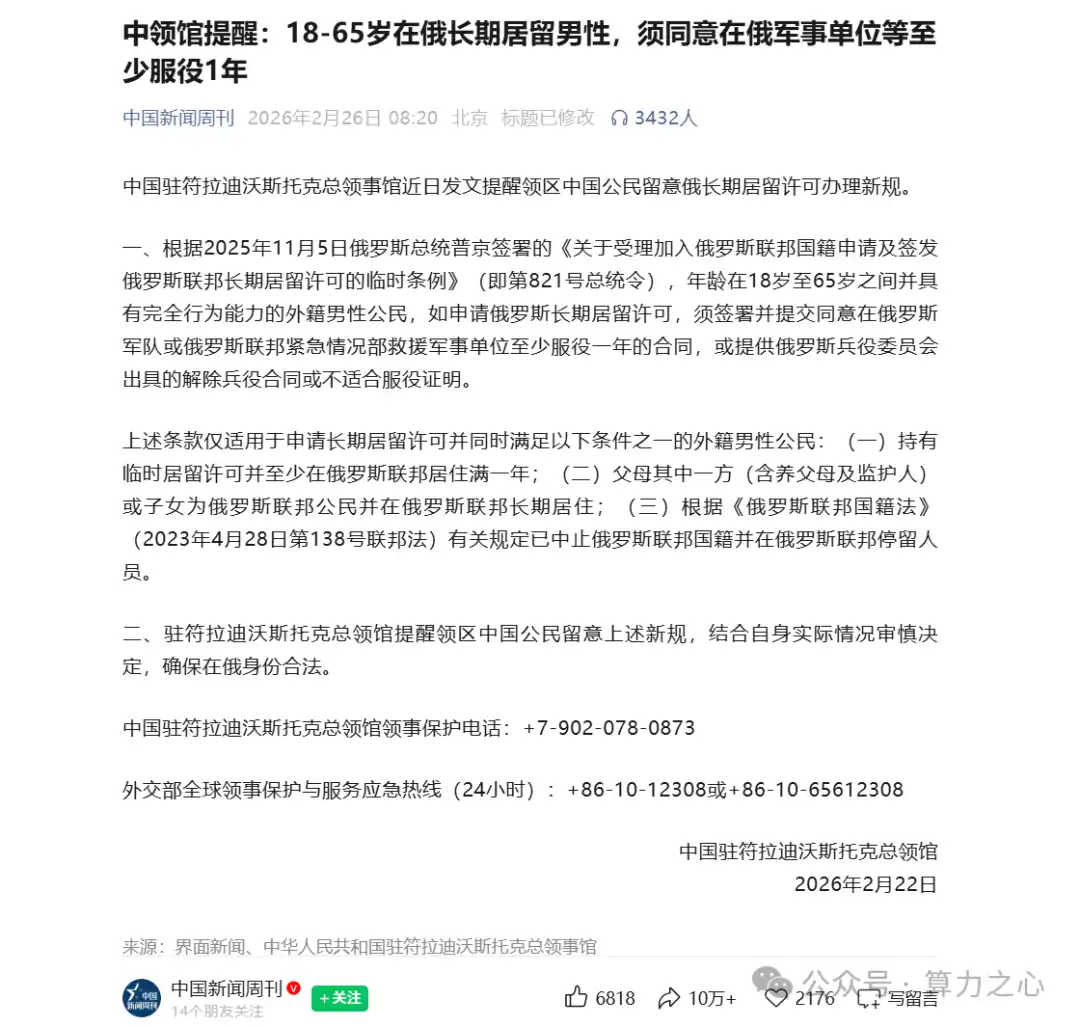
On February 23, 2025, the Chinese Consulate in Russia once again reminded Chinese citizens in Russia to pay attention to Presidential Decree No. 821 signed by Putin.

This decree presents a very real "deadly dilemma" for Chinese miners in Russia:

Either give up their residency status or enlist in the military first.

To stay and earn rubles legally, one might first have to pass through a conflict zone.

The decree is clear:

Foreign males aged 18 to 65 who wish to apply for long-term Russian residence permits must agree to serve for at least one year in Russian military units or similar.

Once, miners went to Siberia for cheap electricity, but now, before their mining rigs have even paid for themselves, they might first be treated as "expendable material."

Now, can those gold rushers, along with their computing power worth tens of millions, make a clean getaway?
I. The Compliance Dead End: To Be Legal, Enlist First

Many miners who ventured to Russia thought they were just transnational money-makers, distant from the front-line gunfire.

But since last year, a targeted net for foreign miners has been quietly cast.

Step one, "Lure them out."

Russia formally legalized cryptocurrency mining in 2024, once seen as a paradise by miners.

But the condition was:

Individuals or enterprises with high electricity consumption must join the official "Miner Registry," fully disclosing wallet addresses and income.

Failure to report would result in heavy fines and equipment confiscation.

This move forced all miners wanting to earn stable money legally to voluntarily submit their names and details.

Once the information was handed over, the next step followed naturally.

Step two, "Identity Lockdown."

As a foreigner, to legally register for large-scale mining,

you must have a Russian long-term residence permit or a registered address within Russia.

And this is precisely the most perilous trap in the entire scheme.

Step three, "Strike the Fatal Blow"

In 2025, with the implementation of Russian Presidential Decree No. 821, the rules for applying for long-term residence permits changed completely.

Either submit a Russian military service contract or provide proof of being unfit for service.

This move directly targets the large number of foreign male mining industry workers in Russia—

those who originally hoped to register as individual entrepreneurs or companies to obtain long-term residence now find that path blocked.
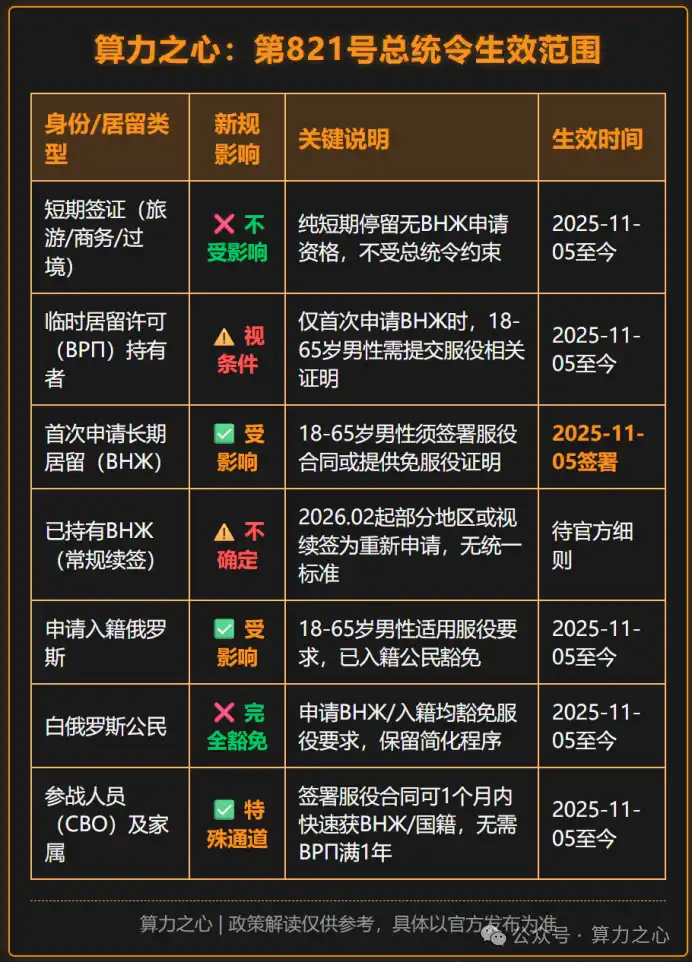
The loop is now closed.

To mine legally, you must register with real names;

To register, you must secure a residence permit;

To get the residence permit, you must be ready to go to the front lines at any time.

First, use the bait of legalization to draw you out, then use heavy penalties to force compliance, and finally, use a residence permit to precisely wash you into a potential source of soldiers.

You thought you were going to mine Bitcoin with machines, but in the eyes of the wartime machine, you are the "mine."

II. The Countdown for Proxy Holdings and "Visa Runs"

If obtaining long-term residence is risky, can one operate in the gray area on a business visa as a "guerrilla"?

The answer is no, this path is being completely sealed off.

In the past, many miners exploited loopholes by "exiting every 90 days" or even finding locals to hold mining farms on their behalf.

But starting in 2025, Russia has dealt several heavy blows, targeting people, behavior, and assets one by one.

First, immigration control came down hard on people.

The "Controlled Persons Registry" effective in February 2025 is very precise.

Once a visa has issues, bank accounts are instantly controlled, with very low limits even for daily expenses.

More critically, police can detain and initiate deportation procedures within 48 hours without court approval.

Using a business visa for mining is illegal work, making one a potential target for removal at any time.

Next, the legal characterization of the behavior changed.

According to the draft amendment to the Criminal Law in December 2025, illegal mining could face up to 5 years imprisonment and huge fines.

What was once at most a violation is now a criminal offense.

The gray area's room for survival is being squeezed out inch by inch by legal条文.

Then assets were targeted.

In February 2026, Putin further signed a new law giving courts the authority to directly confiscate mining equipment and Bitcoin involved in cases.

Nasdaq-listed company The9 once said: Russia might "in specific circumstances implement nationalization and confiscation of foreign enterprise assets."

In Russia, it doesn't matter whose name the machines are under; if they are suspected of being illegal, they will be confiscated.

Besides, you can't hide them.

Since late 2024, the Russian power grid has built an "integrated air-and-ground" detection network.

In the air, thermal imaging drones pinpoint locations; on the ground, AI smart meters monitor in real-time; at the terminal, smart algorithms proactively identify.

In Dagestan alone, 73 cases of electricity theft for mining were uncovered from January to November 2025, causing losses of 85.7 million rubles.

People, behavior, assets, hiding places—all four paths are blocked.

The window for discreet mining by exploiting visa loopholes is closing.

III. The State Machine Wants Energy, Not Hashrate

Taking a step back, even if one secures identity and survives the risks of proxy holdings, there's not enough electricity for mining in Russia anymore.

After China's mining crackdown in 2021, Siberia, Russia, with its natural low temperatures and electricity costing just a few cents, became a sanctuary for global miners.

Russia's largest mining company, BitRiver, started here, managing 175,000 mining rigs at its peak.

In those years, with electricity and courage, money followed.

But the grid couldn't handle it.

By the end of 2024, the mining army consumed 1.5% of Russia's national electricity, pushing grids in many areas to the brink of overload.

Aging infrastructure needs maintenance, people's heating cannot be cut off—in Russia's non-natural gasified regions, electric heating is the most affordable way to stay warm in winter. Thus, these "big electricity consumers" naturally became the first targets.

Starting in 2025, bans landed intensively.

Multiple districts in the North Caucasus and Siberia were completely cut off or subject to seasonal power restrictions. Even BitRiver couldn't withstand it.

However, what broke it wasn't the Bitcoin price, but a combination of judicial debt collection, account freezes, and regional power limits.

As for foreign miners without local connections,

under the triple whammy of "identity threshold (military contract + controlled persons registry) + energy control + asset confiscation,"

they will only be the first to be sacrificed.

The window of野蛮生长 (wild growth) relying on cheap electricity and courage has closed.

In the face of hardline policies, hashrate is just code that can be unplugged at any time.

When everyone withdrew from China in 2021, they were betting on the same thing:

Remote places with loose regulation, alive as long as there's electricity.

Four years later, reality has given another answer.

You can outrun one country's regulation, but you can't outrun another country's conscription order.

In the story of global miner migration, the Russian chapter is coming to an end.

For those people and machines that haven't withdrawn yet, the time window left for them is running out.


Related Questions

QWhat is the main dilemma faced by Chinese Bitcoin miners in Russia according to the article?

AThey face a 'deathly dilemma': either give up their residency status or enlist in the Russian military for at least one year to obtain long-term residence permits.

QWhat specific Russian presidential decree is mentioned that impacts foreign miners?

APresidential Decree No. 821, signed by Putin, which requires foreign males aged 18 to 65 applying for long-term residence permits to agree to serve in Russian military units for at least one year.

QWhat are the three steps described in the article that Russia used to target foreign miners?

A1. Lure them out by legalizing cryptocurrency mining and requiring registration. 2. Lock their identities by tying legal mining registration to long-term residence permits. 3. Strike a critical blow by linking residence permit applications to military service contracts.

QWhy is using business visas for 'grey area' mining no longer viable for miners in Russia?

ARussia has implemented strict controls, including a 'controlled persons register' that freezes bank accounts for visa issues, allows police to detain and deport without court approval, criminalizes illegal mining with up to 5 years imprisonment, and permits confiscation of mining equipment and Bitcoin.

QWhat major operational challenge besides legal issues are miners facing regarding electricity?

AElectricity shortages and restrictions, as mining consumes 1.5% of Russia's national power, leading to blackouts or seasonal power limits in regions like the North Caucasus and Siberia, making it difficult to power mining operations.

Related Reads

Trading

Spot
Futures

Hot Articles

What is $BITCOIN

DIGITAL GOLD ($BITCOIN): A Comprehensive Analysis Introduction to DIGITAL GOLD ($BITCOIN) DIGITAL GOLD ($BITCOIN) is a blockchain-based project operating on the Solana network, which aims to combine the characteristics of traditional precious metals with the innovation of decentralized technologies. While it shares a name with Bitcoin, often referred to as “digital gold” due to its perception as a store of value, DIGITAL GOLD is a separate token designed to create a unique ecosystem within the Web3 landscape. Its goal is to position itself as a viable alternative digital asset, although specifics regarding its applications and functionalities are still developing. What is DIGITAL GOLD ($BITCOIN)? DIGITAL GOLD ($BITCOIN) is a cryptocurrency token explicitly designed for use on the Solana blockchain. In contrast to Bitcoin, which provides a widely recognized value storage role, this token appears to focus on broader applications and characteristics. Notable aspects include: Blockchain Infrastructure: The token is built on the Solana blockchain, known for its capacity to handle high-speed and low-cost transactions. Supply Dynamics: DIGITAL GOLD has a maximum supply capped at 100 quadrillion tokens (100P $BITCOIN), although details regarding its circulating supply are currently undisclosed. Utility: While precise functionalities are not explicitly outlined, there are indications that the token could be utilized for various applications, potentially involving decentralized applications (dApps) or asset tokenization strategies. Who is the Creator of DIGITAL GOLD ($BITCOIN)? At present, the identity of the creators and development team behind DIGITAL GOLD ($BITCOIN) remains unknown. This situation is typical among many innovative projects within the blockchain space, particularly those aligning with decentralized finance and meme coin phenomena. While such anonymity may foster a community-driven culture, it intensifies concerns about governance and accountability. Who are the Investors of DIGITAL GOLD ($BITCOIN)? The available information indicates that DIGITAL GOLD ($BITCOIN) does not have any known institutional backers or prominent venture capital investments. The project seems to operate on a peer-to-peer model focused on community support and adoption rather than traditional funding routes. Its activity and liquidity are primarily situated on decentralized exchanges (DEXs), such as PumpSwap, rather than established centralized trading platforms, further highlighting its grassroots approach. How DIGITAL GOLD ($BITCOIN) Works The operational mechanics of DIGITAL GOLD ($BITCOIN) can be elaborated on based on its blockchain design and network attributes: Consensus Mechanism: By leveraging Solana’s unique proof-of-history (PoH) combined with a proof-of-stake (PoS) model, the project ensures efficient transaction validation contributing to the network's high performance. Tokenomics: While specific deflationary mechanisms have not been extensively detailed, the vast maximum token supply implies that it may cater to microtransactions or niche use cases that are still to be defined. Interoperability: There exists the potential for integration with Solana’s broader ecosystem, including various decentralized finance (DeFi) platforms. However, the details regarding specific integrations remain unspecified. Timeline of Key Events Here is a timeline that highlights significant milestones concerning DIGITAL GOLD ($BITCOIN): 2023: The initial deployment of the token occurs on the Solana blockchain, marked by its contract address. 2024: DIGITAL GOLD gains visibility as it becomes available for trading on decentralized exchanges like PumpSwap, allowing users to trade it against SOL. 2025: The project witnesses sporadic trading activity and potential interest in community-led engagements, although no noteworthy partnerships or technical advancements have been documented as of yet. Critical Analysis Strengths Scalability: The underlying Solana infrastructure supports high transaction volumes, which could enhance the utility of $BITCOIN in various transaction scenarios. Accessibility: The potential low trading price per token could attract retail investors, facilitating wider participation due to fractional ownership opportunities. Risks Lack of Transparency: The absence of publicly known backers, developers, or an audit process may yield skepticism regarding the project's sustainability and trustworthiness. Market Volatility: The trading activity is heavily reliant on speculative behavior, which can result in significant price volatility and uncertainty for investors. Conclusion DIGITAL GOLD ($BITCOIN) emerges as an intriguing yet ambiguous project within the rapidly evolving Solana ecosystem. While it attempts to leverage the “digital gold” narrative, its departure from Bitcoin's established role as a store of value underscores the need for a clearer differentiation of its intended utility and governance structure. Future acceptance and adoption will likely depend on addressing the current opacity and defining its operational and economic strategies more explicitly. Note: This report encompasses synthesised information available as of October 2023, and developments may have transpired beyond the research period.

363 Total ViewsPublished 2025.05.13Updated 2025.05.13

What is $BITCOIN

Discussions

Welcome to the HTX Community. Here, you can stay informed about the latest platform developments and gain access to professional market insights. Users' opinions on the price of BTC (BTC) are presented below.

活动图片














