Chainlink Founder Sergey Nazarov Identifies 3 Trends That Will Define the Cryptosphere as Hyper Token Soars

bitcoinistPublished on 2026-02-10Last updated on 2026-02-10

Abstract

Chainlink co-founder Sergey Nazarov identifies three key trends shaping the crypto industry: real-world asset (RWA) tokenization, cross-chain interoperability, and high-performance infrastructure. These shifts signal a move from speculation to practical, institutional-grade applications. Bitcoin Hyper ($HYPER) emerges as a solution addressing Bitcoin’s scalability and utility limitations. By integrating the Solana Virtual Machine (SVM) as a Bitcoin Layer 2, it enables high-speed, low-cost smart contracts while leveraging Bitcoin’s security. The project has raised over $31.3M in its presale, with significant whale activity, indicating strong institutional interest. Bitcoin Hyper aims to unlock Bitcoin’s dormant capital through DeFi applications, staking rewards, and a decentralized bridge for seamless BTC transfers. This aligns with Nazarov’s vision of a verifiable, interconnected financial ecosystem.

Trusted Editorial content, reviewed by leading industry experts and seasoned editors. Ad Disclosure

Quick Facts:

  • ➡️ Chainlink’s Sergey Nazarov identifies RWA tokenization, cross-chain interoperability, and high-performance infrastructure as the three pillars of the next crypto cycle.
  • ➡️ Bitcoin Hyper addresses the liquidity gap by bringing the Solana Virtual Machine (SVM) to Bitcoin, enabling high-speed smart contracts on the world’s most secure chain.
  • ➡️ Institutional interest in Bitcoin Layer 2s is rising, evidenced by over $31M raised in the Bitcoin Hyper presale and verified whale accumulation.
  • ➡️ Whales join the race with over $1M raised across three transactions-only; FOMO is real.

The crypto market is undergoing a structural transformation that extends far beyond daily price tickers.

In recent keynotes, Chainlink co-founder Sergey Nazarov outlined three critical trends signaling the industry’s shift from speculative experimentation to critical global infrastructure.

It’s a bold claim, but his analysis suggests the next bull cycle won’t be defined by hype, it’ll be defined by the collision of traditional finance (TradFi) and decentralized protocols.

First, Nazarov points to the inevitability of Real-World Assets (RWAs) migrating on-chain. Major institutions aren’t just testing the waters anymore; they’re actively building tokenization platforms. This isn’t just about efficiency, it’s about creating a ‘verifiable web’ where asset ownership is mathematically guaranteed rather than legally promised.

Then there’s the collapse of cross-chain friction. The future isn’t a winner-take-all single chain, but an interconnected ecosystem where liquidity flows seamlessly between networks via protocols like CCIP.

The third trend is perhaps the most immediate: the demand for high-performance infrastructure capable of handling ‘internet-scale’ transactions. As DeFi matures, users are rejecting high latency and exorbitant gas fees.

This sentiment shift is driving capital away from legacy Layer 1s that refuse to scale and toward specialized execution layers. That’s exactly where new solutions are emerging to unlock the dormant capital on the world’s largest blockchain: Bitcoin Hyper ($HYPER).

$HYPER is available here.

Bitcoin Hyper Integrates SVM To Solve The Liquidity Fragmentation Crisis

While Nazarov emphasizes cross-chain standards, a glaring inefficiency remains: Bitcoin holds over 50% of the industry’s market cap but lacks the native programmability to participate in this new ‘verifiable web.’

Enter Bitcoin Hyper ($HYPER). By integrating the Solana Virtual Machine (SVM) directly as a Bitcoin Layer 2, the project introduces high-speed, low-cost transaction execution to the Bitcoin network.

The architecture here is distinct. Rather than relying on slow settlement times, Bitcoin Hyper utilizes a modular setup: Bitcoin L1 handles final settlement and security, while the SVM L2 handles real-time execution.
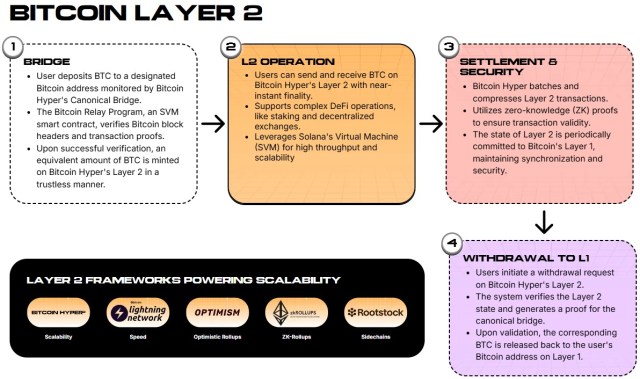
The result? A network capable of sub-second finality and negligible fees, outperforming even Solana in specific latency benchmarks. For developers, this means the ability to build high-performance DeFi applications using Rust, finally bridging the gap between Bitcoin’s liquidity and modern smart contract utility.

Smart money seems to be watching this setup. On-chain data from Etherscan indicates that two whale wallets accumulated $1M+ in recent transactions, with the largest single purchase of $500K occurring on Jan 15, 2026.

This accumulation suggests traders are betting on Layer 2s that can unlock Bitcoin’s yield-bearing potential without compromising its security.

Read more about $HYPER here.

Presale Momentum Accelerates As Capital Rotates Into Bitcoin Layer 2s

The narrative shift toward infrastructure that Nazarov predicts is already reflecting in capital flows. Investors are hunting for protocols offering immediate utility rather than vague roadmap promises.

Bitcoin Hyper ($HYPER) has tapped into this demand, raising over $31.3M in its ongoing presale. With tokens currently priced at $0.0136754, the project is drawing liquidity from traders hedging against Ethereum’s congestion and Solana’s occasional instability.
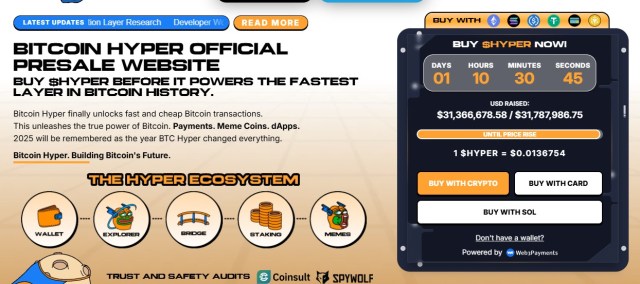
Plus, the economic model is driving interest. Bitcoin Hyper introduces a high-yield staking protocol available immediately after the Token Generation Event (TGE). Unlike traditional mining (which requires hardware), $HYPER staking rewards community participation and governance with a short 7-day vesting period for presale stakers.

It’s a setup designed for both exposure to a high-growth infrastructure token and yield generation on a Bitcoin-native layer.

The project’s Decentralized Canonical Bridge aligns with the industry’s push for interoperability. By allowing trustless transfers of $BTC into the L2 ecosystem, it enables Bitcoin to be used as collateral in lending and derivatives markets previously accessible only to $ETH or $SOL holders.

As the market moves toward the ‘verifiable web’ Nazarov describes, protocols that make Bitcoin actually usable could be positioned to capture significant value.

Buy $HYPER here.

This article is for informational purposes only and does not constitute financial advice. Cryptocurrencies are high-risk assets with significant volatility. The presale data and technical claims regarding Bitcoin Hyper are based on information provided by the project team. Always perform your own due diligence before investing.

Editorial Process for bitcoinist is centered on delivering thoroughly researched, accurate, and unbiased content. We uphold strict sourcing standards, and each page undergoes diligent review by our team of top technology experts and seasoned editors. This process ensures the integrity, relevance, and value of our content for our readers.

patrubogdan

Follow

Full Profile

Related Posts

Russian Lawmaker Predicts Bitcoin Collapse While Smart Money Rotates into Layer 2 Utility

Solana’s Low Fees Create Strong Competition for Base, BNB, and Polygon and Fuel SUBBD Token

Bitcoin Demand Plunges Per CryptoQuant, Yet Maxi Doge Endures

Crypto Markets Catch A Breather As Outflows Begin To Slow: Analysts

SUBBD Token’s Massive Projected Impact on the Content Creation Market in 2026

Government Shutdown Fears Trigger 2% Crypto Dip, But Bitcoin Hyper Remains Unshaken

Related Questions

QWhat are the three critical trends identified by Chainlink's Sergey Nazarov that will define the next crypto cycle?

AThe three trends are Real-World Assets (RWA) tokenization, cross-chain interoperability, and high-performance infrastructure capable of handling internet-scale transactions.

QHow does Bitcoin Hyper ($HYPER) address the liquidity fragmentation problem on the Bitcoin network?

ABitcoin Hyper integrates the Solana Virtual Machine (SVM) as a Bitcoin Layer 2, enabling high-speed smart contracts and low-cost transactions while using Bitcoin L1 for final settlement and security.

QWhat evidence suggests institutional interest in Bitcoin Hyper's presale?

AThe project raised over $31.3 million in its presale, with on-chain data showing whale transactions including a single purchase of $500,000 on January 15, 2026.

QWhat technical advantage does Bitcoin Hyper claim over other networks?

AIt claims sub-second finality and negligible fees, outperforming even Solana in specific latency benchmarks, while maintaining Bitcoin's security through its modular architecture.

QHow does Bitcoin Hyper's staking model differ from traditional Bitcoin mining?

AIt offers a high-yield staking protocol with immediate vesting after Token Generation Event (TGE), requiring no hardware and featuring a 7-day vesting period for presale participants, unlike hardware-dependent mining.

Related Reads

2026 New Policy Interpretation: The "Mutual Pursuit" of Intelligent Agents and AI Terminals, and the Three Major Value Reconstructions in the AIoT Industry

In May 2026, China's national ministries released two pivotal policy documents that jointly establish a strategic "dual-track" framework for the AIoT industry. The "Intelligent Agent Standardized Application and Innovation Development Implementation Opinions" defines the "soul"—positioning intelligent agents as core AI products. The "Artificial Intelligence Terminal Intelligence Grading" national standard defines the "body"—establishing a four-tier capability ladder (L1 to L4) for AI hardware. This synchronized policy approach is globally unique, moving beyond market-led (US) or risk-focused (EU) models. It frames AIoT as a new type of "intelligent infrastructure," comparable to electricity or the internet in historical significance. The core analysis identifies a value evolution from IoT 1.0 (connection) to AIoT 4.0 (collaboration, represented by the forward-looking L4 level). This "L4" signifies a paradigm shift: from users operating tools to delegating tasks to agent-like devices ("Intelligent Action of All Things"). The article outlines three strategic paths for companies: becoming Standard Definers, Scenario Integrators (focusing on 19 specified application areas), or Infrastructure Builders. A critical 18-24 month window is identified for strategic positioning. A "Four Levers" strategy is proposed: leveraging Standards (L-level certification), leveraging Scenarios (deep vertical focus), leveraging Open Source (for cost reduction and ecosystem influence), and leveraging Momentum (engaging in global protocol ecosystems). In conclusion, these policies are a starting gun for a decade-long industrial transformation, shifting the industry narrative from "Intelligent Connection of All Things" to "Intelligent Action of All Things," with companies needing to choose their赛道and execution strategy decisively.

marsbit59m ago

2026 New Policy Interpretation: The "Mutual Pursuit" of Intelligent Agents and AI Terminals, and the Three Major Value Reconstructions in the AIoT Industry

marsbit59m ago

Splashing Out 27 Billion Yuan, OpenAI Establishes New Company to Accelerate AI Deployment

On May 11th, OpenAI announced the formation of a new company, "OpenAI Deployment Company," with an initial investment of over $4 billion (approximately 27.2 billion RMB). This venture aims to help businesses build and deploy AI solutions. OpenAI is also acquiring the AI consulting firm Toromo to rapidly scale the deployment company's capabilities. This new entity, majority-owned by OpenAI, brings together 19 investment, consulting, and system integration partners, led by TPG with co-lead founding partners including Advent International, Bain Capital, and Brookfield. OpenAI's Chief Revenue Officer, Denise Dresser, stated that while AI is becoming increasingly capable, the current challenge lies in integrating these systems into core business infrastructure and workflows. The deployment company is designed to bridge this gap and translate AI capabilities into operational impact. This move comes as OpenAI emphasizes the next competitive phase will depend on the efficiency of deploying AI in real business scenarios. The company reports over 1 million businesses already use its products and APIs. OpenAI is significantly increasing its investments in computing power, with co-founder Greg Brockman stating the company expects to spend $50 billion on compute this year, a dramatic increase from $3 million in 2017. The announcement follows OpenAI's recent completion of a record $122 billion funding round in late March, led by Amazon, Nvidia, and SoftBank, valuing the company at $852 billion post-money. Major strategic investors committed $110 billion as a base for this round. Concurrently, OpenAI is advancing its core model development. It has shifted focus from its Sora video generator to developing advanced robotics and AI models that interact with the physical world. It has also begun allowing select users access to a new model specialized in identifying software vulnerabilities and is reportedly preparing to launch an enhanced image generation model in the coming weeks. According to reports citing founder Sam Altman, OpenAI is considering an IPO as early as 2027, with a potential valuation around $1 trillion.

marsbit1h ago

Splashing Out 27 Billion Yuan, OpenAI Establishes New Company to Accelerate AI Deployment

marsbit1h ago

Trading

Spot
Futures

Hot Articles

How to Buy LINK

Welcome to HTX.com! We've made purchasing ChainLink (LINK) simple and convenient. Follow our step-by-step guide to embark on your crypto journey.Step 1: Create Your HTX AccountUse your email or phone number to sign up for a free account on HTX. Experience a hassle-free registration journey and unlock all features.Get My AccountStep 2: Go to Buy Crypto and Choose Your Payment MethodCredit/Debit Card: Use your Visa or Mastercard to buy ChainLink (LINK) instantly.Balance: Use funds from your HTX account balance to trade seamlessly.Third Parties: We've added popular payment methods such as Google Pay and Apple Pay to enhance convenience.P2P: Trade directly with other users on HTX.Over-the-Counter (OTC): We offer tailor-made services and competitive exchange rates for traders.Step 3: Store Your ChainLink (LINK)After purchasing your ChainLink (LINK), store it in your HTX account. Alternatively, you can send it elsewhere via blockchain transfer or use it to trade other cryptocurrencies.Step 4: Trade ChainLink (LINK)Easily trade ChainLink (LINK) on HTX's spot market. Simply access your account, select your trading pair, execute your trades, and monitor in real-time. We offer a user-friendly experience for both beginners and seasoned traders.

8.6k Total ViewsPublished 2024.03.29Updated 2025.06.26

How to Buy LINK

Discussions

Welcome to the HTX Community. Here, you can stay informed about the latest platform developments and gain access to professional market insights. Users' opinions on the price of LINK (LINK) are presented below.

活动图片