CFTC warns on prediction market insider trading as volumes hit $75B in Q1

ambcryptoPublished on 2026-04-01Last updated on 2026-04-01

Abstract

The U.S. Commodity Futures Trading Commission (CFTC) has warned that insider trading laws apply to prediction markets, countering the belief that such activity operates in a regulatory gray area. A senior official stated the CFTC will aggressively pursue cases involving misuse of material non-public information, emphasizing that prediction market contracts fall under existing anti-fraud provisions. The regulator also highlighted exchanges' responsibilities to maintain surveillance systems and avoid listing easily manipulated contracts. This comes as prediction market trading volume surged to $75 billion in Q1 2026, up dramatically from $330 million in Q1 2024, driven by event-based trading on political, economic, and sports outcomes. The CFTC outlined enforcement priorities including insider trading, market manipulation, and retail fraud, while also introducing a new cooperation framework for self-reporting firms.

The U.S. derivatives regulator is sharpening its stance on prediction markets just as the sector sees explosive growth.

In remarks delivered on 31 March, a senior official at the Commodity Futures Trading Commission said insider trading laws do apply to prediction markets, pushing back against a growing narrative that such activity exists in a regulatory gray area.

The agency signaled that it will “aggressively detect, investigate, and prosecute” insider trading involving the misuse of material non-public information.

Insider trading rules extend to event contracts

The CFTC’s enforcement division emphasized that prediction market contracts fall under existing anti-fraud provisions of U.S. commodities law.

That includes trading based on misappropriated information obtained through a breach of duty, a framework commonly known as the “misappropriation theory.”

The remarks directly challenge a widely circulated belief across social media and parts of the crypto industry that insider trading is either permissible or inevitable in prediction markets.

Instead, the agency made clear that such conduct can constitute fraud under the Commodity Exchange Act, particularly when confidential information is used improperly.

Exchanges face growing compliance pressure

The warning was not limited to individual traders.

The CFTC also highlighted the role of exchanges, noting that platforms must maintain surveillance systems, enforce fair trading practices, and avoid listing contracts susceptible to manipulation.

The regulator highlighted risks in certain event-based contracts, including those tied to individual actions or outcomes, where access to non-public information could distort pricing.

Record growth brings regulatory focus

The renewed scrutiny comes as prediction markets scale rapidly.

Data from CryptoRank and DeFiLlama shows total trading volume across platforms such as Polymarket and Kalshi reached $75 billion in Q1 2026, up sharply from just $330 million in Q1 2024.
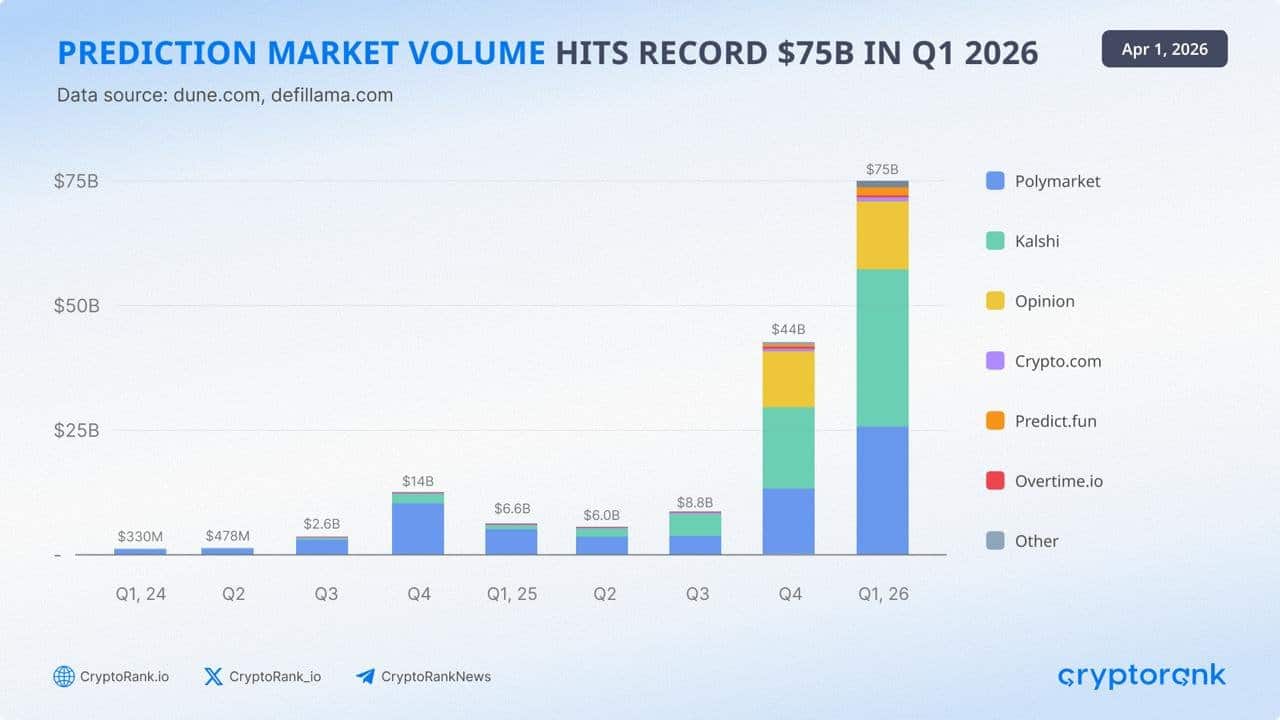
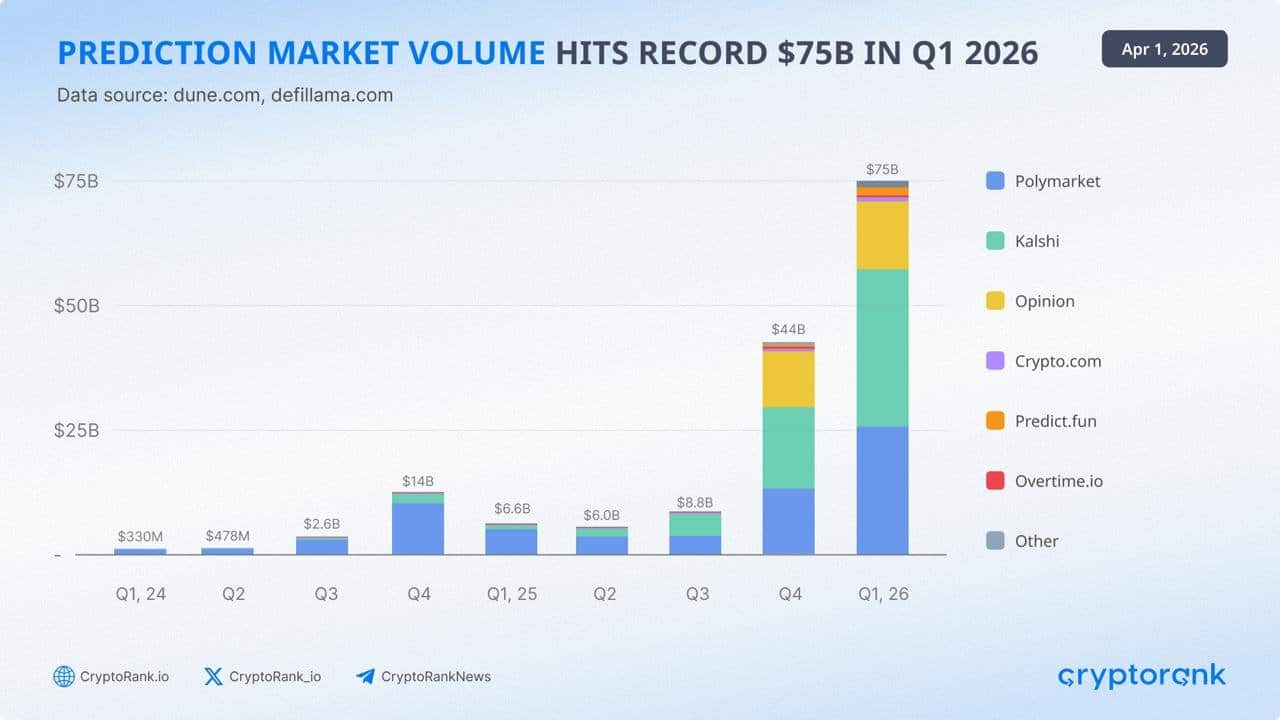
Source: CryptoRank

The growth reflects increasing demand for event-based trading across political outcomes, macroeconomic indicators, and sports markets.

But with that expansion has come rising concern over market integrity, particularly around insider information and potential manipulation.

A shift in enforcement approach

The CFTC also outlined a broader shift in its enforcement approach.

While signaling an end to so-called “regulation by enforcement,” the agency identified five core priorities: insider trading, market manipulation, disruptive trading practices, retail fraud, and willful violations of AML and KYC rules.

At the same time, it plans to introduce a new cooperation framework that could offer declinations for firms that self-report, fully cooperate, and remediate misconduct.


Final Summary

  • Prediction markets have grown rapidly to $75 billion in quarterly volume, drawing increased regulatory scrutiny over insider-trading risks.
  • The CFTC has made clear that insider trading laws apply to these markets, signaling more active enforcement as the sector grows.


Related Questions

QWhat is the CFTC's stance on insider trading in prediction markets according to the article?

AThe CFTC has made clear that insider trading laws apply to prediction markets, and it will 'aggressively detect, investigate, and prosecute' such activity, particularly the misuse of material non-public information.

QWhat was the total trading volume for prediction markets in Q1 2026, and how does it compare to Q1 2024?

AThe total trading volume across prediction market platforms reached $75 billion in Q1 2026, which is a sharp increase from just $330 million in Q1 2024.

QBesides individual traders, who else did the CFTC warn about compliance in its remarks?

AThe CFTC also warned exchanges, highlighting that platforms must maintain surveillance systems, enforce fair trading practices, and avoid listing contracts that are susceptible to manipulation.

QWhat legal framework did the CFTC's enforcement division say prediction market contracts fall under?

AThe CFTC's enforcement division emphasized that prediction market contracts fall under the existing anti-fraud provisions of U.S. commodities law.

QWhat are the five core enforcement priorities the CFTC identified?

AThe five core enforcement priorities identified by the CFTC are: insider trading, market manipulation, disruptive trading practices, retail fraud, and willful violations of AML and KYC rules.

Related Reads

Anthropic's IPO Launch: Commercial Miracle or Valuation Bubble?

Anthropic has confidentially filed for an IPO, led by Morgan Stanley and Goldman Sachs, potentially going public by October. Following its latest $650 billion funding round, its pre-IPO valuation stands at $965 billion, with projections reaching up to $2 trillion at listing, which would make it the highest-valued private company ever. The article, written by Fu Sheng, addresses skepticism that this represents an AI bubble akin to the 2000 dot-com crash. It argues the current situation differs fundamentally. Unlike the internet bubble era, which relied on speculative narratives with little revenue, Anthropic's valuation is backed by unprecedented, measurable financial performance. Key data points include: * **Revenue Growth:** ARR skyrocketed from $10 billion in early 2025 to $470 billion by May 2026, targeting $100 billion by year-end—a growth curve unmatched in business history. * **Profitability:** It achieved operating profitability in Q2 2026 with an estimated $5.6 billion profit. * **Efficiency:** With ~3,000 employees and ~$470 billion ARR, its revenue per employee exceeds $10 million. Products like Claude Code, launched less than a year ago, already generate $25 billion in annualized revenue. * **Enterprise Adoption:** It boasts a strong enterprise client base, with 8 of the Fortune 10 and over 1,000 large firms spending over $1 million annually on Claude. The valuation is framed using a traditional SaaS model (e.g., a 10x Price-to-Sales multiple on $100 billion revenue). The author contends the core question for analysts has shifted from "How big could this be?" to "How much is it earning and will earn next quarter?" The discussion extends beyond Anthropic to a broader paradigm shift: the transition from a "carbon-based" to a "silicon-based" economy. Companies are increasingly prioritizing investment in compute and AI capabilities over human resources, as these directly scale productivity and competitive advantage. Anthropic's IPO is thus positioned not just as a corporate milestone, but as a price anchor for this new economic era.

链捕手2h ago

Anthropic's IPO Launch: Commercial Miracle or Valuation Bubble?

链捕手2h ago

Near Returns to the AI Stage: Transformation into a Public Chain Due to 'Payroll Difficulties,' Agent and Privacy Emerge as New Growth Narratives

NEAR Returns to AI Origins: From Payroll Struggles to Blockchain, Now Focusing on AI Agents and Privacy NEAR Protocol's journey began not with grand blockchain ambitions, but from a practical hurdle: its AI startup founders, including Transformer paper co-author Illia Polosukhin, couldn't efficiently pay international developers in 2017. This led them to pivot and build a high-performance, scalable blockchain. After years navigating various crypto narratives like sharding and cross-chain interoperability, NEAR is now leveraging its AI roots to re-enter the AI arena. A key driver is its "NEAR Intents" layer, which abstracts complex cross-chain transactions. Users simply state their goal (e.g., swap BTC for ETH), and a solver network finds the optimal route. This system has processed over $20B in cross-chain volume, generating significant fee revenue. A major growth area is private transactions via "Confidential Intents/Swaps," which hide trade details until settlement to protect against MEV and front-running. Remarkably, private swaps recently accounted for over 40% of NEAR's transaction volume, highlighting strong demand but also potential regulatory scrutiny. With its AI-founder pedigree, NEAR is positioning itself at the intersection of blockchain, AI agents, and privacy, aiming to become infrastructure for the emerging agent economy while navigating the challenges of its rapid adoption.

marsbit4h ago

Near Returns to the AI Stage: Transformation into a Public Chain Due to 'Payroll Difficulties,' Agent and Privacy Emerge as New Growth Narratives

marsbit4h ago

Trading

Spot
Futures
活动图片




