CFTC pilot opens path for crypto as collateral in derivative markets

cointelegraphPublished on 2025-12-09Last updated on 2025-12-09

Abstract

The U.S. Commodity Futures Trading Commission (CFTC) has introduced updated guidance and a pilot program allowing futures commission merchants (FCMs) to accept Bitcoin, Ether, and USDC as collateral in derivatives trading. The initiative aims to integrate cryptocurrencies into regulated markets, enhance customer protection, reduce settlement friction through instant on-chain transfers, and improve risk management. The program includes strict reporting requirements for FCMs and withdraws outdated advisories. Industry leaders from firms like Circle, StarkWare, and Coinbase have praised the move as a significant step toward broader adoption of digital assets and more efficient, automated settlement processes in derivatives markets.

The US Commodity Futures Trading Commission (CFTC) has issued updated guidance for tokenized collateral in derivatives markets, paving the way for a pilot program to test how cryptocurrencies can be used as collateral in derivatives markets.

Collateral in derivatives markets serves as a security deposit, acting as a guarantee to ensure that a trader can cover any potential losses.

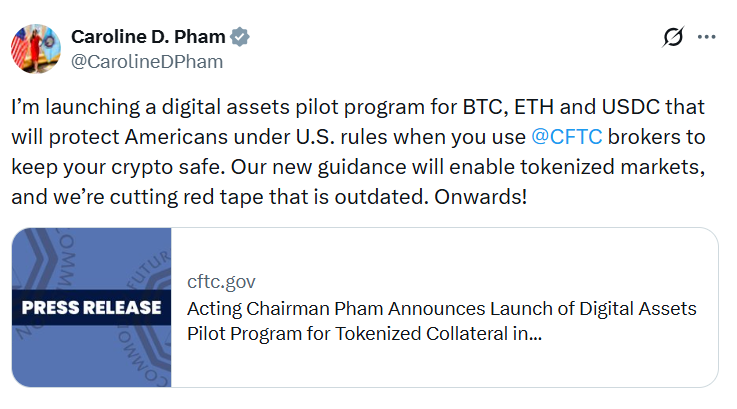
The digital asset pilot, announced by CFTC acting chairman Caroline Pham on Monday, will allow futures commission merchants (FCM) — a company that facilitates futures trades for clients — to accept Bitcoin (BTC), Ether (ETH) and Circle’s stablecoin USDC (USDC) for margin collateral.

The CFTC pilot is another step toward integrating crypto into regulated markets, and Circle CEO Heath Tarbert said it will also protect customers, reduce settlement frictions because tokenized collateral moves instantly onchain, and assist with risk reduction.

Pham said in a statement that the pilot program also “establishes clear guardrails to protect customer assets and provides enhanced CFTC monitoring and reporting.”

As part of the pilot, participating FCMs will be subject to strict reporting criteria, which require weekly reports on total customer holdings and any significant issues that may affect the use of crypto as collateral.
Source: Caroline Pham

Updated CFTC guidance for tokenized assets

The CFTC’s Market Participants Division, Division of Market Oversight, and Division of Clearing and Risk also issued updated guidance on the use of tokenized assets as collateral in the trading of futures and swaps.

The guidance covers tokenized real-world assets, including US Treasury’s money market funds, and topics such as eligible tokenized assets, legal enforceability, segregation, and control arrangements.

Pham said in an X post on Monday that the “guidance provides regulatory clarity and opens the door for more digital assets to be added as collateral by exchanges and brokers, in addition to US Treasurys and money market funds.”

The Market Participants Division also issued a “no-action position” on specific requirements regarding the use of payment stablecoins as customer margin collateral and the holding of certain proprietary payment stablecoins in segregated customer accounts.

A CFTC Staff Advisory that restricted FCMs’ ability to accept crypto as customer collateral, Staff Advisory 20-34, was also withdrawn because it is “outdated and no longer relevant,” in part due to the GENIUS Act.

Crypto execs back CFTC move

Several crypto executives applauded the move by the CFTC.

Katherine Kirkpatrick Bos, the general counsel at blockchain company StarkWare, said the use of “tokenized collateral in the derivatives markets is MASSIVE.”

Related: US regulators dismiss SEC-CFTC merger rumors, move to dispel crypto ‘FUD’

“Atomic settlement, transparency, automation, capital efficiency, savings. Feels abrupt but who recalls the tokenization summit in 2/24, a glimmer of hope in the darkness,” she said.

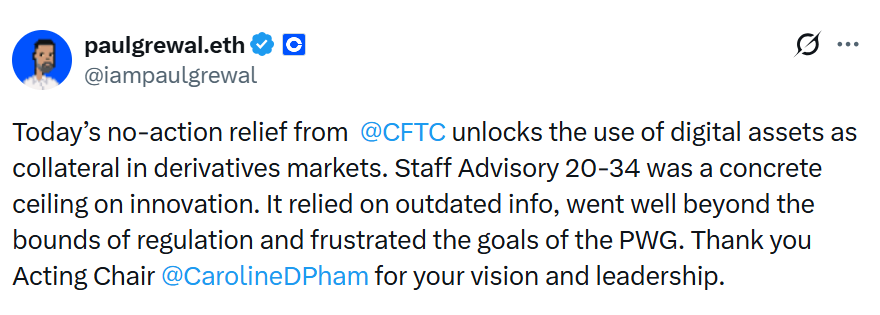
Coinbase chief legal officer Paul Grewal also supported the action, calling Staff Advisory 20-34 a “concrete ceiling on innovation.”

“It relied on outdated info, went well beyond the bounds of regulation and frustrated the goals of the PWG.”
Source: Paul Grewal

Meanwhile, Salman Banaei, the general counsel at layer-1 blockchain, the Plume Network, said it was a “major move” by the CFTC, and another push toward wider adoption.

“This is a step toward the use of onchain infra to automate settlement for the biggest asset class in the world: OTC derivatives, swaps,” he added.

Magazine: XRP’s ‘now or never’ moment, Kalshi taps Solana: Hodler’s Digest, Nov. 30 – Dec. 6

Related Reads

CRCL 暴涨暴跌,COIN 跟着跳水:CLARITY Act 背后真正的利益战争

A recent draft of the CLARITY Act sparked market volatility, with Circle (CRCL) and Coinbase (COIN) stocks plunging. The core issue is Section 404 of the draft, which proposes prohibiting digital asset service providers from paying interest or rewards *solely* for holding payment stablecoins. The article argues this is not merely a technical debate over rewards, but a fundamental battle over the future role of stablecoins: Will they remain purely payment/transaction tools, or evolve into on-chain savings accounts that compete with bank deposits? US banks, fearing deposit outflow, have lobbied heavily for such restrictions. While Circle and Coinbase were both hit, their exposures differ. Circle's direct revenue primarily comes from reserve earnings, so the draft impacts its future growth narrative. Coinbase, however, relies heavily on USDC rewards and balances as part of its "Everything Exchange" platform strategy, making its growth engine more directly vulnerable. The analysis identifies three deeper layers often missed: 1) The political economy of preventing stablecoins from becoming savings substitutes. 2) The distinct impact on issuers (Circle) versus distributors/platforms (Coinbase). 3) The migration of yield demand to other tokenized securities (like MMFs) regulated under existing frameworks, as hinted in Section 505 of the same draft. In essence, three major battles are underway: banks defending their deposit base, Coinbase fighting for user entry and distribution rights, and Wall Street aiming to control the compliant path for tokenization. While a short-term headwind for crypto-native platforms, the article suggests this regulatory push could force the industry to build more sustainable value in real payment and B2B infrastructure.

marsbit19m ago

CRCL 暴涨暴跌,COIN 跟着跳水:CLARITY Act 背后真正的利益战争

marsbit19m ago

Tom Lee充值信仰:加密春天已至,ETH会涨到25万美元

Tom Lee, Chairman of BitMine (NYSE: BMNR), asserts that "Crypto Spring" has arrived and predicts ETH could reach $250,000. In his speech at "Proof of Talk 2026," he outlines five macro catalysts: the end of the Iran war reducing oil-price inflation, the likely passing of pro-crypto US legislation (the Clarity Act), a supportive White House, a crypto-friendly new Fed Chair (Kevin Warsh), and strong demographic-driven equity market growth. Lee argues that two key trends will drive ETH's value: Agentic AI/robotics, which will require blockchain for control and payments, and the massive tokenization of real-world assets (potentially a $300 trillion market). He believes Ethereum is poised to become a future monetary unit, with its price closely linked to software stocks that are already benefiting from AI. He notes the evolving role of the Ethereum Foundation, whose ETH holdings have shrunk to 0.1% of supply. He positions public treasury companies like BitMine—which holds 4.47% of ETH's circulating supply—as the new key ecosystem funders and validators. Finally, Lee promotes BitMine as a leveraged play on ETH's rise. He highlights BitMine's investments in AI/identity (via Eightco/ORBS), its massive ETH staking operation generating ~$1M daily, its stake in content creator MrBeast, and its upcoming inclusion in the Russell 1000 index, which could drive significant institutional buying. He concludes that if ETH reaches $25,000, BitMine's stock could rise dramatically from its current ~$18 price.

Odaily星球日报37m ago

Tom Lee充值信仰:加密春天已至,ETH会涨到25万美元

Odaily星球日报37m ago

Trading

Spot
Futures
活动图片




