CFTC changes guard as Selig takes reins, Pham departs

cointelegraphPublished on 2025-12-23Last updated on 2025-12-23

Abstract

The US Commodity Futures Trading Commission (CFTC) has undergone a leadership transition, with Mike Selig sworn in as the new chairman, replacing acting chair Caroline Pham, who has departed. Selig, confirmed by the Senate after being nominated by President Trump, is now the agency's sole commissioner. He is widely viewed as pro-crypto and has pledged to support innovation in technologies like blockchain by avoiding a "regulation by enforcement" approach. Meanwhile, Pham, who had led the CFTC since January, is moving to crypto fintech company MoonPay. Both expressed support for balanced regulatory frameworks that foster innovation while ensuring market integrity.

The US Commodity Futures Trading Commission has officially undergone a change of leadership, with acting chair Caroline Pham saying she will leave the agency on Monday, while Mike Selig was sworn in as chair.

Pham, who had been serving as the CFTC’s acting chair since January and its sole commissioner since August, said on Monday that it would be her last day at the agency.

Meanwhile, the CFTC confirmed that Selig was sworn in as the agency’s 16th chairman on Monday after being nominated for the role by President Donald Trump on Oct. 27 and confirmed by the Senate on Thursday.

Pham’s departure leaves Selig as the CFTC’s sole commissioner. He is widely seen as pro-crypto and previously served as the chief counsel of the Securities and Exchange Commission’s Crypto Task Force.
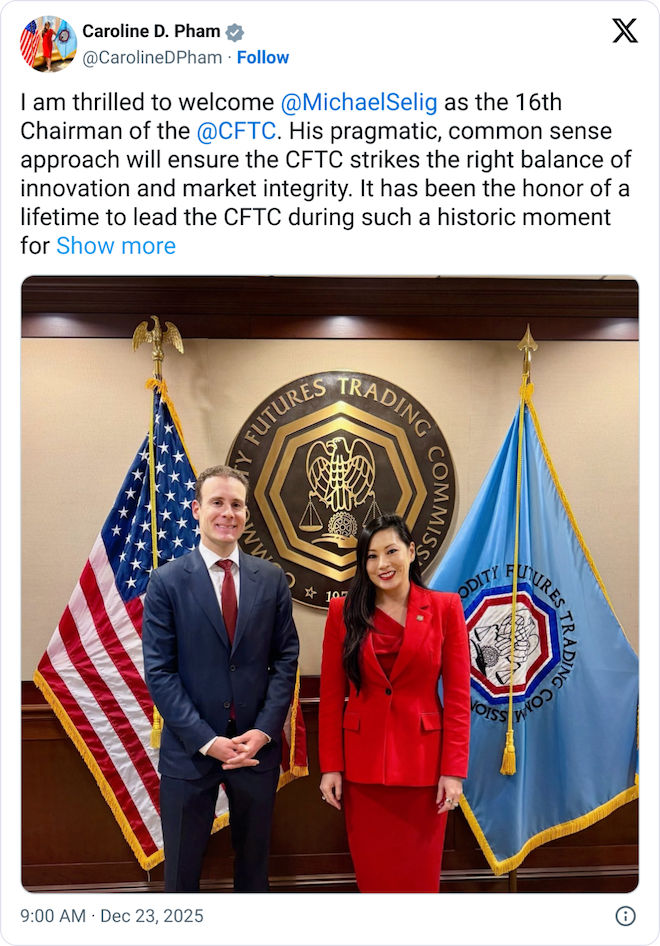
Source: Caroline Pham

Selig to continue positive momentum in crypto oversight

Selig will now serve a term that will expire in April 2029, and has previously vowed to support growth in innovative technologies such as crypto and blockchain by avoiding a so-called “regulation by enforcement” approach.

“I’m grateful for the confidence President Trump has placed in me and for the opportunity to lead the CFTC at this pivotal time,” Selig said.

“We are at a unique moment as a wide range of novel technologies, products, and platforms are emerging, retail participation in the commodity markets is at an all-time high, and Congress is poised to send digital asset market structure legislation to the President’s desk, cementing the US as the Crypto Capital of the World.”

On Monday, White House crypto czar David Sacks said Selig and SEC chair Paul Atkins were a “dream team to define clear regulatory guidelines.”

Pham shifts to crypto after steering CFTC

Pham has long said she would leave the CFTC once Congress confirmed someone to lead the agency, and on Wednesday, MoonPay confirmed earlier reports that Pham was headed to the crypto fintech company.

Pham’s time as acting chair saw her take a proactive approach to supporting crypto regulation.

Related: Wall Street’s bid on crypto dominated 2025 but what’s the demand outlook for 2026?

Pham said in her departing statement that the CFTC had “refocused on our mandate to promote responsible innovation and fair competition as the CFTC prepares to take on expanded oversight of new markets and new products like digital assets, crypto, and prediction markets.”

“I am thrilled to welcome Michael Selig as the 16th Chairman of the CFTC. His pragmatic, common-sense approach will ensure the CFTC strikes the right balance of innovation and market integrity,” she added.

Magazine: Meet the onchain crypto detectives fighting crime better than the cops

Related Questions

QWho is the new chairman of the CFTC and when was he sworn in?

AMike Selig is the new chairman of the CFTC. He was sworn in on Monday after being nominated by President Donald Trump on Oct. 27 and confirmed by the Senate.

QWhat is Mike Selig's stance on cryptocurrency regulation and what is the length of his term?

AMike Selig is widely seen as pro-crypto and has vowed to support growth in innovative technologies by avoiding a 'regulation by enforcement' approach. His term will expire in April 2029.

QWhy did Caroline Pham leave the CFTC and what is her new role?

ACaroline Pham left the CFTC once a new chair was confirmed by Congress. She is headed to the crypto fintech company MoonPay.

QWhat did White House crypto czar David Sacks say about the new regulatory leadership?

ADavid Sacks said that Selig and SEC chair Paul Atkins were a 'dream team to define clear regulatory guidelines'.

QWhat was Caroline Pham's approach to crypto regulation during her time as acting chair?

AAs acting chair, Caroline Pham took a proactive approach to supporting crypto regulation, refocusing the CFTC on its mandate to promote responsible innovation and fair competition for new markets like digital assets.

Related Reads

In Jinjiang, Fujian, a Storage Super Unicorn Lies Quiet

In Fujian's Jinjiang, a city known for sportswear, lies a quiet semiconductor giant: Fujian Jinhua Integrated Circuit Co. (JHICC). Once a promising domestic DRAM manufacturer alongside Yangtze Memory and ChangXin Memory Technologies (CXMT), its journey was derailed in 2018 when the U.S. placed it on an Entity List and filed criminal charges for alleged trade secret theft. This halted production for years. A turning point came in February 2024 when a U.S. federal court found JHICC not guilty. However, it had lost crucial time. While CXMT soared to become a top-valued A-share company in 2024, JHICC, with an estimated valuation of 80 billion RMB, was just restarting. Its current output is primarily customized DDR4 chips, not the advanced DDR5/HBM demanded for AI, but it still benefits from the broader memory chip upcycle. JHICC's story is tied to Chen Zhengkun, a veteran engineer who left Micron to lead the venture. Founded in 2016 with state-backed funding, JHICC partnered with Taiwan's UMC to develop DRAM technology. Rapid progress was cut short by the U.S. actions, which Micron initiated, partly due to its heavy reliance on the Chinese market. Post-sanctions, Chen's team worked to rebuild the production line with reduced reliance on U.S. technology. According to its records, JHICC achieved small-scale production and revenue growth under immense pressure. It now focuses on the stable "niche" DRAM market (e.g., TVs, routers) with a monthly capacity of ~40,000 wafers, aiming for 60,000 by 2026. It holds over 1,000 patents but remains on the Entity List. For Jinjiang, investing in JHICC was a bold industrial leap. The local government provided unwavering financial and logistical support during the crisis, helping the company survive. JHICC has become the anchor for a growing local semiconductor cluster. Though its scale lags behind domestic peers, JHICC's persistence symbolizes a hard-won foothold in a global market long dominated by Samsung, SK Hynix, and Micron. Having missed one boom, it seeks a place in the new AI-driven memory supercycle.

marsbit1h ago

In Jinjiang, Fujian, a Storage Super Unicorn Lies Quiet

marsbit1h ago

Trading

Spot
活动图片





