Cardano Founder Says Midnight Could Eclipse All Privacy Projects Within A Year

bitcoinistPublished on 2026-01-27Last updated on 2026-01-27

Abstract

Cardano founder Charles Hoskinson introduced Midnight as the ecosystem's "crown jewel" and a critical privacy solution for mainstream crypto adoption. He argued that while existing blockchains perfected transparency, they lack a compliant privacy layer essential for real-world business. Midnight enables selective data disclosure for regulatory compliance (like KYC/AML) without sacrificing privacy, and supports hybrid applications across multiple blockchains. Hoskinson revealed that over 50% of Midnight’s tokens were distributed to ADA holders, and early trading volume exceeded $9 billion. He projected that Midnight will surpass all privacy-focused projects within a year, crediting Cardano’s deep research team, which includes pioneering computer scientists. At the time of writing, ADA was trading at $0.3512.

Cardano founder Charles Hoskinson used the opening of a Midnight workshop in Sapporo (Japan tour) on Jan. 25 to frame Midnight as Cardano’s “crown jewel” and a missing primitive for mainstream crypto adoption, arguing the privacy layer is positioned to outpace incumbent privacy-focused networks within 12 months.

Why Cardano’s Midnight ‘Eclipses’ All Privacy Projects

Hoskinson told attendees that while crypto spent the past decade perfecting transparent ledgers, it never built a first-class “private side” that real businesses and regulators can work with. “When you have the yin and yang, well, we only built one side of the yin and yang. We only built the transparent side. We didn’t build the private side,” he said. “So the challenge is that blockchains, every single one of them, they’re missing something. They’re missing a component that’s required for real-life business.”

In his telling, the gap sits at the intersection of privacy-enhancing technology (PET), compliance, and an emerging “abstraction” stack aimed at making crypto usable without forcing consumers to learn how blockchains work. Hoskinson argued that regulated activity like KYC/KYB/AML requires selective disclosure, but public chains force a tradeoff between compliance and privacy. “If you share information about yourself on a public network, everyone in the world, everywhere in the world, gets to see that,” he said. “That doesn’t make any sense. That doesn’t make sense to do commerce.”

He extended the same logic to intent-based execution and account abstraction-style UX, where users describe outcomes and a solver network routes liquidity and settlement across chains. “If I know your intentions, I can trade against you,” Hoskinson said, warning that revealing price bounds or execution constraints invites adverse selection. “Never tell me your intention because I can use it against you. So, intentions also require privacy.”

Midnight, he said, is designed to supply those primitives without demanding wholesale migration to a new Layer 1. Hoskinson described the network as built for “hybrid applications” across multiple ecosystems, claiming Midnight’s launch architecture connected it to “eight different ecosystems, seven different blockchains,” so users can stay on chains like Solana, Cardano, Bitcoin, or Ethereum while invoking Midnight’s privacy features.

He also positioned Midnight as a catalyst for Cardano’s DeFi ambitions, acknowledging a participation gap between staking and on-chain application usage. “There’s 1.4 million people staking, but only about 50,000 people participating on a monthly basis in our DeFi ecosystem,” Hoskinson said, adding that the next phase is to upgrade a subset of leading Cardano dApps so they can tap Midnight and market privacy-native products—such as private DEXs, prediction markets, or stablecoins—to users from other ecosystems.

On rollout, Hoskinson said the first stage of Midnight launched in December and that the first mainnet is “very soon” to follow. He highlighted what he characterized as an unusually retail-heavy distribution: “We never sold a single token. We just gave it away,” he said, claiming ADA holders received more than 50% of supply and that early trading activity surpassed $9 billion in volume and more than $1 billion in value.

Hoskinson closed with his boldest projection: “Within a year, Midnight is going to eclipse anybody in the privacy space because we know how to solve these problems,” he said, attributing the edge to the depth of Cardano’s research bench.

“Because we hired 168 scientists, and they happen to have spent the last four decades of their life chasing this. One of the guys working on this wrote the first computer game online. He was at Stanford when they were building the internet, [...]. He wrote Pong, and it was the first online game. That’s the legacy we have. Now, 40 years later, he’s a fellow in the Royal Society, the same society that Sir Isaac Newton was a member of. He’s working on this, as is that 22-year-old graduate student, as is the developer here in Japan, and everyone in between, and that’s why we’re going to win. It’s not a US cryptocurrency. It’s global,” Hoskison said.

At press time, ADA traded at $0.3512.
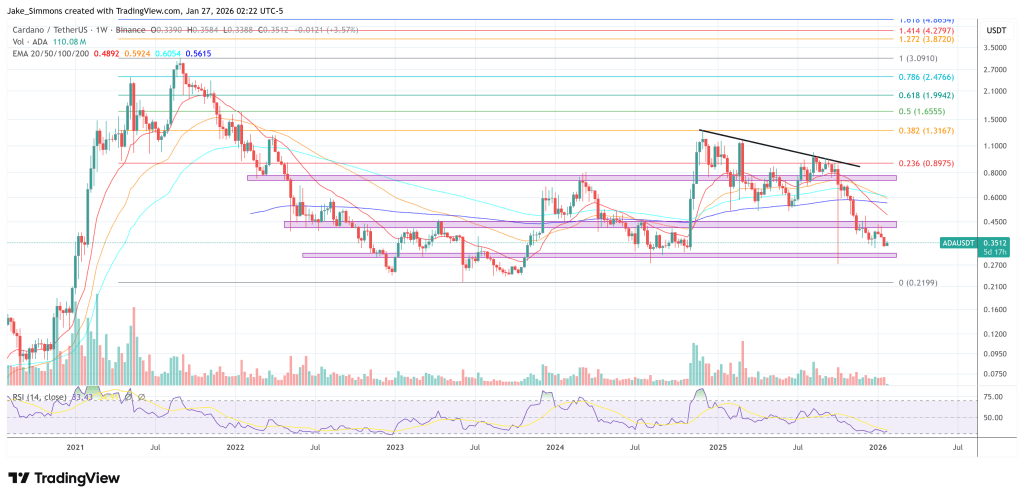
ADA hovers below key resistance, 1-week chart | Source: ADAUSDT on TradingView.com

Related Questions

QWhat is the main argument Charles Hoskinson makes about Midnight in relation to other privacy projects?

ACharles Hoskinson argues that Midnight is positioned to outpace all incumbent privacy-focused networks within 12 months, calling it Cardano's 'crown jewel' and a missing primitive for mainstream crypto adoption.

QAccording to Hoskinson, what key component are current blockchains missing for real-life business?

AHoskinson states that current blockchains are missing a first-class 'private side' that allows for selective disclosure, which is necessary for regulated activities like KYC/KYB/AML and commerce, as public chains force a tradeoff between compliance and privacy.

QHow does Hoskinson describe the distribution of Midnight's tokens?

AHe describes it as an unusually retail-heavy distribution, claiming they never sold a single token but gave it away, with ADA holders receiving more than 50% of the supply, and early trading activity surpassed $9 billion in volume.

QWhat does Hoskinson cite as Midnight's key advantage in the privacy space?

AHe attributes Midnight's edge to the depth of Cardano's research bench, highlighting that they hired 168 scientists, including experienced professionals with decades of expertise in the field, such as a fellow in the Royal Society who wrote the first online game Pong.

QHow is Midnight designed to function in relation to other blockchain ecosystems?

AMidnight is built for 'hybrid applications' across multiple ecosystems, with its launch architecture connected to eight different ecosystems and seven different blockchains, allowing users to stay on chains like Solana, Cardano, Bitcoin, or Ethereum while invoking its privacy features.

Related Reads

Fu Peng's First Public Speech in 2026: What Exactly Are Crypto Assets? Why Did I Join the Crypto Asset Industry?

Fu Peng, a renowned macroeconomist and now Chief Economist at New火 Group, delivered his first public speech of 2026 at the Hong Kong Web3 Festival. He explained his perspective on crypto assets and why he joined the industry, framing it within the context of macroeconomic trends and financial evolution. Fu emphasized that crypto assets are transitioning from an early, belief-driven phase to a mature, institutionally integrated asset class. He drew parallels to the 1970s-80s, when technological advances (like computing) revolutionized traditional finance, leading to the rise of FICC (Fixed Income, Currencies, and Commodities). Similarly, current advancements in AI, data, and blockchain are reshaping finance, with crypto assets becoming part of a new "FICC + C" (C for Crypto) framework. He noted that institutional capital, including traditional hedge funds, avoided early crypto due to its speculative nature but are now engaging as regulatory clarity emerges (e.g., stablecoin laws, CFTC classifying crypto as a commodity). Fu predicted that 2025-2026 marks a turning point where crypto becomes a standardized, financially viable asset for diversified portfolios, akin to commodities or derivatives in traditional finance. Fu defined Bitcoin not as "digital gold" in a simplistic sense but as a value-preserving, financially tradable asset. He highlighted that crypto's future lies in regulated, institutional adoption, moving away from retail-dominated trading. His entry into crypto signals this maturation, where traditional finance integrates crypto into mainstream asset management.

marsbit31m ago

Fu Peng's First Public Speech in 2026: What Exactly Are Crypto Assets? Why Did I Join the Crypto Asset Industry?

marsbit31m ago

Justin Sun Sues Trump Family: What $75 Million Bought Was Only a Blacklist

Justin Sun, founder of Tron, has filed a lawsuit in federal court against World Liberty Financial (WLF), alleging he was made the "primary target of a fraudulent scheme" after investing $75 million. Sun claims the investment secured him an advisor title and WLFI tokens, which were later frozen by WLF, causing "hundreds of millions in losses." The dispute began in late 2024 when Sun's investment helped revive WLF's struggling token sale, which ultimately raised $550 million. Shortly after, the SEC dropped its lawsuit against Sun following Donald Trump's inauguration. However, relations soured when Sun refused WLF's demands for additional funding. In August 2025, WLF added a "blacklist" function to its smart contract, allowing it to unilaterally freeze tokens. Sun's holdings, worth approximately $107 million, were frozen, and he was threatened with token destruction. The lawsuit highlights WLF's structure, which directs 75% of token sale profits to the Trump family, who had earned $1 billion by December 2025. WLF's CEO is Zach Witkoff, son of U.S. Middle East envoy Steve Witkoff. The project faces scrutiny for opaque operations, including a controversial loan arrangement on the Dolomite platform, co-founded by a WLF advisor. Despite Sun's history with the SEC, the case underscores centralization risks within DeFi, as WLF controls governance and holds powers to freeze assets arbitrarily. Sun's tokens remain frozen as legal proceedings begin.

marsbit39m ago

Justin Sun Sues Trump Family: What $75 Million Bought Was Only a Blacklist

marsbit39m ago

$500 to Buy OpenAI Stock: Silicon Valley's Most Respectable Liquidity Invitation

Silicon Valley's largest venture capital platform, AngelList, has launched a new fund called USVC, allowing U.S. retail investors to buy into high-profile AI companies like OpenAI, Anthropic, and xAI with a minimum investment of $500—no accredited investor status required. Promoted by AngelList co-founder Naval Ravikant, the fund is framed as an opportunity for ordinary people to access high-growth private tech investments traditionally reserved for VCs. However, critics argue it functions more like an exit vehicle for early insiders. USVC acquires shares not through primary rounds but largely via secondary transactions—purchasing stakes from early investors, VC funds, and employees looking to cash out at peak valuations. With companies like xAI heavily weighted in the portfolio, the fund effectively channels retail money into providing liquidity for insiders who entered at much lower valuations. The fund’s structure raises concerns: shares are illiquid, with no secondary market, and buybacks are limited and discretionary. The actual annual fee reaches 3.61%, far above the advertised 1% management fee. This model parallels the "low float, high fully diluted valuation" strategy seen in crypto, where early investors profit by selling to latecomers at inflated prices. The timing—alongside similar moves by platforms like Robinhood—suggests that Silicon Valley’s sudden interest in retail inclusion may be less about democratizing access and more about securing exits for insiders.

marsbit1h ago

$500 to Buy OpenAI Stock: Silicon Valley's Most Respectable Liquidity Invitation

marsbit1h ago

Trading

Spot
Futures

Hot Articles

Discussions

Welcome to the HTX Community. Here, you can stay informed about the latest platform developments and gain access to professional market insights. Users' opinions on the price of ADA (ADA) are presented below.

活动图片