Cardano Founder Says He’ll Sell A Blackhawk And Lambos, Mothball His Jet

bitcoinistPublished on 2026-02-02Last updated on 2026-02-02

Abstract

Cardano founder Charles Hoskinson announced plans to sell his Blackhawk helicopter, multiple Lamborghinis, and mothball his private jet, framing the decision as a personal reset and a critique of crypto's cultural shift. Reflecting on the industry's 2021 boom, he argued that mainstream acceptance drained crypto's original "punk rock" energy and led to complacency. Hoskinson admitted his own opulent lifestyle represented the problem and stated he would downsize to return to his roots, focusing on hands-on building and coding. He emphasized a return to core principles, citing recent technical work and the use of AI tools to fuel creativity. At the time of reporting, Cardano (ADA) was trading at $0.2853.

Cardano founder Charles Hoskinson said he plans to sell a Blackhawk helicopter and multiple Lamborghinis and “mothball” his jet, framing the decision as a personal reset and a critique of how crypto’s culture changed after the 2021 boom.

Speaking in a Jan. 31 video recorded from Fukuoka, Hoskinson opened with a market-watcher’s morning ritual and a broader question about what’s still under an industry participant’s control when prices turn against them. “I sat down,” he said, “and I said, ‘Gosh, you know, how did we get here?’” He described the mood as one of reflection after seeing “the markets and the red lights” on his phone.

Why The Cardano Founder Is Selling His Wealth

He tied that reflection to a multi-stop community tour across Japan, saying his team had recently presented in Hokkaido and Osaka before arriving in Fukuoka, and urged viewers to watch the latest Japanese community livestream. The trip, he suggested, pulled him back to the early days when Cardano was “just an idea,” and the scene felt more insurgent than institutional.

Hoskinson leaned into that contrast, calling crypto “the punk rock of finance” and arguing that a kind of mainstream acceptance drained energy from the sector. In his telling, 2021 marked a turning point: “We all got rich and we all got accepted. And you know, we all just basically became part of the system.” Once inside, he said, the system “take[s] the life out of it,” “strip[s] you of all the things that make you special,” and repackages work into something more consumerized.

Hoskinson then turned the critique inward, describing his own lifestyle as part of the problem. “I look at myself and I say, you know, I’ve gotten a little fat and happy, literally fat, and also an opulent lifestyle,” he said, arguing that repeating the same approach — “be part of that club, hedge a little bit” — isn’t compatible with doing “great things.”

“So, you know what I’m going to do is get back to that punk rock group,” he said. “Downsize a little bit. So, I’m going to sell my Blackhawk, mothball the jet, sell my Lamborghinis, just go all in. Why not?” He positioned the move as a return to an earlier, leaner period: “I started from nothing. Many of you older fans, you remember when I was sitting in my apartment and I had the stuffed giraffes back on the dresser and those were the days I love more than any other.”

A key part of Hoskinson’s “back to first principles” framing was day-to-day building. He said he has been coding every day and credited modern AI tooling for accelerating creativity, mentioning “a little bit of help from our friend Claude” and “a little bit of help from our friend Codex.”

He also pointed to a heavier technical workload, saying he wrote “over 400 pages of technical documents for Midnight over Christmas,” including an “executable specification oracle with a TLA spec” and a protocol specification. The thread running through the examples was urgency and immersion, doing the work “in the pits,” surrounded by builders, rather than managing crypto as a portfolio or status marker.

At press time, Cardano traded at $0.2853.
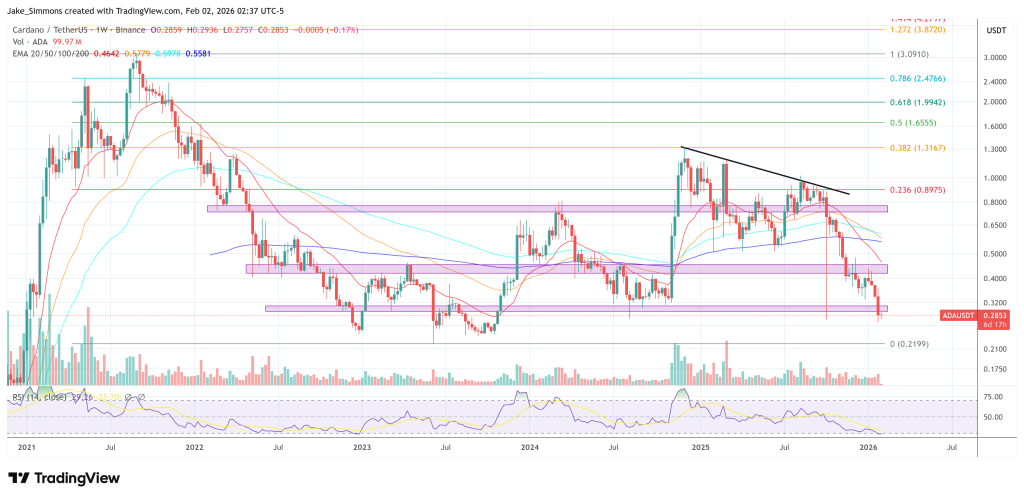
Cardano falls below key support, 1-week chart | Source: ADAUSDT on TradingView.com

Related Questions

QWhat personal assets did Cardano founder Charles Hoskinson announce he would sell or mothball?

ACharles Hoskinson announced he plans to sell a Blackhawk helicopter and multiple Lamborghinis, and to 'mothball' his private jet.

QAccording to Hoskinson, what marked a turning point for the culture of the cryptocurrency sector?

AHoskinson stated that the year 2021 was a turning point, as people in crypto 'all got rich and we all got accepted,' leading to mainstream acceptance that drained energy from the sector's insurgent, 'punk rock' spirit.

QHow did Hoskinson describe his own lifestyle and its impact on his work?

AHe described his own lifestyle as 'a little fat and happy, literally fat, and also an opulent lifestyle,' and argued that this opulence was incompatible with doing 'great things' and needed to change.

QWhat did Hoskinson say he has been doing to get 'back to first principles' and a builder's mindset?

AHe stated that he has been coding every day, using modern AI tooling for acceleration, and mentioned writing over 400 pages of technical documents for the Midnight project over Christmas.

QWhat was the price of Cardano (ADA) at the time the article was published?

AAt press time, Cardano traded at $0.2853.

Related Reads

The Value Distribution of Stablecoins

**Summary: The Value Distribution of Stablecoins** The article argues that stablecoins are evolving from mere trading tools into broader channels for dollar access. It divides the stablecoin ecosystem into four layers to analyze how value is distributed: 1. **Issuance Layer:** Mints stablecoins, holds reserve assets, and captures the spread between reserve yield and user costs (e.g., Tether, Circle). This layer currently earns the largest profit margin. 2. **Infrastructure Layer:** Connects stablecoins to the traditional financial system, handling fiat on/off-ramps, banking integration, compliance (KYC/AML), and asset management (e.g., Bridge, BVNK). This is the "unglamorous" but critical work, building the essential bridges between crypto and real-world finance. 3. **Acquiring/Distribution Layer:** Integrates stablecoins into merchant systems, manages payment flows, and provides enterprise financial software (e.g., Stripe, Coinbase). They act as the access point for businesses. 4. **Application Layer:** The end-users and businesses that ultimately use stablecoins for payments, settlements, or as a store of value. They benefit from convenience but have little pricing power. The core thesis is that while the issuance layer currently dominates profits, the often-overlooked **infrastructure layer holds significant long-term potential**. The real challenge and barrier to mass adoption is not the on-chain transfer of stablecoins (which is simple), but the complex "last mile" integration into existing business workflows, banking systems, and regulatory frameworks across different countries. Companies in this layer are currently in a "land grab" phase, investing heavily to build networks, secure bank partnerships, and establish compliance pathways. While their position is currently pressured by the profitable issuers above and distribution platforms below, the article suggests that if stablecoins become a default financial rail for businesses, the infrastructure providers who have done the hard work of integration will ultimately gain strong pricing power and become entrenched, essential players.

marsbit4h ago

The Value Distribution of Stablecoins

marsbit4h ago

The Value Distribution of Stablecoins

The Value Distribution of Stablecoins The article argues that stablecoins are evolving from a mere trading tool into a broad "dollar channel." It analyzes the industry's value chain through four layers: 1. **Issuance Layer (e.g., Tether, Circle):** The top layer that mints stablecoins, holds reserve assets, and captures the thickest interest rate spread. 2. **Infrastructure Layer (e.g., Bridge, BVNK):** Connects stablecoins to the traditional financial system, handling critical but complex "dirty work" like fiat on/off-ramps, banking integration, compliance (KYC/AML), and cross-border settlement. 3. **Acquiring/Distribution Layer (e.g., Stripe, Coinbase):** Embeds stablecoins into merchant systems, manages payment flows, and integrates with enterprise software. 4. **Application Layer:** End-users and businesses that ultimately use stablecoins for payments, settlement, or storing value. The author posits that while the issuance layer currently captures the most profit, the most overlooked and potentially critical layer is infrastructure. The core challenge for stablecoin adoption isn't the on-chain transfer (which is simple), but bridging the gap between blockchain and the real-world financial system. This involves solving practical problems for businesses: fiat conversion, reconciliation, tax handling, and user onboarding. Infrastructure companies are currently in a difficult "land-grab" phase—building networks, securing banking relationships, and achieving compliance country-by-country. They face pressure from both the profitable issuance layer above and distribution platforms below. However, the author suggests this layer is building a crucial moat. Once stablecoins become a default business rail, the infrastructure players who have done the hard work of integration may gain significant, durable value and pricing power.

链捕手4h ago

The Value Distribution of Stablecoins

链捕手4h ago

How to Do Research Well: Deliberately Practice the Real Skills That Matter

No one truly teaches you how to do research. You're often given a desk, a pre-selected problem, and vague instructions to "create something new." Consequently, many people reverse-engineer the job based on visible outputs—papers, posts, announcements—learning only how to *appear* like a researcher rather than how to *become* one. True research capability is built from stacking small, trainable skills, nearly all of which can be developed through deliberate practice. **Pick Your Own Problem:** Most researchers absorb problems from advisors or trends, lacking the underlying reasoning. Choosing a problem you genuinely care about, as John Schulman advises, leads to original work. Develop "taste" like a muscle: predict experiment outcomes, guess paper results from methods, and track which findings remain important over time. **Upgrade Your Inputs:** Relying on shared reading lists (arXiv hot lists, filtered group chats) leads to unoriginal conclusions. Undervalued old literature often holds crucial insights (e.g., MoE, LSTM, backpropagation). Richard Sutton's "The Bitter Lesson" or Claude Shannon's 1952 talk on creative thinking are more predictive than lengthy modern surveys. Breadth matters as much as depth: draw from neuroscience, mechanism design, hardware knowledge, and honest statistics. Read papers directly, especially appendices and limitations sections. **Write Everything Down:** As Paul Graham noted, writing exposes flaws in seemingly mature ideas. Writing is the cheapest defense against self-deception. Following Feynman's principle, Darwin programmatically wrote down facts contradicting his theory to combat memory bias. Maintain a detailed log of hypotheses, setups, predictions, results, and updated understandings. Reviewing past logs fosters essential humility.

marsbit6h ago

How to Do Research Well: Deliberately Practice the Real Skills That Matter

marsbit6h ago

Trading

Spot
Futures

Hot Articles

Discussions

Welcome to the HTX Community. Here, you can stay informed about the latest platform developments and gain access to professional market insights. Users' opinions on the price of ADA (ADA) are presented below.

活动图片