Cardano Founder Hoskinson Just Released A Free Book On Zero-Knowledge

bitcoinistPublished on 2026-03-30Last updated on 2026-03-30

Abstract

Cardano founder Charles Hoskinson has released a free, 357-page book titled "Proving Nothing: A Layered Guide to Zero-Knowledge Proof Systems" under a Creative Commons license. Designed as a non-technical introduction, the book uses a seven-layer framework to explain ZK systems, covering topics from cryptography and proof systems to private smart contracts and zkVMs. Hoskinson stated the project aims to address the low understanding of ZK technology and also serves as an introduction to Midnight, Cardano’s privacy-focused network. The book is intended to be a living document, with plans to update it as Midnight develops and new advancements emerge.

Cardano founder Charles Hoskinson has released a free book aimed at explaining zero-knowledge systems to a broader crypto audience, framing it as both an educational project and an on-ramp into Midnight, Cardano’s privacy-focused network. The linked GitHub repository shows the work is being published under a Creative Commons Attribution 4.0 license, while the latest public release is now titled Proving Nothing: A Layered Guide to Zero-Knowledge Proof Systems.

Cardano Founder Drops Free 337-Page ZK Book

In a March 27 livestream, Hoskinson said the project grew out of what he described as a “shockingly low level of understanding” around zero-knowledge proofs and ZK cryptography. “So I wrote a 337 page book over the last few months,” he said. He described it as a non-technical manual, though one that still contains a significant amount of technical material, built around a seven-layer framework for understanding how ZK systems are designed from setup and languages down to proof systems, cryptography, and the verification environment.

That structure is central to the pitch. The Cardano founder said the framework is meant to help readers “understand all ZK systems from that lens,” then move upward into adjacent privacy-enhancing technologies and, eventually, Midnight itself. The repository’s README makes the same case in more formal language, describing the book as a guide to “the entire zero-knowledge stack from the ground up” and arguing that ZK systems do not remove trust so much as decompose it into smaller, testable pieces.

The Midnight angle is not incidental. Hoskinson explicitly presented the book as “a good way of introducing Midnight to people,” and said one chapter is dedicated to the network, even if the broader work is designed as a general introduction to zero-knowledge.

He also said the book goes beyond the seven-layer model into private smart contracts, the Aleo-linked ZEXE model, Midnight’s Kachina system, zkVMs, STARK-to-SNARK pipelines, and the wider market landscape for privacy and proof systems.

That scope has already expanded since the version Hoskinson described on video. The GitHub release notes for v1.10, published on March 30, show the book was renamed from The Seven-Layer Magic Trick to Proving Nothing, and now ships in both EPUB and PDF formats. The file inventory in that release lists a 357-page dark-mode PDF, while the chapter notes show edits and additions across 14 chapters, including sections on zkVMs, market structure, eIDAS 2.0, rollups, and a more detailed Midnight case study.

Hoskinson also made clear that this is not a static publication. “This is the first edition, version 1.01,” he said in the livestream. “I’ll keep adding and changing and work on it throughout the weekends as more things come up and as more stuff in Midnight gets launched, I’ll add to this.” That matters because the book appears designed less as a one-off manifesto than as a living educational document tied to Midnight’s rollout and the broader commercialization of privacy tech.

At press time, Cardano traded at $0.2468.
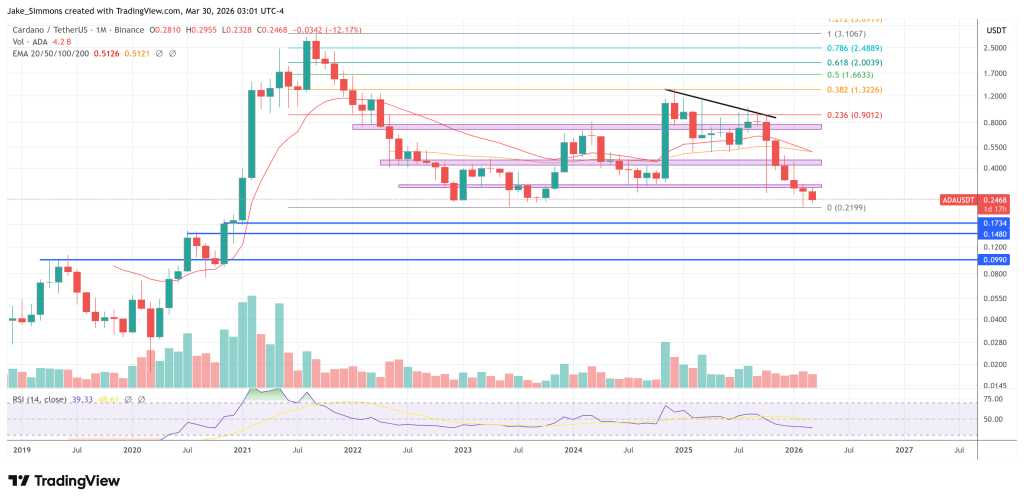
Cardano hovers below key resistance, 1-monthly chart | Source: ADAUSDT on TradingView.com

Related Questions

QWho is the author of the free book on zero-knowledge systems and what is the book's title?

AThe author is Charles Hoskinson, the founder of Cardano, and the book is titled 'Proving Nothing: A Layered Guide to Zero-Knowledge Proof Systems'.

QWhat was the primary motivation for Charles Hoskinson to write this book?

AHe was motivated by what he described as a 'shockingly low level of understanding' around zero-knowledge proofs and ZK cryptography, aiming to provide an educational resource for a broader audience.

QHow is the book structured to help readers understand zero-knowledge systems?

AThe book is built around a seven-layer framework that explains how ZK systems are designed, from setup and languages down to proof systems, cryptography, and the verification environment.

QWhat is the connection between this book and the Midnight network?

AThe book is framed as an educational on-ramp into Midnight, Cardano's privacy-focused network, with one chapter dedicated to it and the broader work designed to introduce people to the technology behind it.

QIs the book a static publication, and what is its current version and format?

ANo, it is a living document that will be updated. The current version at the time of the article is v1.10, and it is available in both EPUB and PDF formats.

Related Reads

Justin Sun Sues Trump Family: What $75 Million Bought Was Only a Blacklist

Justin Sun, founder of Tron, has filed a lawsuit in federal court against World Liberty Financial (WLF), alleging he was made the "primary target of a fraudulent scheme" after investing $75 million. Sun claims the investment secured him an advisor title and WLFI tokens, which were later frozen by WLF, causing "hundreds of millions in losses." The dispute began in late 2024 when Sun's investment helped revive WLF's struggling token sale, which ultimately raised $550 million. Shortly after, the SEC dropped its lawsuit against Sun following Donald Trump's inauguration. However, relations soured when Sun refused WLF's demands for additional funding. In August 2025, WLF added a "blacklist" function to its smart contract, allowing it to unilaterally freeze tokens. Sun's holdings, worth approximately $107 million, were frozen, and he was threatened with token destruction. The lawsuit highlights WLF's structure, which directs 75% of token sale profits to the Trump family, who had earned $1 billion by December 2025. WLF's CEO is Zach Witkoff, son of U.S. Middle East envoy Steve Witkoff. The project faces scrutiny for opaque operations, including a controversial loan arrangement on the Dolomite platform, co-founded by a WLF advisor. Despite Sun's history with the SEC, the case underscores centralization risks within DeFi, as WLF controls governance and holds powers to freeze assets arbitrarily. Sun's tokens remain frozen as legal proceedings begin.

marsbit6m ago

Justin Sun Sues Trump Family: What $75 Million Bought Was Only a Blacklist

marsbit6m ago

$500 to Buy OpenAI Stock: Silicon Valley's Most Respectable Liquidity Invitation

Silicon Valley's largest venture capital platform, AngelList, has launched a new fund called USVC, allowing U.S. retail investors to buy into high-profile AI companies like OpenAI, Anthropic, and xAI with a minimum investment of $500—no accredited investor status required. Promoted by AngelList co-founder Naval Ravikant, the fund is framed as an opportunity for ordinary people to access high-growth private tech investments traditionally reserved for VCs. However, critics argue it functions more like an exit vehicle for early insiders. USVC acquires shares not through primary rounds but largely via secondary transactions—purchasing stakes from early investors, VC funds, and employees looking to cash out at peak valuations. With companies like xAI heavily weighted in the portfolio, the fund effectively channels retail money into providing liquidity for insiders who entered at much lower valuations. The fund’s structure raises concerns: shares are illiquid, with no secondary market, and buybacks are limited and discretionary. The actual annual fee reaches 3.61%, far above the advertised 1% management fee. This model parallels the "low float, high fully diluted valuation" strategy seen in crypto, where early investors profit by selling to latecomers at inflated prices. The timing—alongside similar moves by platforms like Robinhood—suggests that Silicon Valley’s sudden interest in retail inclusion may be less about democratizing access and more about securing exits for insiders.

marsbit37m ago

$500 to Buy OpenAI Stock: Silicon Valley's Most Respectable Liquidity Invitation

marsbit37m ago

Trading

Spot
Futures

Hot Articles

Discussions

Welcome to the HTX Community. Here, you can stay informed about the latest platform developments and gain access to professional market insights. Users' opinions on the price of ADA (ADA) are presented below.

活动图片