Cardano Founder Hoskinson Just Released A Free Book On Zero-Knowledge

bitcoinistPublished on 2026-03-30Last updated on 2026-03-30

Abstract

Cardano founder Charles Hoskinson has released a free, 357-page book titled "Proving Nothing: A Layered Guide to Zero-Knowledge Proof Systems" under a Creative Commons license. Designed as a non-technical introduction, the book uses a seven-layer framework to explain ZK systems, covering topics from cryptography and proof systems to private smart contracts and zkVMs. Hoskinson stated the project aims to address the low understanding of ZK technology and also serves as an introduction to Midnight, Cardano’s privacy-focused network. The book is intended to be a living document, with plans to update it as Midnight develops and new advancements emerge.

Cardano founder Charles Hoskinson has released a free book aimed at explaining zero-knowledge systems to a broader crypto audience, framing it as both an educational project and an on-ramp into Midnight, Cardano’s privacy-focused network. The linked GitHub repository shows the work is being published under a Creative Commons Attribution 4.0 license, while the latest public release is now titled Proving Nothing: A Layered Guide to Zero-Knowledge Proof Systems.

Cardano Founder Drops Free 337-Page ZK Book

In a March 27 livestream, Hoskinson said the project grew out of what he described as a “shockingly low level of understanding” around zero-knowledge proofs and ZK cryptography. “So I wrote a 337 page book over the last few months,” he said. He described it as a non-technical manual, though one that still contains a significant amount of technical material, built around a seven-layer framework for understanding how ZK systems are designed from setup and languages down to proof systems, cryptography, and the verification environment.

That structure is central to the pitch. The Cardano founder said the framework is meant to help readers “understand all ZK systems from that lens,” then move upward into adjacent privacy-enhancing technologies and, eventually, Midnight itself. The repository’s README makes the same case in more formal language, describing the book as a guide to “the entire zero-knowledge stack from the ground up” and arguing that ZK systems do not remove trust so much as decompose it into smaller, testable pieces.

The Midnight angle is not incidental. Hoskinson explicitly presented the book as “a good way of introducing Midnight to people,” and said one chapter is dedicated to the network, even if the broader work is designed as a general introduction to zero-knowledge.

He also said the book goes beyond the seven-layer model into private smart contracts, the Aleo-linked ZEXE model, Midnight’s Kachina system, zkVMs, STARK-to-SNARK pipelines, and the wider market landscape for privacy and proof systems.

That scope has already expanded since the version Hoskinson described on video. The GitHub release notes for v1.10, published on March 30, show the book was renamed from The Seven-Layer Magic Trick to Proving Nothing, and now ships in both EPUB and PDF formats. The file inventory in that release lists a 357-page dark-mode PDF, while the chapter notes show edits and additions across 14 chapters, including sections on zkVMs, market structure, eIDAS 2.0, rollups, and a more detailed Midnight case study.

Hoskinson also made clear that this is not a static publication. “This is the first edition, version 1.01,” he said in the livestream. “I’ll keep adding and changing and work on it throughout the weekends as more things come up and as more stuff in Midnight gets launched, I’ll add to this.” That matters because the book appears designed less as a one-off manifesto than as a living educational document tied to Midnight’s rollout and the broader commercialization of privacy tech.

At press time, Cardano traded at $0.2468.
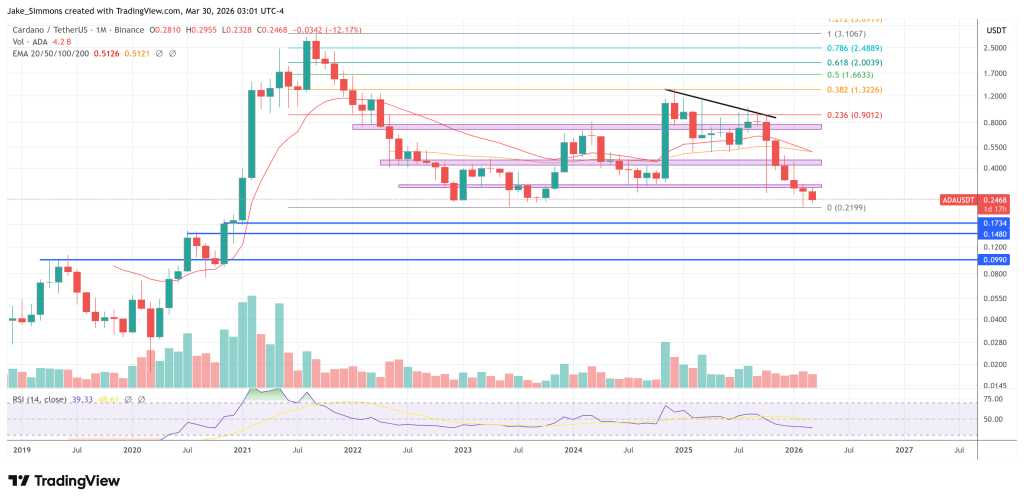
Cardano hovers below key resistance, 1-monthly chart | Source: ADAUSDT on TradingView.com

Related Questions

QWho is the author of the free book on zero-knowledge systems and what is the book's title?

AThe author is Charles Hoskinson, the founder of Cardano, and the book is titled 'Proving Nothing: A Layered Guide to Zero-Knowledge Proof Systems'.

QWhat was the primary motivation for Charles Hoskinson to write this book?

AHe was motivated by what he described as a 'shockingly low level of understanding' around zero-knowledge proofs and ZK cryptography, aiming to provide an educational resource for a broader audience.

QHow is the book structured to help readers understand zero-knowledge systems?

AThe book is built around a seven-layer framework that explains how ZK systems are designed, from setup and languages down to proof systems, cryptography, and the verification environment.

QWhat is the connection between this book and the Midnight network?

AThe book is framed as an educational on-ramp into Midnight, Cardano's privacy-focused network, with one chapter dedicated to it and the broader work designed to introduce people to the technology behind it.

QIs the book a static publication, and what is its current version and format?

ANo, it is a living document that will be updated. The current version at the time of the article is v1.10, and it is available in both EPUB and PDF formats.

Related Reads

Arbitrum Pretends to Be the Hacker, 'Steals' Back the Money Lost by KelpDAO

Title: Arbitrum Poses as Hacker to Recover Stolen Funds from KelpDAO Last week, KelpDAO suffered a hack resulting in nearly $300 million in losses, marking the largest DeFi security incident this year. Approximately 30,765 ETH (worth over $70 million) remained on an Arbitrum address controlled by the attacker. In an unprecedented move, Arbitrum’s Security Council utilized its emergency authority to upgrade the Inbox bridge contract, adding a function that allowed them to impersonate the hacker’s address and initiate a transfer without access to its private key. The council’s action, approved by 9 of its 12 members, moved the stolen ETH to a frozen address in a single transaction before reverting the contract to its original state. The operation was coordinated with law enforcement, which attributed the attack to North Korea’s Lazarus Group. Community reactions are divided: some praise the recovery of funds, while others question the centralization of power, as the council can upgrade core contracts without governance votes. However, such emergency mechanisms are common among major L2s. Despite the partial recovery, over $292 million was stolen in total, with more than $100 million in bad debt on Aave and remaining funds scattered across other chains. The incident highlights escalating security challenges in DeFi, with state-sponsored hackers employing advanced tactics and L2s responding with elevated countermeasures.

marsbit1m ago

Arbitrum Pretends to Be the Hacker, 'Steals' Back the Money Lost by KelpDAO

marsbit1m ago

iQiyi Is Too Impatient

The article "iQiyi Is Too Impatient" discusses the controversy surrounding the Chinese streaming platform IQiyi's recent announcement of an "AI Actor Library" during its 2026 World Conference. IQiyi claimed over 100 actors, including well-known names like Zhang Ruoyun and Yu Hewei, had joined the initiative. CEO Gong Yu suggested AI could enable actors to "star in 14 dramas a year instead of 4" and that "live-action filming might become a world cultural heritage." The announcement quickly sparked backlash. Multiple actors named in the list issued urgent statements denying they had signed any AI-related authorization agreements. This forced IQiyi to clarify that inclusion in the library only indicated a willingness to *consider* AI projects, with separate negotiations required for any specific role. The incident, which trended on social media with hashtags like "IQiyi is crazy," is presented as a sign of the company's growing desperation. Facing intense competition from short-video platforms like Douyin and Kuaishou, as well as Bilibili and Xiaohongshu, IQiyi's financial performance has weakened, with revenues declining for two consecutive years. The author argues that IQiyi is "too impatient" to tell a compelling AI story to reassure the market, especially as it pursues a listing on the Hong Kong stock exchange. The piece concludes by outlining three key "AI questions" IQiyi must answer: defining its role as a tool provider versus a content creator, balancing the "coldness" of AI with the human element audiences desire, and properly managing the interests of platforms, actors, and viewers. The core dilemma is that while AI can reduce costs and increase efficiency, it risks creating homogenized, formulaic content and devaluing human performers.

marsbit55m ago

iQiyi Is Too Impatient

marsbit55m ago

Trading

Spot
Futures

Hot Articles

Discussions

Welcome to the HTX Community. Here, you can stay informed about the latest platform developments and gain access to professional market insights. Users' opinions on the price of ADA (ADA) are presented below.

活动图片