Cardano Foundation Reaches First Milestone In New Governance Roadmap

bitcoinistPublished on 2026-01-22Last updated on 2026-01-22

Abstract

Cardano Foundation has reached the first milestone in its updated governance roadmap by delegating an additional 220 million ADA to 11 community representatives (DReps) focused on Adoption and Operations. This brings the Foundation’s total delegation to community DReps to 360 million ADA. The move aims to decentralize governance by shifting voting power toward representatives with expertise in real-world adoption, business acumen, and network operations—not just technical development. The Foundation also announced it will self-delegate its remaining 171 million ADA stake instead of leaving it passive, reducing its overall voting power by 43 million ADA. The delegations were made without conditions or voting instructions, emphasizing trust in the DReps' decision-making and encouraging healthy dissent as a feature of decentralized governance.

The Cardano Foundation said it has hit the first milestone in its updated governance roadmap, expanding delegation to a new set of community representatives as the ecosystem leans further into on-chain decision-making. The move matters because it shifts meaningful voting weight toward delegated representatives (DReps) whose mandates emphasize adoption and day-to-day network operations rather than purely technical development.

Cardano Foundation Expands DRep Delegation

In a post on X and an accompanying blog update, the Foundation said it has delegated an additional 220 million ADA to 11 selected DReps, roughly 20 million ADA each, focused on the pillars of Adoption and Operations. The Foundation framed the step as a continuation of earlier delegations to “Developer & Builder DReps,” and said the new allocation brings total delegation to community DReps to 360 million ADA.

Alongside the additional community delegation, the Foundation said it is revising how it handles its remaining stake in governance. “Rather than leaving a portion of our funds on auto-abstain as initially planned, we will self-delegate the remaining balance (approximately 171 million ADA),” the Foundation wrote. “While this exceeds our initial estimate, it ensures no ADA remains passive and still results in a net reduction of our overall voting power by approximately 43 million ADA, with the clear majority of our holdings now empowering community DReps.”

The Foundation emphasized that the delegations are intended to distribute voting power without imposing direction. “This delegation is not a blind bet, rather it’s a show of trust in a proven history of sound decision-making,” it said. “As always, it’s also a show of good faith: These new delegations come without any expectation regarding voting outcomes. We will not direct these DReps on how to vote, nor will we provide a voting manual.”

That posture, explicitly accepting dissent from its own views, was positioned as a feature rather than a risk. The Foundation said it expects “differing opinions” between the newly selected DReps and the Foundation itself, describing that divergence as evidence of “a healthy, decentralized governance system.”

The Foundation’s rationale for targeting adoption and operations reads as a governance design choice: broaden the expertise mix beyond protocol engineering. “To build a resilient governance system, we need more than just technical expertise—We need business acumen and operational stability,” it wrote, arguing that Adoption DReps can represent real-world utility, onboarding, and enterprise needs, while Operations DReps reflect the practical constraints faced by stake pool operators, toolmakers, and infrastructure providers.

In the published list, the Adoption cohort includes figures tied to community growth and product-building across the ecosystem, from regional community leadership to DeFi and stablecoin infrastructure, while the Operations cohort highlights long-running infrastructure roles such as block explorer analytics, stake pool operations, and SPO tooling.

The Foundation said all eleven delegations were completed in a single on-chain transaction, linking to the Cardano Explorer entry, and noted the delegations are effective immediately. It also encouraged the broader community to “follow and interact with these DReps,” including engaging with their voting rationales and participating in governance actions.

At press time, Cardano traded at $0.3549.
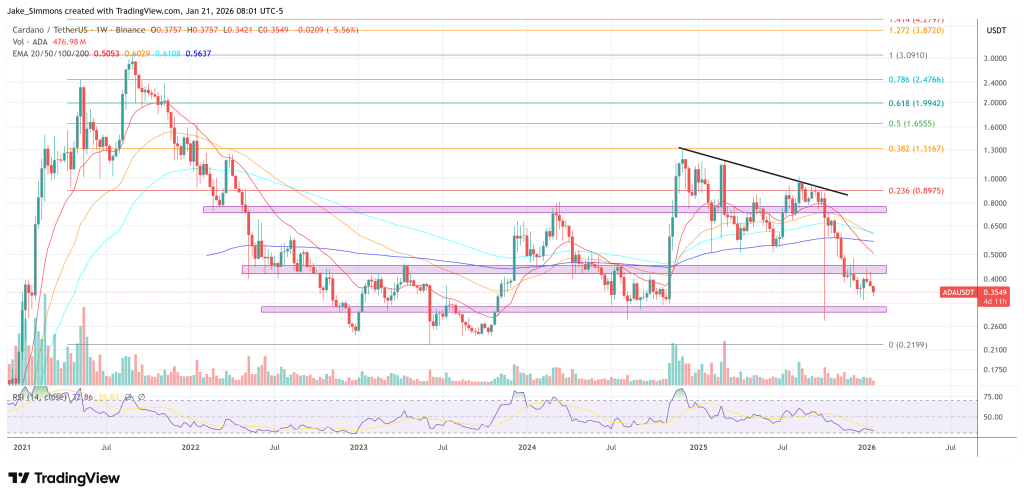
Cardano hovers below key resistance, 1-week chart | Source: ADAUSDT on TradingView.com

Related Questions

QWhat is the first milestone achieved by the Cardano Foundation in its updated governance roadmap?

AThe Cardano Foundation has expanded delegation to a new set of community representatives (DReps) focused on Adoption and Operations, shifting meaningful voting weight towards them.

QHow much ADA was delegated to the 11 selected DReps, and what was the focus of these DReps?

AThe Foundation delegated an additional 220 million ADA, roughly 20 million ADA each, to 11 DReps focused on the pillars of Adoption and Operations.

QWhat change did the Foundation make regarding its remaining stake in governance, and what was the result?

ARather than leaving a portion of funds on auto-abstain, the Foundation self-delegated its remaining balance of approximately 171 million ADA, resulting in a net reduction of its overall voting power by about 43 million ADA.

QHow does the Foundation view differing opinions between itself and the newly selected DReps?

AThe Foundation views differing opinions as evidence of a healthy, decentralized governance system, considering it a feature rather than a risk.

QWhat rationale did the Foundation provide for targeting Adoption and Operations DReps specifically?

AThe Foundation stated that building a resilient governance system requires more than technical expertise; it needs business acumen and operational stability, with Adoption DReps representing real-world utility and enterprise needs, and Operations DReps reflecting practical constraints of stake pool operators and infrastructure providers.

Related Reads

How Many Tokens Away Is Yang Zhilin from the 'Moon Chasing the Light'?

The article explores the intense competition between two leading Chinese AI companies, DeepSeek and Kimi (Moon Dark Side), and the mounting pressure on Yang Zhilin, the founder of Kimi. While DeepSeek re-emerged after 15 months of silence with its powerful V4 model—boasting 1.6 trillion parameters and low-cost, long-context capabilities—Kimi has been focusing on long-context processing and multi-agent systems with its K2.6 model. Yang faces a threefold challenge: technological rivalry, commercialization pressure, and investor expectations. Despite Kimi’s high valuation (reaching $18 billion), its revenue heavily relies on a single product with low paid conversion rates, while DeepSeek’s strategic silence and open-source influence have strengthened its market position and valuation prospects, now targeting over $20 billion. Both companies reflect broader trends in China’s AI ecosystem: Kimi aims for global influence through open-source contributions and agent-based advancements, while DeepSeek prioritizes foundational innovation and hardware independence, notably shifting to Huawei’s chips. Their competition is seen as vital for China’s AI progress, with the gap between top Chinese and U.S. models narrowing to just 2.7% on the Elo rating scale. Ultimately, the article argues that this rivalry, though anxiety-inducing for leaders like Zhilin, is essential for driving innovation and solidifying China’s role in the global AI landscape.

marsbit10h ago

How Many Tokens Away Is Yang Zhilin from the 'Moon Chasing the Light'?

marsbit10h ago

Trading

Spot
Futures

Hot Articles

Discussions

Welcome to the HTX Community. Here, you can stay informed about the latest platform developments and gain access to professional market insights. Users' opinions on the price of ADA (ADA) are presented below.

活动图片