BTC/ETF ETF "Bleeding" VS XRP "Sucking In" Nearly 900 Million: Market Rotation or Shift in Sentiment? | MyToken AMA Recap

金色财经Published on 2025-12-12Last updated on 2025-12-12

Abstract

Recent cryptocurrency ETF markets have shown significant divergence, with Bitcoin and Ethereum ETFs experiencing substantial net outflows, while altcoin ETFs—particularly XRP—have attracted nearly $900 million in institutional inflows. Analysts from a MyToken AMA discussion suggest this shift reflects short-term market rotation and year-end profit-taking rather than a fundamental change in institutional strategy. Experts emphasize that while Bitcoin and Ethereum remain core holdings due to their macro sensitivity and liquidity, funds are temporarily shifting to narrative-driven assets like XRP, which benefits from regulatory progress and niche use cases. Retail investors are advised to maintain a majority allocation in major cryptocurrencies, use data tools to track flows, and avoid impulsive trading. Promising sectors include payment solutions, real-world assets (RWA), and AI-related crypto applications. The muted price reaction to XRP ETF inflows may stem from reduced narrative sensitivity, institutional position reshuffling, and existing sell pressure. Overall, the market is transitioning from broad bull trends to structured, rotation-driven opportunities.

Recently, the cryptocurrency ETF market has shown significant divergence: Bitcoin and Ethereum-related products experienced substantial net outflows, while various altcoin ETFs, particularly the XRP ETF, continued to attract institutional capital, indicating a notable adjustment in fund structure. Outflows from mainstream assets were pronounced:

Bitcoin spot ETFs saw a net outflow of approximately $195 million on December 5th, marking one of the weakest performances in weeks. Ethereum ETFs also recorded significant net outflows at the time. In contrast to the pressure on BTC and ETH, the XRP ETF maintained net inflows for several consecutive weeks, with total inflows approaching $900 million, demonstrating sustained and growing institutional confidence in its relative value and potential regulatory benefits.

Is this phenomenon a short-term risk-off behavior or a fundamental shift in institutional allocation logic? How should retail investors respond?
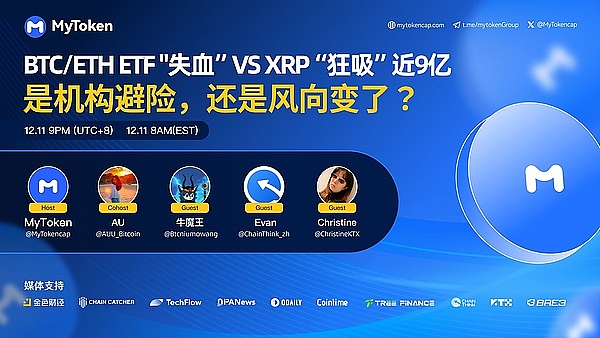
MyToken recently hosted a thematic AMA, inviting several industry experts to provide an in-depth interpretation. Below is a recap of the core viewpoints from the discussion.

Guest Introductions

  • Niu Mowang (@Btcniumowang): Senior crypto analyst and KOL, focused on primary and secondary market investment research, with unique insights into market structure and fund flows.

  • Christina (@ChristineKTX): CMO of KTX Exchange. KTX Exchange recently launched on-chain trading tools, committed to providing data empowerment for retail investors.

  • Evan(@ChainThink_zh): Researcher at ChainThink blockchain media, specializing in market data analysis and industry trend interpretation, skilled at dissecting fund movements from macro and on-chain perspectives.

Viewpoint Summary

1. Diverging Fund Flows: Short-Term Rotation or Long-Term Shift?

The three guests unanimously agreed that the recent flow of funds from mainstream coin ETFs to altcoin ETFs like XRP is more a result of short-term market rotation and macro risk-off sentiment combined, rather than a fundamental change in institutional logic for crypto asset allocation.

  • Niu Mowang pointed out that institutions tend to lock in profits and rebalance their portfolios at year-end. Bitcoin and Ethereum, being highly liquid assets with strong macro correlations, naturally become targets for adjustment. Simultaneously, the market is searching for the next potential ETF hotspot, with assets like XRP attracting capital allocation due to regulatory progress and independent narratives.

  • Christina, representing an exchange focused on user experience and transparency, added that institutions, amid macro uncertainty, choose assets with stronger narratives and regulatory backing. Dynamics in the payments and DeFi sectors have made XRP a recent focus for funds.

  • Evan analyzed from a market cycle perspective, noting that Bitcoin's gains in this cycle are relatively full, and its volatility has decreased year by year. Some profit-taking funds are转向 (turning to) lower-valued altcoins with fundamental support seeking higher alpha returns. However, this remains a "tactical rotation," and the benchmark status of Bitcoin and Ethereum remains unchanged.

2. Will This Become the Norm? What Impact on Market Structure?

The guests generally believe that the model of "exiting mainstream, not exiting the market" fund rotation may become more normalized in the future and will further promote a stratified market valuation system.

  • Niu Mowang analogized that Bitcoin is like the "S&P 500," more influenced by macro factors, while XRP, Solana, etc., are like "growth stocks," more reliant on project fundamentals and narratives. The market will become more structured, with more precise and shorter sector rotation cycles.

  • Christina stated that as the market matures and institutions delve deeper, funds will continuously seek the next growth point. She is optimistic about directions with real business models, such as payments, on-chain credit scoring, and RWA (Real World Assets).

  • Evan pointed out that the total cryptocurrency market capitalization is already massive, making it difficult for funds to support a broad-based rally. Future institutional allocation will focus more on a "mainstream coins + quality altcoins" portfolio to balance risk and return.

3. How Should Retail Investors Respond?

Facing institution-led fund rotation, how should retail investors rationally view and utilize this rotation? Should they follow the flow and quickly switch positions, or stick to core allocations and ignore short-term noise? What aspects need attention? The guests shared their views on this.

  • Niu Mowang advised retail investors should remain rational and avoid blindly following trends. Maintain 70%-80% core allocation in mainstream assets like Bitcoin and Ethereum, and use the remainder for small allocations to promising narrative tracks. Avoid emotional chasing of pumps and dumping.

  • Christina emphasized that retail investors are at a disadvantage regarding information and data. They can use tools (like the on-chain signal product KTX is about to launch) to track fund flows. Allocations should be based on mainstream assets, with a small portion of funds invested in potential sectors after thorough research.

  • Evan used a vivid example of a friend following Duan Yongping to illustrate the vast differences in capital size and risk tolerance between retail investors and institutions. He noted that institutional ETF flows might just be置换 (replacement/swapping) behavior. Therefore, position management is crucial. Avoid high-frequency switching, be wary of high-yield traps, and value the long-term worth and fundamentals of projects.

4. Which Sectors Continue to Attract Institutional Attention?

The guests' favored sectors concentrate on areas with genuine demand, clear business models, and compliance prospects:

  • Niu Mowang: Bullish on Solana (active ecosystem, payment potential), RWA (asset tokenization, stable yields), and AI (combination of computing demand and payment scenarios).

  • Evan: Payment scenarios (like U-card applications) and RWA (improving efficiency of illiquid assets) are important directions.

  • Christina: Besides payment chains, also关注 (pays attention to) on-chain credit scoring and mature DeFi protocols.

5. Why Significant XRP ETF Inflows But Muted Price Reaction?

Furthermore, during the community Q&A session, a listener asked why XRP ETF data shows continuous inflows, yet the XRP price remains relatively unaffected. Evan and Niu Mowang pointed out this is mainly due to:

  • Reduced market sensitivity to the ETF narrative, with effects diminishing after multiple ETFs;

  • Some inflows might be institutional position置换 (swapping/replacement) (converting spot holdings into compliant ETF products);

  • Existence of unlock selling pressure and historical bag holders, suppressing rapid price appreciation.

Conclusion

This AMA revealed the complexity of current cryptocurrency market fund flows: institutional operations are becoming increasingly refined, there is a game between institutions and retail investors, and the market is shifting from a "broad bull market" to a "structural bull market." For investors, understanding the logic of rotation, maintaining core allocations, and rationally participating in trends might be the key to navigating the future market.

MyToken, as a neutral and comprehensive data platform, continuously provides in-depth data such as ETF fund flows and on-chain signals to aid investment decisions, market insight, and tool support. This article is compiled based on the MyToken AMA content; guest opinions are for reference only and do not constitute investment advice.


Related Questions

QAccording to the article, what is the main reason for the significant outflow from Bitcoin and Ethereum ETFs and the inflow into XRP ETFs?

AThe experts in the AMA concluded that this is primarily a result of short-term market rotation and macro risk aversion, not a fundamental shift in institutional allocation logic. Year-end profit-taking, portfolio rebalancing, and the search for the next potential ETF narrative (like XRP's regulatory progress) are key factors.

QWhat analogy did analyst 'Bull Demon King' use to describe the difference between Bitcoin and assets like XRP?

AHe compared Bitcoin to the 'S&P 500,' which is more influenced by macro factors, while comparing XRP and Solana to 'growth stocks,' which are more dependent on project fundamentals and specific narratives.

QWhat was the common advice from the experts on how retail investors should respond to this institutional fund rotation?

AThe consensus advice was for retail investors to maintain a core portfolio (70-80%) of major assets like Bitcoin and Ethereum, use a small portion to invest in promising narrative sectors after research, avoid emotional buying high and selling low, and be cautious of high-yield traps.

QName three sectors that the AMA嘉宾 (guests) are optimistic about for continued institutional interest.

AThe sectors highlighted were Solana (for its active ecosystem and payment potential), RWA - Real World Assets (for asset tokenization and stable yields), and payment scenarios (such as U-card applications and the combination of AI with payment scenarios).

QWhy might significant inflows into the XRP ETF not be causing a strong positive reaction in the price of XRP itself?

AThe reasons include decreased market sensitivity to the ETF narrative (diminishing effects after multiple ETFs), the possibility that some inflows represent institutional position swaps (converting spot holdings into compliant ETF products), and existing unlock selling pressure and historical sell walls that suppress rapid price appreciation.

Related Reads

Trading

Spot
Futures

Hot Articles

What is $BITCOIN

DIGITAL GOLD ($BITCOIN): A Comprehensive Analysis Introduction to DIGITAL GOLD ($BITCOIN) DIGITAL GOLD ($BITCOIN) is a blockchain-based project operating on the Solana network, which aims to combine the characteristics of traditional precious metals with the innovation of decentralized technologies. While it shares a name with Bitcoin, often referred to as “digital gold” due to its perception as a store of value, DIGITAL GOLD is a separate token designed to create a unique ecosystem within the Web3 landscape. Its goal is to position itself as a viable alternative digital asset, although specifics regarding its applications and functionalities are still developing. What is DIGITAL GOLD ($BITCOIN)? DIGITAL GOLD ($BITCOIN) is a cryptocurrency token explicitly designed for use on the Solana blockchain. In contrast to Bitcoin, which provides a widely recognized value storage role, this token appears to focus on broader applications and characteristics. Notable aspects include: Blockchain Infrastructure: The token is built on the Solana blockchain, known for its capacity to handle high-speed and low-cost transactions. Supply Dynamics: DIGITAL GOLD has a maximum supply capped at 100 quadrillion tokens (100P $BITCOIN), although details regarding its circulating supply are currently undisclosed. Utility: While precise functionalities are not explicitly outlined, there are indications that the token could be utilized for various applications, potentially involving decentralized applications (dApps) or asset tokenization strategies. Who is the Creator of DIGITAL GOLD ($BITCOIN)? At present, the identity of the creators and development team behind DIGITAL GOLD ($BITCOIN) remains unknown. This situation is typical among many innovative projects within the blockchain space, particularly those aligning with decentralized finance and meme coin phenomena. While such anonymity may foster a community-driven culture, it intensifies concerns about governance and accountability. Who are the Investors of DIGITAL GOLD ($BITCOIN)? The available information indicates that DIGITAL GOLD ($BITCOIN) does not have any known institutional backers or prominent venture capital investments. The project seems to operate on a peer-to-peer model focused on community support and adoption rather than traditional funding routes. Its activity and liquidity are primarily situated on decentralized exchanges (DEXs), such as PumpSwap, rather than established centralized trading platforms, further highlighting its grassroots approach. How DIGITAL GOLD ($BITCOIN) Works The operational mechanics of DIGITAL GOLD ($BITCOIN) can be elaborated on based on its blockchain design and network attributes: Consensus Mechanism: By leveraging Solana’s unique proof-of-history (PoH) combined with a proof-of-stake (PoS) model, the project ensures efficient transaction validation contributing to the network's high performance. Tokenomics: While specific deflationary mechanisms have not been extensively detailed, the vast maximum token supply implies that it may cater to microtransactions or niche use cases that are still to be defined. Interoperability: There exists the potential for integration with Solana’s broader ecosystem, including various decentralized finance (DeFi) platforms. However, the details regarding specific integrations remain unspecified. Timeline of Key Events Here is a timeline that highlights significant milestones concerning DIGITAL GOLD ($BITCOIN): 2023: The initial deployment of the token occurs on the Solana blockchain, marked by its contract address. 2024: DIGITAL GOLD gains visibility as it becomes available for trading on decentralized exchanges like PumpSwap, allowing users to trade it against SOL. 2025: The project witnesses sporadic trading activity and potential interest in community-led engagements, although no noteworthy partnerships or technical advancements have been documented as of yet. Critical Analysis Strengths Scalability: The underlying Solana infrastructure supports high transaction volumes, which could enhance the utility of $BITCOIN in various transaction scenarios. Accessibility: The potential low trading price per token could attract retail investors, facilitating wider participation due to fractional ownership opportunities. Risks Lack of Transparency: The absence of publicly known backers, developers, or an audit process may yield skepticism regarding the project's sustainability and trustworthiness. Market Volatility: The trading activity is heavily reliant on speculative behavior, which can result in significant price volatility and uncertainty for investors. Conclusion DIGITAL GOLD ($BITCOIN) emerges as an intriguing yet ambiguous project within the rapidly evolving Solana ecosystem. While it attempts to leverage the “digital gold” narrative, its departure from Bitcoin's established role as a store of value underscores the need for a clearer differentiation of its intended utility and governance structure. Future acceptance and adoption will likely depend on addressing the current opacity and defining its operational and economic strategies more explicitly. Note: This report encompasses synthesised information available as of October 2023, and developments may have transpired beyond the research period.

363 Total ViewsPublished 2025.05.13Updated 2025.05.13

What is $BITCOIN

Discussions

Welcome to the HTX Community. Here, you can stay informed about the latest platform developments and gain access to professional market insights. Users' opinions on the price of BTC (BTC) are presented below.

活动图片