Editor's Note: While Bitcoin repeatedly "paints the door," trading sideways in the $80,000 to $90,000 range, market attention likely remains largely focused on Bitcoin itself. However, ZEC, a representative asset in the privacy sector, has once again charted its own independent trajectory, breaking through the $500 mark again to currently trade at $518, representing a nearly 40% increase from its recent low. More ironically, ZEC was once included in Binance's voting candidate list for delisting, yet it has welcomed its own breakout moment in the latter half of 2025, with a阶段性涨幅 (stage gain) once approaching 13x.
This shift from a "peripheral asset" to being "repriced by the market" also raises a more compelling question: Is ZEC's rise merely a short-term concentrated宣泄 (vent) of sentiment and capital manipulation, or is privacy as a monetary attribute being systematically revalued? Messari attempts to explain why ZEC is being rediscovered by the market at this specific juncture, examining multiple dimensions such as monetary attributes, regulatory environment, and structural changes in Bitcoin. The following content is excerpted from @MessariCrypto's "The Crypto Theses 2026".

Among all crypto assets outside of BTC and ETH, ZEC experienced the most significant shift in "monetary attribute perception" in 2025. For a long time, ZEC existed outside the "monetary hierarchy of cryptocurrencies," seen as a niche privacy coin rather than a true monetary asset. However, as concerns about financial surveillance intensify, and Bitcoin accelerates towards institutionalization, privacy is once again being viewed by the market as a core monetary attribute, not merely a preference for a few geeks or ideological groups.
Bitcoin has proven that non-sovereign digital currencies can operate on a global scale; but it does not preserve the privacy attributes people were accustomed to with physical cash. Every transaction is broadcast to a completely transparent public ledger, traceable and analyzable by anyone using a block explorer. The irony is stark: a tool originally intended to weaken state control has inadvertently built a financial "panopticon".
Zcash combines Bitcoin's monetary policy with the privacy attributes of physical cash through zero-knowledge cryptography. In the current digital asset system, no other asset can provide the long-term, battle-tested, and deterministic privacy guarantees offered by the latest Zcash privacy pools. This makes ZEC a form of "private money" that is extremely difficult to replicate.
We believe the market is repricing ZEC relative to BTC based on this very point—viewing it as an "ideal form of private cryptocurrency" and positioning it as a hedge against the rise of the surveillance state and the institutionalization process of Bitcoin.
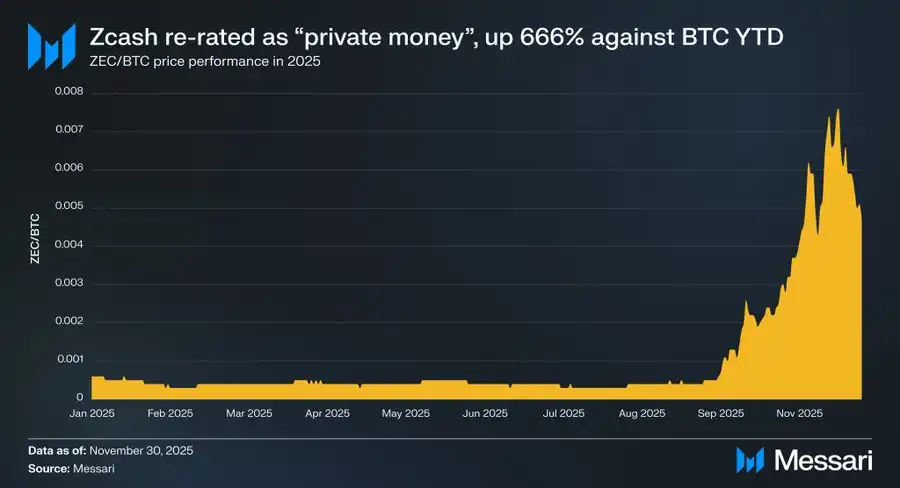
Year-to-date, ZEC has gained 666% against BTC, its market capitalization has risen to approximately $7 billion, and it briefly surpassed XMR in market cap to become the largest privacy coin. This relative strength indicates the market is viewing both ZEC and XMR as viable forms of private cryptocurrency.
Privacy on Bitcoin: A Nearly Impossible Path
It is almost impossible for Bitcoin to introduce a privacy pool architecture similar to Zcash at the protocol layer; therefore, the notion that "Bitcoin will ultimately absorb Zcash's value proposition" is unfounded.
The Bitcoin community is known for its highly conservative technical culture, prioritizing mechanism ossification to minimize attack surfaces and maintain the monetary system's integrity. Embedding privacy features at the protocol layer would require modifications to Bitcoin's core architecture, introducing potential inflation vulnerability risks that threaten its core monetary credibility. For Zcash, this risk is acceptable because privacy is its core value proposition.
Furthermore, introducing zero-knowledge cryptography at the base layer would significantly reduce blockchain scalability. To prevent double-spending, nullifiers and hashed note structures are required, leading to long-term concerns about "state bloat." Nullifiers are essentially an ever-growing list, increasing over time and potentially causing a substantial rise in the resource cost required to run nodes. If nodes are forced to store an ever-expanding set of nullifiers, Bitcoin's decentralization would be substantially weakened as the barrier to running a node increases over time.
As mentioned earlier, in the absence of a soft fork capable of supporting ZK verification (e.g., OP_CAT), no Bitcoin Layer 2 solution can achieve Zcash-level privacy while inheriting Bitcoin's security. You either introduce trusted intermediaries (like federation structures), accept long and highly interactive withdrawal delays (like the BitVM model), or outright outsource execution and security to an independent system (like sovereign Rollups).
Until this landscape changes, there is no practical path that simultaneously offers both Bitcoin's security and Zcash's privacy. This is precisely the fundamental reason why ZEC possesses unique value as a private cryptocurrency.
A Privacy Hedge Against CBDCs
The urgency for privacy is further amplified against the backdrop of the陆续登场 (sequential rollout) of Central Bank Digital Currencies (CBDCs) worldwide. Currently, about half of the world's countries are researching or have already launched a CBDC.
The core feature of CBDCs is "programmability": the issuer can not only track every transaction but also directly control how, when, and where the funds can be used. Funds can even be programmed to be valid only at specified merchants or within specific geographical boundaries.
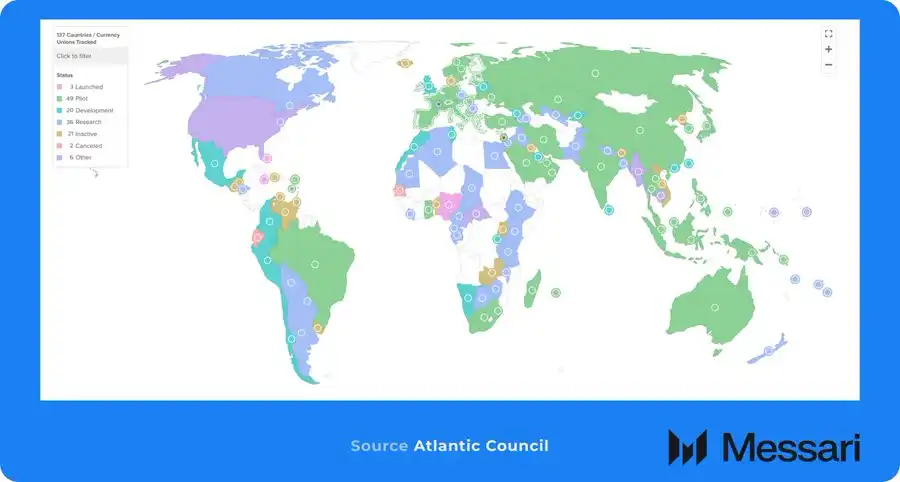
This is not a dystopian fantasy but a present reality:
· Nigeria (2020): During the EndSARS protests against police brutality, the Nigerian Central Bank froze the bank accounts of several protest organizers and feminist groups, forcing the movement to rely on cryptocurrencies to sustain operations.
· United States (2020–2025): Regulators and large banks implemented de-banking against a series of legal but politically unpopular industries citing "reputational risk." The issue became severe enough for the White House to order an investigation, and an OCC research report in 2025 documented systematic restrictions on the oil & gas, firearms, adult content, and crypto industries.
· Canada (2022): During the "Freedom Convoy" protests, the Canadian government invoked the Emergencies Act to freeze the bank and crypto accounts of protesters and small donors without court orders. The Royal Canadian Mounted Police even blacklisted 34 self-custodied crypto wallet addresses, requiring all regulated exchanges to cease transactions with them. This event clearly demonstrated that Western democracies are also willing to weaponize the financial system to suppress political dissent.
In an era where "money can be programmed to control you," ZEC offers a clear "exit mechanism." But Zcash's significance extends beyond escaping CBDCs; it is becoming increasingly important for protecting Bitcoin itself.
An Insurance Mechanism Against Bitcoin's "Co-option"
As emphasized by figures like Naval Ravikant and Balaji Srinivasan, Zcash is essentially an insurance policy for preserving Bitcoin's vision of financial freedom.
Bitcoin is rapidly concentrating towards centralized entities: centralized exchanges hold ~3 million BTC, ETFs hold ~1.3 million, and public companies hold ~829,000. Combined, approximately 5.1 million BTC (24% of total supply) is currently held by third-party custodians.
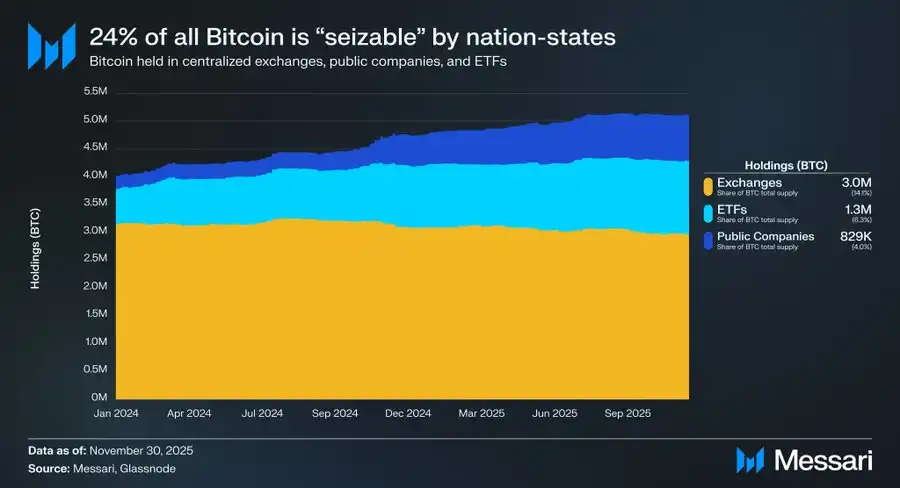
This means theoretically, nearly a quarter of the BTC supply is at risk of regulatory confiscation. This structure highly resembles the centralized conditions during the US government's gold confiscation in 1933. Back then, the US government, via Executive Order 6102,强制公民 (forced citizens) to surrender gold holdings exceeding $100, exchanging them for paper currency at a fixed price, a process accomplished through the banking system without reliance on violence.
For Bitcoin, the path is identical. Regulators don't need your private keys; they only need legal jurisdiction over the custodian. Once the government issues an enforcement order to entities like BlackRock or Coinbase, these companies, under legal obligation, can only freeze and transfer the held BTC. Without modifying a single line of code, nearly a quarter of the BTC supply could be "nationalized" overnight.
Moreover, self-custody is no longer a sufficient defense given the blockchain's high transparency. Any BTC withdrawn from a KYC exchange or brokerage account ultimately leaves a traceable "paper trail."
BTC holders can sever this custodial and regulatory link by converting to Zcash, achieving an air gap for their wealth. Once funds enter Zcash's privacy pools, their destination becomes a cryptographic "black hole" to observers. Regulators can see funds leave the Bitcoin network but cannot ascertain their final destination. Of course, the strength of this anonymity depends entirely on operational security: address reuse or acquiring assets through KYC exchanges leaves permanent associations before entering the privacy pool.
The Path to PMF Is Being Paved
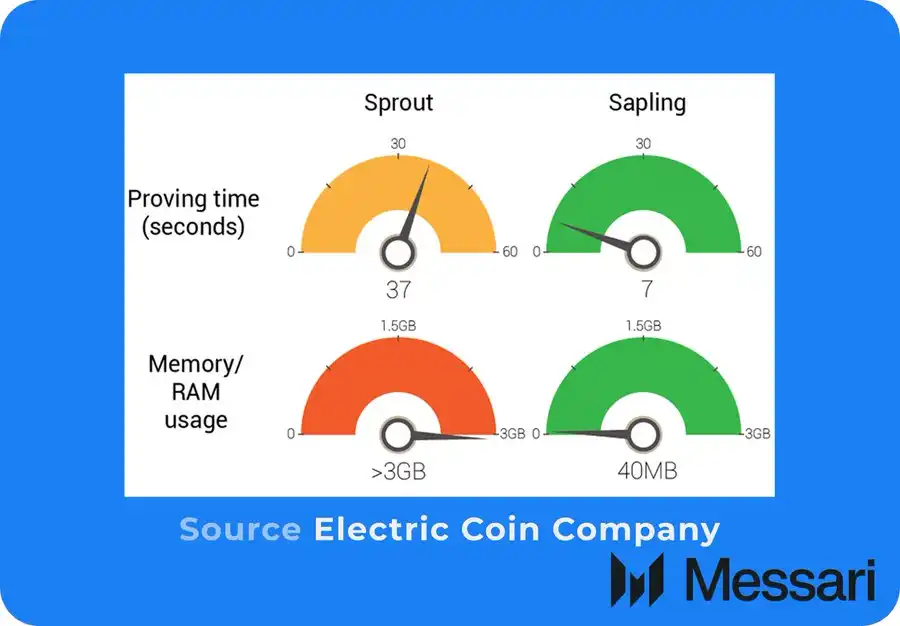
The demand for private money has always existed; the problem was that Zcash was historically difficult to "get in front of users." For a long time, high memory usage, lengthy proof generation times, and complex desktop configurations made private transactions slow and daunting for average users. A series of recent infrastructure breakthroughs have systematically removed these barriers.
The Sapling upgrade reduced memory requirements by 97% (to ~40MB) and proof time by 81% (~7 seconds), enabling mobile private transactions.
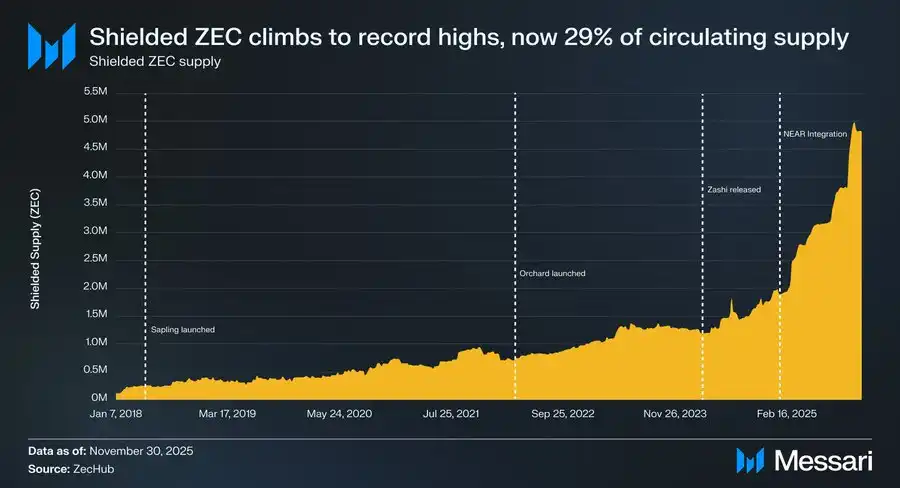
While Sapling solved the speed issue, the trusted setup remained a concern for the privacy community. Subsequently, Orchard removed the reliance on trusted setups entirely by introducing Halo 2 and introduced Unified Addresses, integrating transparent and shielded addresses into a single entry point, significantly reducing user cognitive load.
These improvements culminated in the release of the Zashi mobile wallet in March 2024. Leveraging the abstract design of Unified Addresses, Zashi simplified the operation of private transactions to a few taps on the screen, making "privacy" the default experience.
With the UX problem solved, distribution became the final hurdle. Users still relied on centralized exchanges to deposit and withdraw ZEC to their wallets. The integration of NEAR Intents eliminated user dependence on centralized exchanges, allowing them to directly swap assets like BTC, ETH for shielded ZEC, or even use private ZEC to pay to any address on 20 different chains.
These initiatives collectively helped Zcash bypass historical friction, access global liquidity, and connect with genuine market demand.
Looking Ahead
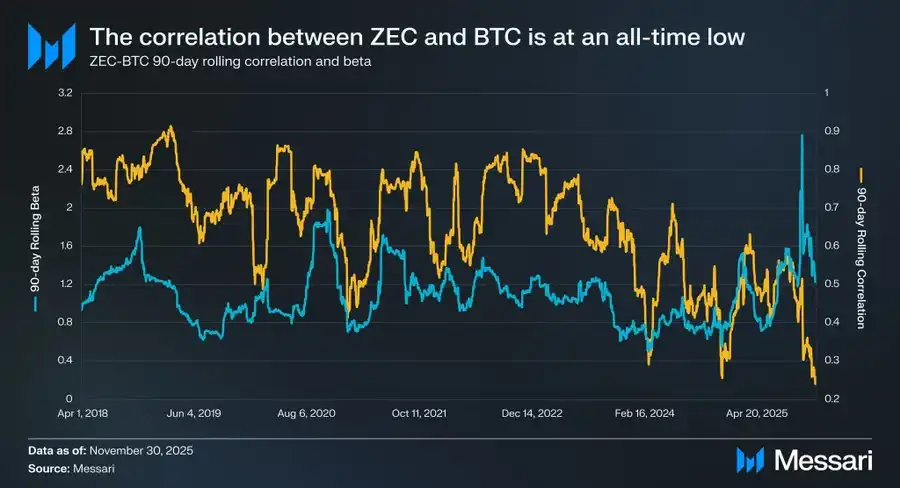
Since 2019, the rolling correlation coefficient between ZEC and BTC has持续下行 (continuously declined), dropping from 0.90 to a recent 0.24; meanwhile, ZEC's rolling Beta against BTC has risen to historical highs. This divergence indicates that the market is assigning an independent premium to Zcash's privacy attributes.
We do not believe ZEC will surpass BTC. Bitcoin, with its transparent supply and auditability, has established itself as the most reliable cryptocurrency; whereas Zcash, as a privacy coin, still inevitably bears the trade-off between privacy and auditability.
But ZEC can absolutely carve out its own niche without replacing BTC. The two are not solving the same problem but play different roles within the cryptocurrency system: BTC is a "sound cryptocurrency" optimized for transparency and security, while ZEC is a "private cryptocurrency" built for privacy and confidentiality.
In this sense, ZEC's success does not depend on defeating Bitcoin, but on complementing the attributes that Bitcoin deliberately abandoned.