Both Suffer Losses Exceeding $9 Billion, Which Is More at Risk: Strategy or Bitmine?

Odaily星球日报Published on 2026-06-04Last updated on 2026-06-04

Abstract

As Bitcoin and Ethereum prices drop significantly, two major corporate treasury holders, Strategy and Bitmine, are facing massive unrealized losses—approximately $100 billion and $90 billion, respectively. The article compares their financial health and underlying risks. Bitmine, holding over 5.4 million ETH, relies primarily on equity financing (like ATM offerings) and has substantial cash reserves, alongside staking income from its ETH holdings. It plans a $300 million perpetual preferred stock offering. In contrast, Strategy, holding Bitcoin, is burdened by significant convertible debt and preferred stock dividends, with cash reserves covering only about six months of its annual dividend obligations. Strategy's leverage is higher, and it faces potential liquidity pressure if BTC prices fall further, possibly forcing asset sales. While both companies are under pressure, Bitmine’s financial structure appears more resilient, whereas Strategy’s high leverage makes it more vulnerable to continued market declines.

Original|Odaily Planet Daily(@OdailyChina)

Author|Wenser(@wenser2010)

Amid the ongoing market decline, Strategy and Bitmine, the "Twin Titans of DAT Treasuries," have both incurred massive floating losses.

This morning, BTC briefly fell below $62,000, currently hovering around $63,800; ETH dropped below $1,800, currently around $1,780. At current prices, Strategy's floating loss has reached a staggering $10 billion; Bitmine's floating loss is also around $9 billion. For now, Michael Saylor and Tom Lee are "fellow sufferers in the same predicament," with Strategy and Bitmine ranking as the top two "DAT companies with the largest losses."

However, compared to Strategy, which requires continuous dividend payments, Bitmine faces less financial pressure and retains flexibility such as raising funds through STRC preferred shares. It is reported that Bitmine plans to raise $300 million by issuing perpetual preferred shares with an annual dividend yield of 9.5%. It seems Bitmine's pace of acquiring ETH continues; meanwhile, the Sword of Damocles hanging over Strategy becomes: Where will the funds for subsequent STRC dividend payments come from? Between the two, who faces greater financial pressure? Odaily Planet Daily will analyze for readers.

Bitmine VS Strategy: The Divergent Paths of DAT Holdings

Following today's BTC plunge, community members used AI to mock Saylor's "promotion" of BTC: "A man in his sixties personally promotes, ancestral BTC price drops to $62,000 per coin."

Returning to Bitmine and Strategy, currently, Bitmine's financial structure appears safer; whereas Strategy's leverage pressure is greater.

Bitmine's Equity Issuance Game: The Debt-Free DAT Financing Play

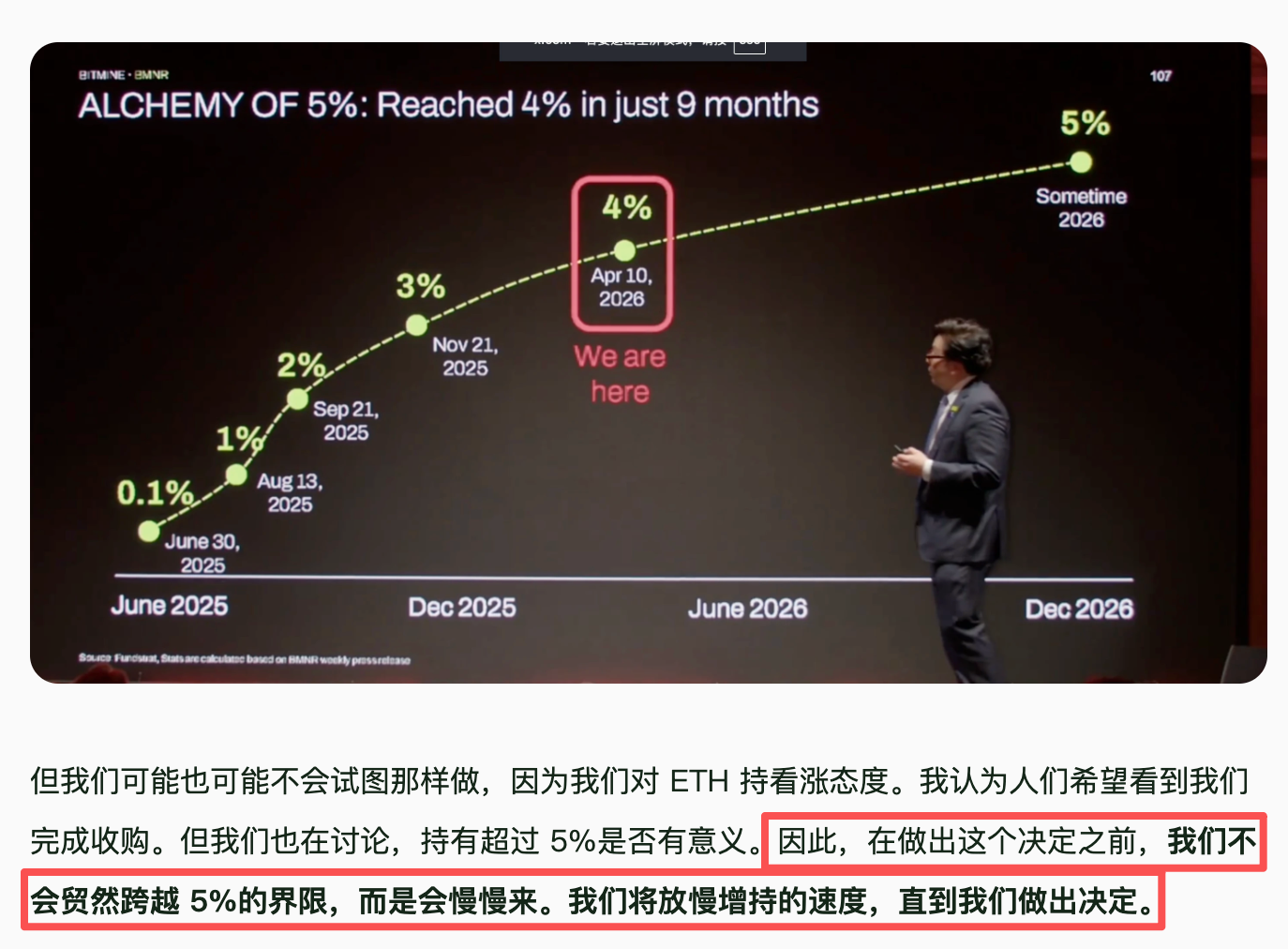
As of June 1, Bitmine holds 5,416,901 ETH; accounting for approximately 4.49% of ETH's total supply, nearing the '5% cap' repeatedly emphasized by Bitmine Chairman Tom Lee. Yesterday, Bitmine once again acquired 25,000 ETH via BitGo, valued at $48 million at the time. Currently, its holdings stand at 5,441,901 ETH.

The reason Bitmine has the confidence to continue accumulating during a market downturn is multifaceted. The primary reason is that Bitmine's funding source is equity issuance:

  • When initiating its ETH treasury and establishing the DAT company in June last year, Bitmine obtained initial seed capital through financing — $250 million, along with a small PIPE financing.
  • After July last year, Bitmine primarily relied on ATM equity issuance, gradually increasing this figure from $2 billion to $24.5 billion.

Sufficient funds give Tom Lee ample confidence, and Bitmine's book cash supports further acquisitions — in its June 1 public announcement, Bitmine also mentioned: The company's stake in Beast Industries is valued at $180 million; its stake in Eightco Holdings is valued at $93 million. The company's total cash amounts to $446 million.

Additionally, Tom Lee has previously boasted that Bitmine's Ethereum treasury generates daily staking rewards of $1 million. This refers to Bitmine staking approximately 87% (about 4.71 million ETH) of its ETH holdings through its MAVAN staking network, with estimated annualized returns of about 2.73%-3% (approximately $250-$300 million), which can also provide relatively stable cash flow.

In summary, Bitmine's financial condition is sound; and the latest preferred share financing with a 9.5% annualized dividend is expected to secure $300 million, further alleviating its financial pressure. For this company, the biggest risk points lie in equity dilution (issuing new shares) and further stock price declines due to book floating losses. If mNVA remains <1, it might trigger stock selling.

Strategy's Debt Leverage Game: Pressure from Convertible Bonds and Preferred Share Dividends

Compared to Bitmine's "using investors' money to buy ETH," Strategy faces greater financial pressure in acquiring BTC because it primarily "borrows money to increase BTC holdings."

According to information on Strategy's official website, currently, Strategy holds approximately $6.7 billion in convertible bond debt, plus about $9.9 billion in STRC preferred shares and market-value-varying amounts of STRD, STRK, STRF, requiring annual massive dividend and interest payments. At the end of May, after repurchasing $1.5 billion in convertible debt, Strategy's cash reserves fell to about $871 million, covering only about 6 months of its estimated $1.7 billion annual preferred dividend obligation.

Moreover, Strategy previously initiated a vote on "proposing to increase STRC dividend payments from monthly to twice monthly." The voting began on April 28 and will conclude on the meeting day of June 8. If approved, the first record date under the new schedule is June 30, and the first payment date is July 15. Eligible voting shareholders (holders of MSTR and STRC shares) must have held shares before April 17.
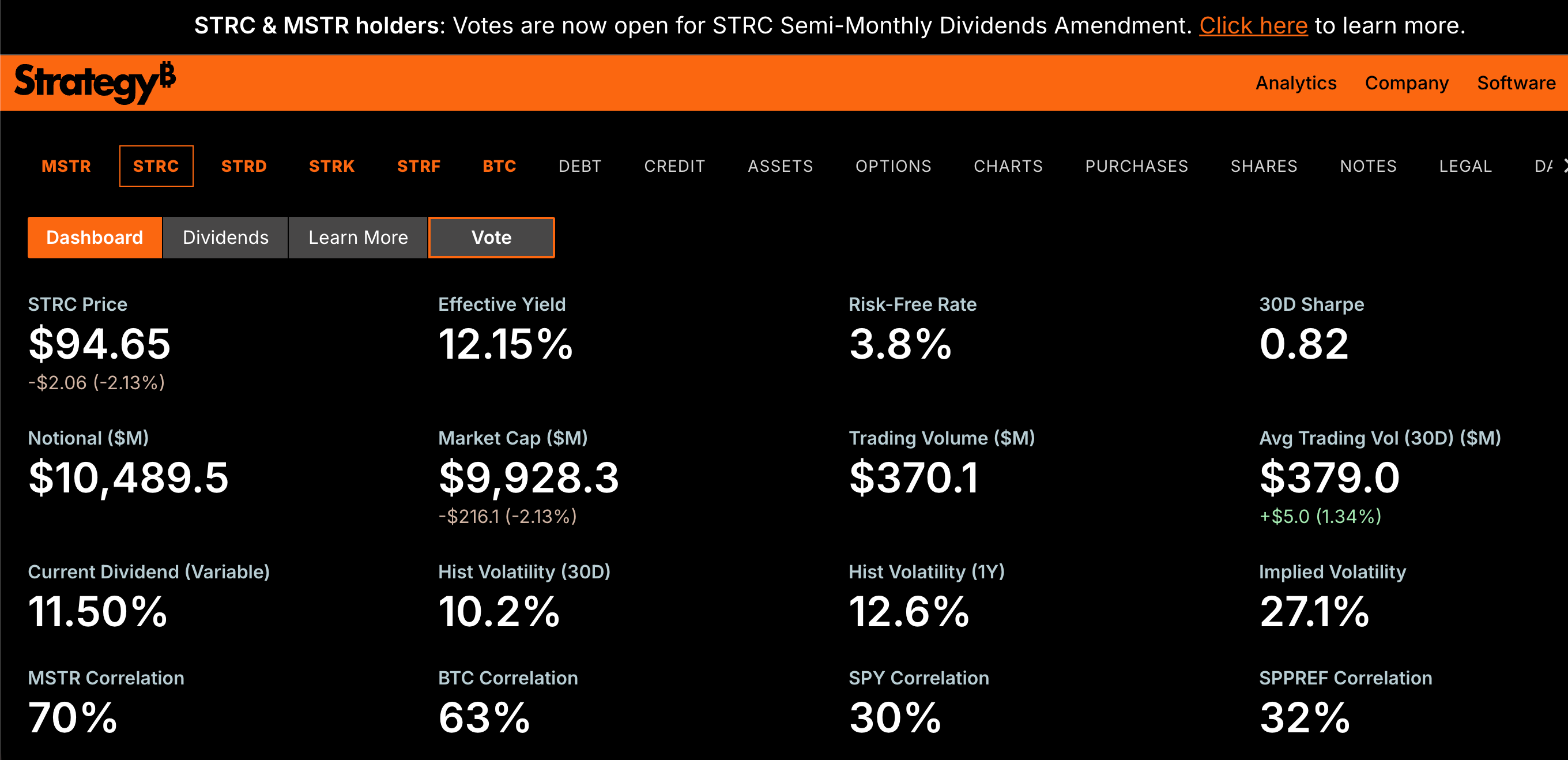
Also worth mentioning is that STRC's authorized issuance cap is approximately $28.3 billion. Possibly affected by BTC's continuous decline and shaken market confidence, STRC fell below $95 this morning, currently at $94.65, "de-pegging" over 5% from the $100 target price.

Compared to Bitmine, Strategy currently faces a significant gap between excessive preferred share financing amounts and dividend payments, exacerbated by BTC's continuous decline. Furthermore, unlike ETH which has a staking ecosystem for additional liquidity, BTC lacks such options.

Therefore, after Strategy sold 32 BTC last month, the market began to doubt the identity of "diamond-handed Strategy that only buys and never sells." Amid BTC's persistent decline, Strategy might face a series of liquidity crises, leading to an inability to repay debts and dividends, thereby selling more BTC and driving down prices. Essentially, Strategy is playing a "high-leverage bet that the BTC price won't fall below a certain level" debt leverage game.

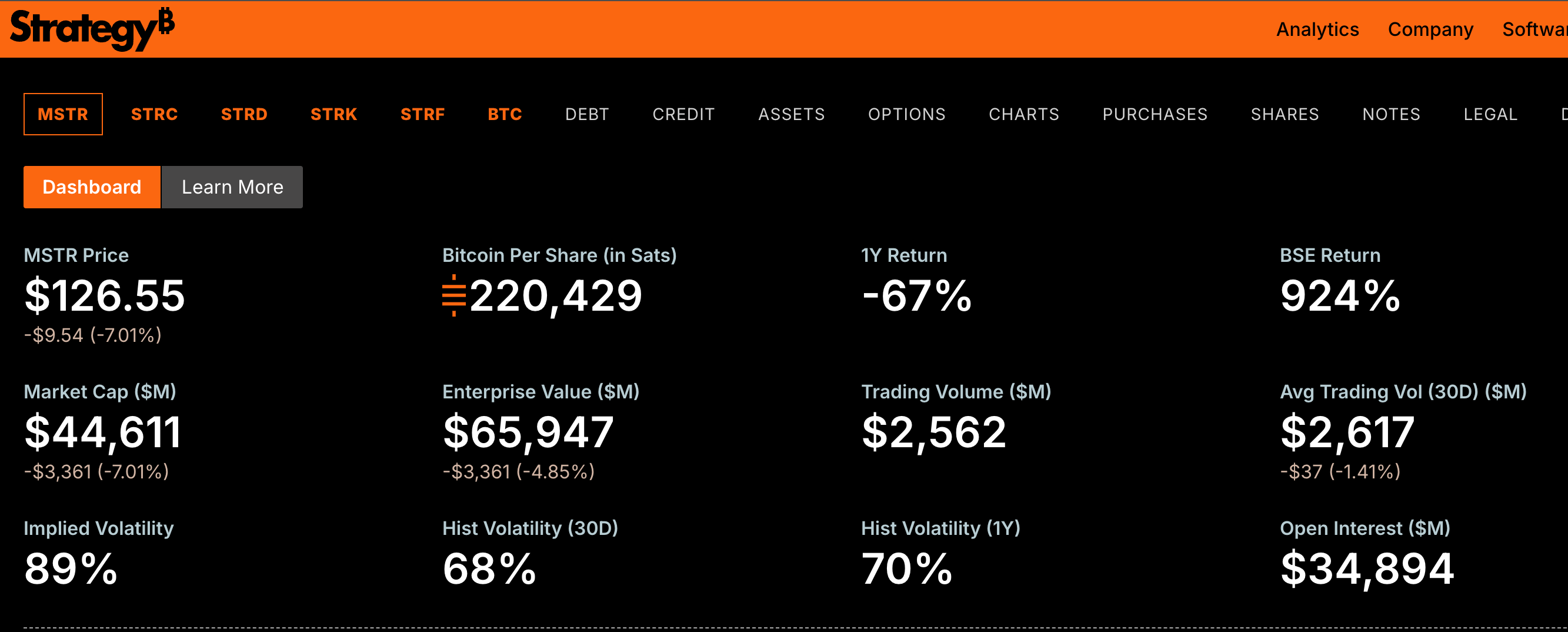
Thus, considering Strategy's current mNAV value of 0.83, the market remains highly skeptical of its future stock performance. Yesterday, its market capitalization already fell out of the top 200 US companies. Currently, Strategy (MSTR) stock is at $126, down 7% in 24 hours; market cap stands at $44.6 billion.
Of course, as a leader among DAT treasury companies, Bitmine Chairman Tom Lee remains quite optimistic about Strategy, previously stating: "Strategy selling Bitcoin and ETF outflows are typical bottoming behavior, not risk signals." At the recent "Proof of Talk 2026" conference at the Louvre in Paris, Tom Lee made bold claims: "With AI and tokenization driving major changes in financial infrastructure, ETH could ultimately reach $250,000." However, when discussing "Bitmine's actions after its ETH holdings reach 5% of the total supply," he also expressed caution about further ETH accumulation. (See "Tom Lee Recharges Faith: Crypto Spring Has Arrived, ETH Will Rise to $250,000")
Currently, Bitmine and Strategy find themselves in highly similar market situations, but Bitmine's financial condition is slightly better; Strategy faces the choice between "selling more BTC to obtain cash flow for dividend payments" and "sitting idle or continuing to borrow for acquisition as BTC keeps falling."


Related Questions

QAccording to the article, what is the main difference in how Bitmine and Strategy finance their digital asset acquisitions?

ABitmine primarily funds its ETH acquisitions through equity issuance (ATM offerings and stock sales), which is a debt-free method. In contrast, Strategy primarily uses debt leverage, including convertible notes and preferred stock, to finance its BTC purchases, creating significant interest and dividend obligations.

QWhat specific financial pressure does Strategy face that the article highlights as its 'sword of Damocles'?

AStrategy faces significant pressure to cover its substantial annual dividend payments for its preferred stock (like STRC), estimated at $1.7 billion. With its cash reserves dwindling, the core question is where the funds for these ongoing dividend payments will come from.

QHow does Bitmine generate an additional income stream from its ETH holdings, as mentioned in the article?

ABitmine stakes approximately 87% of its ETH holdings (around 4.71 million ETH) through the MAVAN staking network. This generates daily staking rewards estimated at $1 million, providing a stable annualized cash flow of approximately $250-300 million.

QWhat are the key risk factors mentioned for Bitmine and Strategy's stock prices respectively?

AFor Bitmine, the main risk is equity dilution from issuing new shares and a declining stock price if its mNVA (market value to net asset value) falls below 1. For Strategy, the key risk is its high leverage and liquidity crisis if BTC prices fall further, potentially forcing asset sales and causing its mNAV to drop (currently 0.83), which could severely impact its stock price.

QWhat recent action by Strategy has caused market doubts about its 'diamond hands' reputation, and what potential consequence does the article suggest?

AStrategy recently sold 32 BTC. This action has led the market to doubt its long-held 'diamond hands' (never selling) policy. The article suggests that if BTC continues to fall, Strategy might face a liquidity crisis, forcing it to sell more BTC to meet its debt and dividend obligations, which could further depress the market.

Related Reads

In Conversation with Ray Dalio: We Are Currently in an AI Bubble, with 1% of My Portfolio in Bitcoin

Ray Dalio, founder of Bridgewater Associates, warns in an interview that the current AI boom shows classic bubble characteristics, which could lead to significant economic downturns as seen in past cycles like 1929 or 2000. He explains that speculative enthusiasm, fueled by debt and overvaluation, often precedes a crash when rising rates or taxation force asset sales, causing widespread losses and recession. Dalio also outlines his "Big Cycle" theory, describing an approximate 80-year pattern where widening wealth gaps, massive government deficits, and shifting geopolitical power (like China's rise) create internal conflict and global instability. He emphasizes that we are in a late-cycle, transitional phase where traditional powers like the US and UK face decline. For personal wealth protection, Dalio advises diversification beyond cash into assets like stocks, bonds, real estate, and particularly gold, which he prefers over Bitcoin. While he holds about 1% of his portfolio in Bitcoin as a non-printable hard asset, he views gold as more secure from technological or governmental threats. Regarding AI's impact, Dalio believes it will disproportionately benefit capital owners, worsening inequality by replacing both physical and cognitive labor. He suggests that human intuition and emotional intelligence, combined with AI, will be key for future workers. On taxation, Dalio argues that wealth taxes are impractical and risk triggering asset sell-offs, reducing productive investment. He points to the UK as a cautionary example of debt, low productivity, and political strife. Geopolitically, Dalio foresees a more regionalized world, with the US showing weakness in prolonged conflicts like with Iran, akin to past imperial declines. The ideal outcome, he suggests, is coexisting powerful blocs (e.g., Americas, China-Asia Pacific) without major war.

marsbit53m ago

In Conversation with Ray Dalio: We Are Currently in an AI Bubble, with 1% of My Portfolio in Bitcoin

marsbit53m ago

Daily 7.2 Trillion KRW: Foreign Capital's Record Net Buying on Friday! Wall Street Says Headwinds for Korean Stock Fund Flows Have Subsided

South Korean stock market sees a dramatic shift in fund flows. On July 31, foreign investors made a record net purchase of approximately KRW 7.2 trillion in KOSPI stocks, marking a fundamental reversal from the persistent large-scale net outflows seen in previous months. This contributed to a significant narrowing of foreign net selling in July to KRW 9.8 trillion, down sharply from KRW 48.4 trillion in June and KRW 44.5 trillion in May. Simultaneously, domestic institutional pressure eased. South Korean pension funds and asset managers turned to a net buying position in July, purchasing KRW 1.0 trillion worth of KOSPI shares, contrasting with net sales in May and June. Market volatility is expected to be dampened by new financial regulations. Effective July 31, the Financial Services Commission tightened access for retail investors to single-stock leveraged ETFs by raising the minimum cash deposit requirement. Trading volumes for these products subsequently dropped to about 50% of their monthly average. Citigroup Research maintains its year-end KOSPI target of 10,000 points. The firm cites several supportive factors: the substantial easing of headwinds from capital outflows, a robust fundamental outlook for the semiconductor sector, historically low market valuations, strong economic fundamentals, and the potential for policy support from financial authorities if needed.

marsbit53m ago

Daily 7.2 Trillion KRW: Foreign Capital's Record Net Buying on Friday! Wall Street Says Headwinds for Korean Stock Fund Flows Have Subsided

marsbit53m ago

Thanks to Dice Rolls, Bitcoin Keys Are Stored Offline, But Not Everyone Will Do It

The article discusses using dice rolls to generate secure Bitcoin wallet seeds, providing entropy independent of potentially flawed hardware random number generators. It explains that each fair dice roll offers about 2.585 bits of entropy, with around 50 rolls needed for a standard 12-word seed phrase and 99+ recommended for higher security. This method gained attention after a vulnerability was revealed in some Coldcard hardware wallets, where a faulty firmware RNG (dating back to 2021) compromised generated keys. The analysis notes that while a dice-generated main seed was safe from this specific flaw, other Coldcard functions (like creating paper wallets, backup keys, or passwords) could still be vulnerable if they used the defective RNG. The piece argues that while dice-based entropy is technically robust, the manual process is error-prone, tedious, and unrealistic for most new users, who might make mistakes in recording or inputting rolls. It concludes that while manual entropy generation should remain an option for advanced users, the long-term goal is to develop reliable, user-friendly hardware and software that securely generates randomness without requiring specialized knowledge. Coldcard users are advised to check their firmware version and replace any secondary secrets (like paper wallet keys) created with vulnerable devices, while also considering multi-signature setups with devices from different manufacturers for added security.

cryptonews.ru6h ago

Thanks to Dice Rolls, Bitcoin Keys Are Stored Offline, But Not Everyone Will Do It

cryptonews.ru6h ago

Trading

Spot
活动图片




