Blockchain Association says no to expanding stablecoin yield prohibition

cointelegraphPublished on 2025-12-19Last updated on 2025-12-19

Abstract

The Blockchain Association, along with over 125 crypto industry groups, has written to the US Senate Committee on Banking opposing a proposed expansion of the ban on offering yield rewards to stablecoin holders. The letter argues that extending the prohibition—originally targeting stablecoin issuers under the GENIUS Act to include third-party platforms—would stifle innovation, increase market concentration, and unfairly disadvantage crypto services compared to traditional financial providers like banks and credit card companies that offer similar rewards. The Association contends that stablecoin rewards help consumers offset inflation and are a standard feature of competitive markets. It also challenges banking industry claims that yield-bearing stablecoins threaten bank lending, stating there is no evidence to support such concerns. Additionally, the letter comes as the FDIC proposes rules allowing banks to issue stablecoins through subsidiaries, subject to reserve requirements and regulatory oversight.

The Blockchain Association, a non-profit crypto advocacy organization, wrote a letter to the US Senate Committee on Banking, signed by over 125 crypto industry groups and companies, opposing the ban on third-party service providers and platforms offering customer rewards to stablecoin holders.

Expanding the prohibition on stablecoin issuers sharing yield directly with customers, outlined in the GENIUS stablecoin regulatory framework, to include third-party service providers stifles innovation and leads to “greater market concentration,” the letter said.

The letter compared the rewards offered by crypto platforms to those offered by credit card companies, banks and other traditional payment providers.
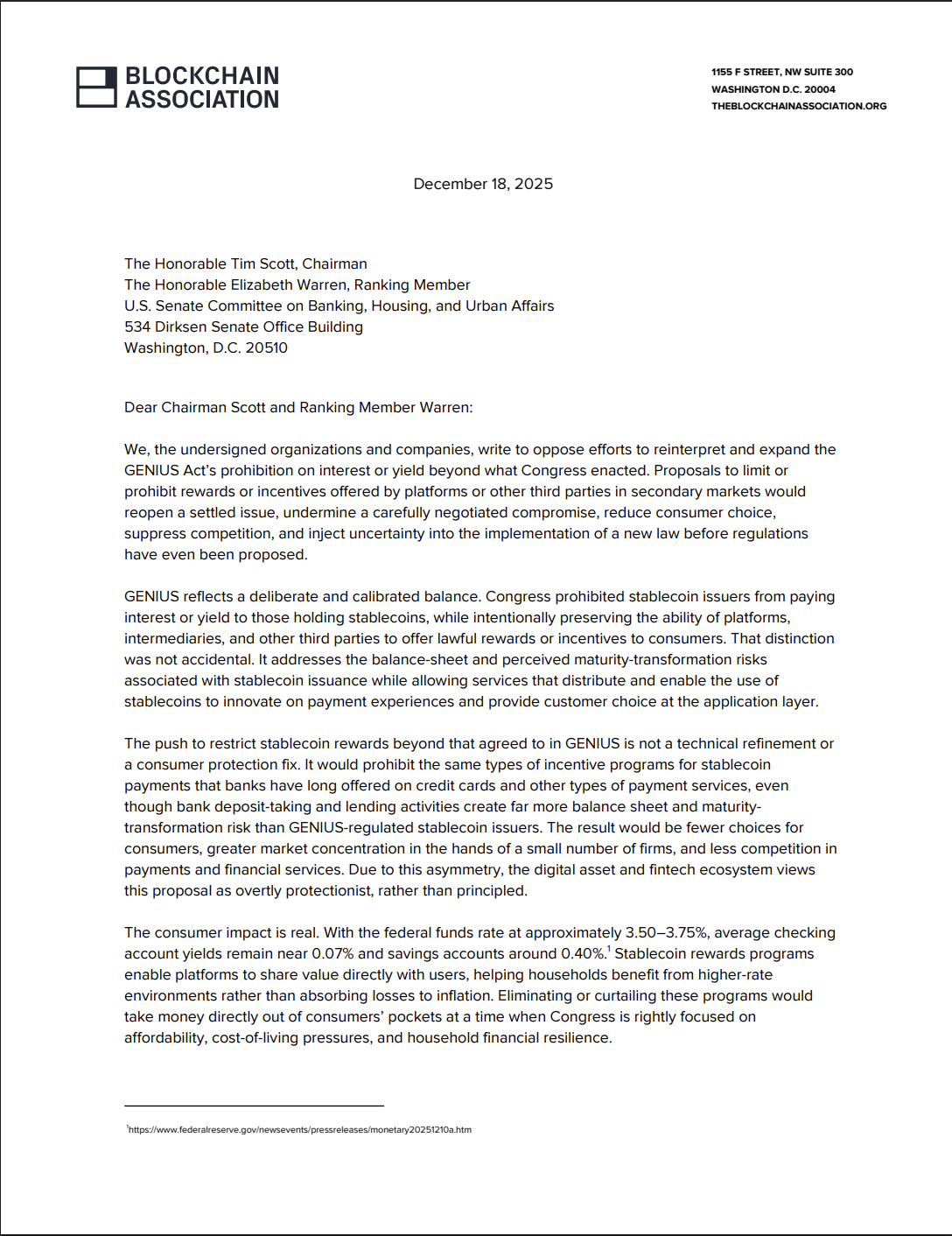
The letter opposes efforts to stop crypto platforms from sharing yield with customers. Source: The Blockchain Association

Prohibiting crypto platforms from offering similar rewards for stablecoins gives an unfair advantage to incumbent financial service providers, the Blockchain Association said.

“The potential benefits of payment stablecoins will not be realized if these types of payments cannot compete on a level playing field with other payment mechanisms. Rewards and incentives are a standard feature of competitive markets.”

The Blockchain Association has issued several statements and letters pushing back against efforts to prohibit crypto platforms from sharing yield-bearing opportunities with customers, arguing that these rewards help consumers offset inflation.

Related: Bank of Canada lays out criteria for ‘good money’ stablecoins

FDIC paves the way for banks to issue stablecoins, industry group says stables aren’t a threat

The Federal Deposit Insurance Corporation (FDIC), the US regulatory agency that oversees and insures the banking sector, published a proposal on Tuesday that would allow banks to issue stablecoins through subsidiaries.

Under the proposal, both the bank and its stablecoin subsidiary would be subject to FDIC rules and assessments for financial fitness, including reserve requirements.
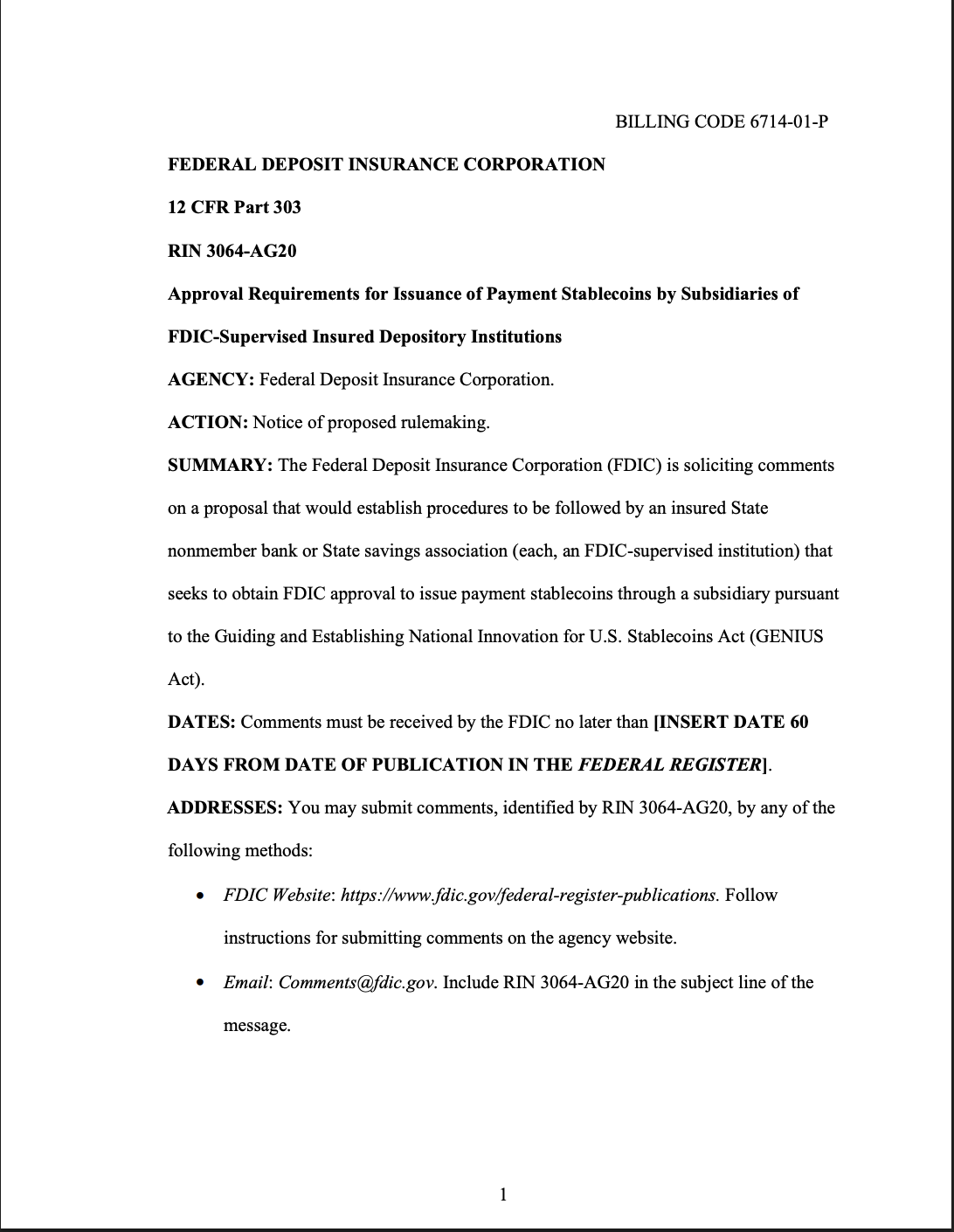
The FDIC proposal to allow banks to issue stablecoins. Source: FDIC

The Blockchain Association continues to push back on claims that yield-bearing stablecoins and sharing rewards with customers threaten the banking sector and bank lending.

“Evidence does not support claims that stablecoin rewards threaten community banks or lending capacity,” the Blockchain Association said, adding that it is difficult to make the case that bank lending is actually constrained by customer deposits.

Despite this, the banking industry has lobbied against yield-bearing stablecoins and crypto platforms sharing yield with clients over fears that interest offered on digital asset products will erode the market share of banks.

Magazine: Unstablecoins: Depegging, bank runs and other risks loom

Related Questions

QWhat is the Blockchain Association's main argument against expanding the stablecoin yield prohibition to third-party service providers?

AThe Blockchain Association argues that expanding the prohibition to third-party service providers stifles innovation, leads to greater market concentration, and gives an unfair advantage to traditional financial service providers by preventing crypto platforms from competing on a level playing field.

QHow does the Blockchain Association compare the rewards offered by crypto platforms to those in traditional finance?

AThe letter compares the rewards offered by crypto platforms to the rewards offered by credit card companies, banks, and other traditional payment providers, stating that such incentives are a standard feature of competitive markets.

QWhat recent proposal did the FDIC make regarding banks and stablecoins?

AThe FDIC published a proposal that would allow banks to issue stablecoins through subsidiaries, with both the bank and its subsidiary being subject to FDIC rules, assessments for financial fitness, and reserve requirements.

QWhat is the banking industry's primary concern regarding yield-bearing stablecoins, according to the article?

AThe banking industry fears that the interest offered on digital asset products like yield-bearing stablecoins will erode their market share, leading them to lobby against these products and platforms sharing yield with clients.

QWhat reason does the Blockchain Association give for supporting the ability of platforms to share yield with stablecoin holders?

AThe Blockchain Association argues that these rewards help consumers offset inflation and are necessary for the potential benefits of payment stablecoins to be realized in a competitive market.

Related Reads

Bitcoin Withdrawals Continue: 8 Years of Storage in a Coldcard Cold Wallet Ended in Zero

Coldcard Hardware Wallet Hacked: Losses Mount Due to Vulnerable Seed Generation A critical vulnerability in Coldcard hardware wallets has led to a continued wave of fund thefts. According to Galaxy Research, the total stolen has reached 1,367.05 BTC (approx. $88.6 million) from 4,585 addresses, a significant increase from the initial 594.5 BTC reported on July 30, 2026. Most of the stolen funds remain on the attackers' addresses. The issue is not with the current firmware, which Coinkite has updated, but with seed phrases generated on vulnerable devices between March 2021 and the release of fixed firmware versions. Due to a programmer error, devices switched from using a hardware random number generator to the software-based Yasmarang generator, which was initialized with publicly accessible data like the chip's serial number. This made the seed phrases predictable through offline brute-force attacks, meaning wallets remain at risk until funds are moved to a new wallet generated with the patched firmware. Affected devices include Mk2/Mk3 with firmware 4.0.1–4.1.9 (and up to 5.0.3), Mk4/Mk5 up to version 5.6.0, and Q models up to 1.5.0Q. The only exceptions are seeds created with a high-entropy method like at least 50 independent dice rolls or a strong unique BIP-39 passphrase. All other owners must generate a new seed on the fixed firmware and transfer their assets. A case highlighting the human impact involves a 39-year-old long-term investor who lost 2 BTC (approx. $130,000) in minutes. He had accumulated the Bitcoin over eight years through physical labor, viewing it as a financial lifeline and a retirement plan in a country suffering from hyperinflation. His story underscores that even conservative "buy and hold in cold storage" strategies can be compromised by such underlying technical flaws. From a technical perspective, this incident echoes historical failures where weak random number generators undermined cryptographic security, challenging the assumption that offline storage is automatically foolproof.

cryptonews.ru3h ago

Bitcoin Withdrawals Continue: 8 Years of Storage in a Coldcard Cold Wallet Ended in Zero

cryptonews.ru3h ago

Trading

Spot
活动图片





