Bitwise Files With SEC to Launch First Uniswap ETF in U.S. Markets

TheNewsCryptoPublished on 2026-02-06Last updated on 2026-02-06

Abstract

Bitwise Asset Management has filed with the SEC to launch the first U.S. ETF focused solely on Uniswap’s UNI token. The proposed fund aims to provide regulated exposure to UNI through a conventional investment vehicle, without staking the tokens. Coinbase Custody is set to serve as the custodian. This filing follows the SEC’s recent conclusion of its investigation into Uniswap Labs, easing regulatory concerns. If approved, the ETF would mark a significant step in offering institutional and retail investors traditional access to a DeFi governance token, reflecting growing demand for regulated crypto investment products.

Bitwise Asset Management has filed a registration statement with the U.S. Securities and Exchange Commission to launch an exchange-traded fund focused on Uniswap. The offering would give investors regulated exposure to the governing UNI token via a traditional investment vehicle. If approved, it will become the first ETF to focus on a DeFi protocol token in the United States.
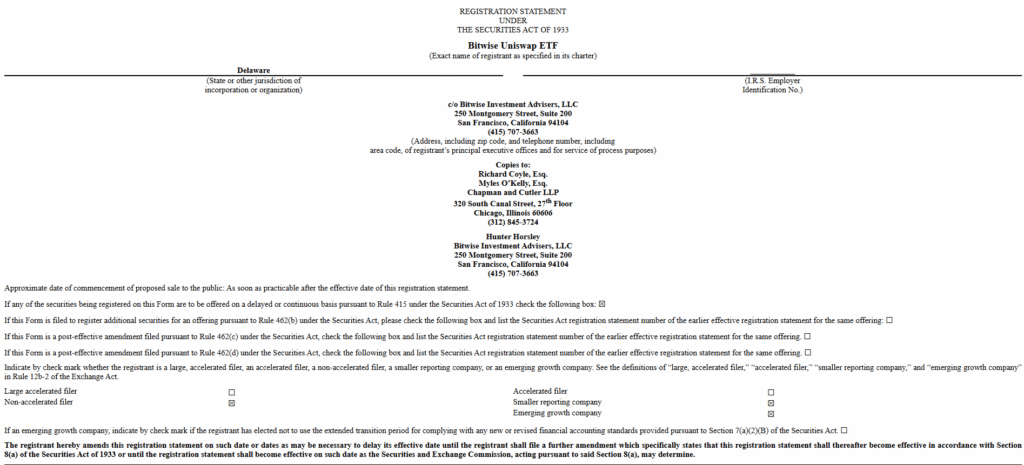
The Bitwise Uniswap ETF would have the UNI token as its main asset for tracking investor exposure. “The Trust’s investment objective is to provide exposure to the value of UNI, less the Trust’s expenses”. If approved, Coinbase Custody Trust Company will serve as the ETF custodian. Meanwhile, Bitwise has confirmed there will be no staking of UNI tokens associated with the proposed ETF at the time of its inception.
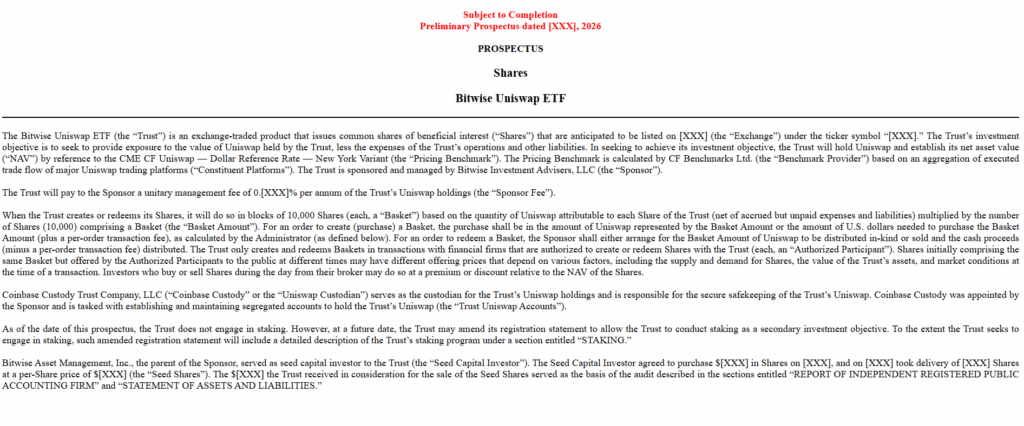
On Thursday, the SEC officially made the filing, bringing the product a step closer to the general financial markets. Indeed, access to DeFi coins via traditional applications has been a major focus for the firm, as stated, as an emerging trend with institutional investment demand. Brokerage accounts could potentially facilitate the ETF, opening more avenues for the UNI asset class. This filing will be part of a trend in crypto ETF filings in the U.S., which started in 2021 with the change in regulations.

Regulatory and Market Context

This comes when the SEC concluded its investigation into the case involving Uniswap Labs last year, which eased regulation issues facing the decentralized finance protocols. Delaware statutory trust filings were the foundation before submitting to the SEC for its approval. Trust filings are technical processes before an actual filing is made to the SEC.

An actual filing of the S-1 form signifies their readiness to start the regulatory process for their Uniswap ETF product. Analysts have revealed that it remains to be seen when the ETF will complete the review and approval process when it is sent to the SEC for processing. The ETF’s standard to trade on the US stock exchange will be determined by the SEC.

Bitwise filing for a Uniswap ETF with the SEC marks a new milestone for bringing a DeFi governance token into a regulated investment product. The new fund would be designed to give investors traditional exposure to UNI without token staking, pending regulatory approval. This action underscores ongoing institutional appetite for regulated crypto-investment vehicles linked to decentralized finance protocols.

Highlighted Crypto News:

Public Retirement Funds Hit by Sharp Decline Amid Bitcoin Slump

TagsBitwiseBlockchainDeFiETFSECUniswapUniswap (UNI)

Related Questions

QWhat is the main asset that the Bitwise Uniswap ETF will use to track investor exposure?

AThe UNI token.

QWhich company will serve as the custodian for the proposed Bitwise Uniswap ETF?

ACoinbase Custody Trust Company.

QWhat significant regulatory event involving Uniswap Labs occurred last year, as mentioned in the article?

AThe SEC concluded its investigation into the case involving Uniswap Labs.

QWhat type of filing with the SEC signifies Bitwise's readiness to start the regulatory process for the Uniswap ETF?

AThe filing of an S-1 form.

QAccording to the article, what will the proposed ETF NOT involve at the time of its inception?

AStaking of UNI tokens.

Related Reads

Uncovering the Truth About Agent Commerce, Payments, and Infrastructure

Decoding Agent Commerce, Payments, and Infrastructure: The Reality Over the past year, I've been building infrastructure for the Agent economy, engaging with major players like Stripe, Visa, Coinbase, Google, and dozens of startups. A clear conclusion emerges: true, large-scale demand does not yet exist. Startups face structural challenges. Data points illustrate this gap. Stripe's Agent commerce platform has over 1,000 merchants but only single-digit transacting agents. Visa's Agent payment token requires 9-month KYC and a $250M revenue threshold, accessible only to giants like Amazon. On-chain analysis reveals actual daily Agent transaction volume is around $17k, half of which are test transactions. The article analyzes four potential markets: **1. Agent-to-Merchant (A2M):** Current AI shopping UX is often inferior to traditional e-commerce for visual, comparison-heavy purchases (clothing, electronics). Chat interfaces are a step back. Real merchant interest is defensive "Agent Engine Optimization," fearing future obsolescence, not current demand. Potential exists in high-frequency, low-decision purchases (e.g., food delivery) or simplifying terrible UX (complex checkouts, non-native shoppers), but these require massive consumer distribution channels dominated by giants like DoorDash and Amazon. **2. Agent-to-API (A2A):** Developers already have subscriptions and billing for core APIs (compute, data). The argument for micro-payments via crypto for sub-dollar API calls is addressed by pre-paid balances today. The deeper issue is supplier resistance; major SaaS firms rely on enterprise contracts, not fractional cent pricing. Opportunity lies in the long tail of niche services, but this is a smaller market catering to developers, a historically low-paying group. **3. Agent-to-Agent (A2A):** This remains a theoretical long-term vision with near-zero current transaction volume. It involves unique challenges: discovery, trust, negotiation, dispute resolution. When it materializes, it will require a fundamentally new settlement infrastructure for high-speed, variable-value, multi-party transactions. It's a real long-term bet, but not the current market. **4. Agent-to-Finance (A2F):** This is the only category with existing, paying demand. Integrating AI into financial workflows (trading, portfolio management) is a natural evolution and enables new capabilities like autonomous rebalancing. However, competition favors incumbents with regulatory licenses, compliance infrastructure, and existing client relationships. **The Real Issue:** Why is infrastructure still being built? Incumbents can afford long-term bets, and payment companies see every problem as a nail for their payment hammer. However, payment is just one piece. The core challenge is *coordination*—orchestrating work between Agents and humans, verifying outcomes, and settling results. Payment is part of settlement, which is part of coordination. Companies that solve the coordination problem will subsume payments, not the other way around. Startups lack the infinite runway of giants and must find today's real market, which, after a year of exploration, lies outside these four categories—in an area with real, growing, and underserved activity.

marsbit27m ago

Uncovering the Truth About Agent Commerce, Payments, and Infrastructure

marsbit27m ago

Kalshi, MTS, and a16z's Ambition

The article "Kalshi, MTS, and a16z's Ambition" explores prediction markets as a focal point of excitement in 2025 for investors, crypto enthusiasts, and media. It traces their intellectual lineage from Friedrich Hayek's ideas on dispersed knowledge and market coordination to Robin Hanson's Logarithmic Market Scoring Rule (LMSR), which incentivizes truthful information sharing. The piece argues that a16z's significant investment in prediction market platform Kalshi (valued at $220B) transcends mere financial speculation. a16z frames prediction markets as a new form of "media" that provides "presence"—a way for individuals to actively engage with and influence world events through financial stakes, countering postmodern detachment. By wagering on outcomes, users become "super observers," and the market's aggregated probabilities gain authoritative power to define event truth and importance. The article uses media company MTS ("Monitoring The Situation") as a case study of a16z's "new media" strategy: rapidly producing high-intensity, multi-format content to "take over the timeline." However, prediction markets like Kalshi are presented as the ultimate piece in this media empire. Their real-money, crowd-sourced probabilities possess a unique "reality distortion field" and perceived objectivity, potentially swaying public opinion and granting a private company unprecedented interpretive power over reality. Ultimately, Kalshi's immense valuation is attributed not just to its exchange model, but to its role as a foundational component in a16z's envisioned new media landscape, where prediction markets define narrative and truth.

链捕手27m ago

Kalshi, MTS, and a16z's Ambition

链捕手27m ago

Trading

Spot
Futures
活动图片