Bittensor (TAO) Bearish Logic: The Income Desert Beneath the Computing Power Myth

marsbitPublished on 2026-03-24Last updated on 2026-03-24

Abstract

Bittensor (TAO), currently priced around $275 with a market cap of $2.6 billion, faces significant challenges in generating sustainable external revenue despite its strong narrative around token scarcity, institutional backing, and AI decentralization. The network relies heavily on inflationary token emissions to subsidize operations, with an estimated $36 million in annual incentives dwarfing confirmed external revenues of only $3–15 million. Key subnet Chutes (SN64), for example, receives subsidies 22–40 times higher than its actual revenue. Without subsidies, its costs would exceed those of centralized competitors. The network lacks transparent demand-side metrics, and its subnets operate in a highly competitive environment, squeezed between low-cost self-hosted solutions and heavily subsidized cloud giants. While TAO’s value is driven by speculative factors like scarcity, halving events, and ETF prospects, its fundamental economic model shows little evidence of long-term viability or competitive advantage in the AI services market.

Author: Pine Analytics

Compiled by: Saoirse, Foresight News

TAO is currently priced around $275, with a market cap of $2.6 billion and a fully diluted valuation of $5.8 billion. The project has received institutional backing from Grayscale (which filed an application for a NYSE ETF listing in December 2025) and public recognition from NVIDIA CEO Jensen Huang. Its token supply narrative is also highly compelling: a hard cap of 21 million tokens with a Bitcoin-style halving mechanism. After the first halving in December 2025, the daily issuance will drop from 7200 tokens to 3600 tokens. Within a year, the number of subnets has grown from 32 to 128, and Templar's Covenant-72B training has proven that decentralized computing power can produce large language models with baseline competitiveness.

This report does not deny the above facts. What we aim to explore is: can the network's economic model generate real external revenue sufficient to support its current valuation, and what is its true competitiveness when pitted against centralized service providers and self-hosted computing power?
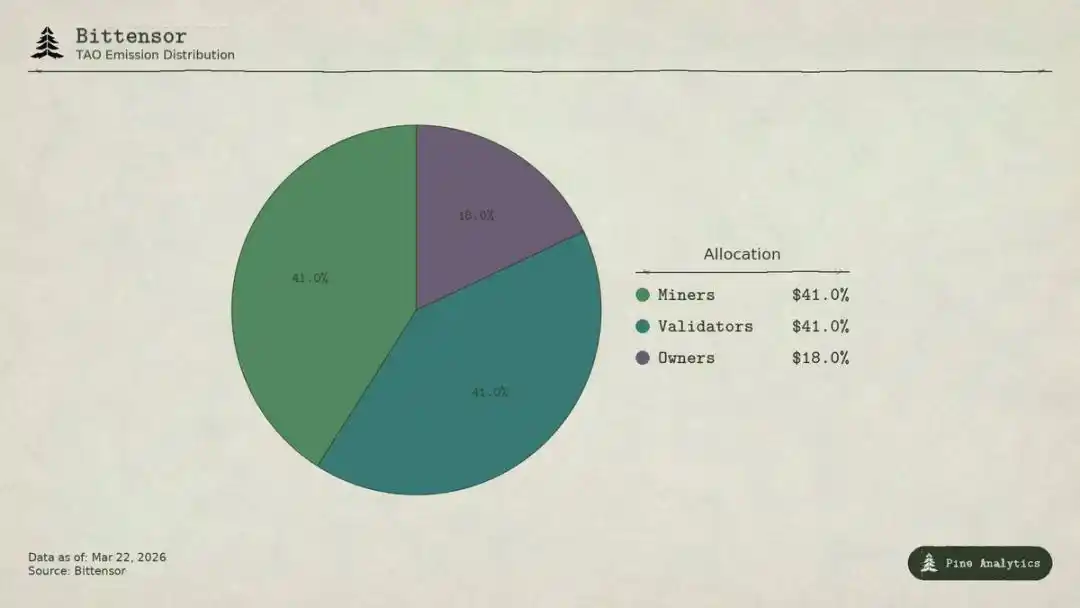
Bittensor (TAO) Token Issuance Allocation Ratio

How Network Value Flows

Bittensor has four types of participants:

  • Subnet owners build specialized AI markets and receive 18% of the TAO issuance rewards for their subnet;
  • Miners perform AI tasks (inference, training, data processing) and receive 41%, totaling about 1476 TAO daily, with an annualized value of approximately $148 million;
  • Validators score the output of miners and receive 41%;
  • Stakers deposit TAO into a subnet's liquidity pool in exchange for the subnet's native token.

Under the Taoflow model, a subnet's reward share is determined by the net inflow of TAO staked; negative net inflow results in no rewards. The top ten subnets control about 56% of the total network issuance.

TAO is the universal network token: miner registration, validator staking, subnet token purchases, and service payments all require TAO. Theoretically, subnet activity should create structural demand for the underlying token.
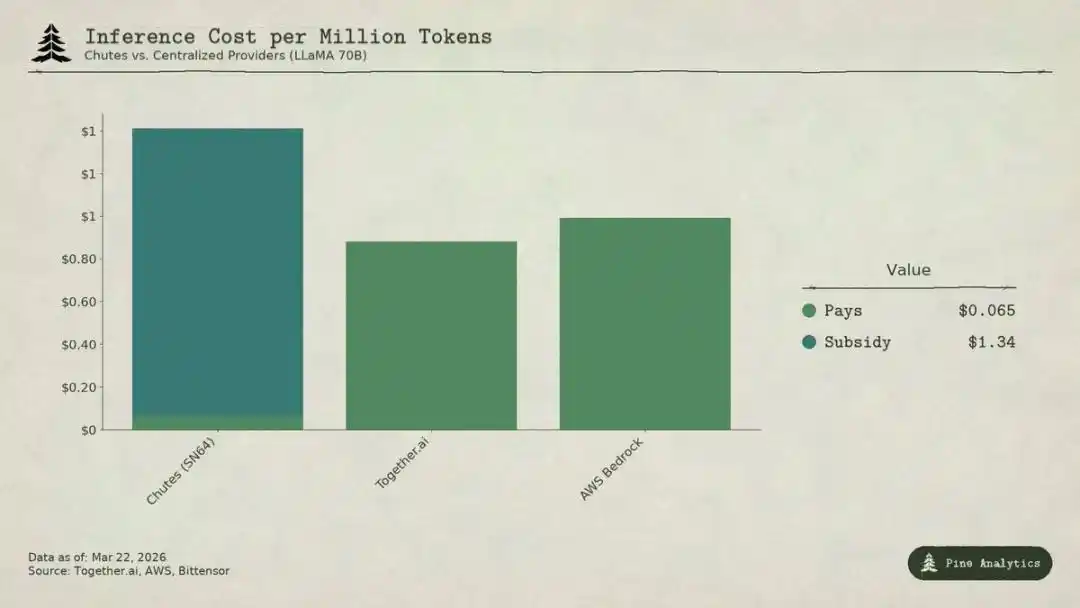
Comparative analysis of inference costs between Bittensor subnet Chutes (SN64) and centralized service provider LLaMA 70B model

Demand-Side Status Quo

Transparent Supply vs. Opaque Demand

Bittensor's supply side is highly transparent: 3600 TAO are distributed programmatically each day, the halving rules are hard-coded, and staking rates (~70%), allocation ratios, and flow data are all on-chain.

However, the demand side is completely opaque. There is no unified dashboard tracking external revenue per subnet. Actual AI service usage (inference, computation, training) occurs off-chain and is not recorded on the blockchain. Investors can only infer demand through indirect indicators like staking flow, subnet token prices, and self-reported data from projects. This opacity is structural, not temporary. The blockchain only records token transfers, not API calls.

Here is the most complete picture of the demand side as of March 2026.

Chutes (SN64): Low Prices Rely Entirely on Subsidies

Chutes commands 14.4% of the total network issuance, the highest of any subnet. Developed by Rayon Labs, it offers serverless inference services for open-source models, quoting prices 85% lower than AWS and 10%–50% lower than Together AI. Its usage data is unparalleled within the ecosystem: over 400,000 users (over 100,000 API users), over 5 million daily requests, cumulative processing of 9.1 trillion tokens, with a three-day average token generation surging from 6.6 billion to 101 billion. It is also a top inference provider on OpenRouter, with some models outperforming centralized competitors.

However, these low prices do not come from operational efficiency but from subsidies.

Calculated based on its 14.4% share, Chutes receives approximately 518 TAO daily, with an annualized value of about $52 million. Its external annual revenue is only about $1.3–2.4 million (the higher figure is self-reported by the team, not independently audited). The protocol's subsidy ratio for this subnet is approximately 22:1 to 40:1. For every $1 users pay, the network must release $22–40 worth of TAO through inflation as a subsidy.

Without subsidies, based on its daily processing volume of about 101 billion tokens, the cost price would be approximately $1.41 per million tokens. The current centralized market prices are:

  • Together.ai's LLaMA 3.3 70B Turbo ~$0.88 / million tokens;
  • DeepSeek V3 ~$0.40–0.80;
  • Small models can be as low as $0.18.

This means that without subsidies, Chutes' price would be 1.6–3.5 times more expensive than centralized solutions. The so-called 85% cost advantage is completely reversed; its low price is essentially paid for by TAO holders through inflation, not structural efficiency brought by decentralization.

When the next halving arrives (expected late 2026 or 2027), either prices will double, miners will leave, or the gap between subsidies and revenue will widen further.

Some might draw parallels to early internet subsidies for customer acquisition, but Uber, DoorDash, and AWS built switching costs during their subsidy periods: proprietary platforms, driver networks, enterprise ecosystems. Bittensor subnets have no barriers: models are open-source, interfaces are standardized, and users can switch providers at zero cost. Once subsidies recede, there is no lock-in mechanism to retain users.

Rayon Labs also operates SN56 and SN19, collectively controlling about 23.7% of the total network issuance. Neither has disclosed external revenue. A single team controls almost a quarter of the network's incentive distribution.

Targon, Templar, and Other Subnets

Targon (SN4) is the highest-revenue subnet, operated by Manifold Labs, providing confidential GPU computing services to enterprises. Estimated annual revenue is approximately $10.4 million, corresponding to a valuation of $48 million, a P/S ratio of about 4.6x, making it the most solid valuation within the ecosystem. However, the $10.4 million is a predicted figure cited by multiple reports, not an audited number.

Templar (SN3) completed the Covenant-72B training, with a market cap of $98 million, but has zero external revenue. Training API and enterprise sales are still in progress, with no paid product launched yet.

The remaining 120+ subnets either have no public revenue or are still in the early product stages, surviving primarily on token issuance subsidies.

Overall Picture

The total confirmed demand-side annual revenue for the entire network is only about $3–15 million. The annualized subsidy for Chutes alone (~$52 million) exceeds the upper limit of the entire network's external revenue.

Based on a $2.6 billion market cap, its revenue multiple is about 175–200x; based on the $5.8 billion fully diluted valuation, it's nearly 400x. In contrast, centralized AI computing companies have recently raised funds at valuations of 15–25x forward revenue, and high-growth SaaS rarely sustains above 50x for long. Bittensor's valuation multiple is 4–10 times that of aggressive industry benchmarks.

The huge gap between valuation and demand fundamentals indicates that the price of TAO is almost entirely based on supply-side scarcity (halving, staking lock-up), institutional catalysts (Grayscale ETF, exchange listing expectations), and AI sector sentiment, rather than real economic output. These are indeed price drivers, but they are completely separate from the logic of "Bittensor creating sustainable value as an AI service network."
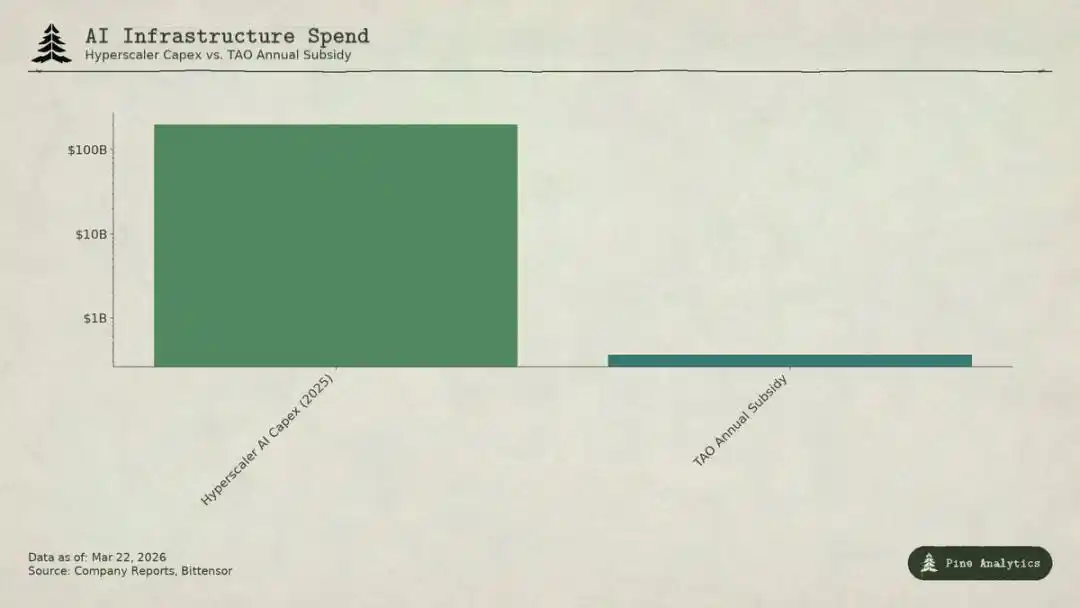
Comparison of hyperscale cloud provider AI capital expenditure vs. Bittensor (TAO) annual subsidy scale

Pricing Dilemma: Squeezed from Both Sides

Subnets face pressure from two sides:

  • Above: Self-Hosting Ceiling

All models on the platform are open-source, weights are public, the comprehensive cost to run a 70B model on a single H100 is only $40–50 per day, and tools like vLLM and Ollama make local deployment extremely simple. NVIDIA's new generation of chips will further significantly reduce inference costs. Institutions with sufficient volume will find self-building deployment cheaper.

  • Below: Pressure from Cloud Giants

Microsoft, Google, Amazon, and Meta had combined AI capital expenditures exceeding $200 billion in 2025. They have hardware priority allocation, dedicated data centers, enterprise customer relationships, and can subsidize AI with cash flow from other businesses. Bittensor's annual incentive budget (~$360 million) is less than Microsoft's weekly AI infrastructure investment. Professional service providers also use VC subsidies to compete on price with open-source models.

Subnet pricing is compressed into an extremely narrow band, while also bearing decentralization-specific costs: token friction, validator node overhead, subnet owner share, network latency, etc.

The Moat Problem

Even if a subnet creates a valuable service, the underlying model and methods are inherently public: Covenant-72B uses the Apache license, and technical papers are published. Any competitor can replicate it directly without participating in the TAO ecosystem.

Traditional moats (proprietary technology, network effects, switching costs, brand) do not hold:

  • Technology is open-source;
  • Network effects belong to TAO, not individual subnets;
  • Model weights are identical, user switching cost is zero.

The community believes the incentive mechanism is the moat, but this relies on continuous large-scale token issuance, and each halving will steadily shrink the incentive budget.

What is TAO Actually Trading On

At a $2.6 billion market cap, TAO's price does not reflect demand fundamentals; $3–15 million in annual revenue cannot support it under any traditional framework. The market is trading on: Bitcoin-style scarcity, Grayscale ETF expectations, AI sector rotation, and the long-term option value of decentralized AI. These are all reasonable speculative factors, but they come entirely from the supply side and market sentiment.

If you hold TAO based on scarcity and narrative, you might profit even with weak demand; but if you believe Bittensor will become a truly large-scale AI service network, there is currently no evidence, and it encounters structural resistance that is difficult to break through. Investors should clearly distinguish their investment logic.


Related Questions

QWhat is the main bearish argument against Bittensor (TAO) presented in the article?

AThe main bearish argument is that Bittensor's current valuation is not supported by its real external revenue. The network's demand-side revenue is minimal (estimated at $3-15 million annually), while its largest subnet, Chutes, relies on a massive 22:1 to 40:1 subsidy from TAO token inflation to offer competitive pricing. Without these subsidies, its services would be more expensive than centralized alternatives, and the network lacks a sustainable economic model or competitive moat to justify its multi-billion dollar valuation.

QHow does the subsidy model for the subnet Chutes (SN64) work and what does it reveal?

AChutes receives approximately 518 TAO daily (14.4% of the network's issuance), which is an annualized subsidy worth about $52 million. However, its external annual revenue is only between $1.3-$2.4 million. This creates a subsidy-to-revenue ratio of 22:1 to 40:1, meaning the network inflates the token supply by $22-$40 for every $1 of real revenue earned. This reveals that its low prices are artificial and dependent on unsustainable token emissions, not superior efficiency.

QWhat are the key challenges Bittensor faces in competing with centralized AI service providers?

ABittensor faces a pricing squeeze from two sides. From above, self-hosting is becoming cheaper and easier with tools like vLLM and Ollama. From below, tech giants like Microsoft, Google, and Amazon have massive AI capital expenditures (over $200 billion combined in 2025), hardware advantages, and the ability to subsidize services with other business revenues. Bittensor's entire annual incentive budget (~$360 million) is dwarfed by these competitors, and its subnets must also bear the additional costs of decentralization, such as token friction and network latency.

QWhy does the article claim that Bittensor subnets lack a traditional economic moat?

AThe article claims subnets lack a moat because their core technologies are open-source (e.g., Covenant-72B uses an Apache license), which allows any competitor to replicate their models and services without participating in the TAO ecosystem. There is no proprietary technology, no significant network effects that benefit individual subnets (the effects belong to TAO itself), and zero switching costs for users since model weights are consistent across providers. The only perceived moat, the incentive system, relies on continuous and substantial token emissions, which are scheduled to halve.

QWhat does the article conclude is the primary driver of TAO's current market price and valuation?

AThe article concludes that TAO's price is primarily driven by speculative factors on the supply side and market sentiment, not fundamental demand or revenue. These factors include its Bitcoin-like scarcity narrative (fixed supply and halvings), the Grayscale ETF application and exchange listing expectations, general AI sector hype, and its value as a long-term bet on decentralized AI. The $2.6 billion market cap is trading on these narratives, as the proven $3-15 million in annual revenue cannot support the valuation under any conventional framework.

Related Reads

After 50x Storage Surge, Justin Sun Always Looks to the Next Decade

Sun Yuchen, known for his controversial stunts like a $30 million lunch with Warren Buffett (canceled due to a kidney stone) and eating a $6.2 million duct-taped banana, is often overshadowed by a significant fact: his decade-long track record of spotting major investment trends. In 2016, he famously advised young people to invest in Bitcoin, Nvidia, Tesla, and Tencent instead of buying property. A hypothetical $20,000 investment in Nvidia and Tesla from that list would now be worth over 50 million RMB. His latest major call was on November 6, 2025, predicting a "50x storage opportunity" tied to the AI boom, which materialized with Sandisk's stock surging nearly 50-fold by 2026. Looking ahead, Sun now focuses on the next frontier: Physical AI. He identifies four key areas: 1. **Embodied AI/Robotics**: He sees this reaching its "iPhone moment," with companies like UBTech and Galaxy General leading in commercialization. 2. **Drones**: Viewed as the first commercially viable form of Physical AI, revolutionizing sectors from warfare (e.g., AeroVironment's Switchblade) to logistics. 3. **Spatial Computing**: Beyond VR, it's about AI understanding physical space, a foundational technology for robotics and autonomous systems, exemplified by Apple's Vision Pro. 4. **Space Exploration**: After a 2025 suborbital flight with Blue Origin, Sun advocates for space as the ultimate frontier, discussing blockchain's potential role in space asset management and data transactions. His investment philosophy involves betting on entire, inevitable trends rather than single companies. For robotics, he sees Tesla (the body/manufacturer) and Nvidia (the brain/AI platform) as complementary plays. In defense drones, he highlights companies making tanks obsolete (AeroVironment) and those augmenting fighter jets (Kratos). For space, he participated in Blue Origin's flight and anticipates SpaceX's potential IPO to redefine the sector's valuation. Sun Yuchen's vision frames the next two decades not as a revolution in information flow (like the internet), but in the fundamental operation of the physical world through AI-powered robots, autonomous systems, and spatial intelligence, ultimately extending human and AI activity into space. While many still focus on conventional assets, he continues to look toward the next technological horizon.

marsbit37m ago

After 50x Storage Surge, Justin Sun Always Looks to the Next Decade

marsbit37m ago

The Billionaires Behind the Most Expensive Midterm Election in History

"The Most Expensive Midterm Elections and Their Billionaire Backers" This analysis details the unprecedented scale of spending in the 2026 midterm elections, highlighting the key billionaire donors shaping the political landscape. Jeff Yass, founder of Susquehanna International Group, has contributed over $81 million, ranking third among individual donors behind George Soros ($102.6M) and Elon Musk ($84.8M). Yass is a major donor to Trump's MAGA Inc. and supports school choice and various candidates. Overall, federal committees have raised over $4.7 billion this cycle, with political ad spending projected to reach $10.8 billion. Republican-aligned groups are significantly out-raising their Democratic counterparts. "Dark money" from undisclosed sources continues to grow. The core stakes involve control of Congress and policy direction for Trump's final term. Donors are also motivated by specific issues: Sergey Brin and Chris Larsen are funding opposition to a proposed California wealth tax and supporting crypto-friendly policies. Other top donors include OpenAI's Greg Brockman and his wife Anna ($50M total to MAGA Inc. and an AI-focused PAC), Richard Uihlein ($45.3M to conservative causes), venture capitalists Marc Andreessen and Ben Horowitz (each over $44M to crypto/AI PACs and MAGA Inc.), Miriam Adelson ($42.6M to GOP leadership PACs), Paul Singer ($33.9M), and Diane Hendricks ($25.8M to MAGA Inc.). The article notes that the peak fundraising period is still ahead, with major primaries approaching.

marsbit39m ago

The Billionaires Behind the Most Expensive Midterm Election in History

marsbit39m ago

The Largest IPO in History Is Approaching, Surpassing SpaceX, 28 Years of AI Self-Iteration, Countdown to Intelligence Explosion

"Anthropic Nears Trillion-Dollar IPO, Fueled by Explosive Growth and 2028 'Intelligence Explosion' Warning Anthropic is considering a deal valuing the AI company near $1 trillion, potentially leading to one of the largest IPOs ever and surpassing SpaceX. Its revenue has skyrocketed, with Annual Recurring Revenue (ARR) reaching $45 billion in May 2026—a 500% increase in just five months. This vertical growth curve is attributed to its key products, Claude Code and Cowork, dominating AI coding and enterprise collaboration. Beyond commercial success, co-founder Jack Clark issued a pivotal warning in an interview: there is a greater than 50% chance that by the end of 2028, AI systems will achieve recursive self-improvement—the ability to autonomously build a 'better version' of themselves, initiating an 'intelligence explosion.' This prophecy underpins the company's astronomical valuation, as the market prices in the potential for transformative and disruptive AI. Further signaling its ambition, Anthropic formed a $1.5 billion joint venture with Goldman Sachs and Blackstone, aiming to disrupt traditional consulting firms like McKinsey by deploying Claude AI for complex strategic work. This move tests AI's capacity to replace high-level cognitive labor, a precursor to its predicted autonomous evolution. The narrative presents a dual future: unprecedented economic opportunity alongside significant risks like economic restructuring and security threats. Anthropic's meteoric rise and Clark's 2028 prediction frame the coming years as a countdown to a potential technological singularity."

marsbit51m ago

The Largest IPO in History Is Approaching, Surpassing SpaceX, 28 Years of AI Self-Iteration, Countdown to Intelligence Explosion

marsbit51m ago

Trading

Spot
Futures
活动图片