Bithumb Seeks Legal Action To Recover Unreturned Bitcoin From $40B Payout Error

bitcoinistPublished on 2026-04-10Last updated on 2026-04-10

Abstract

Crypto exchange Bithumb is pursuing legal action to freeze and recover approximately 7 Bitcoin (worth nearly $500,000) that were not returned after a major payout error in February. The incident occurred when Bithumb accidentally distributed 620,000 Bitcoin (valued at over $40 billion) to 249 users due to a "fat-finger" mistake. Although the exchange recovered 99.7% of the funds, a small portion was sold or converted by users. Under South Korean law, such mistaken payments are considered unjust enrichment and must be returned. The error also prompted regulatory scrutiny, leading to stricter asset-matching requirements for domestic crypto exchanges and a preliminary six-month business suspension notice for Bithumb over AML and KYC violations.

Crypto exchange Bithumb is pursuing legal action to freeze nearly $500,000 in Bitcoin (BTC) unrecovered from the $40 billion payout error in February, signaling that the platform will turn to the courts to reclaim the assets.

Bithumb Launches Legal Action

On Thursday, local news media outlet Chosun Biz reported that the South Korean crypto exchange Bithumb had begun legal proceedings to recover part of the Bitcoin that had not been returned after a recent error.

On February 6, Bithumb accidentally distributed 620,000 Bitcoin, worth over $40 billion, to 249 users participating in the crypto exchange’s “random box” promotional event due to a “fat-finger” error.

The exchange quickly canceled the payments and recovered most of the assets. However, some customers immediately sold or exchanged the BTC for cash or other cryptocurrencies, leaving approximately 0.3% of the Bitcoin unrecovered.

According to the report, Bithumb filed for a provisional seizure this week to reclaim 7 Bitcoin it had failed to recover after the erroneous payout incident. This is a legal measure to temporarily freeze a debtor’s assets, preventing their concealment or disposal before a lawsuit to recover the money is filed.

Legal experts believe that customers who did not return the mistakenly paid Bitcoin would likely lose the lawsuit. Head of the Financial Supervisory Service (FSS) and a former attorney, Lee Chan-jin, has said that those customers are “clearly subject to the return of unjust enrichment. Those who sold and converted them into money (cash out) face disaster (as they could be drawn into lawsuits).”

An industry source told Chosun Biz that some of these clients argued they should not be responsible for the exchange’s mistake, but under South Korean law, mistakenly received assets are usually classified as unjust enrichment and must be returned in kind.

The report noted that if BTC’s price falls by the time of return, the customer could benefit, but if the price surges, the customer could face losses if the court rules in the exchange’s favor.

‘Ghost Bitcoin’ Error Reshapes Industry Practices

Although 99.7% of the BTC were recovered, the incident raised serious concerns about the crypto exchange’s internal controls. As reported by Bitcoinist, Bithumb held 175 BTC in its own books and less than 50,000 BTC between its own assets and customer-held assets at the time of the incident.

This meant that Bithumb’s system failed to block the irregular transaction, distributing assets that did not actually exist and distorting market prices. As a result, the FSS, alongside the Korean Financial Intelligence Unit (KoFIU) and the Digital Asset eXchange Alliance (DAXA), formed an emergency task force to organize follow-up measures and review industry-wide practices, including domestic exchanges’ virtual asset reserves, management practices, operational conditions, and internal control systems.

In March, the KoFIU preliminarily notified Bithumb of a six-month partial suspension of its business for alleged violations of Anti-Money Laundering (AML) and Know-Your-Customer (KYC) regulations.

Earlier this week, the Financial Services Commission (FSC) found that domestic crypto exchanges’ trade-halting systems, also known as kill switches, are unreliable when a massive asset mismatch occurs.

Therefore, the regulator ordered all domestic crypto exchanges to switch from the 24‐hour reconciliation cycles most exchanges currently have to a 5‐minute asset‐matching regime by the end of May. In addition, they asked all platforms to disclose their asset-matching balance daily.
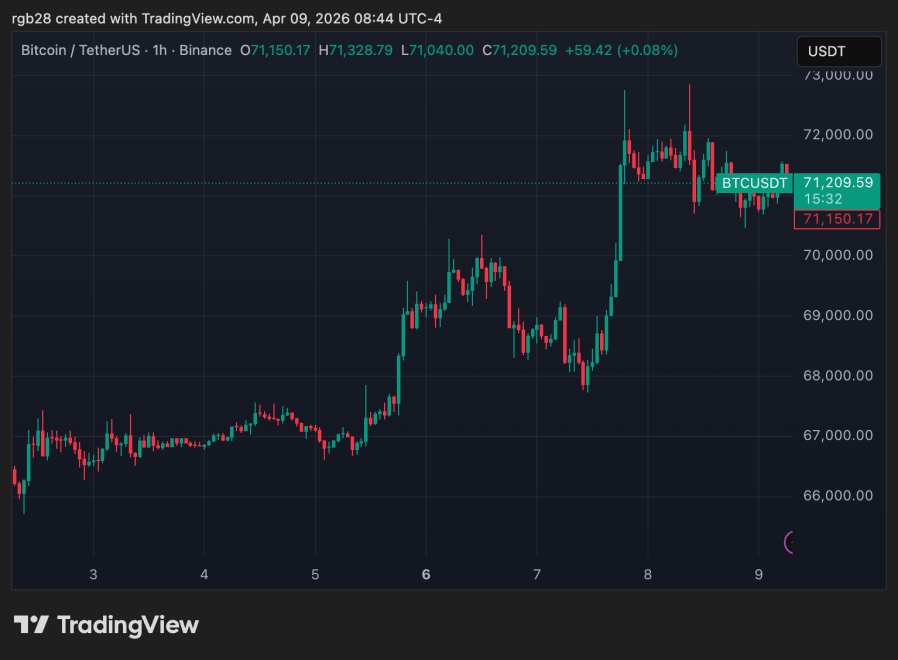
Bitcoin trades at $71,209 in the one-week chart. Source: BTCUSDT on TradingView


Related Questions

QWhat was the reason behind Bithumb's accidental distribution of Bitcoin to its users?

AThe distribution was due to a 'fat-finger' error during the crypto exchange's 'random box' promotional event.

QHow much Bitcoin remains unrecovered from the $40 billion payout error, and what action is Bithumb taking?

AApproximately 0.3% of the Bitcoin, or 7 BTC worth nearly $500,000, remains unrecovered. Bithumb is pursuing legal action to freeze and reclaim these assets.

QWhat legal principle in South Korean law supports Bithumb's claim to recover the mistakenly paid Bitcoin?

AUnder South Korean law, mistakenly received assets are classified as unjust enrichment and must be returned in kind.

QWhat regulatory consequences did Bithumb face following the incident, aside from the legal action to recover funds?

ABithumb was preliminarily notified of a six-month partial suspension of its business for alleged violations of Anti-Money Laundering (AML) and Know-Your-Customer (KYC) regulations.

QWhat changes did the Financial Services Commission (FSC) order for domestic crypto exchanges in response to this incident?

AThe FSC ordered all domestic crypto exchanges to switch from 24-hour reconciliation cycles to a 5-minute asset-matching regime by the end of May and to disclose their asset-matching balance daily.

Related Reads

Trading

Spot
Futures

Hot Articles

What is $BITCOIN

DIGITAL GOLD ($BITCOIN): A Comprehensive Analysis Introduction to DIGITAL GOLD ($BITCOIN) DIGITAL GOLD ($BITCOIN) is a blockchain-based project operating on the Solana network, which aims to combine the characteristics of traditional precious metals with the innovation of decentralized technologies. While it shares a name with Bitcoin, often referred to as “digital gold” due to its perception as a store of value, DIGITAL GOLD is a separate token designed to create a unique ecosystem within the Web3 landscape. Its goal is to position itself as a viable alternative digital asset, although specifics regarding its applications and functionalities are still developing. What is DIGITAL GOLD ($BITCOIN)? DIGITAL GOLD ($BITCOIN) is a cryptocurrency token explicitly designed for use on the Solana blockchain. In contrast to Bitcoin, which provides a widely recognized value storage role, this token appears to focus on broader applications and characteristics. Notable aspects include: Blockchain Infrastructure: The token is built on the Solana blockchain, known for its capacity to handle high-speed and low-cost transactions. Supply Dynamics: DIGITAL GOLD has a maximum supply capped at 100 quadrillion tokens (100P $BITCOIN), although details regarding its circulating supply are currently undisclosed. Utility: While precise functionalities are not explicitly outlined, there are indications that the token could be utilized for various applications, potentially involving decentralized applications (dApps) or asset tokenization strategies. Who is the Creator of DIGITAL GOLD ($BITCOIN)? At present, the identity of the creators and development team behind DIGITAL GOLD ($BITCOIN) remains unknown. This situation is typical among many innovative projects within the blockchain space, particularly those aligning with decentralized finance and meme coin phenomena. While such anonymity may foster a community-driven culture, it intensifies concerns about governance and accountability. Who are the Investors of DIGITAL GOLD ($BITCOIN)? The available information indicates that DIGITAL GOLD ($BITCOIN) does not have any known institutional backers or prominent venture capital investments. The project seems to operate on a peer-to-peer model focused on community support and adoption rather than traditional funding routes. Its activity and liquidity are primarily situated on decentralized exchanges (DEXs), such as PumpSwap, rather than established centralized trading platforms, further highlighting its grassroots approach. How DIGITAL GOLD ($BITCOIN) Works The operational mechanics of DIGITAL GOLD ($BITCOIN) can be elaborated on based on its blockchain design and network attributes: Consensus Mechanism: By leveraging Solana’s unique proof-of-history (PoH) combined with a proof-of-stake (PoS) model, the project ensures efficient transaction validation contributing to the network's high performance. Tokenomics: While specific deflationary mechanisms have not been extensively detailed, the vast maximum token supply implies that it may cater to microtransactions or niche use cases that are still to be defined. Interoperability: There exists the potential for integration with Solana’s broader ecosystem, including various decentralized finance (DeFi) platforms. However, the details regarding specific integrations remain unspecified. Timeline of Key Events Here is a timeline that highlights significant milestones concerning DIGITAL GOLD ($BITCOIN): 2023: The initial deployment of the token occurs on the Solana blockchain, marked by its contract address. 2024: DIGITAL GOLD gains visibility as it becomes available for trading on decentralized exchanges like PumpSwap, allowing users to trade it against SOL. 2025: The project witnesses sporadic trading activity and potential interest in community-led engagements, although no noteworthy partnerships or technical advancements have been documented as of yet. Critical Analysis Strengths Scalability: The underlying Solana infrastructure supports high transaction volumes, which could enhance the utility of $BITCOIN in various transaction scenarios. Accessibility: The potential low trading price per token could attract retail investors, facilitating wider participation due to fractional ownership opportunities. Risks Lack of Transparency: The absence of publicly known backers, developers, or an audit process may yield skepticism regarding the project's sustainability and trustworthiness. Market Volatility: The trading activity is heavily reliant on speculative behavior, which can result in significant price volatility and uncertainty for investors. Conclusion DIGITAL GOLD ($BITCOIN) emerges as an intriguing yet ambiguous project within the rapidly evolving Solana ecosystem. While it attempts to leverage the “digital gold” narrative, its departure from Bitcoin's established role as a store of value underscores the need for a clearer differentiation of its intended utility and governance structure. Future acceptance and adoption will likely depend on addressing the current opacity and defining its operational and economic strategies more explicitly. Note: This report encompasses synthesised information available as of October 2023, and developments may have transpired beyond the research period.

363 Total ViewsPublished 2025.05.13Updated 2025.05.13

What is $BITCOIN

Discussions

Welcome to the HTX Community. Here, you can stay informed about the latest platform developments and gain access to professional market insights. Users' opinions on the price of BTC (BTC) are presented below.

活动图片














