Bitfinex Hack Mastermind Released Early From Prison, Credits 2018 Trump Law – Details

bitcoinistPublished on 2026-01-03Last updated on 2026-01-03

Abstract

Ilya Lichtenstein, the mastermind behind the 2016 Bitfinex hack that stole 119,574 Bitcoin, has been released early from prison after serving 14 months of his five-year sentence. He credited his release to the First Step Act, a 2018 criminal justice reform law signed by former President Donald Trump. The stolen Bitcoin, initially worth $71 million, is now valued at nearly $11 billion. Lichtenstein expressed remorse and pledged to contribute positively to cybersecurity. His wife, Heather Morgan, who was also convicted for laundering the stolen funds and released early under the same law, celebrated their reunion. The couple used sophisticated methods to launder a portion of the stolen cryptocurrency.

The mastermind behind the Bitfinex hack, one of the most prominent cases in crypto security history, has been released early from prison after serving 14 months, under a 2018 law signed by US President Donald Trump.

Bitfinex Hack Mastermind Receives Early Release

On Friday, Ilya Lichtenstein, the mastermind behind the 2016 hack that stole over 120,000 Bitcoin (BTC) from crypto exchange Bitfinex, announced that he had been released from prison a year after receiving a five-year sentence.

On X, Lichtenstein thanked a law signed by President Trump during his first administration for his release. “Thanks to President Trump’s First Step Act, I have been released from prison early,” the post stated.

Notably, Trump signed the bipartisan First Step Act on December 21, 2018, aiming to improve criminal justice outcomes and reduce the size of the federal prison population. The law included a series of reforms, including one to establish a “risk and needs assessment system” that offers some inmates rehabilitative programming and the opportunity to be released early into home confinement.

According to CNBC, A Trump administration official stated on January 2 that the mastermind behind the Bitfinex hack “has served significant time on his sentence and is currently on home confinement consistent with statute and Bureau of Prisons policies.”

The US Department of Justice (DOJ) previously declared that Lichtenstein used advanced hacking techniques and tools to access Bitfinex’s network. He then transferred 119,574 Bitcoin to one of his crypto wallets through more than 2,000 transactions.

At the time, the stolen funds were valued at around $71 million. However, its value has increased exponentially in the past decade, being worth nearly $11 billion at current prices. During his sentencing hearing, he expressed remorse for using his talents on criminal activities “instead of a positive contribution to society.”

“I remain committed to making a positive impact in cybersecurity as soon as I can,” Lichtenstein affirmed on his Friday announcement, thanking his supporters for the help and vowing to prove “the haters” wrong.

Crypto Heist Figures Reunite Under Trump’s Law

Lichtenstein’s wife, Heather Morgan, reacted to the news online, declaring that being reunited at home with her husband after four years was “the best New Year’s present” she could get.

Morgan, a rapper known online as “Razzlekhan,” entered prison in February 2025 but was released early from prison after eight months under the First Step Act. In late October, she posted a video on X, sharing the news and thanking President Trump for her release.

“It is very good to be back, and I want to give a shout out to Papa Trump for making my 18-month sentence shorter,” she stated. However, it appears that the US President was not directly involved in the decision.

As reported by Bitcoinist, the self-titled “Crocodile of Wall Street” was sentenced to 18 months in prison on November 18, 2024, for her role in the Bitfinex heist. Despite not being involved in the hack, Morgan assisted her husband in laundering the stolen funds by using “numerous sophisticated laundering techniques” to disguise them.

Notably, they used fake identities to create online accounts, deposited the stolen Bitcoin in several darknet markets and crypto exchanges to withdraw the funds, converted BTC to other cryptocurrencies, and deposited part of the funds into crypto mixers. The couple seemingly managed to launder 21% of the total funds stolen from Bitfinex.

At the time, prosecutors argued that Morgan was “a willing participant and bears full responsibility for her actions.” Nonetheless, they noted that she was “a lower-level participant,” which resulted in her reduced sentence.
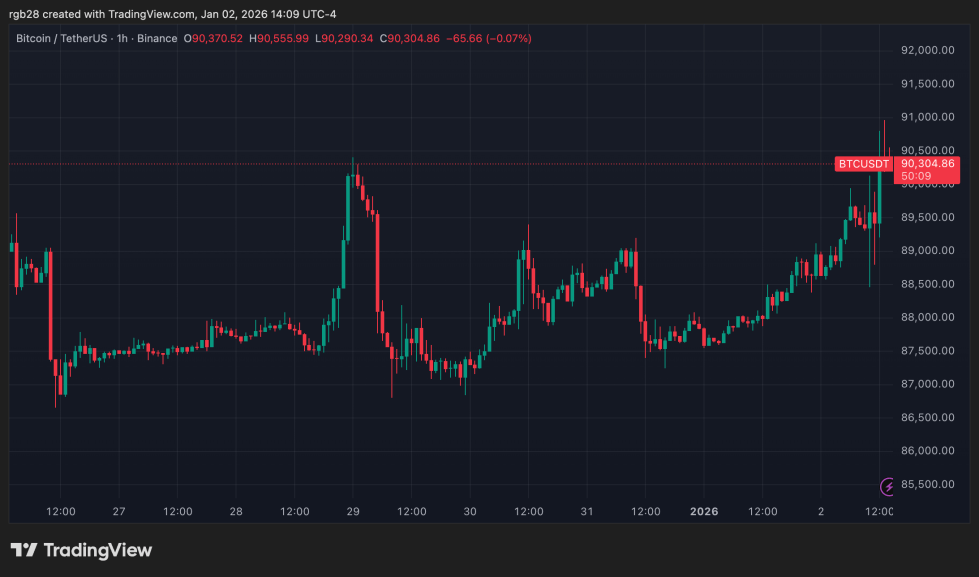
Bitcoin (BTC) trades at $90,304 in the one-week chart. Source: BTCUSDT on TradingView


Related Questions

QWho was released early from prison for the Bitfinex hack and what law was credited for the release?

AIlya Lichtenstein, the mastermind behind the Bitfinex hack, was released early from prison. He credited his release to the First Step Act, a 2018 law signed by President Donald Trump.

QWhat was the value of the stolen Bitcoin at the time of the hack and what is its approximate value now?

AAt the time of the hack, the stolen 119,574 Bitcoin were valued at around $71 million. At current prices, the stolen funds are worth nearly $11 billion.

QWhat role did Heather Morgan play in the Bitfinex heist and what was her sentence?

AHeather Morgan, Ilya Lichtenstein's wife, did not participate in the hack itself but assisted in laundering the stolen funds. She was sentenced to 18 months in prison but was released early after 8 months under the First Step Act.

QWhat specific techniques did the couple use to launder the stolen Bitcoin?

AThe couple used numerous sophisticated laundering techniques, such as creating online accounts with fake identities, depositing Bitcoin into darknet markets and crypto exchanges to withdraw funds, converting BTC to other cryptocurrencies, and using crypto mixers.

QWhat was the primary goal of the First Step Act signed by President Trump?

AThe First Step Act, signed on December 21, 2018, was a bipartisan law aimed at improving criminal justice outcomes, reducing the federal prison population, and establishing a system that offers rehabilitative programming and the opportunity for early release into home confinement for some inmates.

Related Reads

Stocks Fell Even More Violently Than Crypto, Where Did the Money Go?

From June to late July 2026, global stock markets, particularly technology and semiconductor stocks, experienced severe declines, with South Korea's KOSPI index facing historic circuit breakers and shedding 40% from its June peak. Key catalysts included SK Hynix's earnings miss despite record profits and competitive pressures from China's CXMT IPO. A global forced deleveraging event unfolded, devastating highly leveraged instruments like the 2x leveraged SK Hynix ETF, which lost over 80% of its value. Surprisingly, Bitcoin showed relative stability during this period, rising roughly 15% from its July low. The article clarifies this wasn't due to an inflow of equity flight capital but because Bitcoin had already undergone a significant correction in May and June, with U.S. spot Bitcoin ETFs seeing record outflows. True safe-haven flows went to gold, severing Bitcoin's short-term "digital gold" narrative. The sell-off is characterized not as an AI story collapse but a liquidity-driven清算 of crowded leveraged positions, potentially halfway through according to some analysts. For substantial capital to return to Bitcoin, the article cites necessary conditions: eased global liquidity pressure, a soft-landing Fed rate cut, and regulatory clarity from the stalled U.S. CLARITY Act. The conclusion is that Bitcoin is not a current safe haven but a pre-cleared asset. Its decoupling from tech stocks highlights its potential future role as a non-correlated asset for institutional portfolios, positioning it favorably for when global capital reallocates post-crisis.

marsbit54m ago

Stocks Fell Even More Violently Than Crypto, Where Did the Money Go?

marsbit54m ago

"The Final Phase Before the New Cycle". What Will Happen to Bitcoin in August

"Bitcoin Faces Crucial Test in August: Experts Predict Consolidation or Further Decline" The price of Bitcoin (BTC) is expected to remain under pressure in August, with experts anticipating either consolidation within a narrow range or a potential drop below $60,000. Despite a double-digit recovery from its July low near $58,000, BTC ended the month trading around $63,500, still roughly 50% below its October 2025 peak of $126,200. Analysts cite several headwinds: a challenging macroeconomic environment with high US interest rates and persistent inflation, which makes fixed-income assets more attractive than speculative ones like crypto. Furthermore, competition for capital is intense, with many investors favoring AI-related stocks. This is reflected in significant outflows from US spot Bitcoin ETFs, with a record $4.5 billion leaving in June and a net outflow of $5.4 billion for the first half of the year. Historically, August is a weak month for crypto, with a median return of -7.49% from 2013 to 2025. Experts also note regulatory uncertainty in the US, particularly the stalled CLARITY Act, as a dampening factor. Despite the bearish near-term outlook, several experts view the current phase as the "last phase before a new Bitcoin cycle" begins, potentially in Q4 2024. This makes it a favorable time for accumulating Bitcoin for the long term. Key price levels to watch are support at $60,000-$61,000, with a break below $58,000 potentially leading to $53,000-$55,000. A move above $67,000 could target $70,000-$75,000, though this is considered a lower probability scenario.

cryptonews.ru59m ago

"The Final Phase Before the New Cycle". What Will Happen to Bitcoin in August

cryptonews.ru59m ago

Trading

Spot
活动图片