Bitcoin’s Institutional Footprint Expands Exponentially Across Markets – Here’s How Much They Hold

bitcoinistPublished on 2026-05-14Last updated on 2026-05-14

Abstract

Bitcoin's adoption has shifted from primarily retail investors to significant institutional accumulation. According to analyst On-Chain Mind, institutions now hold a staggering 3.24 million BTC, valued at approximately $261.2 billion. This massive stack is equivalent to nearly 20 years of new Bitcoin issuance. The holdings are distributed across Bitcoin ETFs (42.9%), corporate firms (38.0%), and sovereign entities (19.1%). Concurrently, on-chain data from Santiment shows key stakeholders (wallets holding 10 to 10,000 BTC) have been accumulating more Bitcoin recently, adding over 16,622 BTC, while smaller retail wallets have sold off minor amounts. This sustained institutional and large-holder accumulation, even amid market uncertainty, highlights Bitcoin's evolution into a strategic reserve asset and supports its price stability above $80,000.

At the beginning, Bitcoin, the largest cryptocurrency asset by market cap, was particularly common among retail investors who saw the coin as a speculative asset rather than an actual store of value. However, years later, the cryptocurrency has become a major target for large firms, acquiring the asset at a significant rate.

Institutional Bitcoin Holdings Reach New Scale

Despite being labeled as a highly volatile asset, Bitcoin continues to see major interest and adoption across the dynamic cryptocurrency sector. One interesting part about this development is the notable interest from big firms in the crypto and financial sectors, who steadily purchased the leading asset.

Over the years, institutional participation in Bitcoin has grown significantly, turning the asset from a specialized digital experiment into a well-known part of contemporary financial portfolios. This accumulation by corporations, asset managers, and financial institutions points to growing conviction in the asset as a reliable store of value and a strategic financial asset.

After years of steady accumulation, On-Chain Mind, a crypto data analyst on X, reported that the institutional Bitcoin stack has now reached a staggering 3.24 million BTC, valued at approximately $261.2 billion at current price levels. According to the expert, this BTC stash is equivalent to almost the entire new issuance of BTC in the last 20 years.
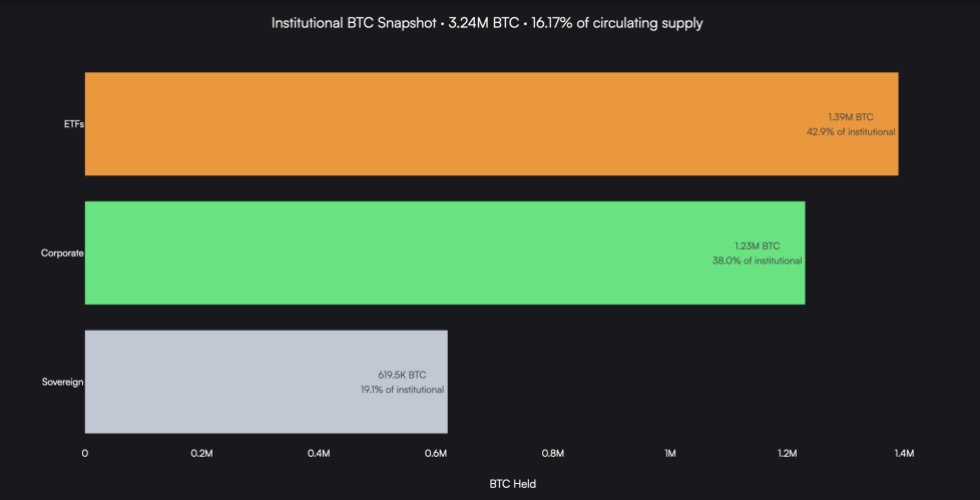
Source: Chart from On-Chain Mind on X

As seen in the chart, the Bitcoin Exchange-Traded Funds (ETFs) hold about 1.39 million BTC, reflecting around 42.9% of the entire holdings of institutions. Furthermore, Corporate firms hold 1.23 million BTC, representing 38.0% of the institutional stack. Meanwhile, approximately 619,500 BTC, which marks over 19.1% of the stash, is being held by Sovereigns.

According to On-Chain Mind, this stash is expected to grow higher than this in the next few years. A few years ago, the expert highlighted that the institutions had zero BTC in their portfolios, which strengthens its prediction about additional growth. This sudden adoption by institutional investors demonstrates Bitcoin’s evolution from a risk asset people rent to a reserve asset people fight to own across the sector.

Key Stakeholders Are Buying More BTC

Santiment, a leading on-chain data analytics platform, has outlined a renewed accumulation trend among key stakeholders amid growing momentum. While BTC’s price stayed above the $80,000 mark despite the unexpected CPI report, these investors were observed buying more BTC consistently as retail holders started to exhibit signs of hesitance. This was part of the reason that BTC was able to maintain its newfound upward move.

In the report, it was seen that wallet addresses holding between 10 and 10,000 BTC have scooped up over 16,622 BTC, representing an increase of +0.12%. Meanwhile, those holding less than 0.01 BTC have dumped 28 BTC; a drop of -0.05%.

Large stakeholder persistently adding to their bags while store displays FUD are excellent conditions for any coin, making this bullish for BTC in the short term. During most of crypto’s bull markets, this 10-10,000 BTC group has played a major role in igniting pumps while prices move opposite to retail expectations.

BTC trading at $80,971 on the 1D chart | Source: BTCUSDT on Tradingview.com

Related Questions

QWhat is the total amount of Bitcoin that institutions currently hold, according to the data analyst On-Chain Mind?

AInstitutions currently hold a staggering 3.24 million BTC, valued at approximately $261.2 billion.

QAmong the institutional Bitcoin holdings, which category holds the largest share?

ABitcoin Exchange-Traded Funds (ETFs) hold the largest share at about 1.39 million BTC, representing approximately 42.9% of the entire institutional holdings.

QHow does the article describe the change in institutional perception of Bitcoin over time?

AThe article describes Bitcoin's evolution from a speculative asset primarily held by retail investors into a well-known part of financial portfolios, seen by institutions as a reliable store of value and a strategic financial asset.

QWhat recent accumulation trend among key stakeholders did the on-chain analytics platform Santiment report?

ASantiment reported that wallet addresses holding between 10 and 10,000 BTC accumulated over 16,622 BTC (+0.12%), while addresses holding less than 0.01 BTC sold off 28 BTC (-0.05%).

QWhat does the data suggest about the growth potential of the institutional Bitcoin stash?

AThe data suggests the stash is expected to grow further. The analyst notes that institutions had zero BTC a few years ago, and the current rapid adoption indicates a strong trend of continued accumulation.

Related Reads

USDC Begins Nested Issuance, Coinbase Launches Custom Stablecoin Branding Service

Coinbase has launched its "Custom Stablecoins" platform, enabling businesses to offer branded stablecoins. The first client is Flipcash, a social payments app, which has introduced USDF. USDF is a Solana-based stablecoin, pegged 1:1 to USDC, and is designed to serve as a stable pricing and settlement unit for Flipcash's user-created community currencies. This move shifts the focus of stablecoins from being standalone assets or investment products to becoming embedded payment and settlement components within broader applications. For businesses like Flipcash, the core need is not to become a stablecoin issuer, but to integrate stable, reliable digital cash functionality—handling pricing, payments, and settlements—without managing the complex underlying infrastructure of issuance, reserves, on-chain contracts, fiat on-ramps, and compliance. Coinbase's platform provides this infrastructure as a service, positioning the exchange as a stablecoin infrastructure provider. While USDC remains the foundational reserve asset, the branded token (e.g., USDF) offers applications a tailored, user-facing financial tool. This development highlights a potential path for stablecoins to become ubiquitous backend utilities in social, gaming, and e-commerce applications, though it also brings significant regulatory and operational complexities associated with handling real user funds.

链捕手55m ago

USDC Begins Nested Issuance, Coinbase Launches Custom Stablecoin Branding Service

链捕手55m ago

Detained for 37 Days: The First Wave of People Who Got Rich from 'AI Gateways' Are Starting to Go to Jail

A prominent AI proxy service operator was reportedly detained for 37 days and is now on bail pending trial, highlighting the legal risks in China's booming but unregulated AI intermediary market. These services act as "AI scalpers," providing domestic users with access to restricted overseas models (like OpenAI, Claude) by bundling APIs, handling payments, and bypassing network blocks, all for a fee. Their controversial profitability stems from practices like bulk-registering accounts to resell free credits, exploiting refund policies, overcharging for tokens, substituting cheaper models, and illegally selling user conversation data. Major figures, including cryptocurrency entrepreneurs, are now entering this space. Legally, these operations face severe risks. Their core model often involves unauthorized API access and operating without required telecom licenses, potentially constituting illegal business operations. They fail to meet data security obligations for the vast amounts of user data they process, risking charges for failing to fulfill network security duties. Crucially, the unauthorized collection and sale of user data, which can include personal and commercial secrets, easily meets the threshold for the crime of infringing on personal information. The case underscores a critical juncture for the AI industry. While proxies lower access barriers, they expose user data to unsecured middlemen and undermine the business models of AI developers, forcing them to divert resources to security and distorting market value perceptions. The article argues that the industry's sustainable future depends on building trust, protecting data, and fostering compliant competition, moving away from its current "wild growth" phase.

marsbit1h ago

Detained for 37 Days: The First Wave of People Who Got Rich from 'AI Gateways' Are Starting to Go to Jail

marsbit1h ago

Putting Markets On-Chain: Canton Network Quietly Becomes the New Backbone of Institutional Finance

**Title: Letting the Market Itself Go On-Chain: Canton Network Quietly Becomes the New Backbone for Institutional Finance** **Summary:** The Canton Network, a blockchain platform designed for institutional finance, is gaining significant traction. A key sign of its maturity was Visa's recent entry as a super-validator, a proposal approved in just three days—highlighting prior, extensive collaboration between traditional finance and crypto. Unlike public chains like Ethereum that prioritize transparency and asset onboarding, Canton focuses on enabling confidential, compliant business operations for regulated institutions. Its core design features built-in **data visibility control**, meaning transaction details are only shared between direct counterparties. This privacy is fundamental, allowing competing institutions (like banks Goldman Sachs, JPMorgan, and BNP Paribas, all validators) to interact on the same network without exposing sensitive positions or strategies. Developed by Wall Street veterans at Digital Asset, Canton has taken a slow, deliberate approach to onboard real financial activity. It now handles over **$9 trillion monthly** in transaction volume, primarily from real-world institutional use cases like **tokenized repo agreements**, Treasury settlements, and collateral mobility. Major live applications include **JPM Coin** for institutional payments and **DTCC's tokenized U.S. Treasuries** project. Canton's native token, **CC**, is framed as a "network utility asset" with zero pre-mine or VC allocations. Its value is intended to be driven by the volume of real financial activity on the network. Looking ahead, Canton aims to become the invisible foundational layer for global finance—enabling atomic settlement (where payment and asset delivery occur simultaneously), 24/7 capital flows, and the native issuance and settlement of various asset classes, from corporate bonds to potentially equities. The main challenges are no longer technical but involve navigating fragmented global regulations and integrating with legacy financial systems.

marsbit1h ago

Putting Markets On-Chain: Canton Network Quietly Becomes the New Backbone of Institutional Finance

marsbit1h ago

Trading

Spot
Futures

Hot Articles

What is $BITCOIN

DIGITAL GOLD ($BITCOIN): A Comprehensive Analysis Introduction to DIGITAL GOLD ($BITCOIN) DIGITAL GOLD ($BITCOIN) is a blockchain-based project operating on the Solana network, which aims to combine the characteristics of traditional precious metals with the innovation of decentralized technologies. While it shares a name with Bitcoin, often referred to as “digital gold” due to its perception as a store of value, DIGITAL GOLD is a separate token designed to create a unique ecosystem within the Web3 landscape. Its goal is to position itself as a viable alternative digital asset, although specifics regarding its applications and functionalities are still developing. What is DIGITAL GOLD ($BITCOIN)? DIGITAL GOLD ($BITCOIN) is a cryptocurrency token explicitly designed for use on the Solana blockchain. In contrast to Bitcoin, which provides a widely recognized value storage role, this token appears to focus on broader applications and characteristics. Notable aspects include: Blockchain Infrastructure: The token is built on the Solana blockchain, known for its capacity to handle high-speed and low-cost transactions. Supply Dynamics: DIGITAL GOLD has a maximum supply capped at 100 quadrillion tokens (100P $BITCOIN), although details regarding its circulating supply are currently undisclosed. Utility: While precise functionalities are not explicitly outlined, there are indications that the token could be utilized for various applications, potentially involving decentralized applications (dApps) or asset tokenization strategies. Who is the Creator of DIGITAL GOLD ($BITCOIN)? At present, the identity of the creators and development team behind DIGITAL GOLD ($BITCOIN) remains unknown. This situation is typical among many innovative projects within the blockchain space, particularly those aligning with decentralized finance and meme coin phenomena. While such anonymity may foster a community-driven culture, it intensifies concerns about governance and accountability. Who are the Investors of DIGITAL GOLD ($BITCOIN)? The available information indicates that DIGITAL GOLD ($BITCOIN) does not have any known institutional backers or prominent venture capital investments. The project seems to operate on a peer-to-peer model focused on community support and adoption rather than traditional funding routes. Its activity and liquidity are primarily situated on decentralized exchanges (DEXs), such as PumpSwap, rather than established centralized trading platforms, further highlighting its grassroots approach. How DIGITAL GOLD ($BITCOIN) Works The operational mechanics of DIGITAL GOLD ($BITCOIN) can be elaborated on based on its blockchain design and network attributes: Consensus Mechanism: By leveraging Solana’s unique proof-of-history (PoH) combined with a proof-of-stake (PoS) model, the project ensures efficient transaction validation contributing to the network's high performance. Tokenomics: While specific deflationary mechanisms have not been extensively detailed, the vast maximum token supply implies that it may cater to microtransactions or niche use cases that are still to be defined. Interoperability: There exists the potential for integration with Solana’s broader ecosystem, including various decentralized finance (DeFi) platforms. However, the details regarding specific integrations remain unspecified. Timeline of Key Events Here is a timeline that highlights significant milestones concerning DIGITAL GOLD ($BITCOIN): 2023: The initial deployment of the token occurs on the Solana blockchain, marked by its contract address. 2024: DIGITAL GOLD gains visibility as it becomes available for trading on decentralized exchanges like PumpSwap, allowing users to trade it against SOL. 2025: The project witnesses sporadic trading activity and potential interest in community-led engagements, although no noteworthy partnerships or technical advancements have been documented as of yet. Critical Analysis Strengths Scalability: The underlying Solana infrastructure supports high transaction volumes, which could enhance the utility of $BITCOIN in various transaction scenarios. Accessibility: The potential low trading price per token could attract retail investors, facilitating wider participation due to fractional ownership opportunities. Risks Lack of Transparency: The absence of publicly known backers, developers, or an audit process may yield skepticism regarding the project's sustainability and trustworthiness. Market Volatility: The trading activity is heavily reliant on speculative behavior, which can result in significant price volatility and uncertainty for investors. Conclusion DIGITAL GOLD ($BITCOIN) emerges as an intriguing yet ambiguous project within the rapidly evolving Solana ecosystem. While it attempts to leverage the “digital gold” narrative, its departure from Bitcoin's established role as a store of value underscores the need for a clearer differentiation of its intended utility and governance structure. Future acceptance and adoption will likely depend on addressing the current opacity and defining its operational and economic strategies more explicitly. Note: This report encompasses synthesised information available as of October 2023, and developments may have transpired beyond the research period.

363 Total ViewsPublished 2025.05.13Updated 2025.05.13

What is $BITCOIN

Discussions

Welcome to the HTX Community. Here, you can stay informed about the latest platform developments and gain access to professional market insights. Users' opinions on the price of BTC (BTC) are presented below.

活动图片















