Bitcoin’s Civil War: Nervous Sellers Exit As Long-Term Holders Refuse To Budge

bitcoinistPublished on 2026-03-09Last updated on 2026-03-09

Abstract

Bitcoin's market is currently characterized by a divergence between short-term and long-term holders. Short-term holders, who purchased BTC around $68,000 within the past month, are actively taking profits by sending over 27,000 BTC to exchanges during price bounces above $70,000. This represents some of the highest profit-realization activity in recent months. In contrast, long-term holders, defined as those holding for more than 155 days, show minimal selling pressure. The Coin Value Days Destroyed (CVDD) metric reads 0.34, far below the 2.0 level typically associated with market tops, indicating these seasoned investors are neither selling nor accumulating aggressively. This suggests underlying stability despite short-term volatility.

Bitcoin’s holder metric is quietly telling two very different stories right now, and both give different interpretations of what to expect for the leading cryptocurrency’s price outlook.

On one side, a wave of short-term holders is rushing to lock in profits at the first sign of a price bounce, flooding exchanges with Bitcoin. On the other hand, long-term holders, the market’s most battle-hardened participants, are sitting on their coins in near-total silence, unbothered by the noise.

Short-Term Holders Cashing Out Into Strength

Bitcoin barely twitched above $70,000 for only a few days before the exits started filling up. Data highlighted by crypto analyst Darkfrost on CryptoQuant shows that short-term holder selling pressure is beginning to stand out.

Notably, more than 27,000 BTC in profit was reportedly sent to exchanges by short-term holders within a space of 24 hours, a figure that places current activity among the highest profit-realization readings seen in recent months. As shown in the chart below, the last time more BTC in profit was sent to crypto exchanges was in early January 2026.

That matters because short-term holders tend to be the market’s most reactive participants. They usually respond quickly to price swings. The chart tracking short-term holder profit and loss to exchanges shows a spike in profit-taking as Bitcoin attempted to regain footing above $70,000.

Interestingly, the cohort currently in profit are addresses who bought Bitcoin between one week and one month ago, with a realized price around $68,000. That places them in a position where even the recovery is an opportunity to de-risk. Everyone else in the short-term cohort is either at breakeven or underwater.
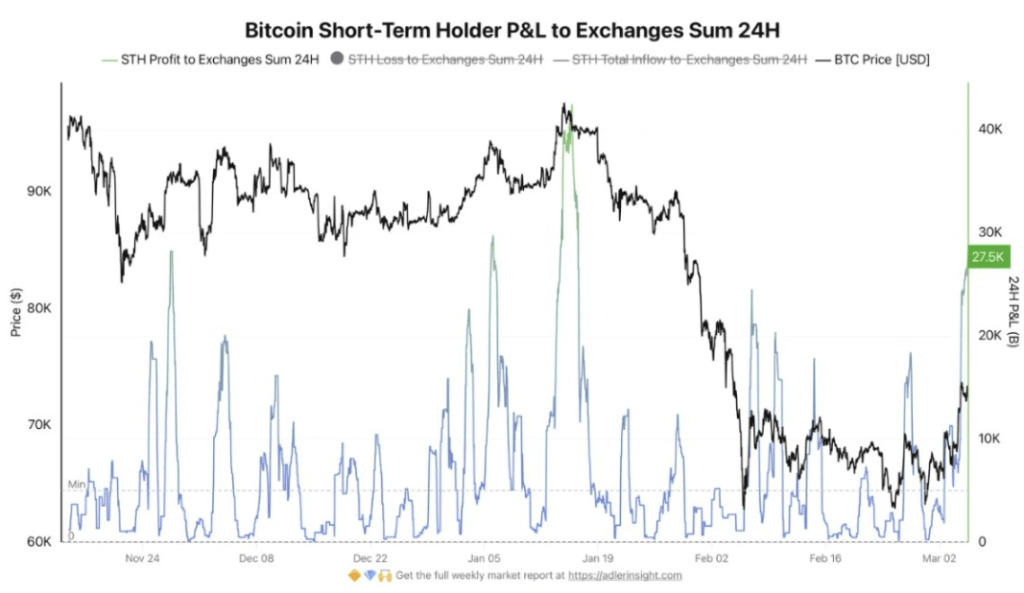
Bitcoin Short-Term Holder P&L To Exchanges. Source: CryptoQuant

Long-Term Holders Sending A Different Message

Long-term holders (LTHs), the cohort defined by holding Bitcoin for more than 155 days, are exhibiting a level of inactivity that matches conditions associated with bear market lows. According to the Coin Value Days Destroyed (CVDD) metric, which measures not just when long-held coins are moved but how much economic weight those movements carry, the current reading sits around 0.34.

To put that in context, market tops have historically formed when CVDD exceeded 2.0, which shows that LTHs are selling heavily. At 0.34, the market is nowhere near that territory. Therefore, long-term holders are, by and large, choosing to sit still and not contribute to selling pressure.

BTCUSD currently trading at $68,115. Chart: TradingView

As shown in the metric chart below, the last time long-term holders had high selling activity was in early January 2026. This matters because LTHs aren’t just a passive footnote in the Bitcoin narrative.

They are always the crypto industry’s most strategically minded participants. Right now, they appear to be waiting either for higher prices to sell into or for the price action to deteriorate enough to accumulate more.
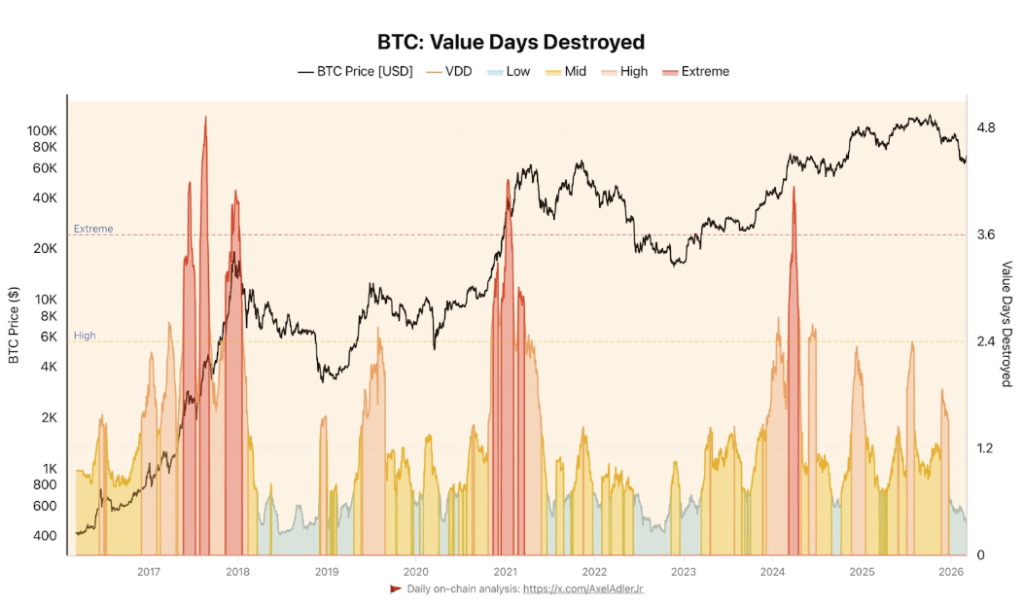
BTC: Value Days Destroyed. Source: @Darkfost_Coc On X

Featured image from Unsplash, chart from TradingView

Related Questions

QWhat are the two different stories that Bitcoin's holder metric is currently telling about the price outlook?

AOn one side, short-term holders are rushing to lock in profits and flooding exchanges with Bitcoin at the first sign of a price bounce. On the other hand, long-term holders are sitting on their coins in near-total silence, not contributing to selling pressure.

QAccording to the data from CryptoQuant, how much BTC in profit was sent to exchanges by short-term holders in a 24-hour period?

AMore than 27,000 BTC in profit was sent to exchanges by short-term holders within a space of 24 hours.

QWhat is the realized price for the cohort of short-term holders who are currently in profit, and when did they buy their Bitcoin?

AThe short-term holders currently in profit bought Bitcoin between one week and one month ago with a realized price around $68,000.

QWhat metric is used to measure the economic weight of movements by long-term holders, and what is its current reading?

AThe Coin Value Days Destroyed (CVDD) metric is used, and its current reading is around 0.34.

QWhat does the current low CVDD reading of 0.34 indicate about the behavior of long-term holders compared to historical market tops?

AA CVDD reading of 0.34 indicates that long-term holders are largely inactive and not selling heavily. This is in stark contrast to historical market tops, which form when the CVDD reading exceeds 2.0, indicating heavy selling by long-term holders.

Related Reads

Anthropic Starts Poaching Scientists? $27K Weekly Onsite Stipend to Fix Claude's Expert-Level Errors

Anthropic has launched a new STEM Fellow program, offering $3,800 per week for a three-month, in-person residency in San Francisco. The role targets experts from science, technology, engineering, and mathematics (STEM) fields—machine learning experience is helpful but not required. Instead, Anthropic values scientific judgment and a willingness to learn quickly. Fellows will work with Claude models and internal tools under the guidance of an Anthropic researcher. Example projects include a materials scientist identifying errors in Claude’s reasoning or a climate scientist integrating atmospheric modeling software with Claude. The goal is to have experts "tell Claude where it's wrong" and improve its scientific capabilities. This initiative is part of Anthropic’s broader strategy to strengthen its scientific ecosystem, following earlier programs like the AI Safety Fellows and AI for Science programs. The company acknowledges that current AI models, while powerful, still produce high-confidence errors and lack end-to-end research autonomy. The program aims to embed domain expertise directly into model development, turning scientists into "high-level reviewers" for AI. Anthropic CEO Dario Amodei has previously emphasized AI’s potential to accelerate scientific breakthroughs, particularly in biology and healthcare. The company believes that the next phase of AI competition will depend not on scaling parameters, but on integrating human expertise to refine model accuracy and reliability.

marsbit26m ago

Anthropic Starts Poaching Scientists? $27K Weekly Onsite Stipend to Fix Claude's Expert-Level Errors

marsbit26m ago

On the Eve of X Money's Launch, Musk Dismantles the Referee First

"X Money Launches After Dismantling Regulator: Musk's 9-Day Power Play" In February 2025, a team from the "Department of Government Efficiency" (DOGE), led by Elon Musk, entered the Consumer Financial Protection Bureau (CFPB) headquarters. Shortly after, the CFPB was effectively dismantled—its funding frozen, activities suspended, and nearly 90% of staff laid off. This move came just nine days after X announced a partnership with Visa and as X Money prepared to launch. The article contrasts this with the decade-long regulatory battles faced by companies like Coinbase and PayPal. Coinbase spent over $75 million in political contributions and endured a major SEC lawsuit to operate legally. PayPal complied with strict state and federal rules for its stablecoin PYUSD, including 100% reserve requirements and monthly audits. However, Musk’s approach was different. After the CFPB introduced a rule placing large digital payment apps under federal oversight, Musk tweeted "Delete CFPB." Within months, the rule was revoked by Congress. Meanwhile, DOGE operatives gained "god-tier" access to CFPB databases, potentially obtaining sensitive competitive information from rivals like Apple, Google, and PayPal. The article also highlights a "suspicious exemption clause" in the GENIUS Act, which allows private companies like X to issue stablecoins with fewer restrictions. Senator Elizabeth Warren questioned whether Musk, who was a senior presidential advisor during the Act’s drafting, influenced this clause. X Money offers a 6% APY on deposits, despite FDIC warnings that stablecoin users are not insured. As X Money launches to 600 million monthly users, the article questions the fairness of a system where Musk can bypass regulations that others spent years and millions to comply with. The dismantling of the CFPB and the alleged regulatory advantages raise concerns about the future of equitable rule-making in the U.S. financial system.

marsbit34m ago

On the Eve of X Money's Launch, Musk Dismantles the Referee First

marsbit34m ago

Trading

Spot
Futures

Hot Articles

What is $BITCOIN

DIGITAL GOLD ($BITCOIN): A Comprehensive Analysis Introduction to DIGITAL GOLD ($BITCOIN) DIGITAL GOLD ($BITCOIN) is a blockchain-based project operating on the Solana network, which aims to combine the characteristics of traditional precious metals with the innovation of decentralized technologies. While it shares a name with Bitcoin, often referred to as “digital gold” due to its perception as a store of value, DIGITAL GOLD is a separate token designed to create a unique ecosystem within the Web3 landscape. Its goal is to position itself as a viable alternative digital asset, although specifics regarding its applications and functionalities are still developing. What is DIGITAL GOLD ($BITCOIN)? DIGITAL GOLD ($BITCOIN) is a cryptocurrency token explicitly designed for use on the Solana blockchain. In contrast to Bitcoin, which provides a widely recognized value storage role, this token appears to focus on broader applications and characteristics. Notable aspects include: Blockchain Infrastructure: The token is built on the Solana blockchain, known for its capacity to handle high-speed and low-cost transactions. Supply Dynamics: DIGITAL GOLD has a maximum supply capped at 100 quadrillion tokens (100P $BITCOIN), although details regarding its circulating supply are currently undisclosed. Utility: While precise functionalities are not explicitly outlined, there are indications that the token could be utilized for various applications, potentially involving decentralized applications (dApps) or asset tokenization strategies. Who is the Creator of DIGITAL GOLD ($BITCOIN)? At present, the identity of the creators and development team behind DIGITAL GOLD ($BITCOIN) remains unknown. This situation is typical among many innovative projects within the blockchain space, particularly those aligning with decentralized finance and meme coin phenomena. While such anonymity may foster a community-driven culture, it intensifies concerns about governance and accountability. Who are the Investors of DIGITAL GOLD ($BITCOIN)? The available information indicates that DIGITAL GOLD ($BITCOIN) does not have any known institutional backers or prominent venture capital investments. The project seems to operate on a peer-to-peer model focused on community support and adoption rather than traditional funding routes. Its activity and liquidity are primarily situated on decentralized exchanges (DEXs), such as PumpSwap, rather than established centralized trading platforms, further highlighting its grassroots approach. How DIGITAL GOLD ($BITCOIN) Works The operational mechanics of DIGITAL GOLD ($BITCOIN) can be elaborated on based on its blockchain design and network attributes: Consensus Mechanism: By leveraging Solana’s unique proof-of-history (PoH) combined with a proof-of-stake (PoS) model, the project ensures efficient transaction validation contributing to the network's high performance. Tokenomics: While specific deflationary mechanisms have not been extensively detailed, the vast maximum token supply implies that it may cater to microtransactions or niche use cases that are still to be defined. Interoperability: There exists the potential for integration with Solana’s broader ecosystem, including various decentralized finance (DeFi) platforms. However, the details regarding specific integrations remain unspecified. Timeline of Key Events Here is a timeline that highlights significant milestones concerning DIGITAL GOLD ($BITCOIN): 2023: The initial deployment of the token occurs on the Solana blockchain, marked by its contract address. 2024: DIGITAL GOLD gains visibility as it becomes available for trading on decentralized exchanges like PumpSwap, allowing users to trade it against SOL. 2025: The project witnesses sporadic trading activity and potential interest in community-led engagements, although no noteworthy partnerships or technical advancements have been documented as of yet. Critical Analysis Strengths Scalability: The underlying Solana infrastructure supports high transaction volumes, which could enhance the utility of $BITCOIN in various transaction scenarios. Accessibility: The potential low trading price per token could attract retail investors, facilitating wider participation due to fractional ownership opportunities. Risks Lack of Transparency: The absence of publicly known backers, developers, or an audit process may yield skepticism regarding the project's sustainability and trustworthiness. Market Volatility: The trading activity is heavily reliant on speculative behavior, which can result in significant price volatility and uncertainty for investors. Conclusion DIGITAL GOLD ($BITCOIN) emerges as an intriguing yet ambiguous project within the rapidly evolving Solana ecosystem. While it attempts to leverage the “digital gold” narrative, its departure from Bitcoin's established role as a store of value underscores the need for a clearer differentiation of its intended utility and governance structure. Future acceptance and adoption will likely depend on addressing the current opacity and defining its operational and economic strategies more explicitly. Note: This report encompasses synthesised information available as of October 2023, and developments may have transpired beyond the research period.

363 Total ViewsPublished 2025.05.13Updated 2025.05.13

What is $BITCOIN

Discussions

Welcome to the HTX Community. Here, you can stay informed about the latest platform developments and gain access to professional market insights. Users' opinions on the price of BTC (BTC) are presented below.

活动图片