Bitcoin Treasury Firm Strategy To Repurchase $1.5B Of Convertible Notes — Details

bitcoinistPublished on 2026-05-17Last updated on 2026-05-17

Abstract

Bitcoin treasury firm Strategy (formerly MicroStrategy) plans to repurchase approximately $1.5 billion of its convertible notes due in 2029 for an estimated $1.38 billion. According to a filing with the SEC, the company will fund the buyback using cash reserves, proceeds from securities sales, and/or potential sales of Bitcoin. This move, authorized by Chairman Michael Saylor, follows recent comments from CEO Phong Le about possible scenarios for selling Bitcoin to enhance shareholder value. The repurchase could positively impact equity holders by preventing future stock dilution. The news follows a record $1.53 billion trading volume for Strategy's preferred stock (STRC), a key instrument for its Bitcoin acquisitions. The firm remains the largest corporate Bitcoin holder with 818,869 BTC.

Bitcoin treasury company Strategy (formerly MicroStrategy) has disclosed its intention to repurchase $1.5 billion of its 2029 convertible debt notes. This move comes amid commentary on the shift in the Michael Saylor-led firm’s “Never Sell” perspective, intensifying focus on the company’s market actions in the coming weeks.

Will Strategy Sell Bitcoin To Repurchase Its Debt?

In a May 15th post on the social media platform X, Strategy’s chairman, Michael Saylor, confirmed that the firm has filed to repurchase $1.5 billion principal amount of its convertible senior notes due in 2029. This decision comes as part of the outcome of privately negotiated transactions with holders of this debt security.

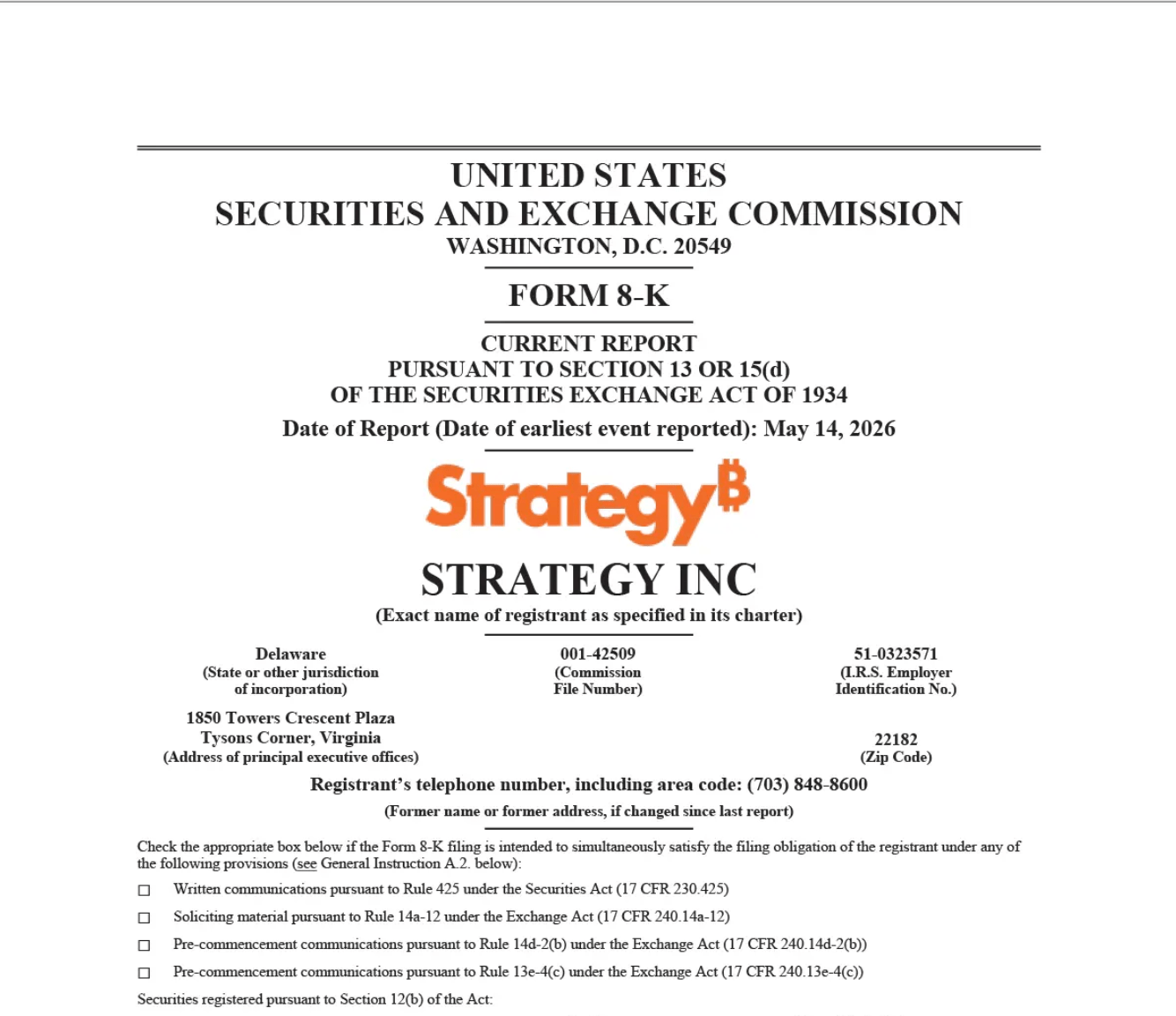
In the Form 8-K filed with the United States Securities and Exchange Commission (SEC) on May 14th, Strategy disclosed that it agreed to retire approximately $1.50 billion in aggregate principal amount of the 2029 Notes for an estimated aggregate cash repurchase price of approximately $1.38 billion.
Source: Strategy

The official filing read:

The final aggregate cash repurchase price for the Repurchased Notes is subject to adjustment, and will be based in part on the daily volume-weighted average price per share of Strategy’s class A common stock, par value $0.001 per share (the “Class A Common Stock”), during an agreed upon measurement period (the “Measurement Period”).

The Bitcoin treasury firm also revealed that these repurchase transactions will be funded with available cash reserves, proceeds from sales of securities under its at-the-market offering program, and/or proceeds from the sale of Bitcoin. Quite interestingly, this filing comes barely a week after the company’s CEO, Phong Le, highlighted scenarios in which the firm might shed some of its Bitcoin holdings.

According to the executive, this included situations that would increase shareholder value, such as dividend payments. It remains to be seen whether the firm debt repurchase falls into the category of activities that warrants the sale of a portion of its Bitcoin.

Merely looking at the action, retiring these convertible notes could be positive for equity investors, as it means that the hybrid debt instrument holders won’t be able to convert to common stock (and potentially dilute the shareholders). Instead, the repurchase gives Strategy a perfect opportunity to reorganize its balance sheet and capital structure.

Strategy’s STRC Registers Record High Daily Trading Volume

Interestingly, the news of this debt repurchase comes merely a day after STRC, Strategy’s Variable Rate Series A Perpetual Stretch Preferred Stock, posted its highest daily trading volume of $1.53 billion on Thursday, May 14th. This represents a significant jump from the previous record of $1.1 bill reached on April 13.

This trading explosion in STRC, which has been Strategy’s capital-raising instrument for purchasing Bitcoin, could help the firm raise about $735 million to buy BTC. As of this writing, the firm maintains its position as the largest corporate Bitcoin holder, with a stash of 818,869 Bitcoin, worth about $66 billion.

The price of BTC on the daily timeframe | Source: BTCUSDT chart on TradingView

Related Questions

QWhat is the Bitcoin treasury firm formerly known as MicroStrategy planning to repurchase?

AThe Bitcoin treasury firm Strategy (formerly MicroStrategy) is planning to repurchase $1.5 billion principal amount of its convertible senior notes due in 2029.

QHow does Strategy plan to fund the repurchase of its convertible notes?

AStrategy plans to fund the repurchase transactions with available cash reserves, proceeds from sales of securities under its at-the-market offering program, and/or proceeds from the sale of Bitcoin.

QWhy could retiring the convertible notes be positive for Strategy's equity investors?

ARetiring the convertible notes could be positive for equity investors because it prevents holders of the debt instrument from converting to common stock, which would potentially dilute the shareholders. It also gives Strategy an opportunity to reorganize its balance sheet and capital structure.

QWhat recent record was set by Strategy's STRC preferred stock, and what could it enable the firm to do?

AStrategy's STRC (Variable Rate Series A Perpetual Stretch Preferred Stock) posted its highest daily trading volume of $1.53 billion on May 14th. This trading activity could help the firm raise about $735 million to buy Bitcoin.

QHow much Bitcoin does Strategy currently hold, and what is its approximate value?

AStrategy currently holds 818,869 Bitcoin, which is worth approximately $66 billion, maintaining its position as the largest corporate Bitcoin holder.

Related Reads

In-Depth Research Report on U.S. Crypto Equity Market in 2026 — Opportunities, Risks, and Portfolio Allocation Framework

Since the U.S. Securities and Exchange Commission (SEC) historically approved spot Bitcoin ETFs in January 2024, the U.S. crypto investment landscape has undergone a profound maturation process. In 2026, investors can participate in the crypto market through four primary channels: spot ETFs, crypto-related public equities (including miners and treasury companies), leveraged and inverse ETFs, and blockchain-themed funds. As of March 30, 2026, U.S. spot Bitcoin ETFs collectively held approximately 1.29 million BTC, representing roughly $86.9 billion in assets under management (AUM), while spot Ethereum ETFs reached approximately $18 billion in AUM. Notably, the rise of the Ethereum treasury company model is reshaping the logic of institutional participation. Exemplified by Bitmine Immersion Technologies (BMNR), these firms generate native on-chain yield annually through ETH staking, creating a fundamentally different business resilience model compared with traditional Bitcoin treasury companies. On the regulatory front, the 2025 GENIUS Act established the first federal stablecoin framework in the United States. The U.S. Strategic Bitcoin Reserve has been officially established, banks have been authorized to provide crypto custody services, and major compliance bottlenecks have been definitively removed. Nevertheless, the high volatility of leveraged ETFs, the balance-sheet risks embedded in treasury-company financing structures, and the slashing risk of staked assets continue to pose investment obstacles that cannot be overlooked. For investors seeking exposure to this sector, building a tiered portfolio comprising core holdings, sector beta exposure, and high-risk tactical position may be the most viable path of participation.

HTX Learn10m ago

In-Depth Research Report on U.S. Crypto Equity Market in 2026  — Opportunities, Risks, and Portfolio Allocation Framework

HTX Learn10m ago

Viewpoint: After Surviving the Death Cycle, Why Has Privacy Pioneer Zcash Returned to the Mainstream Spotlight?

Zcash, the pioneering privacy-focused cryptocurrency built with zero-knowledge proof (ZK) technology, is re-emerging as a major narrative. Having survived a "death cycle" and proven its resilient community, Zcash is now positioned at a unique convergence of factors driving renewed institutional and retail interest. Key catalysts include the increasing institutionalization of crypto (e.g., BlackRock's ETF), which creates a "Trojan horse" for privacy adoption through Zcash's transparent mode. The rise of AI-powered on-chain surveillance makes financial privacy a critical necessity, not just for niche users but for mainstream wealth preservation against overreach. ZK technology has finally matured to enable practical, user-friendly private transactions, a core advantage over older "obfuscation" methods like Monero's ring signatures. Zcash’s narrative as "private Bitcoin"—a fork with the same 2100M cap and PoW—is simple and powerful. It competes in the store-of-value arena, offering cryptographic privacy as a fundamental human right. Its development roadmap is robust, featuring a soon-to-be-complete quantum resistance upgrade for its shielded pool, faster block times, and improved wallet support (e.g., from Ledger). With backing from major funds and a growing developer ecosystem, Zcash is seen as leading the crucial reintegration of privacy into the crypto landscape, fulfilling the original cypherpunk vision.

marsbit18m ago

Viewpoint: After Surviving the Death Cycle, Why Has Privacy Pioneer Zcash Returned to the Mainstream Spotlight?

marsbit18m ago

Conversation with Glassnode Analyst: Bitcoin Bull Market Has Restarted, Current Market Still in 'Sell on Rally' Phase

Bitcoin analyst Checkmate believes the cryptocurrency market is now in a bull phase following a likely capitulation event in June, with an 80% probability the $60,000 low marked the bottom. However, he expects a prolonged consolidation period, similar to past cycles. Key resistance levels are identified at $78,000 (short-term cost basis), $85,000 (a critical supply zone and 200-day moving average), and $95,000. Sustained price appreciation requires consistent capital inflows, with institutions expected to enter more aggressively if Bitcoin surpasses $100,000. The discussion extends to macroeconomics, where rising global bond yields signal a loss of trust in government fiscal management. Checkmate argues this reflects a broader monetary regime change, where Bitcoin and gold will serve as primary stores of value outside the traditional system, while fiat currencies like the USD act as mediums of exchange. Finally, Checkmate criticizes proposed Australian capital gains tax reforms, calling them a "wealth grab." The plan to replace a 50% discount for assets held over a year with inflation indexing based on low CPI rates would drastically increase effective tax rates, punishing savers and investors trying to overcome the country's severe housing affordability crisis. He urges public opposition to prevent such policies from spreading globally.

marsbit1h ago

Conversation with Glassnode Analyst: Bitcoin Bull Market Has Restarted, Current Market Still in 'Sell on Rally' Phase

marsbit1h ago

Trading

Spot
Futures
活动图片





