Bitcoin Slides Beneath $77K Support While Bitcoin Hyper Presale Capitalizes on L2 Narrative

bitcoinistPublished on 2026-02-04Last updated on 2026-02-04

Abstract

Bitcoin recently dipped below the key $77,000 support level, driven by short-term profit-taking and a cooling of futures funding rates. However, on-chain analysis suggests this is not a mass exit but a rotation of capital. Liquidity is moving toward Bitcoin Layer 2 scaling solutions, with significant interest in the Bitcoin Hyper ($HYPER) presale, which has raised over $31 million. The project integrates the Solana Virtual Machine (SVM) to offer high-speed execution and sub-second finality while using Bitcoin for secure settlement. This addresses scalability issues, enabling DeFi, gaming, and high-frequency trading on Bitcoin. Smart money accumulation indicates strong conviction in Bitcoin's programmability narrative.

Bitcoin dipped below the psychological $77,000 threshold this week.

While technical analysts are calling it a necessary leverage flush rather than a capitulation, the red candles still draw bearish clicks. But look past the headline number, and the on-chain reality tells a different story.

We aren’t seeing a mass exit; we’re seeing rotation. There’s a sharp divergence between spot price stagnation and the aggressive increase in infrastructure investment.

This retracement seems driven by short-term profit-taking and a cooling of perpetual futures funding rates (which, frankly, had reached unsustainable levels).

However, most coverage misses where that liquidity is going. It isn’t exiting back to fiat. Instead, it’s moving further out on the risk curve, specifically targeting protocols that solve Bitcoin’s notorious scalability bottlenecks.

The market realizes that for Bitcoin to evolve beyond its ‘digital gold’ status, it needs a robust execution layer. Smart money is watching the Layer 2 sector because history suggests that during L1 consolidation phases, infrastructure tokens often outperform.

That rotation has catalyzed massive interest in Bitcoin Hyper ($HYPER), a project commanding serious attention in its presale phase.

You can buy $HYPER here.

Bitcoin Hyper Deploys SVM Integration to Solve L1 Congestion

While the broader market feels indecisive, Bitcoin Hyper ($HYPER) is attacking the primary friction point preventing institutional DeFi adoption on Bitcoin: latency.

y integrating the Solana Virtual Machine (SVM) as a Layer 2 execution environment, the project offers an architecture that looks nothing like the sluggish, EVM-equivalent rollups of the past.

Why does that matter? Because high-frequency trading and complex DeFi apps require sub-second finality, something the Bitcoin mainnet, with its 10-minute blocks, simply can’t provide.
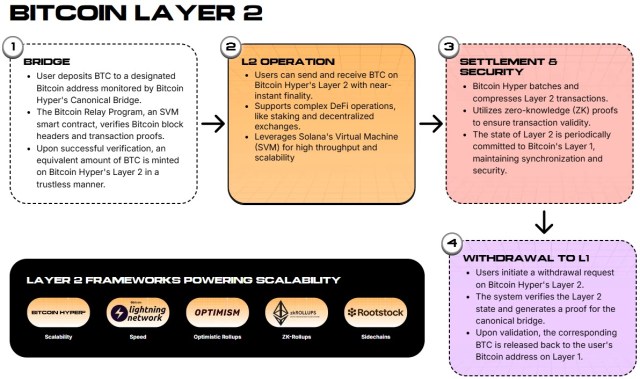
Bitcoin Hyper takes a modular approach. It uses the Bitcoin L1 strictly for settlement (security), while the SVM L2 handles real-time execution (speed). This lets developers write in Rust using the existing, mature Solana SDK. It effectively bridges Solana’s speed with Bitcoin’s security guarantees.

The protocol also introduces a Decentralized Canonical Bridge to mitigate the risks often associated with wrapped assets. For developers, this opens the door to building payments, lending protocols, and gaming dApps that settle on Bitcoin without the prohibitive fees.

Explore the technical whitepaper at Bitcoin Hyper.

$HYPER is available here.

Whales Accumulate $31M in Presale as Smart Money Targets Layer 2 Utility

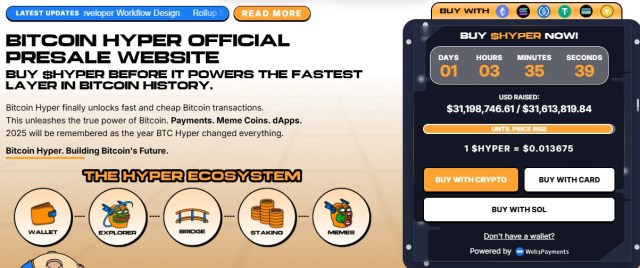
The disconnect between Bitcoin’s price dip and the funding pouring into its L2 ecosystem is backed by hard numbers. According to official project data, Bitcoin Hyper has successfully raised over $31.2M in its ongoing presale.

With the token currently priced at $0.0136751, the valuation suggests investors are pricing in a significant premium on the ‘Bitcoin Programmability’ narrative.
On-chain forensics show that high-net-worth wallets are positioning themselves aggressively before the Token Generation Event (TGE).
Seeing that kind of institutional-grade accumulation during a general market downturn is a strong signal of conviction.

Investors seem particularly drawn to the incentive structure. The project offers immediate staking after TGE with a 7-day vesting period for presale participants. This setup is designed to prevent immediate post-launch dumping while rewarding governance participation.

Between the high APY staking and the utility of using $HYPER for gas, the project offers a dual-value mechanism that stands out in a crowded market.

Visit the $HYPER presale now.

Disclaimer: The content provided in this article is for informational purposes only and does not constitute financial advice. Cryptocurrency investments are highly volatile and carry significant risk. Always perform your own due diligence before making investment decisions.


Related Reads

Anthropic Cries Wolf: Is the AGI Threat Real, or Just an IPO Story?

Anthropic has published an article titled "When AI builds itself," discussing the emerging concept of "recursive self-improvement," where AI begins to actively participate in designing, training, testing, and optimizing its own subsequent versions. The company presents internal data showing that by May 2026, over 80% of code merged into its codebase was written by Claude, its AI model. Claude's capabilities have expanded to handling complex, open-ended engineering tasks, achieving a 76% success rate in such areas, and even contributing to research processes, such as optimizing code performance and conducting AI safety experiments. Anthropic outlines an evolution from human-driven development to AI-assisted workflows, culminating in the current stage where AI agents can autonomously write, run, and delegate code. The company cautions that the path toward a "closed loop," where AI continuously improves itself, is becoming visible. It calls for coordinated global mechanisms to potentially slow or pause frontier AI development to allow safety research and societal structures to catch up. However, the timing of this warning coincides with Anthropic's preparations for an IPO, framing the narrative not just as a safety concern but also as a demonstration of Claude's advanced capabilities and its integral role in accelerating Anthropic's own R&D—creating a potential "flywheel" effect for competitive advantage. This contrasts with OpenAI's recent, more policy-oriented discussion of the same risks, highlighting the competitive dynamics in the AI industry as companies position themselves in both the technological and regulatory landscape.

marsbit35m ago

Anthropic Cries Wolf: Is the AGI Threat Real, or Just an IPO Story?

marsbit35m ago

BIT Research: ETF Purchases Have Slowed, Strategy (MicroStrategy) Has Slowed, What Else Can Drive Bitcoin's Rise?

Market Refocus on Inflation and Rate Expectations Weighs on Bitcoin Currently, the market is in a phase of macro-repricing dominated by inflation and interest rate expectations. Bitcoin, which previously benefited from easy liquidity and low inflation, is seeing its core bullish drivers weaken. These drivers were market expectations for interest rate cuts and strong inflows from Bitcoin ETFs and institutions like MicroStrategy (referred to as "Strategy" in the text). The logic has shifted. Recent high inflation data (e.g., CPI hitting 3.8% in a May 2026 report) has caused the market to sharply reduce its rate cut expectations for 2025 and even price in potential hikes. This is a key constraint for Bitcoin, as it lacks cash flows and is highly sensitive to rate expectations. Concurrently, institutional capital flows have slowed significantly. Following the hot CPI data, Bitcoin ETFs saw accelerated outflows, with around $4.3 billion leaving over a period. MicroStrategy's ability to keep adding substantial Bitcoin to its balance sheet is also diminishing. Together, ETF and MicroStrategy holdings total roughly $110 billion, but their momentum as growth engines is cooling. In summary, Bitcoin's current pressure stems not from its own fundamentals but from a changing macro environment. As long as inflation stays elevated, Bitcoin is likely to remain in a consolidating phase. However, historically, inflation eventually peaks. Once it recedes and rate cut expectations rebuild, institutional capital could return, potentially fueling a new and more robust recovery phase for Bitcoin.

marsbit43m ago

BIT Research: ETF Purchases Have Slowed, Strategy (MicroStrategy) Has Slowed, What Else Can Drive Bitcoin's Rise?

marsbit43m ago

Earning 1000 Trillion in Half a Year, 'Pocketing' 20 Million per Capita: This Round of Wealth Creation in the Korean Stock Market is Unprecedented in Scale

The South Korean stock market is experiencing an unprecedented wealth surge in 2026, with household equity and fund asset values soaring by over 1,000 trillion KRW (~$730bn) year-to-date. This translates to an average per capita wealth increase of roughly 20 million KRW, fueled by a historic 109% rally in the KOSPI index. The boom is driven by three converging forces: an AI-driven semiconductor supercycle boosting giants like Samsung and SK Hynix; the government's "Value-Up" market reforms addressing long-standing corporate governance issues; and aggressive real estate regulations that have locked capital within financial markets, preventing profits from flowing back into property. This has triggered a wealth effect, boosting high-end consumption significantly. However, the gains are highly concentrated. The two semiconductor behemoths account for over half the index's value, but retail investors own relatively low stakes in them, systematically missing the biggest rallies. Wealth and consumption benefits are skewed towards luxury goods and imported cars, bypassing mainstream retail. Further risks stem from excessive leverage, with high trading volume in leveraged ETFs, and a market sentiment heavily reliant on the AI sector's fortunes and speculative rumors. While this cycle marks a potential shift from real estate to equities as a primary wealth generator for Koreans, its sustainability, amid structural imbalances and leverage, remains a critical test.

marsbit48m ago

Earning 1000 Trillion in Half a Year, 'Pocketing' 20 Million per Capita: This Round of Wealth Creation in the Korean Stock Market is Unprecedented in Scale

marsbit48m ago

Trading

Spot
Futures

Hot Articles

What is $BITCOIN

DIGITAL GOLD ($BITCOIN): A Comprehensive Analysis Introduction to DIGITAL GOLD ($BITCOIN) DIGITAL GOLD ($BITCOIN) is a blockchain-based project operating on the Solana network, which aims to combine the characteristics of traditional precious metals with the innovation of decentralized technologies. While it shares a name with Bitcoin, often referred to as “digital gold” due to its perception as a store of value, DIGITAL GOLD is a separate token designed to create a unique ecosystem within the Web3 landscape. Its goal is to position itself as a viable alternative digital asset, although specifics regarding its applications and functionalities are still developing. What is DIGITAL GOLD ($BITCOIN)? DIGITAL GOLD ($BITCOIN) is a cryptocurrency token explicitly designed for use on the Solana blockchain. In contrast to Bitcoin, which provides a widely recognized value storage role, this token appears to focus on broader applications and characteristics. Notable aspects include: Blockchain Infrastructure: The token is built on the Solana blockchain, known for its capacity to handle high-speed and low-cost transactions. Supply Dynamics: DIGITAL GOLD has a maximum supply capped at 100 quadrillion tokens (100P $BITCOIN), although details regarding its circulating supply are currently undisclosed. Utility: While precise functionalities are not explicitly outlined, there are indications that the token could be utilized for various applications, potentially involving decentralized applications (dApps) or asset tokenization strategies. Who is the Creator of DIGITAL GOLD ($BITCOIN)? At present, the identity of the creators and development team behind DIGITAL GOLD ($BITCOIN) remains unknown. This situation is typical among many innovative projects within the blockchain space, particularly those aligning with decentralized finance and meme coin phenomena. While such anonymity may foster a community-driven culture, it intensifies concerns about governance and accountability. Who are the Investors of DIGITAL GOLD ($BITCOIN)? The available information indicates that DIGITAL GOLD ($BITCOIN) does not have any known institutional backers or prominent venture capital investments. The project seems to operate on a peer-to-peer model focused on community support and adoption rather than traditional funding routes. Its activity and liquidity are primarily situated on decentralized exchanges (DEXs), such as PumpSwap, rather than established centralized trading platforms, further highlighting its grassroots approach. How DIGITAL GOLD ($BITCOIN) Works The operational mechanics of DIGITAL GOLD ($BITCOIN) can be elaborated on based on its blockchain design and network attributes: Consensus Mechanism: By leveraging Solana’s unique proof-of-history (PoH) combined with a proof-of-stake (PoS) model, the project ensures efficient transaction validation contributing to the network's high performance. Tokenomics: While specific deflationary mechanisms have not been extensively detailed, the vast maximum token supply implies that it may cater to microtransactions or niche use cases that are still to be defined. Interoperability: There exists the potential for integration with Solana’s broader ecosystem, including various decentralized finance (DeFi) platforms. However, the details regarding specific integrations remain unspecified. Timeline of Key Events Here is a timeline that highlights significant milestones concerning DIGITAL GOLD ($BITCOIN): 2023: The initial deployment of the token occurs on the Solana blockchain, marked by its contract address. 2024: DIGITAL GOLD gains visibility as it becomes available for trading on decentralized exchanges like PumpSwap, allowing users to trade it against SOL. 2025: The project witnesses sporadic trading activity and potential interest in community-led engagements, although no noteworthy partnerships or technical advancements have been documented as of yet. Critical Analysis Strengths Scalability: The underlying Solana infrastructure supports high transaction volumes, which could enhance the utility of $BITCOIN in various transaction scenarios. Accessibility: The potential low trading price per token could attract retail investors, facilitating wider participation due to fractional ownership opportunities. Risks Lack of Transparency: The absence of publicly known backers, developers, or an audit process may yield skepticism regarding the project's sustainability and trustworthiness. Market Volatility: The trading activity is heavily reliant on speculative behavior, which can result in significant price volatility and uncertainty for investors. Conclusion DIGITAL GOLD ($BITCOIN) emerges as an intriguing yet ambiguous project within the rapidly evolving Solana ecosystem. While it attempts to leverage the “digital gold” narrative, its departure from Bitcoin's established role as a store of value underscores the need for a clearer differentiation of its intended utility and governance structure. Future acceptance and adoption will likely depend on addressing the current opacity and defining its operational and economic strategies more explicitly. Note: This report encompasses synthesised information available as of October 2023, and developments may have transpired beyond the research period.

363 Total ViewsPublished 2025.05.13Updated 2025.05.13

What is $BITCOIN

Discussions

Welcome to the HTX Community. Here, you can stay informed about the latest platform developments and gain access to professional market insights. Users' opinions on the price of BTC (BTC) are presented below.

活动图片














