Bitcoin Should Wait On Quantum Fixes, Says Epoch Ventures

bitcoinistPublished on 2026-01-23Last updated on 2026-01-23

Abstract

Epoch Ventures founder Erik Yakes advises against rushing quantum-resistant upgrades for Bitcoin, arguing the quantum computing threat remains unproven and premature action could impose long-term efficiency costs. He attributes recent quantum anxiety to behavioral biases rather than technical evidence, noting quantum computers haven't factored numbers larger than 15. Yakes emphasizes that quantum-resistant signatures currently consume excessive block space, potentially reducing network throughput. He recommends leveraging existing taproot address features for short-term protection and allowing more efficient solutions to develop. Governance challenges and the risk of locking in inefficient protocols outweigh immediate quantum concerns, which he considers less urgent than geopolitical or monetary risks.

Epoch Ventures founder Erik Yakes is urging bitcoin investors and protocol watchers to slow down on quantum “panic” and resist premature upgrades, arguing that the practical threat to Bitcoin’s cryptography remains unproven and that moving too early could lock the network into inefficient signature schemes for years.

In a section on quantum risk in his 2026 Bitcoin Ecosystem report, Yakes framed the late-2025 flare-up in quantum anxiety as something closer to a behavioral event than a technical one. He wrote that “a focus on quantum computing risks to bitcoin’s underlying cryptography potentially drove an institutional investor sell-off,” and attributed that reaction to “loss aversion, herd mentality, and availability.” The core of his argument is not that quantum computing is irrelevant, but that the market’s implied timeline is being built on expectations rather than observable progress.

At the center of the debate is “Neven’s law,” the idea that quantum computational power grows at a doubly exponential rate relative to classical computing, sometimes translated into a claim that the clock to break Bitcoin’s cryptography could be “as short as 5 years.” Yakes pushed back on treating that as an empirical trajectory. He compared it to Moore’s law, but drew a sharp distinction: “Moore’s law was an observation. Neven’s law is not an observation because logical qubits are not increasing at such a rate. Neven’s law is an expectation of experts.”

Yakes’ skepticism is anchored in what he characterizes as the gap between lab metrics and real-world cryptographic capability. “Today, quantum computers have not observably factored a number greater than 15,” he wrote, arguing that the industry has yet to demonstrate the kind of scaling evidence that would make the threat tangible to Bitcoin. Progress, in his view, has been largely confined to “physical (not logical) qubits” and declining error rates, without translating into the logical-qubit reliability needed for meaningful factorization. Rising physical qubits and lower error rates are not increasing logical qubits and factorization,” he said.

He also highlighted a compounding problem that could limit practical breakthroughs even if headline qubit counts climb: “a potentially existential issue for quantum computing is that error rates scale exponentially with the number of qubits.” If that relationship persists, Yakes suggested, quantum systems may not convert theoretical scaling into usable cryptographic attacks. He went further, arguing that in a world where algorithmic improvements and classical hardware continue to advance, “it may even be more likely that classical computers, through Moore’s law and algorithm improvements, break the cryptography used by Bitcoin before quantum computers do.”

Bitcoin Could Pay A High Price If It Rushes Quantum Signatures

Where Yakes becomes most concrete is in describing the trade-offs of “quantum-resistant” mitigation. He doesn’t argue the ecosystem lacks candidate solutions, he argues the network should be careful about choosing the wrong one too early. “Quantum-resistant signature algorithms exist — implementing one of them is not the issue,” he wrote. “The issue is that they’re all too large for Bitcoin and would consume block space, thereby lowering transaction throughput on the network. New signatures emerging today are being tested and are increasingly data-efficient.”

That sizing problem is central to his warning about premature action. In a network where block space is scarce and transaction throughput is a persistent constraint, large signature schemes don’t just change security posture; they reshape the economics of using the chain. Yakes called out what he sees as the “worst-case scenario” for quantum risk planning: not a sudden cryptographic collapse, but a rushed upgrade that hard-codes an avoidable performance penalty.

“The worst-case scenario we see for quantum risk is that a solution is implemented prematurely, with an exponentially lower efficiency trade-off had we waited longer before implementing,” he wrote.

Yakes pointed to existing research and mitigation pathways that could buy time if quantum progress suddenly accelerates. He cited Chaincode Labs’ work recommending “a 2-year contingency plan and a 7-year comprehensive plan,” and described a near-term lever tied to modern Bitcoin script and address design.

“For the short-term contingency plan, we know that taproot address types can make commitments to spend before the public key is revealed — thus hiding the public key from a quantum computer and protecting quantum-vulnerable public keys,” he wrote. “Basically, modern address types have a hidden form of quantum resistance that can be unlocked, and this could be used if quantum factorization suddenly grows exponentially.”

The harder question, in his telling, is governance and coordination. Bitcoin’s bar for consensus is deliberately high, and “achieving bitcoin consensus for improvement proposals is very challenging,” Yakes noted, emphasizing the ecosystem’s history of adopting soft forks. If an existential threat materialized, he expects a broader stakeholder alignment could emerge, yet he still flags the risk that any adopted signature transition “would materially decrease the efficiency of the blockchain,” pointing to ongoing work by “the BIP360 team” on such proposals.

For investors, Yakes’ bottom line is to triage: quantum is worth understanding, but not worth displacing more immediate risks in a “geopolitical environment with monetary commodities and fiat currencies.” “We do not view quantum computing as a primary risk for the reasons above,” he wrote. “If you’re reducing your allocation because of quantum risk, you’re being driven by behavioral bias and failing to see the benefits of a bitcoin allocation on net.”

At press time, BTC traded at $90,046.
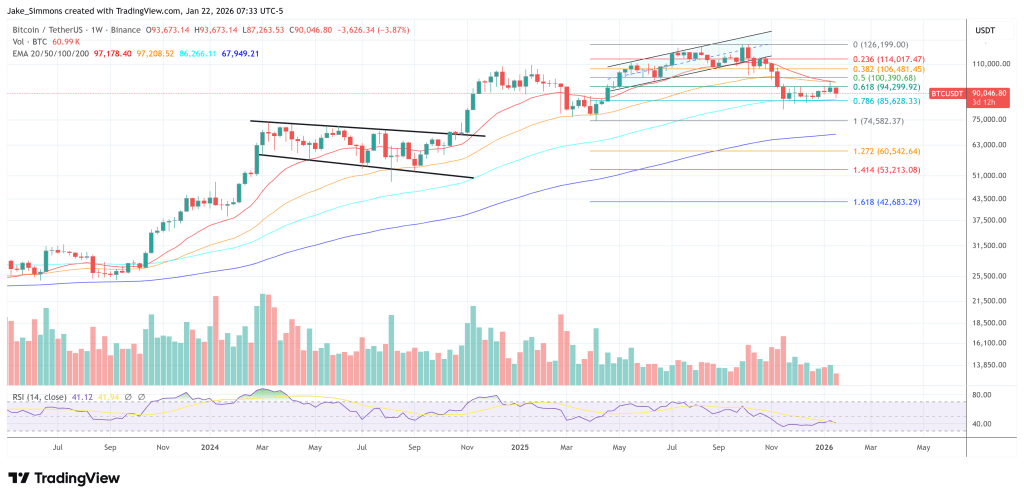
Bitcoin remains between the 0.618 and 0.786 Fib, 1-week chart | Source: BTCUSDT on TradingView.com

Related Questions

QAccording to Erik Yakes, what is the main reason investors should not panic about quantum computing threats to Bitcoin?

AHe argues that the practical threat to Bitcoin's cryptography remains unproven, and the market's implied timeline is based on expectations rather than observable progress, driven by behavioral biases like loss aversion and herd mentality.

QWhat key distinction does Yakes make between Moore's Law and Neven's Law?

AYakes states that Moore's Law was an observation of empirical progress, while Neven's Law is an expectation of experts because logical qubits are not actually increasing at a doubly exponential rate.

QWhat does Yakes identify as the 'worst-case scenario' regarding quantum risk for Bitcoin?

AThe worst-case scenario is not a sudden cryptographic collapse, but a rushed upgrade that implements an inefficient quantum-resistant signature scheme too early, locking the network into a permanent performance penalty.

QWhat short-term contingency plan does Yakes mention that Bitcoin already has for quantum risk?

AHe cites that modern Taproot address types can hide the public key until the moment of spending, providing a form of built-in quantum resistance that can be used as a contingency if quantum progress suddenly accelerates.

QWhy does Yakes believe that classical computers might break Bitcoin's cryptography before quantum computers?

AHe suggests that with the continued advancement of classical hardware (Moore's Law) and algorithmic improvements, it may be more likely that classical computers, not quantum ones, break Bitcoin's cryptography first.

Related Reads

Anthropic's IPO Launch: Commercial Miracle or Valuation Bubble?

Anthropic has confidentially filed for an IPO, led by Morgan Stanley and Goldman Sachs, potentially going public by October. Following its latest $650 billion funding round, its pre-IPO valuation stands at $965 billion, with projections reaching up to $2 trillion at listing, which would make it the highest-valued private company ever. The article, written by Fu Sheng, addresses skepticism that this represents an AI bubble akin to the 2000 dot-com crash. It argues the current situation differs fundamentally. Unlike the internet bubble era, which relied on speculative narratives with little revenue, Anthropic's valuation is backed by unprecedented, measurable financial performance. Key data points include: * **Revenue Growth:** ARR skyrocketed from $10 billion in early 2025 to $470 billion by May 2026, targeting $100 billion by year-end—a growth curve unmatched in business history. * **Profitability:** It achieved operating profitability in Q2 2026 with an estimated $5.6 billion profit. * **Efficiency:** With ~3,000 employees and ~$470 billion ARR, its revenue per employee exceeds $10 million. Products like Claude Code, launched less than a year ago, already generate $25 billion in annualized revenue. * **Enterprise Adoption:** It boasts a strong enterprise client base, with 8 of the Fortune 10 and over 1,000 large firms spending over $1 million annually on Claude. The valuation is framed using a traditional SaaS model (e.g., a 10x Price-to-Sales multiple on $100 billion revenue). The author contends the core question for analysts has shifted from "How big could this be?" to "How much is it earning and will earn next quarter?" The discussion extends beyond Anthropic to a broader paradigm shift: the transition from a "carbon-based" to a "silicon-based" economy. Companies are increasingly prioritizing investment in compute and AI capabilities over human resources, as these directly scale productivity and competitive advantage. Anthropic's IPO is thus positioned not just as a corporate milestone, but as a price anchor for this new economic era.

链捕手3h ago

Anthropic's IPO Launch: Commercial Miracle or Valuation Bubble?

链捕手3h ago

Trading

Spot
Futures

Hot Articles

What is $BITCOIN

DIGITAL GOLD ($BITCOIN): A Comprehensive Analysis Introduction to DIGITAL GOLD ($BITCOIN) DIGITAL GOLD ($BITCOIN) is a blockchain-based project operating on the Solana network, which aims to combine the characteristics of traditional precious metals with the innovation of decentralized technologies. While it shares a name with Bitcoin, often referred to as “digital gold” due to its perception as a store of value, DIGITAL GOLD is a separate token designed to create a unique ecosystem within the Web3 landscape. Its goal is to position itself as a viable alternative digital asset, although specifics regarding its applications and functionalities are still developing. What is DIGITAL GOLD ($BITCOIN)? DIGITAL GOLD ($BITCOIN) is a cryptocurrency token explicitly designed for use on the Solana blockchain. In contrast to Bitcoin, which provides a widely recognized value storage role, this token appears to focus on broader applications and characteristics. Notable aspects include: Blockchain Infrastructure: The token is built on the Solana blockchain, known for its capacity to handle high-speed and low-cost transactions. Supply Dynamics: DIGITAL GOLD has a maximum supply capped at 100 quadrillion tokens (100P $BITCOIN), although details regarding its circulating supply are currently undisclosed. Utility: While precise functionalities are not explicitly outlined, there are indications that the token could be utilized for various applications, potentially involving decentralized applications (dApps) or asset tokenization strategies. Who is the Creator of DIGITAL GOLD ($BITCOIN)? At present, the identity of the creators and development team behind DIGITAL GOLD ($BITCOIN) remains unknown. This situation is typical among many innovative projects within the blockchain space, particularly those aligning with decentralized finance and meme coin phenomena. While such anonymity may foster a community-driven culture, it intensifies concerns about governance and accountability. Who are the Investors of DIGITAL GOLD ($BITCOIN)? The available information indicates that DIGITAL GOLD ($BITCOIN) does not have any known institutional backers or prominent venture capital investments. The project seems to operate on a peer-to-peer model focused on community support and adoption rather than traditional funding routes. Its activity and liquidity are primarily situated on decentralized exchanges (DEXs), such as PumpSwap, rather than established centralized trading platforms, further highlighting its grassroots approach. How DIGITAL GOLD ($BITCOIN) Works The operational mechanics of DIGITAL GOLD ($BITCOIN) can be elaborated on based on its blockchain design and network attributes: Consensus Mechanism: By leveraging Solana’s unique proof-of-history (PoH) combined with a proof-of-stake (PoS) model, the project ensures efficient transaction validation contributing to the network's high performance. Tokenomics: While specific deflationary mechanisms have not been extensively detailed, the vast maximum token supply implies that it may cater to microtransactions or niche use cases that are still to be defined. Interoperability: There exists the potential for integration with Solana’s broader ecosystem, including various decentralized finance (DeFi) platforms. However, the details regarding specific integrations remain unspecified. Timeline of Key Events Here is a timeline that highlights significant milestones concerning DIGITAL GOLD ($BITCOIN): 2023: The initial deployment of the token occurs on the Solana blockchain, marked by its contract address. 2024: DIGITAL GOLD gains visibility as it becomes available for trading on decentralized exchanges like PumpSwap, allowing users to trade it against SOL. 2025: The project witnesses sporadic trading activity and potential interest in community-led engagements, although no noteworthy partnerships or technical advancements have been documented as of yet. Critical Analysis Strengths Scalability: The underlying Solana infrastructure supports high transaction volumes, which could enhance the utility of $BITCOIN in various transaction scenarios. Accessibility: The potential low trading price per token could attract retail investors, facilitating wider participation due to fractional ownership opportunities. Risks Lack of Transparency: The absence of publicly known backers, developers, or an audit process may yield skepticism regarding the project's sustainability and trustworthiness. Market Volatility: The trading activity is heavily reliant on speculative behavior, which can result in significant price volatility and uncertainty for investors. Conclusion DIGITAL GOLD ($BITCOIN) emerges as an intriguing yet ambiguous project within the rapidly evolving Solana ecosystem. While it attempts to leverage the “digital gold” narrative, its departure from Bitcoin's established role as a store of value underscores the need for a clearer differentiation of its intended utility and governance structure. Future acceptance and adoption will likely depend on addressing the current opacity and defining its operational and economic strategies more explicitly. Note: This report encompasses synthesised information available as of October 2023, and developments may have transpired beyond the research period.

363 Total ViewsPublished 2025.05.13Updated 2025.05.13

What is $BITCOIN

Discussions

Welcome to the HTX Community. Here, you can stay informed about the latest platform developments and gain access to professional market insights. Users' opinions on the price of BTC (BTC) are presented below.

活动图片