Bitcoin Returns to $70K: Rebound or Real Trap?

marsbitPublished on 2026-02-09Last updated on 2026-02-09

Abstract

Bitcoin surged from $60,000 to over $70,000 in under 24 hours, erasing a 14% drop, but the rebound was driven more by macro-market stabilization and forced liquidations than strong spot buying. The sell-off was triggered by risk-off sentiment across assets, including tech stocks and metals, exacerbated by expectations of tighter liquidity under a potential Trump-appointed Fed chair. Despite the rebound, derivatives markets show persistent bearish signals: negative funding rates, skewed put options, and ETF outflows. Options traders are pricing in a significant chance of a drop to $50,000–$60,000 by late February. Holding $70,000 depends on sustained macro stability, reduced leverage, improved miner conditions, and a reversal in institutional outflows. The rebound appears fragile, with underlying sentiment remaining cautious.

Author: CryptoSlate

Compiled by: Deep Tide TechFlow

Original link: https://cryptoslate.com/bitcoin-rocketed-15-to-get-back-above-70000-but-the-options-market-is-currently-pricing-in-a-terrifying-new-floor/

Deep Tide Insights:

After a violent 24-hour rebound from $60,000 to $70,000, Bitcoin appears to have recouped its losses. However, the fundamental logic reveals that this was not driven by firm spot buying but rather by forced position adjustments and short squeezes triggered by a recovery in the broader macro market. This article delves into the causes of this "hair-raising turmoil" in early February 2026: from liquidity contraction expectations following Trump's appointment of Kevin Warsh to the pressure on miners' profits hitting a historical low. Despite the price climbing back above $70,000, options traders are heavily betting on a potential secondary dip to $50,000-$60,000 by the end of February, revealing the still-fragile sentiment and complex financial games beneath the surface of this "violent rebound."

Bitcoin surged from $60,000 to above $70,000 in less than 24 hours, erasing the brutal 14% drop that had tested all the "buy-the-dip" theories in the market.

The speed of this reversal—a 12% single-day rally, rebounding 17% from the intraday low—was so intense that it felt like the dust settling after a liquidation. However, the mechanism behind the rebound tells another story: it was more a combination of cross-asset stabilization and forced position rebalancing, rather than conviction-driven, large-scale spot demand.

Meanwhile, the derivatives market remains crowded with bearish protective positions, pricing in that $70,000 might be just a waystation, not a true bottom.

Liquidation Wave Meets Macro Pressure

On February 5th, the market opened around $73,100, briefly attempted an upward move, then collapsed, closing at $62,600. According to CoinGlass data, the single-day decline led to the liquidation of approximately $1 billion in leveraged Bitcoin positions.

This figure alone speaks volumes about the chain reaction of forced selling, but the broader context was even worse.

CoinGlass data shows that Bitcoin futures open interest (OI) had already dropped from around $61 billion to $49 billion last week, meaning the market was already deleveraging before the final wave of冲击 hit.

The trigger was not internal to cryptocurrency. Media reports characterized the sell-off as a deterioration in risk sentiment, primarily driven by a sell-off in tech stocks and volatility shocks in precious metals—silver plummeted by up to 18% to around $72.21, dragging down all correlated risk assets.

Deribit's research confirmed this spillover effect, pointing to a shift in derivatives sentiment to extreme pessimism: negative funding rates, an inverted implied volatility term structure, and the 25-delta risk-reversal skew depressed to around -13%.

This is a classic state of "extreme fear," where positioning amplifies price swings in both directions.

Policy narratives added fuel to the fire. According to Reuters, the market reacted strongly to reports that President-elect Donald Trump might choose Kevin Warsh as Fed Chair, with traders interpreting this as a signal of future balance sheet contraction and liquidity tightening.

Simultaneously, miners faced immense profit pressure. According to TheMinerMag, the hash price fell below $32 per PH/s, and the network difficulty was expected to下调 (adjust downward) by approximately 13.37% in two days. However, this relief mechanism had not yet taken effect before price broke below support levels.
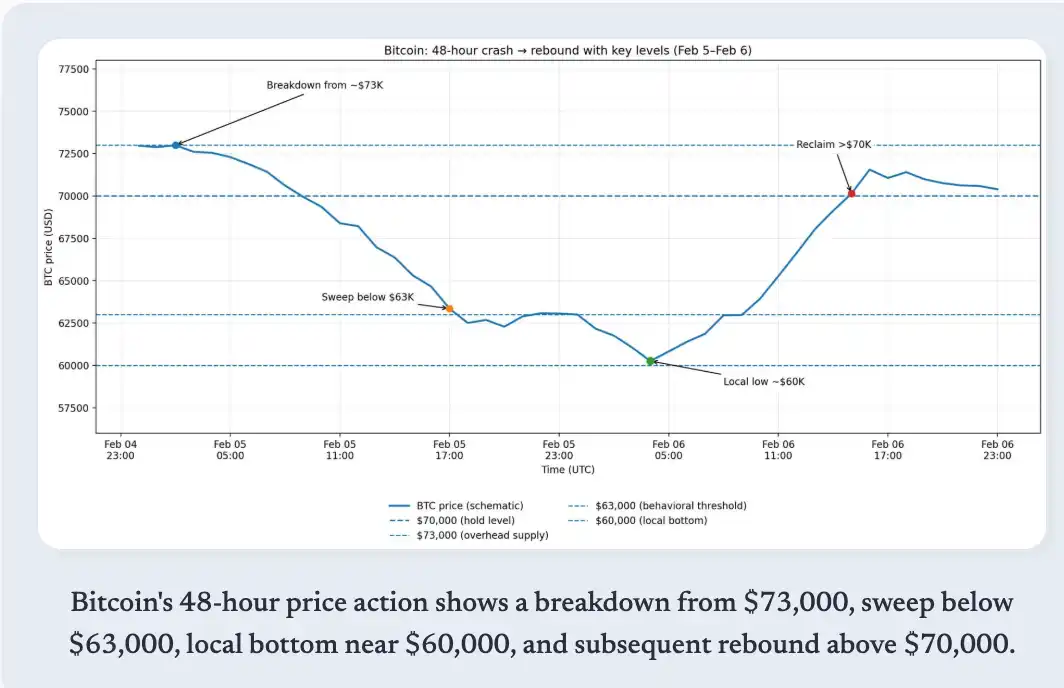
Bitcoin's price action over 48 hours, showing the crash from $73K, the sweep below $63K, local basing near $60K, and the subsequent rebound back above $70K.

Macro Reversal and Squeeze Mechanism

February 6th opened at the previous day's close, then fell to a daily low near $60,000 before rocketing to a high of $71,422. After three failed attempts to break above this level, the price fell back below $70,000.

The catalyst did not originate from within the crypto industry but was a sharp U-turn in cross-asset movements. Wall Street performed strongly: the S&P 500 rose 1.97%, the Nasdaq gained 2.18%, the Dow Jones increased 2.47%, and the Philadelphia Semiconductor Index (SOX) surged 5.7%.

Metal prices rebounded violently, with gold up 3.9% and silver up 8.6%, while the US Dollar Index fell 0.2%, signaling easier financial conditions.

Bitcoin moved mechanically with this shift. The correlation was evident: as tech stocks stabilized and metals rebounded, Bitcoin was pulled up through common risk exposures.

However, the violence of this rebound also reflected derivatives positioning. The near -13% skew, negative funding rates, and inverted volatility structure created conditions where any macro-positive catalyst could trigger short-covering and forced position adjustments.

This rally was essentially driven by a liquidity event and amplified by the unwinding of crowded short positions.

Nevertheless, forward-looking signals remain bearish. Data from Deribit shows that for options expiring on February 27th, put open interest is heavily concentrated at strike prices between $60,000 and $50,000.

Sean Dawson from Deribit told Reuters that the demand for downside protection is "extreme." This is not hindsight analysis; traders are explicitly hedging against the next leg down, even after the rebound.
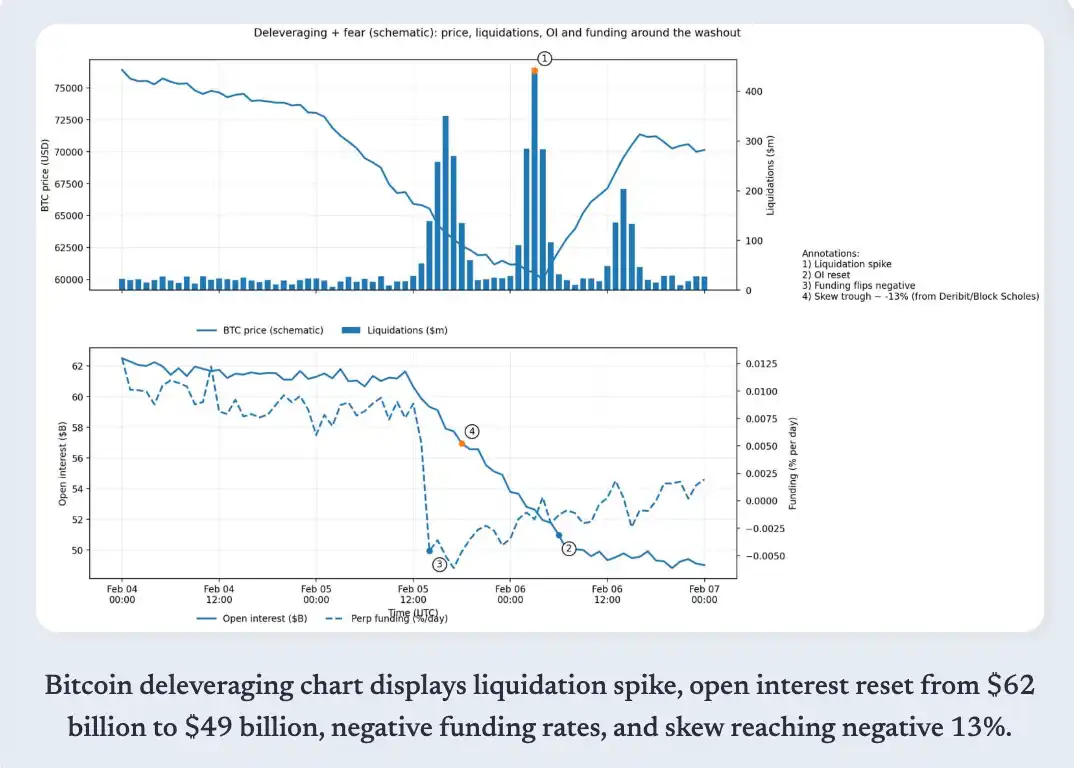
Bitcoin deleveraging chart showing liquidation spikes, OI reset from $62B to $49B, negative funding, and skew hitting -13%.

Can $70K Hold? Analytical Framework

The logic for holding $70,000 is based on three conditions.

First, the macro rebound needs to persist, with tech stocks continuing to stabilize, and US Treasury yields and the dollar not tightening again. This rally was clearly a cross-asset correlation; if US stocks turn lower again, Bitcoin will not be immune.

Second, leverage needs to continue cooling off with no new forced selling emerging. Open interest has already declined significantly, reducing the risk of a "vacuum drop."

Third, miner pressure needs substantive relief when the difficulty adjustment takes effect. If prices can hold steady within the adjustment window, the anticipated 13.37% difficulty下调 should reduce marginal selling pressure and allow the hash rate to stabilize.

Arguments supporting another washout also have three reasons:

First, options positioning remains skewed bearish. The largest put concentrations for late February are at $60K-$50K, a forward-looking signal embedded in market-implied probabilities, not lagging sentiment.

Second, derivatives signals remain fragile. Extreme skew, the recent prevalence of negative funding rates, and an inverted volatility structure align more with the characteristics of a "relief rally" within a fear regime, not a trend reversal.

Third, ETF flow data shows continued outflows. As of February 5th, Bitcoin ETF net monthly outflows had reached $690 million. Although data for February 6th is not yet available, the existing pattern suggests institutional allocators have not shifted from "de-risking" to "re-engagement."

Signal Dashboard

Indicator Latest Reading / Status (As of Publishing) Bull Confirmation (What Needs to Change) Bear Continuation (What to Watch For) Source
Derivatives Perp Funding Rate Negative (below 0%) -- "Extremely Bearish" state Funding turns positive & stabilizes on major platforms (not just 1-2 hour spikes) Funding stays negative / oscillates wildly during price chops → "Bull Trap" risk
Options Risk 25D Risk Reversal (Skew) Short-term skew as low as ~-13% (Surge in put demand) Skew recovers towards 0 (Less downside protection demand) & stabilizes Skew remains deeply negative (Sustained protective buying)
Leverage Futures OI Deleveraging / OI drop (Forced liquidation phase); Recent reports show ~$55B equiv exited in 30d OI flattens out (No rapid re-levering) & price holds $70K OI accumulates quickly during bounce → Probability of next liquidation leg increases
Fund Flows Spot BTC ETF Net Flow Net Outflows: Feb 4 -$544.9M, Feb 5 -$434.1M Outflows decelerate to flat, then turn to slight inflows Outflows accelerate (Consecutive -$400M to -$500M days)→ Repeat washout risk
Mining Hash Price + Difficulty Adj Hash Price < $32/PH/s (Historic lows); Difficulty下调 ~13.37% expected Difficulty下调 arrives & hashrate stabilizes (Reduces miner sell pressure) Hash price falls further / Hashrate drops significantly → Increased miner selling/inventory outflow

The True Meaning of $70K

This price level itself holds no magic. Its importance lies in its position just above the $66,900 to $70,600 on-chain absorption cluster identified by Glassnode.

Holding $70,000 means this cluster has absorbed enough supply to temporarily stabilize prices. However, holding firm depends not just on technical support but also on the return of spot demand, the unwinding of derivatives hedge positions, and the stabilization of institutional flows.

The rebound from $60,000 was real, but its composition is crucial. If macro conditions change, cross-asset stability will reverse.

The unwinding of forced positions created a mechanical rebound, which does not necessarily translate into a sustained trend. Options traders are still pricing in a significant probability of a move down towards $50,000-$60,000 within the next three weeks.

Bitcoin reclaimed $70,000 but is currently consolidating below it. This suggests a pause before the next test, and the outcome of that next test depends on three conditions occurring in sequence: sustained macro risk appetite, deceleration or reversal of ETF outflows, and normalization of derivatives sentiment.

The market delivered a violent snap-back, but the forward curve and flow data indicate traders are not yet betting on its persistence. $70,000 is not the endgame; it is merely the baseline that will determine the winner of the next phase of the debate.


Related Questions

QWhat were the main factors that triggered the violent Bitcoin price drop to around $60,000 on February 5th, 2026?

AThe main triggers were a broader risk-off sentiment in financial markets, including a sell-off in tech stocks and extreme volatility in precious metals (like silver dropping ~18%), which negatively impacted all risk assets. Additionally, market concerns about potential future liquidity tightening—sparked by reports that Donald Trump might appoint Kevin Warsh as Fed Chair—exacerbated the sell-off. Forced liquidations of leveraged Bitcoin positions (around $1 billion in BTC liquidations) also amplified the downward move.

QHow did the rebound from ~$60,000 to over $70,000 occur within 24 hours, and what was the primary mechanism behind it?

AThe rebound was primarily driven by a macro market reversal, where tech stocks rallied (S&P 500 +1.97%, Nasdaq +2.18%), metals recovered sharply (gold +3.9%, silver +8.6%), and the Dollar Index weakened. This cross-asset stabilization created a mechanical lift for Bitcoin. The violent nature of the bounce was amplified by a short squeeze—derivatives positioning was extremely bearish (with negative funding rates, inverted volatility, and a -13% risk-reversal skew), so any macro improvement forced short covering and rapid position rebalancing.

QWhat does the options market indicate about traders' expectations for Bitcoin's price by the end of February 2026?

AThe options market shows significant bearish hedging, with a large concentration of put open interest at strike prices between $50,000 and $60,000 for February 27th expiries. This indicates that traders are pricing in a substantial risk of a second downturn to those levels, despite the recent rebound. The demand for downside protection is described as 'extreme,' suggesting a lack of conviction in the sustainability of the $70,000 recovery.

QWhat three conditions are necessary for Bitcoin to sustainably hold above $70,000, according to the analysis?

A1. Sustained macro rebound: Tech stocks must continue to stabilize, with no renewed tightening in Treasury yields or the US Dollar. 2. Leverage cooling: Further forced selling must be avoided, and open interest should not rapidly re-leverage. 3. Miner relief: The expected 13.37% network difficulty adjustment must take effect, reducing mining pressure and stabilizing hash rate to minimize marginal selling from miners.

QWhat key on-chain level is referenced as important for Bitcoin's price stability, and why is holding $70,000 significant in that context?

AThe $66,900 to $70,600 range is identified as an on-chain absorption cluster by Glassnode. Holding above $70,000 means that this cluster has absorbed enough supply to provide temporary price support. However, for the level to be sustained, it requires genuine spot demand, normalization of derivatives sentiment, and a reversal in ETF outflows—not just technical absorption.

Related Reads

From Robinhood to Polymarket: Is the Era of Integrating All Assets on a Single Platform Coming?

From Robinhood to Polymarket: The Era of All-in-One Asset Platforms Is Coming Asset classes are rapidly converging. Platforms that once specialized in single categories—such as stocks, cryptocurrencies, or prediction markets—are now moving toward offering all three. Robinhood pioneered this model, starting with equities, adding crypto in 2018, and prediction markets in 2025. This strategy has proven resilient: when crypto revenues fell, other segments like options and stocks filled the gap. Now, prediction market leaders Polymarket and Kalshi are moving in the same direction, both announcing perpetual futures trading on April 21, 2026, pending regulatory approval. These futures will cover assets like Bitcoin, gold, and stocks such as Nvidia. This trend mirrors the consolidation seen in consumer tech, like smartphones replacing dedicated cameras and MP3 players. Younger users, accustomed to interacting with multiple asset types from an early age, will increasingly demand unified platforms. A key competitive advantage in prediction markets is collateral utilization—idle assets locked during betting periods. Polymarket’s move into perpetuals may be a strategy to generate yield from that capital, similar to earlier DeFi integrations like PolyAave. As the regulatory landscape evolves, traditional finance is also likely to incorporate crypto and prediction markets, further accelerating this convergence.

marsbit35m ago

From Robinhood to Polymarket: Is the Era of Integrating All Assets on a Single Platform Coming?

marsbit35m ago

OpenAI Goes Left, DeepSeek Goes Right

On April 24, 2026, DeepSeek released V4, a Chinese large language model offering a free "million-token context window," enabling it to process vast amounts of data like entire books or years of corporate documents in one go. In contrast, OpenAI’s GPT-5.5, released around the same time, is more powerful but significantly more expensive, charging up to $180 per million output tokens. DeepSeek’s strategy represents a shift from a pure AI research firm to a heavy-infrastructure player, building data centers in Inner Mongolia’s Ulanqab to bypass U.S. chip export restrictions. This move, supported by Huawei’s Ascend chips and China’s cheap green electricity, highlights a fundamental divergence in AI development models: U.S. firms focus on high-cost, high-margin services, while Chinese players like DeepSeek prioritize accessibility and affordability. Facing intense talent poaching from tech giants, DeepSeek is seeking a $44 billion valuation funding round to retain researchers and scale infrastructure. Meanwhile, Chinese manufacturers are compressing AI models to run on smartphones, making AI accessible offline and across the Global South. Through open-source models and localized solutions, Chinese AI is empowering non-English speakers and low-income users, driving a form of "digital equality." While Silicon Valley builds walled gardens, DeepSeek and others are turning AI into a public utility—like tap water—flowing freely to those previously left behind.

marsbit1h ago

OpenAI Goes Left, DeepSeek Goes Right

marsbit1h ago

Trading

Spot
Futures

Hot Articles

What is $BITCOIN

DIGITAL GOLD ($BITCOIN): A Comprehensive Analysis Introduction to DIGITAL GOLD ($BITCOIN) DIGITAL GOLD ($BITCOIN) is a blockchain-based project operating on the Solana network, which aims to combine the characteristics of traditional precious metals with the innovation of decentralized technologies. While it shares a name with Bitcoin, often referred to as “digital gold” due to its perception as a store of value, DIGITAL GOLD is a separate token designed to create a unique ecosystem within the Web3 landscape. Its goal is to position itself as a viable alternative digital asset, although specifics regarding its applications and functionalities are still developing. What is DIGITAL GOLD ($BITCOIN)? DIGITAL GOLD ($BITCOIN) is a cryptocurrency token explicitly designed for use on the Solana blockchain. In contrast to Bitcoin, which provides a widely recognized value storage role, this token appears to focus on broader applications and characteristics. Notable aspects include: Blockchain Infrastructure: The token is built on the Solana blockchain, known for its capacity to handle high-speed and low-cost transactions. Supply Dynamics: DIGITAL GOLD has a maximum supply capped at 100 quadrillion tokens (100P $BITCOIN), although details regarding its circulating supply are currently undisclosed. Utility: While precise functionalities are not explicitly outlined, there are indications that the token could be utilized for various applications, potentially involving decentralized applications (dApps) or asset tokenization strategies. Who is the Creator of DIGITAL GOLD ($BITCOIN)? At present, the identity of the creators and development team behind DIGITAL GOLD ($BITCOIN) remains unknown. This situation is typical among many innovative projects within the blockchain space, particularly those aligning with decentralized finance and meme coin phenomena. While such anonymity may foster a community-driven culture, it intensifies concerns about governance and accountability. Who are the Investors of DIGITAL GOLD ($BITCOIN)? The available information indicates that DIGITAL GOLD ($BITCOIN) does not have any known institutional backers or prominent venture capital investments. The project seems to operate on a peer-to-peer model focused on community support and adoption rather than traditional funding routes. Its activity and liquidity are primarily situated on decentralized exchanges (DEXs), such as PumpSwap, rather than established centralized trading platforms, further highlighting its grassroots approach. How DIGITAL GOLD ($BITCOIN) Works The operational mechanics of DIGITAL GOLD ($BITCOIN) can be elaborated on based on its blockchain design and network attributes: Consensus Mechanism: By leveraging Solana’s unique proof-of-history (PoH) combined with a proof-of-stake (PoS) model, the project ensures efficient transaction validation contributing to the network's high performance. Tokenomics: While specific deflationary mechanisms have not been extensively detailed, the vast maximum token supply implies that it may cater to microtransactions or niche use cases that are still to be defined. Interoperability: There exists the potential for integration with Solana’s broader ecosystem, including various decentralized finance (DeFi) platforms. However, the details regarding specific integrations remain unspecified. Timeline of Key Events Here is a timeline that highlights significant milestones concerning DIGITAL GOLD ($BITCOIN): 2023: The initial deployment of the token occurs on the Solana blockchain, marked by its contract address. 2024: DIGITAL GOLD gains visibility as it becomes available for trading on decentralized exchanges like PumpSwap, allowing users to trade it against SOL. 2025: The project witnesses sporadic trading activity and potential interest in community-led engagements, although no noteworthy partnerships or technical advancements have been documented as of yet. Critical Analysis Strengths Scalability: The underlying Solana infrastructure supports high transaction volumes, which could enhance the utility of $BITCOIN in various transaction scenarios. Accessibility: The potential low trading price per token could attract retail investors, facilitating wider participation due to fractional ownership opportunities. Risks Lack of Transparency: The absence of publicly known backers, developers, or an audit process may yield skepticism regarding the project's sustainability and trustworthiness. Market Volatility: The trading activity is heavily reliant on speculative behavior, which can result in significant price volatility and uncertainty for investors. Conclusion DIGITAL GOLD ($BITCOIN) emerges as an intriguing yet ambiguous project within the rapidly evolving Solana ecosystem. While it attempts to leverage the “digital gold” narrative, its departure from Bitcoin's established role as a store of value underscores the need for a clearer differentiation of its intended utility and governance structure. Future acceptance and adoption will likely depend on addressing the current opacity and defining its operational and economic strategies more explicitly. Note: This report encompasses synthesised information available as of October 2023, and developments may have transpired beyond the research period.

363 Total ViewsPublished 2025.05.13Updated 2025.05.13

What is $BITCOIN

Discussions

Welcome to the HTX Community. Here, you can stay informed about the latest platform developments and gain access to professional market insights. Users' opinions on the price of BTC (BTC) are presented below.

活动图片