Written by: Tiger Research
Compiled by: AididiaoJP, Foresight News
As Bitcoin prices continue to decline, many miners are facing a survival crisis. In the face of increasingly fierce core mining competition, how can these companies save themselves? Leasing data centers for artificial intelligence (AI) has become a highly regarded path.
Core Conclusions
-
Bitcoin mining revenue is unstable, while costs continue to rise, making the core business model unsustainable.
-
Mining companies are beginning to leverage their existing sites and infrastructure to rent out data center space to large tech companies.
-
This transformation alleviates恶性竞争 and helps improve the health and stability of the entire industry.
I. Core Operational Risks Faced by Mining Companies
The business model of Bitcoin mining companies is relatively单一, which constitutes its fundamental脆弱点. Their revenue is almost entirely tied to the highly volatile price of Bitcoin, full of unpredictability; while on the cost side, including increasing mining difficulty, rising electricity prices, and hardware迭代, it shows a rigid upward trend.
When the币价 falls, the problem is particularly acute: revenue plummets, costs remain high, creating a "squeeze from both ends" dilemma. In addition, regulatory risks loom large, such as the proposal in New York State to increase the mining consumption tax. Although it has limited impact on mining companies currently concentrated in宽松 areas like Texas, it预示着 the possibility of broader compliance pressures in the future.
All this forces mining companies to ponder a fundamental question: can the single mining business model survive in the long term?
II. Cost Inversion: The Increasingly Fragile Profit Structure
According to data from CoinShares, the average cost to mine one Bitcoin has now risen to approximately $74,600. If costs such as equipment depreciation are included, the total production cost is close to $130,000 per Bitcoin.
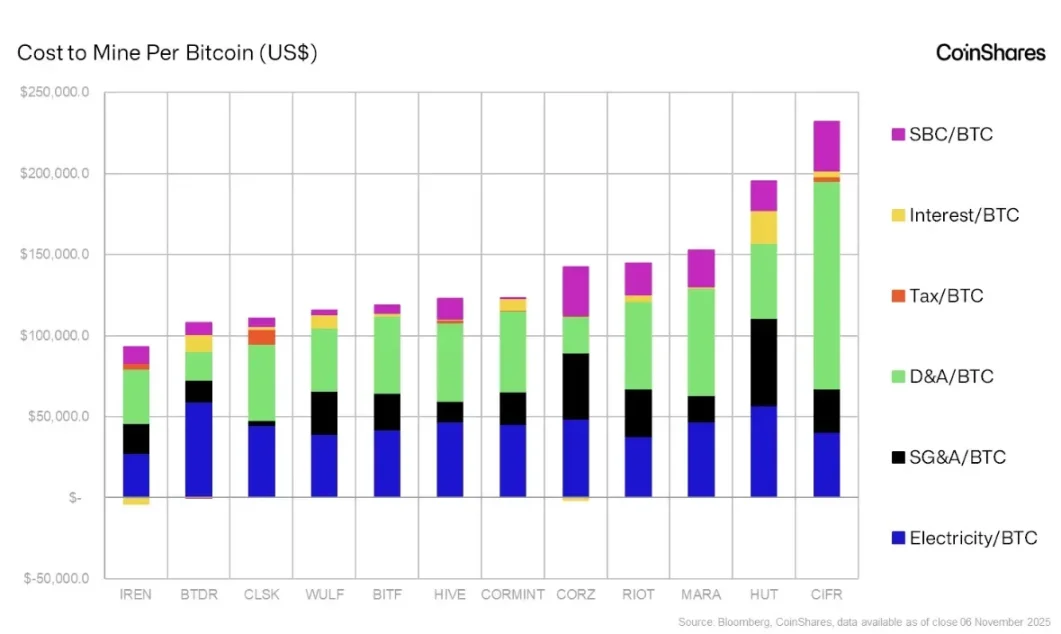
However, the current price of Bitcoin is around $91,000. This means that for every Bitcoin produced, mining companies face a paper loss of approximately $46,000. The increasing mining difficulty and tightening energy policies further worsen the cost structure, leading to an increasingly fragile overall profitability foundation for the industry.
III. The Path to Transformation: Why AI Data Centers?
The白热化 AI race has催生 an explosive demand for data centers from tech giants. Building data centers from scratch is time-consuming, and market opportunities are fleeting, so leasing existing, quickly adaptable facilities becomes the preferred option.
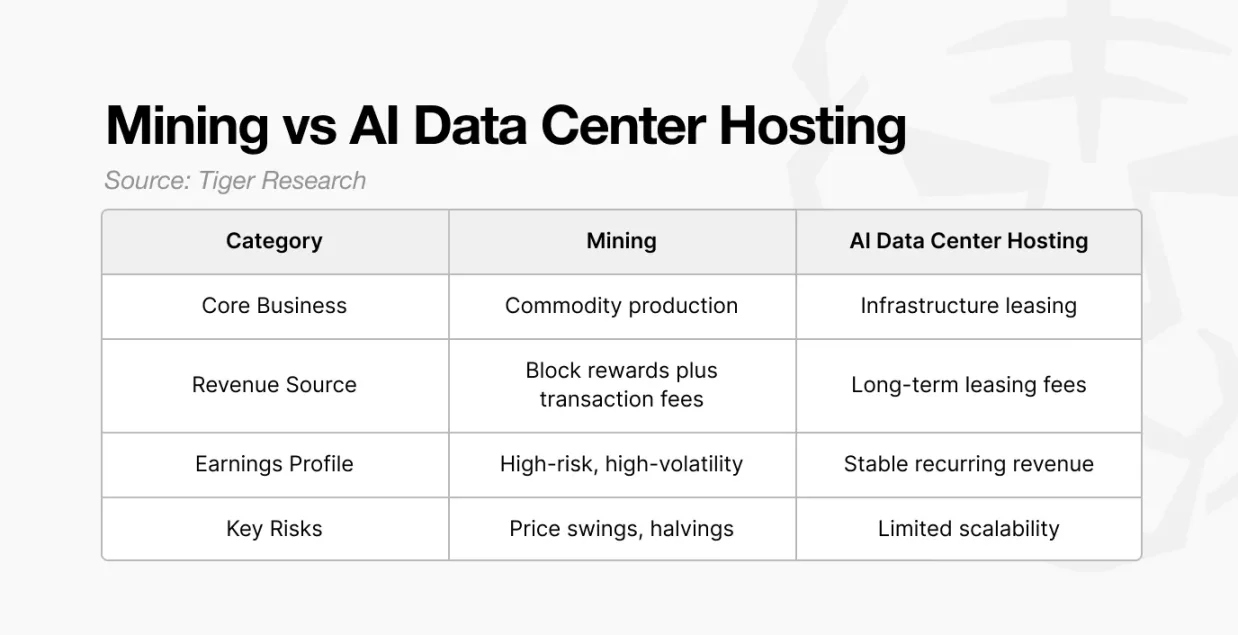
The existing assets of mining companies恰好 match this demand:
-
Computing Hardware: Possess大量 high-performance GPUs (such as NVIDIA chips) that can be repurposed for AI computing.
-
Power Resources: Already approved grid access at the数百兆瓦 level is a scarce resource in today's energy market.
-
Cooling Capacity: Experience in operating high-power mining machines积累, which can be directly applied to managing AI servers like H100/H200.
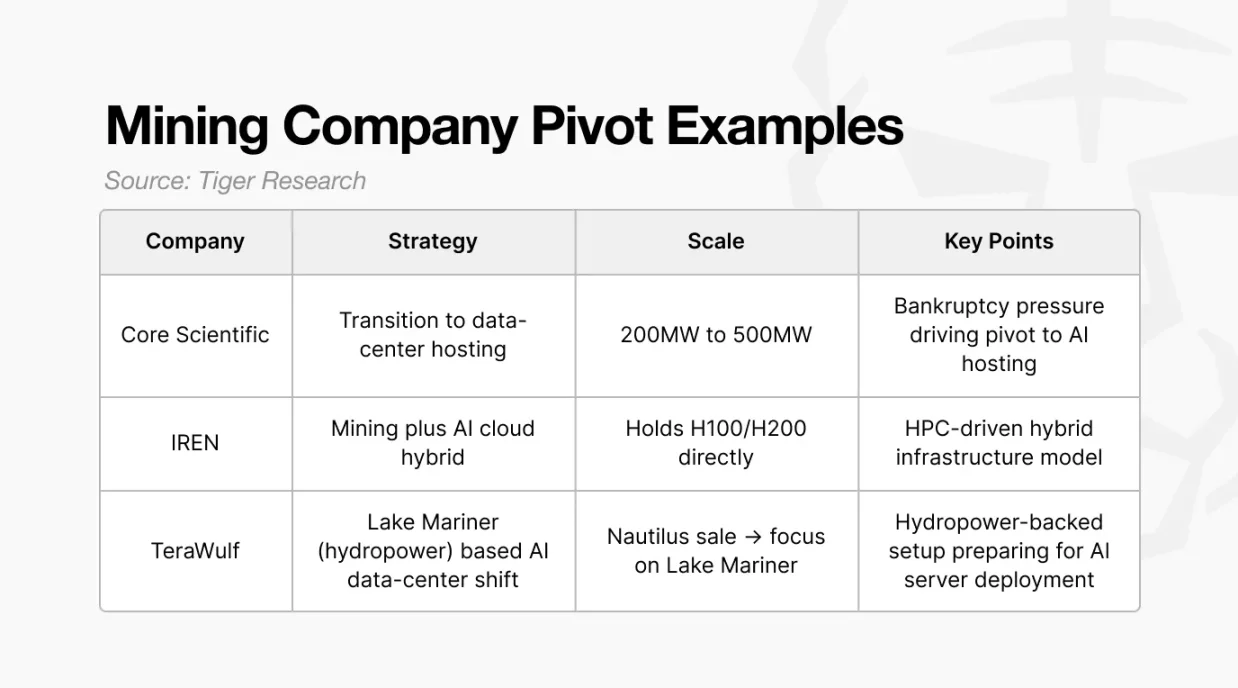
A typical case is Core Scientific, which was once濒临破产. By transforming into AI data center leasing, it now operates approximately 200 megawatts of capacity and plans to expand to 500 megawatts, successfully turning a profit. Companies like IREN and TeraWulf are also exploring similar paths of business diversification. This is not just about pursuing growth, but a necessity for survival.
IV. Diversified Evolution: More Than Just Data Centers
Transitioning to AI data center leasing is the mainstream trend, but it is not the only way out. This is essentially a rational choice for mining companies to reallocate capital to more efficient areas. Stable data center revenue can provide mining companies with a cash flow buffer, allowing them to more从容 strategically hold Bitcoin assets and avoid forced sales during market downturns.
Meanwhile, some mining companies, such as Bitmine and Cathedra Bitcoin, are exploring expansion into broader Digital Asset Technology (DAT) business models. These diversification attempts collectively point to a trend:纯挖矿 players with weak competitiveness are being淘汰 or转型, while leading companies are evolving into comprehensive service providers. The entire cryptocurrency mining industry is moving towards a new, more mature, and more resilient stage.