Bitcoin treasury Kindly MD faces potential delisting after Nasdaq price notice

cointelegraphPublished on 2025-12-16Last updated on 2025-12-16

Abstract

Bitcoin treasury company Kindly MD (ticker: NAKA) has received a Nasdaq delisting warning after its stock traded below the $1 minimum bid price for 30 consecutive business days. The company has until June 8, 2026, to regain compliance by maintaining a share price above $1 for 10 consecutive days. Its stock has plummeted over 98% from its May peak to $0.39, largely due to downward pressure from $563 million in PIPE financing deals that flooded the market with discounted shares. Despite holding 5,398 Bitcoin, making it the 19th largest public company BTC holder, its value has crashed following its merger with Nakamoto Holdings and its ambitious Bitcoin treasury strategy.

Bitcoin treasury company Kindly MD has received a Nasdaq notice after its shares traded below the exchange’s $1 minimum bid price for 30 consecutive business days, starting a six-month window to regain compliance or risk being delisted.

The notice, which was issued Wednesday, does not immediately affect trading, but gives the company until June 8, 2026, to lift its share price above $1 for at least 10 consecutive trading days, according to a regulatory filing from the Securities and Exchange Commission (SEC).

If the company fails to regain compliance within the initial 180-day period, it may seek an additional extension by transferring its listing to the Nasdaq Capital Market, subject to meeting other listing requirements, the according to the filing. Nasdaq could ultimately delist the shares if the company fails to satisfy the bid price rule or pursue available remedies.

Kindly MD, a Utah-based healthcare services provider, announced on May 12 plans to merge with Nakamoto Holdings, marking a shift toward a Bitcoin treasury strategy. The company’s shares surged to a peak of around $25 by May 27, and the merger was closed on Aug. 14.

The stock, trading under the ticker NAKA, has since fallen by more than 98% and was at $0.39 a share at the time of writing, according to Yahoo Finance data.
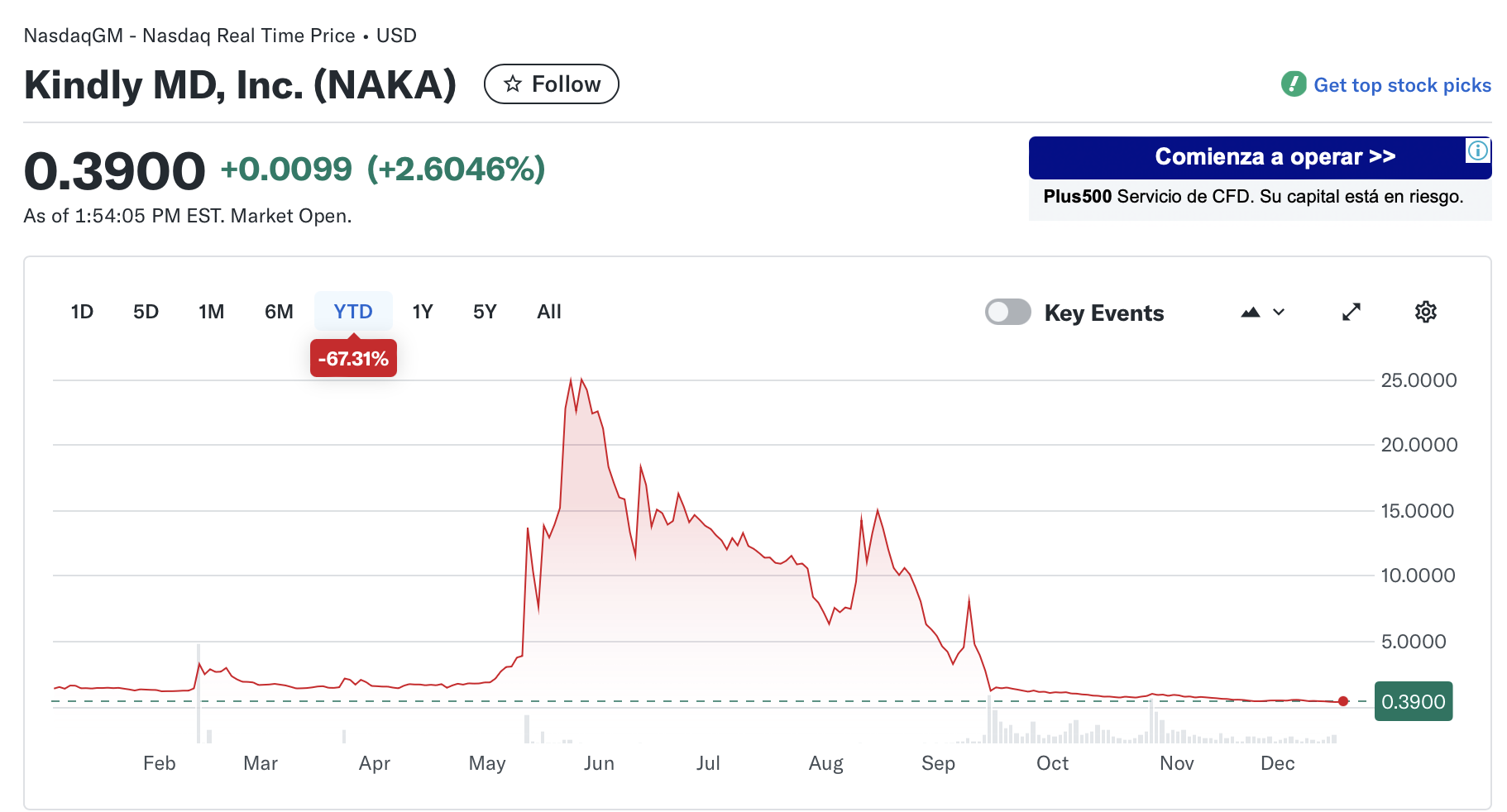
Kindly stock price year-to-date. Source: Yahoo Finance

Related: Trump-backed American Bitcoin flips ProCap in corporate BTC treasury race

PIPE financing weighs on Nakamoto shares

Nakamoto Holdings was founded in 2025 by Bitcoin Magazine CEO David Bailey and is structured as a Bitcoin-native holding company building a network of crypto treasury businesses in partnership with BTC Inc., the parent company of Bitcoin Magazine and the Bitcoin Conference.

The sharp drop in Kindly MD’s share price, which fell below $1 in October, has been linked to the company’s financing strategy, which relied on selling discounted shares to private investors through $563 million in private investment in public equity (PIPE) deals to fund BTC purchases.

Those PIPE deals created sharp downward pressure when a large portion of the shares became eligible for resale in September. The surge in sell orders drove a steep drop in the share price, CEO David Bailey told Forbes in October.

Bailey also said he plans to bring Bitcoin Magazine, the Bitcoin Conference and hedge fund 210k Capital under Nakamoto Holdings as part of an effort to strengthen the company’s cash flow.
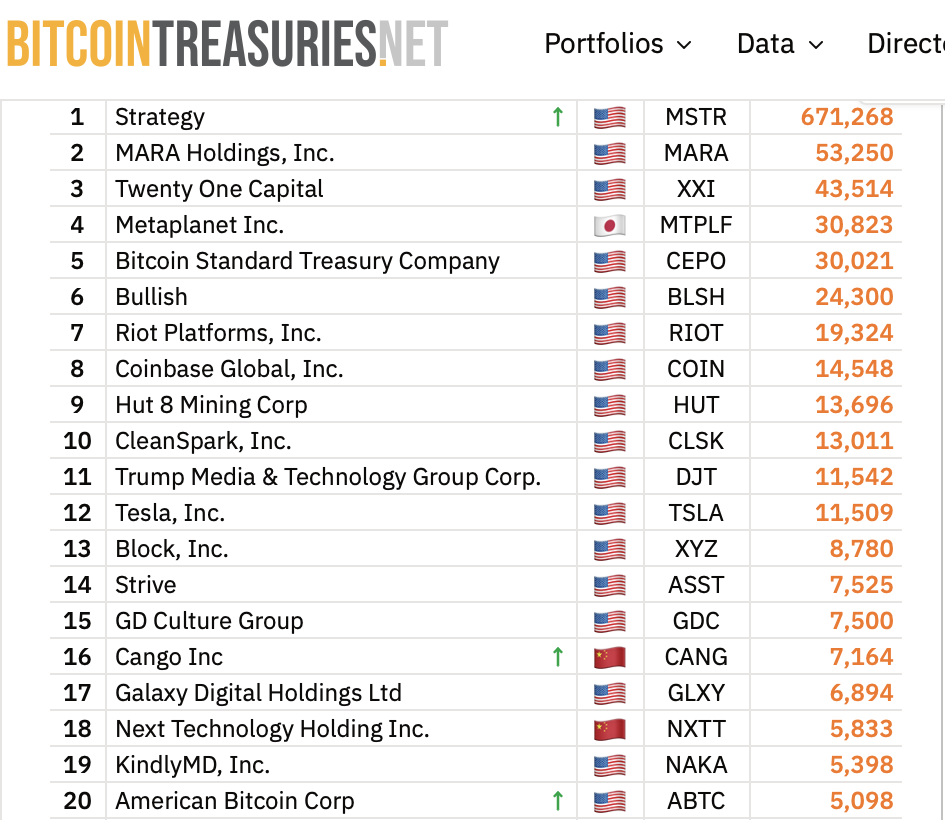
Top 20 Bitcoin treasury companies. Source: BitcoinTreasuries.net

Kindly MD still holds 5,398 Bitcoin, ranking it as the 19th largest public company by BTC holdings, according to data from BitcoinTreasuries.NET. Back in August, the company said one of its goals was to acquire 1 million Bitcoin (BTC).

By comparison, Strategy, the first Bitcoin treasury company, holds 671,268 BTC. Although its stock (MSTR) is down over 40% year-to-date, it’s still up 452% since the company began buying BTC in 2020.
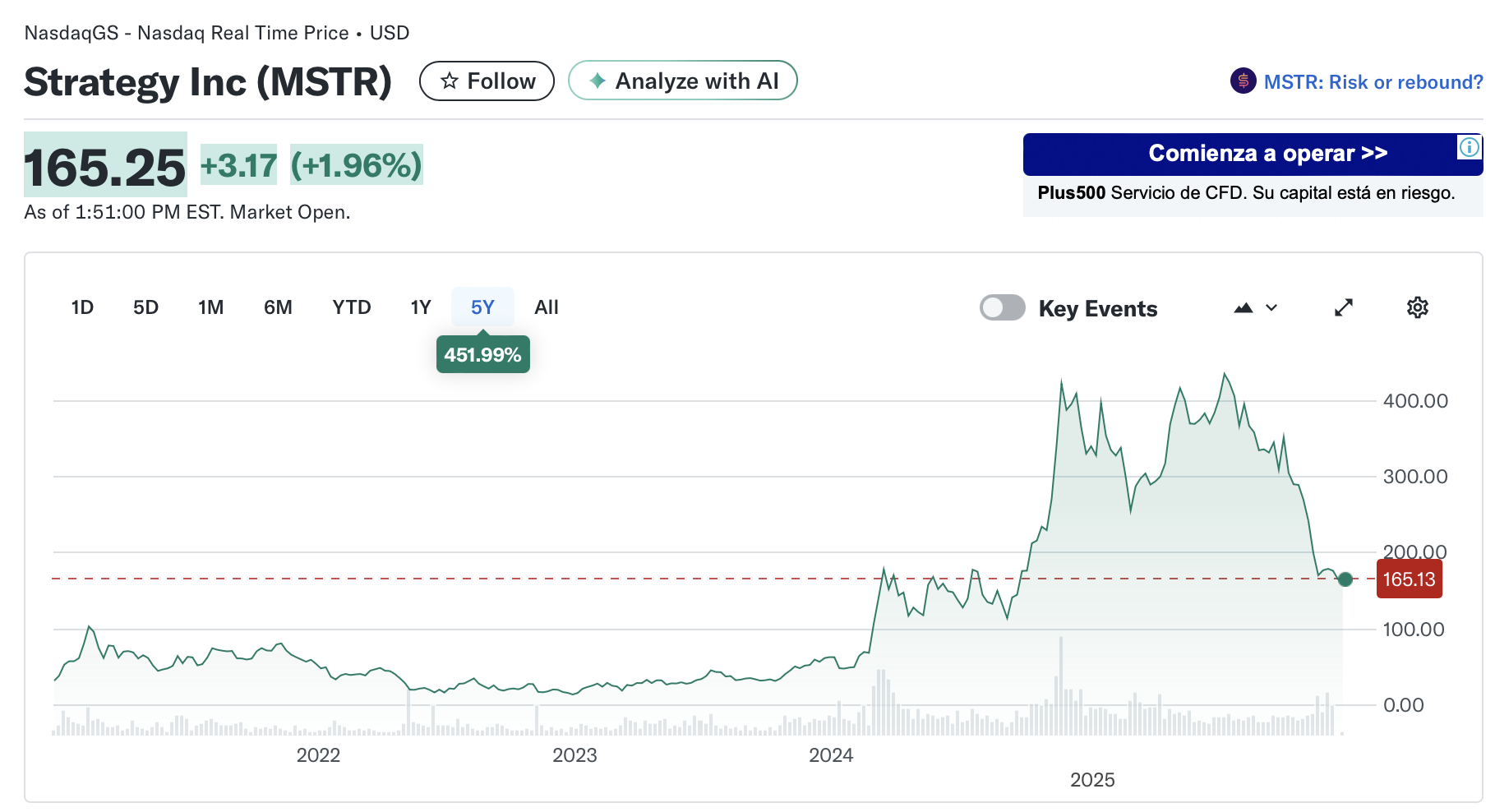
Strategy price over five years. Source: Yahoo Finance

Magazine: Big questions: Would Bitcoin survive a 10-year power outage?

Related Reads

a16z: How Should Crypto Entrepreneurs Understand the CLARITY Act?

a16z: How Crypto Entrepreneurs Should Understand the CLARITY Act? The U.S. Senate Banking Committee's bipartisan vote to advance crypto market structure legislation, specifically the Digital Asset Market CLARITY Act, marks a historic moment for the industry. For a decade, a lack of clear U.S. regulation has stifled innovation, created consumer risks, and pushed development overseas. CLARITY aims to end this by establishing clear rules for blockchain networks and digital assets, similar to how the 1933 Securities Act shaped capital formation. The current regulatory patchwork has failed, causing legal confusion and enabling bad actors while hindering responsible builders. CLARITY provides a path forward by clarifying the regulatory roles of the SEC and CFTC, defining whether digital assets are securities or commodities, and establishing oversight for crypto exchanges and consumer protections. Crucially, CLARITY recognizes that blockchain networks are fundamentally different from traditional companies. Networks operate through shared rules and decentralized coordination, not centralized control. Applying corporate frameworks distorts them, leading to value extraction by intermediaries. Blockchain enables truly decentralized networks where value can be distributed to participants. CLARITY is designed to make this viable under U.S. law, allowing builders to operate transparently, raise capital domestically, and focus on long-term innovation without structural compromises due to regulatory ambiguity. The bill's progression follows earlier House efforts like FIT21 and the House CLARITY Act, which received strong bipartisan support. If passed, CLARITY could unlock significant innovation within the U.S., similar to the growth seen after the GENIUS Act for stablecoins, helping the U.S. lead in the digital economy while better combating fraud and abuse.

marsbit17m ago

a16z: How Should Crypto Entrepreneurs Understand the CLARITY Act?

marsbit17m ago

AI Benefits Senior Staff? 40% of CEOs Plan to Cut Junior Positions, Young People's Jobs Are More at Risk

The traditional assumption that senior employees are first in line during layoffs is being inverted in the AI era. A survey of 415 CEOs by Oliver Wyman and the NYSE reveals 43% plan to cut entry-level positions in the next 1-2 years to shift towards a mid-to-senior talent structure, a sharp rise from 17% last year. The logic is that AI excels at automating routine, cognitive tasks typically handled by junior staff (e.g., coding, data review), while the experience and judgment of senior employees remain harder to replicate. Research indicates this shift primarily manifests as a hiring freeze for junior roles rather than mass layoffs. Goldman Sachs estimates AI currently nets a loss of about 16,000 US jobs monthly, disproportionately impacting Generation Z concentrated in highly automatable white-collar roles. This raises long-term concerns about a broken talent pipeline, as companies risk having no future senior managers trained internally. Despite the dominant trend, a minority of successful AI adopters, like IBM and Salesforce, are expanding junior hiring, arguing these employees are adept at using and building AI tools. However, most companies are still in early AI deployment phases, with 67% in planning/pilot stages and many reporting returns below expectations. The overarching reality is a weakening of job security across all levels, as organizations reshape for an AI-augmented, leaner future.

marsbit1h ago

AI Benefits Senior Staff? 40% of CEOs Plan to Cut Junior Positions, Young People's Jobs Are More at Risk

marsbit1h ago

Physical AI is Hot, Some New Thoughts from Me

The term "Physical AI" is gaining significant traction, marking a shift from AI that processes information to AI that understands and interacts with the physical world. Unlike traditional AI confined to screens, Physical AI involves integrating intelligence into robotic bodies to perform tasks in environments governed by gravity, friction, and inertia. The concept, formally defined in a 2020 paper, focuses on creating embodied systems that can complete perception-to-action cycles. 2026 is identified as a pivotal "deployment year," where the focus moves from demonstrations to practical utility. Companies like China's Zhiyuan Robotics have transitioned to live, unscripted factory deployments and announced mass production targets. Internationally, Figure AI, after a major funding round, shifted to its own neural system, while NVIDIA partnered with major industrial robot firms to upgrade millions of existing units with AI capabilities. A key trend is the crossover from the automotive supply chain. Companies like Aptiv and Valeo are entering the Physical AI space, leveraging their expertise in sensors, control systems, and mass production from the autonomous vehicle sector. This "technology spillover" is accelerating development, as seen with Tesla's plans to repurpose automotive production lines for its Optimus robot. The technical breakthrough enabling this progress is the engineering maturity of "world models." Previously theoretical, these AI models can now simulate physical interactions and generate vast, realistic synthetic training data for robots. Innovations from NVIDIA's Cosmos, Ant's LingBot-World, and others have made this capability more accessible, drastically reducing the cost and time needed for real-world data collection. This is driving a fundamental architectural shift in robotics: from the traditional "sense-plan-act" model, reliant on pre-programmed rules, to a "sense-reason-act" paradigm where neural networks reason and make decisions. This change represents a new paradigm where machines understand the world's physics. The competition is intense, with the landscape still forming. While the direction is clear, success will depend not just on AI algorithms but on manufacturing scalability, supply chain resilience, and efficient data strategies, with infrastructure providers potentially capturing significant value in this new era.

marsbit1h ago

Physical AI is Hot, Some New Thoughts from Me

marsbit1h ago

Trading

Spot
Futures

Hot Articles

What is $BITCOIN

DIGITAL GOLD ($BITCOIN): A Comprehensive Analysis Introduction to DIGITAL GOLD ($BITCOIN) DIGITAL GOLD ($BITCOIN) is a blockchain-based project operating on the Solana network, which aims to combine the characteristics of traditional precious metals with the innovation of decentralized technologies. While it shares a name with Bitcoin, often referred to as “digital gold” due to its perception as a store of value, DIGITAL GOLD is a separate token designed to create a unique ecosystem within the Web3 landscape. Its goal is to position itself as a viable alternative digital asset, although specifics regarding its applications and functionalities are still developing. What is DIGITAL GOLD ($BITCOIN)? DIGITAL GOLD ($BITCOIN) is a cryptocurrency token explicitly designed for use on the Solana blockchain. In contrast to Bitcoin, which provides a widely recognized value storage role, this token appears to focus on broader applications and characteristics. Notable aspects include: Blockchain Infrastructure: The token is built on the Solana blockchain, known for its capacity to handle high-speed and low-cost transactions. Supply Dynamics: DIGITAL GOLD has a maximum supply capped at 100 quadrillion tokens (100P $BITCOIN), although details regarding its circulating supply are currently undisclosed. Utility: While precise functionalities are not explicitly outlined, there are indications that the token could be utilized for various applications, potentially involving decentralized applications (dApps) or asset tokenization strategies. Who is the Creator of DIGITAL GOLD ($BITCOIN)? At present, the identity of the creators and development team behind DIGITAL GOLD ($BITCOIN) remains unknown. This situation is typical among many innovative projects within the blockchain space, particularly those aligning with decentralized finance and meme coin phenomena. While such anonymity may foster a community-driven culture, it intensifies concerns about governance and accountability. Who are the Investors of DIGITAL GOLD ($BITCOIN)? The available information indicates that DIGITAL GOLD ($BITCOIN) does not have any known institutional backers or prominent venture capital investments. The project seems to operate on a peer-to-peer model focused on community support and adoption rather than traditional funding routes. Its activity and liquidity are primarily situated on decentralized exchanges (DEXs), such as PumpSwap, rather than established centralized trading platforms, further highlighting its grassroots approach. How DIGITAL GOLD ($BITCOIN) Works The operational mechanics of DIGITAL GOLD ($BITCOIN) can be elaborated on based on its blockchain design and network attributes: Consensus Mechanism: By leveraging Solana’s unique proof-of-history (PoH) combined with a proof-of-stake (PoS) model, the project ensures efficient transaction validation contributing to the network's high performance. Tokenomics: While specific deflationary mechanisms have not been extensively detailed, the vast maximum token supply implies that it may cater to microtransactions or niche use cases that are still to be defined. Interoperability: There exists the potential for integration with Solana’s broader ecosystem, including various decentralized finance (DeFi) platforms. However, the details regarding specific integrations remain unspecified. Timeline of Key Events Here is a timeline that highlights significant milestones concerning DIGITAL GOLD ($BITCOIN): 2023: The initial deployment of the token occurs on the Solana blockchain, marked by its contract address. 2024: DIGITAL GOLD gains visibility as it becomes available for trading on decentralized exchanges like PumpSwap, allowing users to trade it against SOL. 2025: The project witnesses sporadic trading activity and potential interest in community-led engagements, although no noteworthy partnerships or technical advancements have been documented as of yet. Critical Analysis Strengths Scalability: The underlying Solana infrastructure supports high transaction volumes, which could enhance the utility of $BITCOIN in various transaction scenarios. Accessibility: The potential low trading price per token could attract retail investors, facilitating wider participation due to fractional ownership opportunities. Risks Lack of Transparency: The absence of publicly known backers, developers, or an audit process may yield skepticism regarding the project's sustainability and trustworthiness. Market Volatility: The trading activity is heavily reliant on speculative behavior, which can result in significant price volatility and uncertainty for investors. Conclusion DIGITAL GOLD ($BITCOIN) emerges as an intriguing yet ambiguous project within the rapidly evolving Solana ecosystem. While it attempts to leverage the “digital gold” narrative, its departure from Bitcoin's established role as a store of value underscores the need for a clearer differentiation of its intended utility and governance structure. Future acceptance and adoption will likely depend on addressing the current opacity and defining its operational and economic strategies more explicitly. Note: This report encompasses synthesised information available as of October 2023, and developments may have transpired beyond the research period.

363 Total ViewsPublished 2025.05.13Updated 2025.05.13

What is $BITCOIN

Discussions

Welcome to the HTX Community. Here, you can stay informed about the latest platform developments and gain access to professional market insights. Users' opinions on the price of BTC (BTC) are presented below.

活动图片