Bitcoin Is Only One Leg From Hitting A Bottom, But How Low Can It Go?

bitcoinistPublished on 2026-05-15Last updated on 2026-05-15

Abstract

Crypto analyst Bee forecasts a major Bitcoin price bottom is imminent. Despite a recent rally above $83,000, Bee contends BTC remains in a broader bear market, viewing the gains as a temporary bounce within a long-term descending channel. The analysis shows BTC forming lower highs and lower lows since its October 2025 all-time high above $126,200. Following a recent rejection around $83,000, which is marked as another lower high, Bee predicts Bitcoin's price could decline to approximately $43,035, representing a drop of over 45%. The analyst notes that typical bear market cycles last 365 days, and with the current cycle only on day 217, more downside is expected. Only after this final bottom is formed does Bee anticipate a sustained recovery, projecting a potential rally back to $100,000 by 2027.

Crypto analyst Bee has forecasted a major price bottom for Bitcoin (BTC), the world’s largest digital currency. Despite its recent rally above $80,000, the expert still believes that BTC remains in a broader bearish market, likely viewing the latest price gains as a temporary bounce. While some analysts think that Bitcoin’s downtrend is over and others project a bottom around the $50,000 range, Bee expects BTC’s price to decline even lower before a sustained rally can begin.

Bitcoin Price Set To Bottom Around $42,000

In an X post on May 11, Bee said that Bitcoin is just one leg away from reaching its historical cycle bottom. The market expert shared a video chart analysis highlighting technical patterns and historical trends to support their bearish Bitcoin price outlook.

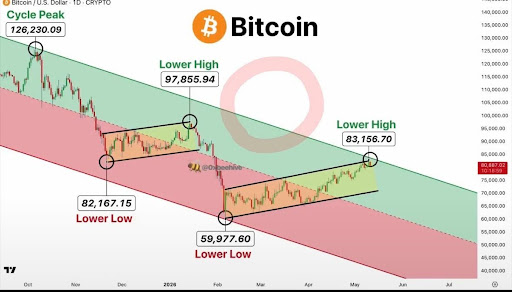
The analyst’s chart shows that Bitcoin has been forming multiple ascending channels within a broader descending channel since reaching a cycle peak above $126,200 in October 2025. After recording this all-time high, Btc crashed to $82,167, forming a lower low, where the first ascending channel began. Within this channel, the cryptocurrency traded sideways for months before rallying again to touch the upper boundary of the pattern at around $97,855.

After that lower high was reached, BTC began crashing again, but this time, the decline was even sharper and more severe. The cryptocurrency had fallen to $59,900 around February 2026, forming a lower low that many analysts still consider BTC’s final cycle bottom.
Source: Chart from Bee on X

Since hitting that floor, Bitcoin has been on a steady upward rally with occasional pullbacks and volatility impacting its price. The latest jump saw the cryptocurrency skyrocketing above $83,000, which Bee marks as the second-lowest high since the 2025 ATH. However, after being rejected at that level, the analyst predicts that Bitcoin’s next move could see its price crash to $43,035. Notably, a decline to this bottom would represent a more than 45% drop from Btc’s price levels above $79,000, at the time of writing.

BTC Rally To $100,000 Will Only Come After Bottom

In the same analysis, Bee explained that bear market cycles typically last 365 days. At the time of his post, he said that Bitcoin’s current bear market is on its 217th day, reinforcing his bearish outlook on its price. Because of this gap, he believes that BTC still has more room for a final flush.

Once a bottom is reached, Bee expects the market to likely reset and begin a sustained recovery back to $100,000 by 2027. However, he boldly projected that this milestone will not be achieved before a bottom is formed. This shows that the analyst still sees Bitcoin’s market structure as heavily bearish despite recent price increases and shifting sentiment.

BTC trading at $79,637 on the 1D chart | Source: BTCUSDT on Tradingview.com

Related Questions

QAccording to the article, what price level does analyst Bee predict for Bitcoin's historical cycle bottom?

AAnalyst Bee predicts that Bitcoin's price could crash to a historical cycle bottom around $42,000 to $43,035.

QWhat is the main reason given by analyst Bee for believing Bitcoin has not yet reached its market bottom?

ABee states that bear market cycles typically last 365 days, and at the time of his analysis, Bitcoin's current bear market was only on its 217th day, indicating more room for a 'final flush' downward before a true bottom.

QWhat does the analyst, Bee, identify as the two significant 'lower highs' for Bitcoin since its 2025 peak?

AThe two significant lower highs identified are the first at around $97,855 and the second at above $83,000 (following the rally in early 2026).

QWhen does analyst Bee project Bitcoin could reach $100,000, and what condition must be met first?

ABee projects that Bitcoin could reach $100,000 by 2027, but only after a market bottom is first formed.

QBased on the chart analysis described, what was the all-time high price for Bitcoin mentioned in the article, and when did it occur?

AAccording to the article, Bitcoin reached a cycle peak (all-time high) above $126,200 in October 2025.

Related Reads

Winter for Crypto IPOs: Consensys and Ledger Withdraw Applications

The crypto IPO window is tightening significantly in 2026, marked by prominent companies delaying or pausing their public listing plans. Following a successful 2025 "harvest year" that saw Circle, Bullish, and Gemini go public amidst a bull market, the tide has turned. Consensys, developer of MetaMask, recently postponed its IPO until at least fall 2026. Hardware wallet leader Ledger also suspended its planned US listing due to unfavorable market conditions, with Kraken having previously delayed its own plans. This shift is driven by a cooling market in 2026, characterized by a significant Bitcoin price correction, declining trading volumes, and reduced investor risk appetite for crypto stocks. The poor post-IPO performance of 2025 listings like Circle and Bullish, which saw major share price declines, has heightened investor caution. This contrasts sharply with the current AI sector, where companies like SpaceX, OpenAI, and Anthropic are commanding massive valuations and investor enthusiasm based on narratives of stable, exponential growth. Crypto companies now face pressure to transition from hype-driven models to demonstrating reliable cash flows and robust compliance. While the paused IPO plans may lead to valuation resets and affect ecosystem liquidity, they also accelerate industry consolidation toward stronger, more compliant infrastructure players. A potential recovery in Bitcoin's price and clearer regulations could reopen the IPO window in the latter half of 2026.

marsbit1h ago

Winter for Crypto IPOs: Consensys and Ledger Withdraw Applications

marsbit1h ago

ChatGPT Can Manage Your Money for You. Would You Trust It with Your Bank Account?

OpenAI has launched a personal finance tool for ChatGPT, currently in preview for US-based ChatGPT Pro users. This feature allows users to connect their bank and investment accounts (via Plaid, supporting over 12,000 institutions) directly to ChatGPT. It analyzes transactions, generates visual dashboards, and offers conversational financial advice—such as budgeting or planning for major purchases—based on the user's actual data. This move follows OpenAI's acquisitions of fintech startups Roi and Hiro Finance, signaling a strategic push into vertical "super assistant" applications, similar to its earlier health-focused feature. However, the launch has sparked significant privacy concerns. Critics question the safety of granting such sensitive financial access to an AI, especially amid ongoing lawsuits alleging OpenAI shared user chat data with third parties like Meta and Google. OpenAI emphasizes that ChatGPT only reads data (no transaction capabilities), deletes it within 30 days if disconnected, and offers opt-out options for model training. Yet, trust remains a major hurdle. The trend reflects a broader industry shift: AI companies like Anthropic and Perplexity are also targeting high-value, data-rich domains like finance and health. While technically promising, the tool operates in a regulatory gray area—it provides personalized guidance but disclaims formal financial advice or liability. Ultimately, OpenAI's challenge is convincing users to trust an AI with their most private financial information.

marsbit1h ago

ChatGPT Can Manage Your Money for You. Would You Trust It with Your Bank Account?

marsbit1h ago

Trading

Spot
Futures

Hot Articles

What is $BITCOIN

DIGITAL GOLD ($BITCOIN): A Comprehensive Analysis Introduction to DIGITAL GOLD ($BITCOIN) DIGITAL GOLD ($BITCOIN) is a blockchain-based project operating on the Solana network, which aims to combine the characteristics of traditional precious metals with the innovation of decentralized technologies. While it shares a name with Bitcoin, often referred to as “digital gold” due to its perception as a store of value, DIGITAL GOLD is a separate token designed to create a unique ecosystem within the Web3 landscape. Its goal is to position itself as a viable alternative digital asset, although specifics regarding its applications and functionalities are still developing. What is DIGITAL GOLD ($BITCOIN)? DIGITAL GOLD ($BITCOIN) is a cryptocurrency token explicitly designed for use on the Solana blockchain. In contrast to Bitcoin, which provides a widely recognized value storage role, this token appears to focus on broader applications and characteristics. Notable aspects include: Blockchain Infrastructure: The token is built on the Solana blockchain, known for its capacity to handle high-speed and low-cost transactions. Supply Dynamics: DIGITAL GOLD has a maximum supply capped at 100 quadrillion tokens (100P $BITCOIN), although details regarding its circulating supply are currently undisclosed. Utility: While precise functionalities are not explicitly outlined, there are indications that the token could be utilized for various applications, potentially involving decentralized applications (dApps) or asset tokenization strategies. Who is the Creator of DIGITAL GOLD ($BITCOIN)? At present, the identity of the creators and development team behind DIGITAL GOLD ($BITCOIN) remains unknown. This situation is typical among many innovative projects within the blockchain space, particularly those aligning with decentralized finance and meme coin phenomena. While such anonymity may foster a community-driven culture, it intensifies concerns about governance and accountability. Who are the Investors of DIGITAL GOLD ($BITCOIN)? The available information indicates that DIGITAL GOLD ($BITCOIN) does not have any known institutional backers or prominent venture capital investments. The project seems to operate on a peer-to-peer model focused on community support and adoption rather than traditional funding routes. Its activity and liquidity are primarily situated on decentralized exchanges (DEXs), such as PumpSwap, rather than established centralized trading platforms, further highlighting its grassroots approach. How DIGITAL GOLD ($BITCOIN) Works The operational mechanics of DIGITAL GOLD ($BITCOIN) can be elaborated on based on its blockchain design and network attributes: Consensus Mechanism: By leveraging Solana’s unique proof-of-history (PoH) combined with a proof-of-stake (PoS) model, the project ensures efficient transaction validation contributing to the network's high performance. Tokenomics: While specific deflationary mechanisms have not been extensively detailed, the vast maximum token supply implies that it may cater to microtransactions or niche use cases that are still to be defined. Interoperability: There exists the potential for integration with Solana’s broader ecosystem, including various decentralized finance (DeFi) platforms. However, the details regarding specific integrations remain unspecified. Timeline of Key Events Here is a timeline that highlights significant milestones concerning DIGITAL GOLD ($BITCOIN): 2023: The initial deployment of the token occurs on the Solana blockchain, marked by its contract address. 2024: DIGITAL GOLD gains visibility as it becomes available for trading on decentralized exchanges like PumpSwap, allowing users to trade it against SOL. 2025: The project witnesses sporadic trading activity and potential interest in community-led engagements, although no noteworthy partnerships or technical advancements have been documented as of yet. Critical Analysis Strengths Scalability: The underlying Solana infrastructure supports high transaction volumes, which could enhance the utility of $BITCOIN in various transaction scenarios. Accessibility: The potential low trading price per token could attract retail investors, facilitating wider participation due to fractional ownership opportunities. Risks Lack of Transparency: The absence of publicly known backers, developers, or an audit process may yield skepticism regarding the project's sustainability and trustworthiness. Market Volatility: The trading activity is heavily reliant on speculative behavior, which can result in significant price volatility and uncertainty for investors. Conclusion DIGITAL GOLD ($BITCOIN) emerges as an intriguing yet ambiguous project within the rapidly evolving Solana ecosystem. While it attempts to leverage the “digital gold” narrative, its departure from Bitcoin's established role as a store of value underscores the need for a clearer differentiation of its intended utility and governance structure. Future acceptance and adoption will likely depend on addressing the current opacity and defining its operational and economic strategies more explicitly. Note: This report encompasses synthesised information available as of October 2023, and developments may have transpired beyond the research period.

363 Total ViewsPublished 2025.05.13Updated 2025.05.13

What is $BITCOIN

Discussions

Welcome to the HTX Community. Here, you can stay informed about the latest platform developments and gain access to professional market insights. Users' opinions on the price of BTC (BTC) are presented below.

活动图片















