Bitcoin Institutional Shift: CLARITY Act Nears Senate Review

bitcoinistPublished on 2026-01-14Last updated on 2026-01-14

Abstract

Bitcoin's price has been stagnant, fueling bearish sentiment, but underlying on-chain data suggests a structural market shift. Despite upcoming U.S. Senate review of the CLARITY Act on January 15, 2026—a key crypto regulation bill—exchange inflows remain muted, indicating investors aren't treating it as an immediate threat. Metrics like Exchange Netflow and SOPR show reduced selling pressure, low profit-taking, and decreased on-chain movement. This reflects a patient, long-term holding behavior, signaling Bitcoin's transition toward institutional adoption phase rather than speculative trading, even amid regulatory uncertainty.

Bitcoin has spent several weeks struggling around a pivotal price range, frustrating traders and reinforcing bearish narratives across the market. After failing to reclaim key resistance levels, a growing number of analysts are calling for a broader bear market to unfold. Price action has been choppy, momentum has faded, and volatility has compressed—conditions that often amplify pessimism. Yet beneath the surface, some analysts argue that Bitcoin is no longer behaving as it did in previous cycles.

According to this view, the market structure itself is changing. Long-term holders appear less reactive, sell-side pressure has moderated, and on-chain activity suggests a slower, more deliberate market. Rather than a reflexive risk asset, Bitcoin is increasingly traded and held with a longer time horizon. This shift becomes especially relevant as the policy backdrop evolves in the United States.

The US Senate Banking Committee is scheduled to mark up the crypto market structure bill known as the CLARITY Act on January 15, 2026. This event should not be interpreted as a short-term price catalyst. Instead, it represents a potential inflection point in how Bitcoin is positioned within the US regulatory framework.

While prices remain relatively stable, on-chain data already hints at a market adapting to a more institutional, regulated environment. The implication is clear: Bitcoin may be entering a structurally different phase, even as sentiment remains divided.

A report by CryptoQuant, authored by XWIN Research Japan, highlights that Exchange Netflow remains a critical signal in the current environment. Historically, periods of regulatory uncertainty tend to push Bitcoin into exchanges as investors prepare to sell or reduce exposure.

Ahead of the upcoming CLARITY bill discussions, however, this behavior has not materialized. Exchange inflows have stayed relatively muted, suggesting that market participants are not positioning defensively or treating the legislative process as an immediate threat.
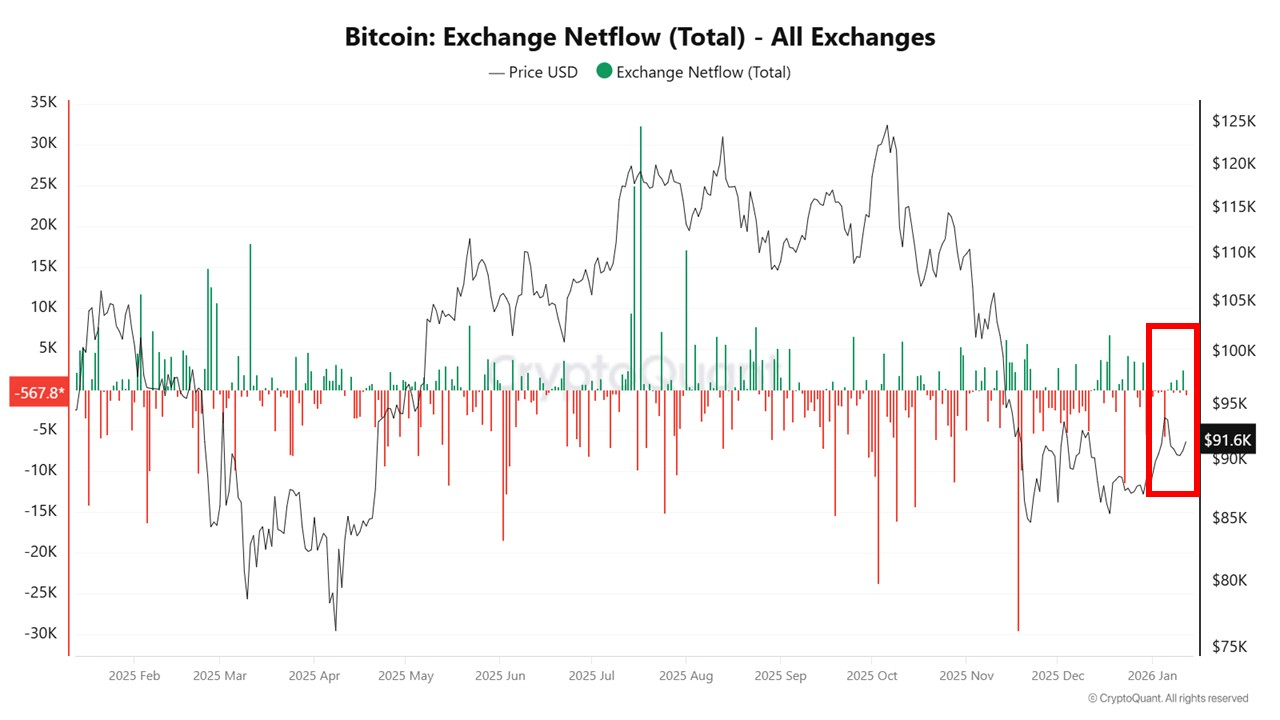
Bitcoin Exchange Netflow | Source: CryptoQuant

SOPR (Spent Output Profit Ratio) reinforces this interpretation. The metric, which measures whether moved coins are sold at a profit or a loss, is hovering around or slightly below the 1.0 threshold. This indicates subdued profit-taking activity. More importantly, it implies that on-chain spending itself remains low. In simple terms, Bitcoin is not being moved aggressively, either to realize gains or to exit positions.
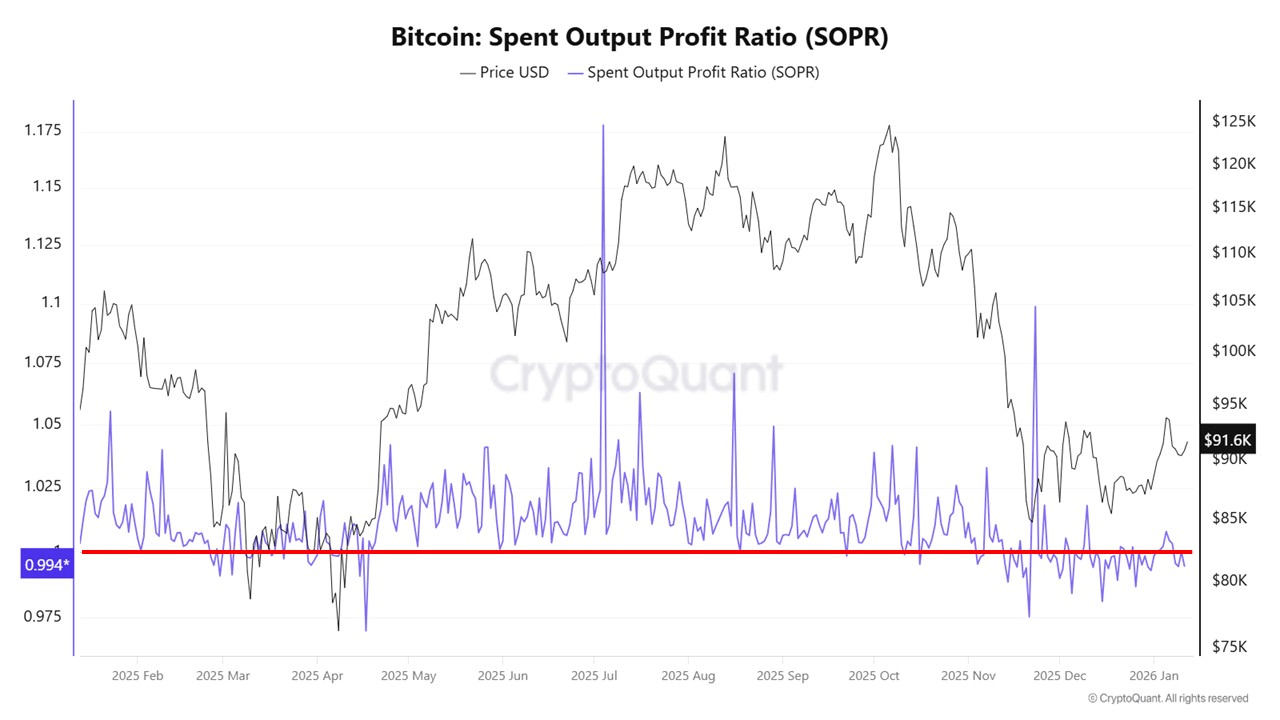
Bitcoin Spent Output Profit Ratio | Source: CryptoQuant

Together, Exchange Netflow and SOPR point to a market posture that is patient rather than defensive. Investors appear willing to hold through uncertainty instead of rotating capital or rushing to de-risk. The time horizon is clearly lengthening.

From this perspective, the CLARITY Act represents more than a policy debate. It marks a potential step toward integrating Bitcoin into the U.S. financial framework as a regulated digital commodity. On-chain data already reflects this shift: before any major price move, Bitcoin is becoming increasingly “sticky,” signaling a transition away from speculative trading and toward institutional-grade holding behavior.


Related Questions

QWhat is the CLARITY Act and when is it scheduled for review by the US Senate Banking Committee?

AThe CLARITY Act is a crypto market structure bill scheduled to be marked up by the US Senate Banking Committee on January 15, 2026.

QAccording to the article, how is Bitcoin's market behavior different from previous cycles?

ABitcoin is no longer behaving as a reflexive risk asset; it's being traded and held with a longer time horizon, with long-term holders being less reactive and sell-side pressure moderating.

QWhat two key on-chain metrics suggest that investors are not treating the CLARITY Act as an immediate threat?

AExchange Netflow and SOPR (Spent Output Profit Ratio) both indicate investors are not positioning defensively, with muted exchange inflows and subdued profit-taking activity.

QWhat does the Spent Output Profit Ratio (SOPR) hovering around 1.0 indicate about market activity?

AIt indicates subdued profit-taking activity and that on-chain spending remains low, meaning Bitcoin is not being moved aggressively to realize gains or exit positions.

QWhat broader shift in Bitcoin's market structure does the article suggest is happening?

AThe article suggests Bitcoin is transitioning away from speculative trading and toward a more institutional, regulated environment with institutional-grade holding behavior, making it 'sticky'.

Related Reads

Trading

Spot
Futures

Hot Articles

What is $BITCOIN

DIGITAL GOLD ($BITCOIN): A Comprehensive Analysis Introduction to DIGITAL GOLD ($BITCOIN) DIGITAL GOLD ($BITCOIN) is a blockchain-based project operating on the Solana network, which aims to combine the characteristics of traditional precious metals with the innovation of decentralized technologies. While it shares a name with Bitcoin, often referred to as “digital gold” due to its perception as a store of value, DIGITAL GOLD is a separate token designed to create a unique ecosystem within the Web3 landscape. Its goal is to position itself as a viable alternative digital asset, although specifics regarding its applications and functionalities are still developing. What is DIGITAL GOLD ($BITCOIN)? DIGITAL GOLD ($BITCOIN) is a cryptocurrency token explicitly designed for use on the Solana blockchain. In contrast to Bitcoin, which provides a widely recognized value storage role, this token appears to focus on broader applications and characteristics. Notable aspects include: Blockchain Infrastructure: The token is built on the Solana blockchain, known for its capacity to handle high-speed and low-cost transactions. Supply Dynamics: DIGITAL GOLD has a maximum supply capped at 100 quadrillion tokens (100P $BITCOIN), although details regarding its circulating supply are currently undisclosed. Utility: While precise functionalities are not explicitly outlined, there are indications that the token could be utilized for various applications, potentially involving decentralized applications (dApps) or asset tokenization strategies. Who is the Creator of DIGITAL GOLD ($BITCOIN)? At present, the identity of the creators and development team behind DIGITAL GOLD ($BITCOIN) remains unknown. This situation is typical among many innovative projects within the blockchain space, particularly those aligning with decentralized finance and meme coin phenomena. While such anonymity may foster a community-driven culture, it intensifies concerns about governance and accountability. Who are the Investors of DIGITAL GOLD ($BITCOIN)? The available information indicates that DIGITAL GOLD ($BITCOIN) does not have any known institutional backers or prominent venture capital investments. The project seems to operate on a peer-to-peer model focused on community support and adoption rather than traditional funding routes. Its activity and liquidity are primarily situated on decentralized exchanges (DEXs), such as PumpSwap, rather than established centralized trading platforms, further highlighting its grassroots approach. How DIGITAL GOLD ($BITCOIN) Works The operational mechanics of DIGITAL GOLD ($BITCOIN) can be elaborated on based on its blockchain design and network attributes: Consensus Mechanism: By leveraging Solana’s unique proof-of-history (PoH) combined with a proof-of-stake (PoS) model, the project ensures efficient transaction validation contributing to the network's high performance. Tokenomics: While specific deflationary mechanisms have not been extensively detailed, the vast maximum token supply implies that it may cater to microtransactions or niche use cases that are still to be defined. Interoperability: There exists the potential for integration with Solana’s broader ecosystem, including various decentralized finance (DeFi) platforms. However, the details regarding specific integrations remain unspecified. Timeline of Key Events Here is a timeline that highlights significant milestones concerning DIGITAL GOLD ($BITCOIN): 2023: The initial deployment of the token occurs on the Solana blockchain, marked by its contract address. 2024: DIGITAL GOLD gains visibility as it becomes available for trading on decentralized exchanges like PumpSwap, allowing users to trade it against SOL. 2025: The project witnesses sporadic trading activity and potential interest in community-led engagements, although no noteworthy partnerships or technical advancements have been documented as of yet. Critical Analysis Strengths Scalability: The underlying Solana infrastructure supports high transaction volumes, which could enhance the utility of $BITCOIN in various transaction scenarios. Accessibility: The potential low trading price per token could attract retail investors, facilitating wider participation due to fractional ownership opportunities. Risks Lack of Transparency: The absence of publicly known backers, developers, or an audit process may yield skepticism regarding the project's sustainability and trustworthiness. Market Volatility: The trading activity is heavily reliant on speculative behavior, which can result in significant price volatility and uncertainty for investors. Conclusion DIGITAL GOLD ($BITCOIN) emerges as an intriguing yet ambiguous project within the rapidly evolving Solana ecosystem. While it attempts to leverage the “digital gold” narrative, its departure from Bitcoin's established role as a store of value underscores the need for a clearer differentiation of its intended utility and governance structure. Future acceptance and adoption will likely depend on addressing the current opacity and defining its operational and economic strategies more explicitly. Note: This report encompasses synthesised information available as of October 2023, and developments may have transpired beyond the research period.

363 Total ViewsPublished 2025.05.13Updated 2025.05.13

What is $BITCOIN

Discussions

Welcome to the HTX Community. Here, you can stay informed about the latest platform developments and gain access to professional market insights. Users' opinions on the price of BTC (BTC) are presented below.

活动图片














