Bitcoin Finds Relief As Futures-Driven Sell-Side Activity Declines Sharply, A Major Shift Incoming?

bitcoinistPublished on 2026-01-14Last updated on 2026-01-14

Abstract

Bitcoin's price has rebounded above $94,000, reigniting bullish sentiment as futures-driven selling pressure declines sharply. The BTC Net Taker Volume metric shows a tenfold decrease from its recent peak of $489 million, indicating reduced sell-side activity. While sellers still slightly dominate, the trend is approaching positive territory, potentially setting the stage for a bullish reversal. Additionally, Bitcoin's realized volatility has compressed to around 23%, a critical level that historically precedes significant price movements. BTC is currently trading near $94,890, up over 3% in 24 hours, with trading volume surging 61%.

With the latest bounce on Tuesday, the Bitcoin price has moved back above the $94,000 level, which appears to have reignited bullish sentiment across the market. A confirmed indication of the renewed bullish sentiment is the recent drop in selling pressure from investors and the futures market.

Futures Market Sellers Are Stepping Back

The cryptocurrency market is showing upward strength with Bitcoin reclaiming resistance levels that previously halted its upside attempts. While the price of BTC is trending upwards once again, selling pressure on the flagship asset from the futures market is declining sharply.

Following weeks of aggressive short positioning and high funding rates that exacerbated downward movements, indicators currently reflect a substantial cooling of sell-side activity. As outlined by Darkfost, a market expert and author at CryptoQuant, the selling pressure has now divided by 10 after reaching a monthly average peak of $489 million in the BTC Net Taker Volume metric.

This shift in sentiment is a sign that open interest is returning to normal, liquidations have slowed, and traders are reducing rather than increasing their negative wagers. Although this does not guarantee an immediate rise in BTC’s price, it alleviates one of the biggest headwinds that has affected prices in recent sessions.
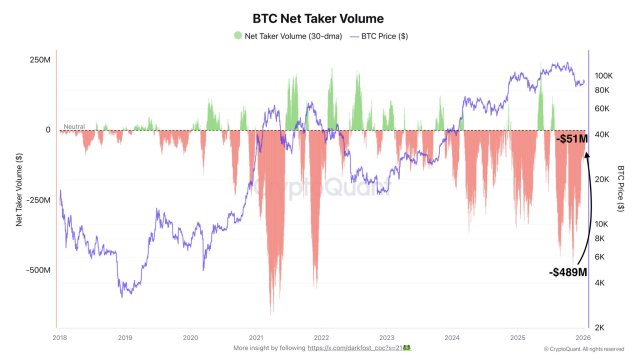
BTC sell-side pressure is declining | Source: Chart from Darkfost on X

The Bitcoin Net Taker Volume metric provides a net volume, which aids in determining who is controlling the futures order books. Furthermore, it is simpler to identify changes in trend and trading activity when the data is smoothed using a monthly average. Currently, Darkfost highlighted that sellers are still slightly dominating the orders, with over $51 million worth of trades.

While the metric has not yet flipped into positive territory, the data shows that it is gradually approaching it. According to the expert, it is quite encouraging when traders begin to change their approach, especially considering the significant impact futures volumes have on price action.

It is worth noting that the BTC price action has experienced a stable trend since the decline in selling pressure kicked off. Thus, if Net Taker Volume were to turn positive once more, it would undoubtedly set off a bullish reversal for Bitcoin.

Is Bitcoin Volatility Heading For Rock Bottom?

As the bullish sentiment returns to the market, the ongoing volatility is starting to fade, leading to a period of low risk. Axel Adler Jr., another author at CryptoQuant, has shared an update revealing that BTC’s realized volatility has compressed significantly, reaching approximately 23%, a level that statistically rarely persists for long.

In the past, these compression regimens have resulted in a dramatic range expansion. With realized volatility now sitting at 23.6%, compression has reached a critical threshold, bringing BTC to a crucial stage that could play a role in its next move.

At the time of writing, the price of BTC was trading at $94,890, indicating a more than 3% increase in the last 24 hours. Its trading volume has also increased significantly, rising by nearly 61% over the past day.

BTC trading at $95,256 on the 1D chart | Source: BTCUSDT on Tradingview.com

Trending Cryptos

Related Questions

QWhat key metric indicates a sharp decline in futures-driven sell-side activity for Bitcoin?

AThe BTC Net Taker Volume metric, which showed a drop from a monthly average peak of $489 million to around $51 million, indicating selling pressure has divided by 10.

QAccording to the article, what is the significance of the Net Taker Volume potentially turning positive?

AIf the Net Taker Volume turns positive, it would set off a bullish reversal for Bitcoin, indicating buyers are dominating the futures order books.

QWhat current Bitcoin price level is mentioned as reigniting bullish sentiment?

AThe Bitcoin price moving back above the $94,000 level is mentioned as reigniting bullish sentiment.

QWhat does the current level of Bitcoin's realized volatility (23.6%) suggest, according to Axel Adler Jr.?

AIt suggests that volatility has compressed to a critical threshold that rarely persists for long, and historically, such compression has resulted in a dramatic range expansion, indicating a potential significant price move is imminent.

QWhat are the observed market changes that accompany the decline in sell-side pressure from the futures market?

AThe decline in sell-side pressure is accompanied by open interest returning to normal, liquidations slowing down, and traders reducing their negative wagers (short positions).

Related Reads

Bank of Japan Signals Interest Rate Hike Despite Keeping Them at 1%

The Bank of Japan (BOJ) kept its benchmark interest rate at 1% on July 31, as widely expected, following a June hike to a 31-year high. The decision passed with an 8-1 vote, with board member Hajime Takata again dissenting in favor of a hike to 1.25%. Despite holding rates steady, the BOJ signaled a hawkish tilt, warning that underlying inflation is likely to accelerate and exceed 2% from the latter half of the fiscal year. While it slightly lowered its core inflation forecast for FY2026, officials expressed stronger confidence that an overshoot will occur later, driven by yen weakness, corporate pricing behavior, and lingering energy shock effects. Markets were focused on the BOJ's forward guidance. Analysts noted the central bank appeared to balance short-term caution with a long-term warning of tighter policy. Governor Kazuo Ueda faces the challenge of reconciling a government reluctant to tighten further with bond markets already pricing in additional hikes, with the timing of the next move debated. Adding complexity, the BOJ reportedly intervened in currency markets hours before the rate decision, buying yen to support the currency which had fallen to 40-year lows against the dollar. Yen weakness stems from the wide U.S.-Japan interest rate gap, high fuel prices, and market skepticism about the pace of BOJ policy normalization. The yield on Japan's 10-year government bonds fell to 2.8%, indicating investor expectations for future monetary tightening.

cryptonews.ru7m ago

Bank of Japan Signals Interest Rate Hike Despite Keeping Them at 1%

cryptonews.ru7m ago

Why Are Leveraged ETFs like 7709 Inherently Negative EV Products?

This article argues that the SK H力士 2x Leveraged ETF (7709) is fundamentally a negative expected value (EV) product, rather than simply a "double SK H力士" investment. Its core issue stems from its daily rebalancing mechanism to maintain a 2x leverage target. After a price move, the fund must buy more after a rise or sell after a fall to readjust its leverage, creating a systematic pattern of buying high and selling low. This introduces a "delay loss": it always reacts to past price changes, missing potential gains from adjusting earlier during an uptrend and suffering greater losses from adjusting later during a downtrend. While more frequent intraday rebalancing would improve returns in strong, smooth trending markets by reinvesting profits or cutting losses sooner, it also dramatically increases volatility drag (frictional losses) during choppy, oscillating markets due to more frequent high-buy/low-sell trades. The author draws a parallel to an option seller who delta hedges (short gamma), which involves similar "buy high, sell low" dynamic hedging. However, unlike an option seller who receives upfront premium (IV and theta) as compensation for this risk, the leveraged ETF investor receives no such compensation. Instead, they bear all the path-dependent volatility decay, plus additional costs like swap/derivatives financing, management fees, and trading slippage. Thus, the product's return profile can be framed as: 2x directional return minus realized variance drag minus financing costs minus derivatives costs minus management fees minus transaction costs. For the investor to profit, SK H力士's price must not only rise significantly but do so in a strong, sustained, and smooth trend to overcome these inherent structural costs. High volatility and frequent price reversals are particularly damaging. The article also notes that while the ETF has no explicit liquidation line like perpetual futures, avoiding a sudden "blow-up," its net asset value can still decay towards zero over time through this combination of volatility drag and fees. For experienced traders, directly managing leverage via perpetual contracts may offer more control and potentially lower costs than this packaged, mechanistic product.

marsbit14m ago

Why Are Leveraged ETFs like 7709 Inherently Negative EV Products?

marsbit14m ago

'Backstabbing' or 'Win-Win'? How Likely Is TradeXYZ to Break Away from Hyperliquid and Go Solo?

The article discusses the growing debate over whether TradeXYZ, which dominates Hyperliquid's HIP-3 market with over 90% of its volume, might break away to build its own independent trading platform. This possibility is fueled by TradeXYZ's immense market influence and the common industry trend of successful projects seeking more control and profit capture. Key arguments for a potential split include TradeXYZ's overwhelming contribution to Hyperliquid's metrics and the financial incentive to retain all transaction fees, as it currently splits them 50/50 with Hyperliquid. The piece draws parallels to other cases, like Anthropic's "Claude Code" competing with its former partner Cursor, suggesting "betrayal" can occur when business leverage shifts. However, strong counterarguments suggest a split is unlikely or would be detrimental. TradeXYZ relies on Hyperliquid's high-performance infrastructure and its platform as a primary user acquisition channel. Building a comparable system would be challenging. Furthermore, the founders of both projects share a history of trust and mutual admiration. The analysis concludes that a separation would likely be a lose-lose scenario: Hyperliquid would lose a major growth narrative and trading volume, while TradeXYZ would face technical hurdles, user migration issues, and reputational damage, potentially allowing competitors to seize market share. The most rational path is seen as continued collaboration, with TradeXYZ potentially negotiating better terms while leveraging Hyperliquid's established strengths.

marsbit23m ago

'Backstabbing' or 'Win-Win'? How Likely Is TradeXYZ to Break Away from Hyperliquid and Go Solo?

marsbit23m ago

Trading

Spot

Hot Articles

What is $BITCOIN

DIGITAL GOLD ($BITCOIN): A Comprehensive Analysis Introduction to DIGITAL GOLD ($BITCOIN) DIGITAL GOLD ($BITCOIN) is a blockchain-based project operating on the Solana network, which aims to combine the characteristics of traditional precious metals with the innovation of decentralized technologies. While it shares a name with Bitcoin, often referred to as “digital gold” due to its perception as a store of value, DIGITAL GOLD is a separate token designed to create a unique ecosystem within the Web3 landscape. Its goal is to position itself as a viable alternative digital asset, although specifics regarding its applications and functionalities are still developing. What is DIGITAL GOLD ($BITCOIN)? DIGITAL GOLD ($BITCOIN) is a cryptocurrency token explicitly designed for use on the Solana blockchain. In contrast to Bitcoin, which provides a widely recognized value storage role, this token appears to focus on broader applications and characteristics. Notable aspects include: Blockchain Infrastructure: The token is built on the Solana blockchain, known for its capacity to handle high-speed and low-cost transactions. Supply Dynamics: DIGITAL GOLD has a maximum supply capped at 100 quadrillion tokens (100P $BITCOIN), although details regarding its circulating supply are currently undisclosed. Utility: While precise functionalities are not explicitly outlined, there are indications that the token could be utilized for various applications, potentially involving decentralized applications (dApps) or asset tokenization strategies. Who is the Creator of DIGITAL GOLD ($BITCOIN)? At present, the identity of the creators and development team behind DIGITAL GOLD ($BITCOIN) remains unknown. This situation is typical among many innovative projects within the blockchain space, particularly those aligning with decentralized finance and meme coin phenomena. While such anonymity may foster a community-driven culture, it intensifies concerns about governance and accountability. Who are the Investors of DIGITAL GOLD ($BITCOIN)? The available information indicates that DIGITAL GOLD ($BITCOIN) does not have any known institutional backers or prominent venture capital investments. The project seems to operate on a peer-to-peer model focused on community support and adoption rather than traditional funding routes. Its activity and liquidity are primarily situated on decentralized exchanges (DEXs), such as PumpSwap, rather than established centralized trading platforms, further highlighting its grassroots approach. How DIGITAL GOLD ($BITCOIN) Works The operational mechanics of DIGITAL GOLD ($BITCOIN) can be elaborated on based on its blockchain design and network attributes: Consensus Mechanism: By leveraging Solana’s unique proof-of-history (PoH) combined with a proof-of-stake (PoS) model, the project ensures efficient transaction validation contributing to the network's high performance. Tokenomics: While specific deflationary mechanisms have not been extensively detailed, the vast maximum token supply implies that it may cater to microtransactions or niche use cases that are still to be defined. Interoperability: There exists the potential for integration with Solana’s broader ecosystem, including various decentralized finance (DeFi) platforms. However, the details regarding specific integrations remain unspecified. Timeline of Key Events Here is a timeline that highlights significant milestones concerning DIGITAL GOLD ($BITCOIN): 2023: The initial deployment of the token occurs on the Solana blockchain, marked by its contract address. 2024: DIGITAL GOLD gains visibility as it becomes available for trading on decentralized exchanges like PumpSwap, allowing users to trade it against SOL. 2025: The project witnesses sporadic trading activity and potential interest in community-led engagements, although no noteworthy partnerships or technical advancements have been documented as of yet. Critical Analysis Strengths Scalability: The underlying Solana infrastructure supports high transaction volumes, which could enhance the utility of $BITCOIN in various transaction scenarios. Accessibility: The potential low trading price per token could attract retail investors, facilitating wider participation due to fractional ownership opportunities. Risks Lack of Transparency: The absence of publicly known backers, developers, or an audit process may yield skepticism regarding the project's sustainability and trustworthiness. Market Volatility: The trading activity is heavily reliant on speculative behavior, which can result in significant price volatility and uncertainty for investors. Conclusion DIGITAL GOLD ($BITCOIN) emerges as an intriguing yet ambiguous project within the rapidly evolving Solana ecosystem. While it attempts to leverage the “digital gold” narrative, its departure from Bitcoin's established role as a store of value underscores the need for a clearer differentiation of its intended utility and governance structure. Future acceptance and adoption will likely depend on addressing the current opacity and defining its operational and economic strategies more explicitly. Note: This report encompasses synthesised information available as of October 2023, and developments may have transpired beyond the research period.

1.2k Total ViewsPublished 2025.05.13Updated 2025.05.13

What is $BITCOIN

Discussions

Welcome to the HTX Community. Here, you can stay informed about the latest platform developments and gain access to professional market insights. Users' opinions on the price of BTC (BTC) are presented below.

活动图片