Bitcoin Exchange Supply Remains At 8-Year Lows: Bullish Sign?

bitcoinistPublished on 2026-05-16Last updated on 2026-05-16

Abstract

Bitcoin exchange reserves, a measure of supply held on centralized platforms, have remained near their lowest levels in eight years despite recent price recovery. This stagnant trend, with around 5.6% of BTC's total supply on exchanges, suggests investors are not depositing coins for potential selling, which is typically viewed as a bullish sign. In contrast, Ethereum's exchange supply has seen a recent increase from 4.2% to 4.6%, though it also remains near historical lows. The on-chain data indicates continued holder accumulation for Bitcoin, even as its price trades around $79,400. Analysts note that the significance of exchange reserves alone has evolved with the rise of off-chain investment vehicles like spot ETFs.

On-chain data shows the Bitcoin exchange reserves have been at 8-year lows for the past month despite the recovery that the asset has witnessed.

Bitcoin Supply On Exchanges Has Been Flat Recently

As highlighted by on-chain analytics firm Santiment in an X post, Bitcoin and Ethereum have differed in their trend of the Supply On Exchanges. This indicator measures, as its name suggests, the total amount of a given asset that’s currently stored in the wallets associated with centralized exchanges.

When the value of the metric rises, it means investors are depositing a net number of tokens to these platforms. As one of the main reasons why holders transfer to exchanges is for selling-related purposes, this kind of trend can have a bearish impact on the cryptocurrency’s price.

On the other hand, the indicator witnessing a decline suggests the exchange outflows are overwhelming the inflows. Such a trend implies the investors may be participating in accumulation, which can naturally be a bullish signal.

Now, here is the chart shared by Santiment that shows the trend in the Supply On Exchanges for Bitcoin and Ethereum over the past year:
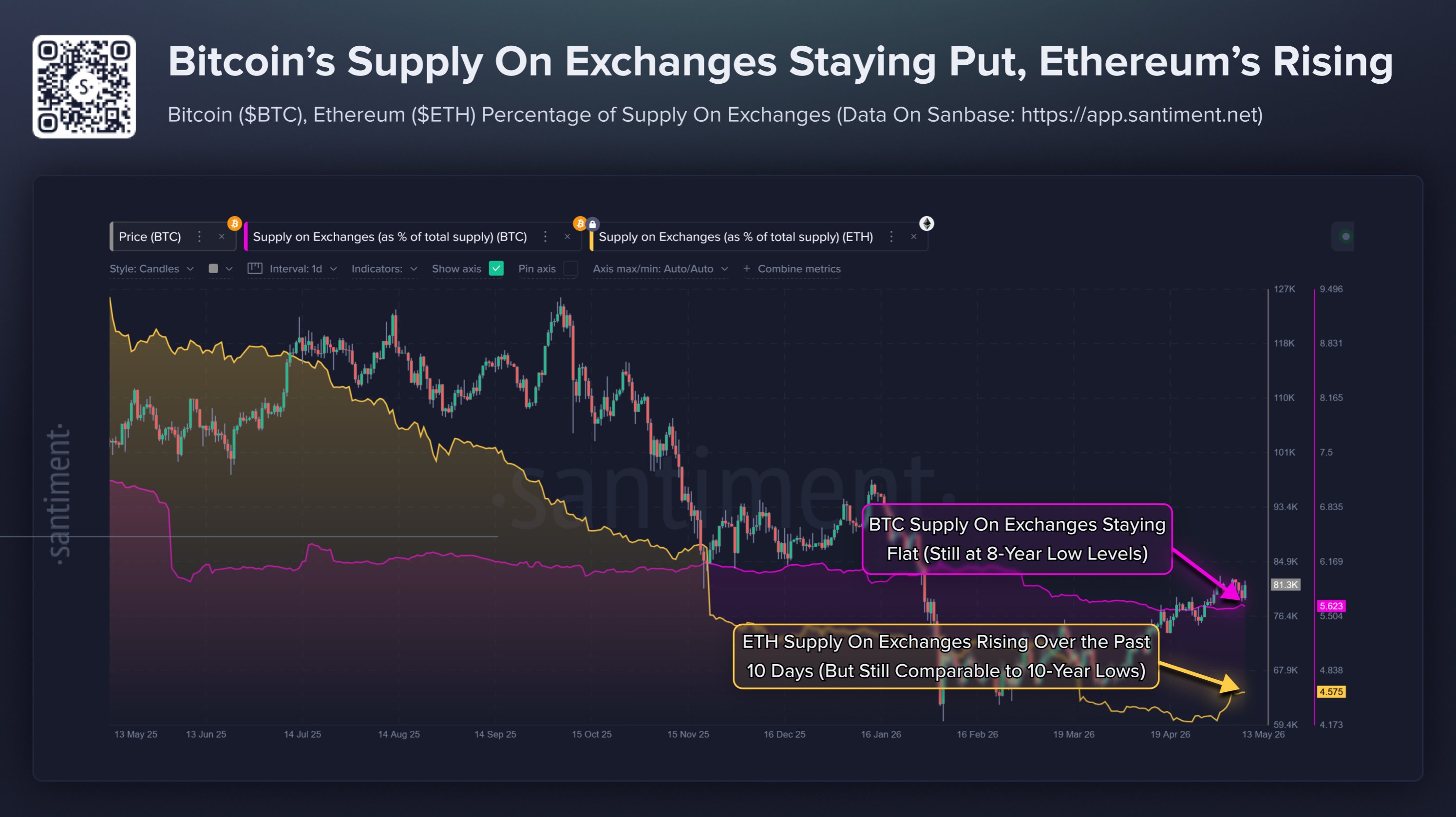
Looks like the value of the metric has gone up for ETH in recent days | Source: Santiment on X

As displayed in the above graph, the Bitcoin Supply On Exchanges observed some decline during March and has since followed a mostly flat trajectory. Currently, around 5.6% of the BTC supply is sitting inside exchange-connected wallets. “It has stayed consistent around this level for the past month, and it is the lowest ratio of BTC supply on exchanges since 2018,” noted the analytics firm.

While Bitcoin has witnessed its exchange supply remain flat at 8-year lows recently, the trend has been a bit different for Ethereum. From the chart, it’s apparent that ETH observed a much more dramatic decline in the Supply On Exchanges compared to BTC for most of the past year, but recently, the trajectory has flipped for the network.

Over the past 10 days, Ethereum has seen the indicator go from 4.2% to 4.6%, which is a notable increase. “Nevertheless, this is also still near the lowest levels we’ve seen since $ETH’s public trading inception back in 2015,” explained Santiment.

Interestingly, the flat exchange netflow for Bitcoin has arrived while BTC has observed a recovery surge. This means that despite the profit-taking opportunity, holders haven’t made deposits to sell.

Something to note when it comes to the Supply On Exchanges is that while exchanges held a central role in the digital asset sector earlier, the paradigm has shifted recently as a result of the emergence of off-chain investment routes like the spot exchange-traded funds (ETFs). As such, the exchange reserves alone no longer capture the full picture of the market.

BTC Price

At the time of writing, Bitcoin is floating around $79,400, down 0.9% in the last seven days.

The trend in the price of the coin over the last five days | Source: BTCUSDT on TradingView


Related Questions

QWhat does the 'Supply On Exchanges' indicator measure for Bitcoin, and what does a decline in this indicator typically signify?

AThe 'Supply On Exchanges' indicator measures the total amount of a given asset currently stored in wallets associated with centralized exchanges. A decline in this indicator suggests that exchange outflows are overwhelming the inflows, implying investors may be accumulating the asset, which is generally considered a bullish signal.

QHow does the current percentage of Bitcoin supply on exchanges compare to historical levels, and why is this notable?

ACurrently, around 5.6% of the Bitcoin supply is sitting on exchanges, which is the lowest ratio of BTC supply on exchanges since 2018. This is notable because it has remained consistent at this 8-year low for the past month, even during a price recovery, indicating a lack of selling pressure from holders.

QHow has the trend for Ethereum's 'Supply On Exchanges' differed from Bitcoin's in recent days?

AIn recent days, Ethereum's 'Supply On Exchanges' has increased from 4.2% to 4.6%, which is a notable rise. This is in contrast to Bitcoin's supply, which has remained flat at its 8-year low. However, despite the recent increase, Ethereum's exchange supply is still near its lowest levels since its public trading began in 2015.

QAccording to the article, what is an important limitation of the 'Supply On Exchanges' metric in today's market?

AAn important limitation is that while exchanges were central earlier, the emergence of off-chain investment routes like spot ETFs has shifted the paradigm. Therefore, exchange reserves alone no longer capture the full picture of the market, as significant investment activity now occurs outside of centralized exchanges.

QWhat price movement for Bitcoin is mentioned alongside the flat exchange netflows, and what does this combination suggest about holder behavior?

ABitcoin has observed a recovery surge in price. The combination of a price increase and flat exchange netflows suggests that despite the profit-taking opportunity, holders have not been making significant deposits to exchanges to sell, indicating potential confidence in holding or further price appreciation.

Related Reads

Putting Markets On-Chain: Canton Network Quietly Becomes the New Backbone of Institutional Finance

**Title: Letting the Market Itself Go On-Chain: Canton Network Quietly Becomes the New Backbone for Institutional Finance** **Summary:** The Canton Network, a blockchain platform designed for institutional finance, is gaining significant traction. A key sign of its maturity was Visa's recent entry as a super-validator, a proposal approved in just three days—highlighting prior, extensive collaboration between traditional finance and crypto. Unlike public chains like Ethereum that prioritize transparency and asset onboarding, Canton focuses on enabling confidential, compliant business operations for regulated institutions. Its core design features built-in **data visibility control**, meaning transaction details are only shared between direct counterparties. This privacy is fundamental, allowing competing institutions (like banks Goldman Sachs, JPMorgan, and BNP Paribas, all validators) to interact on the same network without exposing sensitive positions or strategies. Developed by Wall Street veterans at Digital Asset, Canton has taken a slow, deliberate approach to onboard real financial activity. It now handles over **$9 trillion monthly** in transaction volume, primarily from real-world institutional use cases like **tokenized repo agreements**, Treasury settlements, and collateral mobility. Major live applications include **JPM Coin** for institutional payments and **DTCC's tokenized U.S. Treasuries** project. Canton's native token, **CC**, is framed as a "network utility asset" with zero pre-mine or VC allocations. Its value is intended to be driven by the volume of real financial activity on the network. Looking ahead, Canton aims to become the invisible foundational layer for global finance—enabling atomic settlement (where payment and asset delivery occur simultaneously), 24/7 capital flows, and the native issuance and settlement of various asset classes, from corporate bonds to potentially equities. The main challenges are no longer technical but involve navigating fragmented global regulations and integrating with legacy financial systems.

marsbit4m ago

Putting Markets On-Chain: Canton Network Quietly Becomes the New Backbone of Institutional Finance

marsbit4m ago

It's Bankless That Needs Ethereum, Not Ethereum That Needs Bankless

Titled "Bankless Needs Ethereum, Not the Other Way Around," this article analyzes the significant recent news involving Bankless, a prominent crypto media outlet. Bankless co-founder David Hoffman announced the sale of all his ETH holdings, while the company also reportedly underwent major layoffs, with its founders parting ways. The news, likened to a high-profile defection, initially sent shockwaves through the Ethereum community, given Bankless's historical role as a key evangelist and "semi-official" narrative builder for Ethereum. For years, through its podcasts and writings, Bankless championed core Ethereum ideas like "ultrasound money" and the blockchain's role as a new financial settlement layer, acting as a crucial community hub and belief system during its growth phase. However, the article argues this development is not necessarily negative for Ethereum. It suggests Bankless's "first mission"—serving as Ethereum's passionate, inward-facing "propaganda department"—has largely been completed. As Ethereum matures and moves towards mainstream, institutional adoption, the narrative baton has shifted. Today, the value propositions of ETH are increasingly communicated to traditional finance by asset managers like BlackRock and VanEck, public companies adding ETH to their treasuries, and established financial figures. This represents a natural evolution towards a more decentralized, professional, and institutionally-focused narrative network. Therefore, while Bankless's retreat marks the end of an era, it signifies Ethereum's growing resilience and its reduced reliance on any single entity for belief, as its story is now carried forward by a broader and more mature ecosystem of advocates.

链捕手26m ago

It's Bankless That Needs Ethereum, Not Ethereum That Needs Bankless

链捕手26m ago

Google Officially Declares War

Google Declares War with AI-First I/O 2026 At its 2026 I/O developer conference, Google launched an aggressive, multi-pronged offensive, embedding AI across its ecosystem and challenging rivals on performance and price. The event showcased three major releases: Gemini 3.5 Flash, the video-centric Gemini Omni Flash, and the system-level AI assistant Spark. Gemini 3.5 Flash, despite being a smaller "Flash" model, outperforms its Pro counterpart in key benchmarks like mathematical reasoning (GSM8K) and coding (SWE-bench). Google attributes this to "extreme knowledge distillation" from a larger teacher model and a novel, highly granular MoE (Mixture of Experts) architecture with 256 experts, achieving sub-65ms response times. The native multi-modal model, Gemini Omni Flash, offers real-time video understanding with 120ms latency, enabling applications like preventing a cup from overfilling. The new Spark assistant gains deep Android system integration, allowing it to automate complex multi-app workflows based on voice commands. Complementing these, Google unveiled lightweight AI glasses featuring Micro-OLED displays and on-device Gemini chips for instant, offline translation and scene analysis. CEO Sundar Pichai announced Gemini has reached 900 million monthly active users, leveraged through integration into Chrome, Android, and Workspace. Google also slashed prices dramatically: the Gemini 3.5 Flash API is priced at a fraction of competitor rates. This price war is enabled by Google's vertically integrated TPU infrastructure. The strategy signals a shift: standalone AI models are becoming commoditized. Google's advantage lies in its "device + cloud + ecosystem + hardware" integration, aiming to reshape internet traffic from user-initiated searches to AI-driven service distribution. This move pressures pure-play AI firms like OpenAI and Anthropic on business models, and challenges Apple to respond in the next-generation, screen-less device race.

链捕手45m ago

Google Officially Declares War

链捕手45m ago

Top 10 Promising Emerging Hyperliquid Native Protocols to Watch

Title: A Review of 10 Emerging Native Protocols on Hyperliquid Hyperliquid is evolving beyond perpetual contracts into a comprehensive on-chain financial stack. This article highlights 10 key native protocols driving this growth: 1. **Monetrix**: A yield-optimizing protocol akin to Ethena, aggregating funding rates, HLP rewards, maker rebates, and HIP-3 into a single stablecoin yield. 2. **ROSETTA**: An automated stablecoin yield router, allocating USDC across top protocols (e.g., Felix, Aave, HLP) for optimal returns, factoring in gas and slippage. 3. **papertrade.xyz**: A fair-launched perpetuals protocol offering up to 1000x leverage, no funding rates, no slippage, and fully on-chain, oracle-based execution. 4. **alt.fun**: A launchpad where tokens are paired with leveraged perpetual positions (2x-5x), linking token price to trading activity and underlying position performance. 5. **Ventuals**: Pre-IPO perpetual contracts (built on HIP-3) allowing up to 10x leveraged speculation on valuations of private companies like SpaceX and Stripe. 6. **Liminal**: A delta-neutral yield protocol that captures funding rates via automated short positions and uses generated xTokens (xBTC, etc.) as DeFi collateral. 7. **Melt**: Brings tokenized stocks, commodities, and RWAs to Hyperliquid spot markets, enabling 24/7 trading alongside crypto assets. 8. **Chainsight**: An oracle and data infrastructure protocol providing low-latency (<3s) price feeds, volatility indices, and risk metrics for novel derivatives. 9. **rip.xyz**: Tokenized vault strategies on HyperEVM; its flagship rHYPURR offers liquidity and fractional exposure to a Hypurr NFT basket, priced hourly via NAV. 10. **Markets**: A perpetuals exchange (by Kinetiq) for trading stocks, forex, commodities, bonds, and crypto with up to 50x leverage, using USDH collateral and Kaiko oracles. These protocols form the foundational layer for generating real yield, liquidity, and innovative financial products natively on Hyperliquid.

marsbit1h ago

Top 10 Promising Emerging Hyperliquid Native Protocols to Watch

marsbit1h ago

Trading

Spot
Futures

Hot Articles

What is $BITCOIN

DIGITAL GOLD ($BITCOIN): A Comprehensive Analysis Introduction to DIGITAL GOLD ($BITCOIN) DIGITAL GOLD ($BITCOIN) is a blockchain-based project operating on the Solana network, which aims to combine the characteristics of traditional precious metals with the innovation of decentralized technologies. While it shares a name with Bitcoin, often referred to as “digital gold” due to its perception as a store of value, DIGITAL GOLD is a separate token designed to create a unique ecosystem within the Web3 landscape. Its goal is to position itself as a viable alternative digital asset, although specifics regarding its applications and functionalities are still developing. What is DIGITAL GOLD ($BITCOIN)? DIGITAL GOLD ($BITCOIN) is a cryptocurrency token explicitly designed for use on the Solana blockchain. In contrast to Bitcoin, which provides a widely recognized value storage role, this token appears to focus on broader applications and characteristics. Notable aspects include: Blockchain Infrastructure: The token is built on the Solana blockchain, known for its capacity to handle high-speed and low-cost transactions. Supply Dynamics: DIGITAL GOLD has a maximum supply capped at 100 quadrillion tokens (100P $BITCOIN), although details regarding its circulating supply are currently undisclosed. Utility: While precise functionalities are not explicitly outlined, there are indications that the token could be utilized for various applications, potentially involving decentralized applications (dApps) or asset tokenization strategies. Who is the Creator of DIGITAL GOLD ($BITCOIN)? At present, the identity of the creators and development team behind DIGITAL GOLD ($BITCOIN) remains unknown. This situation is typical among many innovative projects within the blockchain space, particularly those aligning with decentralized finance and meme coin phenomena. While such anonymity may foster a community-driven culture, it intensifies concerns about governance and accountability. Who are the Investors of DIGITAL GOLD ($BITCOIN)? The available information indicates that DIGITAL GOLD ($BITCOIN) does not have any known institutional backers or prominent venture capital investments. The project seems to operate on a peer-to-peer model focused on community support and adoption rather than traditional funding routes. Its activity and liquidity are primarily situated on decentralized exchanges (DEXs), such as PumpSwap, rather than established centralized trading platforms, further highlighting its grassroots approach. How DIGITAL GOLD ($BITCOIN) Works The operational mechanics of DIGITAL GOLD ($BITCOIN) can be elaborated on based on its blockchain design and network attributes: Consensus Mechanism: By leveraging Solana’s unique proof-of-history (PoH) combined with a proof-of-stake (PoS) model, the project ensures efficient transaction validation contributing to the network's high performance. Tokenomics: While specific deflationary mechanisms have not been extensively detailed, the vast maximum token supply implies that it may cater to microtransactions or niche use cases that are still to be defined. Interoperability: There exists the potential for integration with Solana’s broader ecosystem, including various decentralized finance (DeFi) platforms. However, the details regarding specific integrations remain unspecified. Timeline of Key Events Here is a timeline that highlights significant milestones concerning DIGITAL GOLD ($BITCOIN): 2023: The initial deployment of the token occurs on the Solana blockchain, marked by its contract address. 2024: DIGITAL GOLD gains visibility as it becomes available for trading on decentralized exchanges like PumpSwap, allowing users to trade it against SOL. 2025: The project witnesses sporadic trading activity and potential interest in community-led engagements, although no noteworthy partnerships or technical advancements have been documented as of yet. Critical Analysis Strengths Scalability: The underlying Solana infrastructure supports high transaction volumes, which could enhance the utility of $BITCOIN in various transaction scenarios. Accessibility: The potential low trading price per token could attract retail investors, facilitating wider participation due to fractional ownership opportunities. Risks Lack of Transparency: The absence of publicly known backers, developers, or an audit process may yield skepticism regarding the project's sustainability and trustworthiness. Market Volatility: The trading activity is heavily reliant on speculative behavior, which can result in significant price volatility and uncertainty for investors. Conclusion DIGITAL GOLD ($BITCOIN) emerges as an intriguing yet ambiguous project within the rapidly evolving Solana ecosystem. While it attempts to leverage the “digital gold” narrative, its departure from Bitcoin's established role as a store of value underscores the need for a clearer differentiation of its intended utility and governance structure. Future acceptance and adoption will likely depend on addressing the current opacity and defining its operational and economic strategies more explicitly. Note: This report encompasses synthesised information available as of October 2023, and developments may have transpired beyond the research period.

363 Total ViewsPublished 2025.05.13Updated 2025.05.13

What is $BITCOIN

Discussions

Welcome to the HTX Community. Here, you can stay informed about the latest platform developments and gain access to professional market insights. Users' opinions on the price of BTC (BTC) are presented below.

活动图片














