Bitcoin continues to trade below the psychologically important $90,000 level, reinforcing a cautious tone across the market as more analysts begin to warn that the current cycle could be transitioning toward a broader bear phase in 2026. Despite several attempts to regain upside momentum, price action has remained fragile, with volatility picking up and confidence fading among short-term participants.
Recent on-chain insights from analyst Axel Adler add weight to the growing risk-off narrative. Market sentiment, which reached euphoric levels earlier this month, has undergone a notable reversal. After peaking in early December, optimism quickly faded as prices failed to sustain higher levels, triggering a steady deterioration in sentiment indicators. The latest readings now place sentiment firmly below neutral, reflecting a clear cooling in trader conviction.
This shift is particularly notable because it follows a failed seasonal rebound attempt, often referred to as the “Santa rally,” which historically tends to support prices. Instead, the market’s inability to capitalize on that window has reinforced the view that short-term conditions have deteriorated. The downward turn in sentiment metrics suggests that traders are increasingly defensive, with reduced risk appetite and lower willingness to add exposure at current levels.
As Bitcoin remains capped below key resistance, sentiment dynamics point to a market that is no longer driven by momentum but by caution, uncertainty, and a reassessment of the medium-term outlook.
Bitcoin Trades Below Key Cost Bases as Recovery Signals Remain Elusive
Bitcoin continues to trade under pressure, with price hovering near the $87,400 level, a zone that analysts view as structurally weak in the short term. According to insights shared by Axel Adler, Bitcoin is currently trading below all major short-term holder realized price benchmarks, highlighting the fragility of recent demand. The closest overhead barrier is the short-term holder, 1-week to 1-month realized price around $90,300, a level now acting as immediate resistance rather than support.
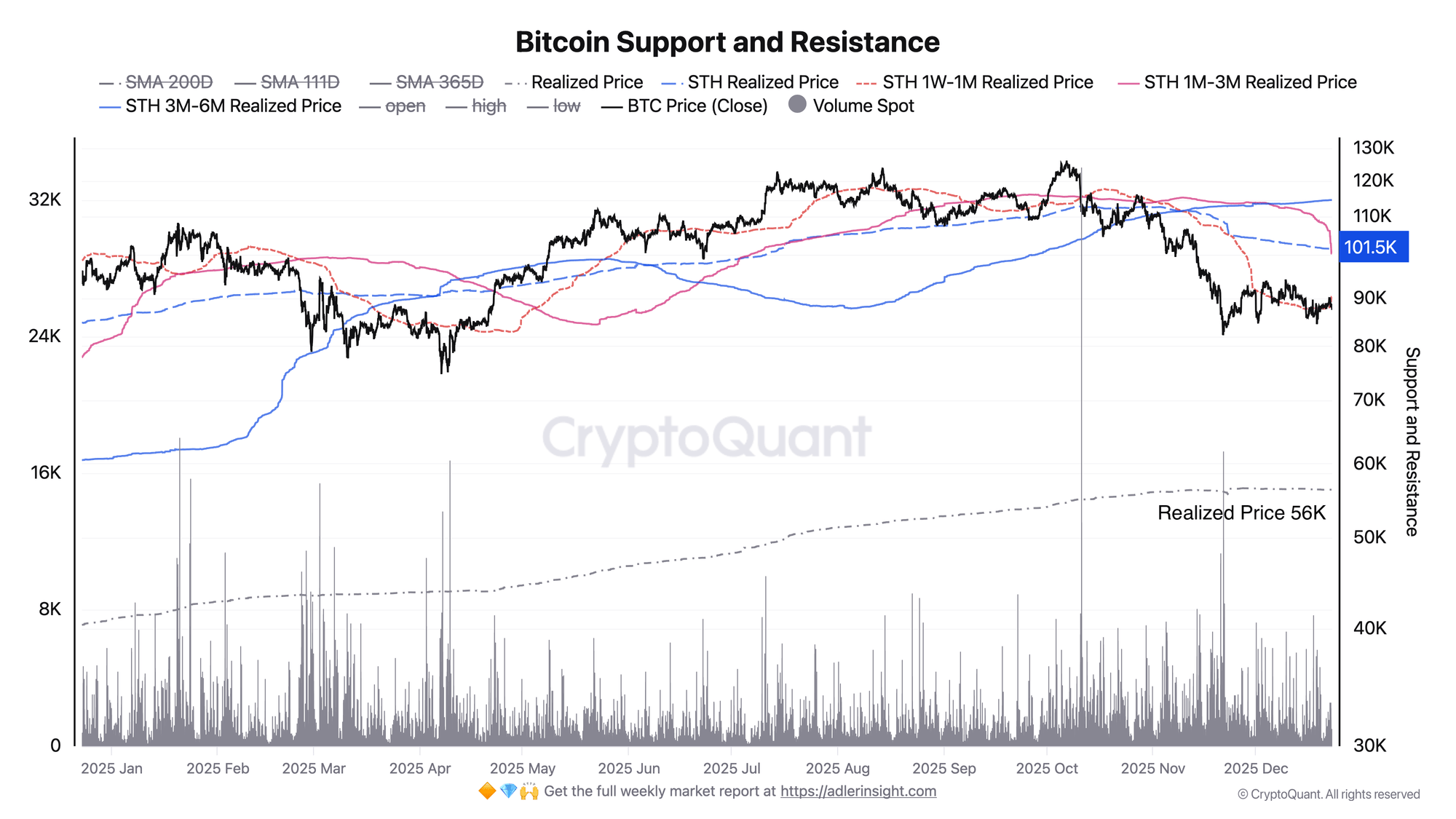
Bitcoin Support and Resistance | Source: CryptoQuant
Above that, resistance intensifies sharply. A dense supply cluster emerges between $100,400 and $101,500, where the 1-month to 3-month short-term holder realized price converges with the aggregate short-term holder realized price. This zone also aligns closely with the 365-day simple moving average near $101,800, reinforcing its importance as a longer-term inflection area. Additional moving average resistance is positioned even higher, with the 111-day and 200-day SMAs near $104,300 and $107,900, respectively.
Trading below short-term holder cost bases implies that the most recent buyers are sitting on unrealized losses. As a result, relief rallies toward breakeven levels risk triggering renewed selling. For market conditions to improve meaningfully, Bitcoin would need to reclaim and hold above the $90,000 area. Until then, the absence of strong spot demand leaves the market exposed to further downside, despite long-term support anchored near the aggregate realized price at $56,300.