Bitcoin Derivatives Buying Pressure Continues To Rise — Is $80K Inevitable?

bitcoinistPublished on 2026-04-27Last updated on 2026-04-27

Abstract

Bitcoin's price has been experiencing significant bullish momentum, with recent gains primarily driven by strong demand in the perpetual futures market rather than spot trading. On-chain analysis reveals sustained buying pressure in Bitcoin derivatives, as indicated by the Net Taker Volume metric, which has remained positive at around $145 million since March 7. This metric, which measures the difference between long and short orders, suggests continued dominance of buyers and reflects bullish sentiment among traders. Historically, such a shift from selling to buying pressure has consistently led to upward price movements. Analysts expecting the trend to continue, potentially pushing Bitcoin toward the $80,000 mark, though that level remains a key resistance zone. Currently, BTC is around $77,508 with little change over the past day.

The price of Bitcoin has been enjoying significant bullish momentum over the past few weeks, with last week delivering the largest gains in over three months. According to different pundits, the flagship cryptocurrency’s latest rally above $79,000 was primarily driven by demand in the perpetual futures market rather than the spot market. Recent on-chain evaluation shows that the buying pressure on the Bitcoin derivatives side has yet to simmer down over the past few days.

BTC Net Taker Volume Surges To Around $145 Million

In an April 25th post on the X platform, pseudonymous analyst Darkfost revealed that the bulls have continued to dominate the Bitcoin perpetual futures market. This on-chain observation is based on a surge in the Net Taker Volume metric, which measures the difference between the volume of long (buy) and short (sell) orders in the derivatives market of a particular cryptocurrency.

The on-chain metric can be used to identify the market’s most dominant participant (buyers or sellers) at a given time. A positive Net Taker Volume metric indicates that buying volume exceeds selling volume, while a negative value suggests that sellers are overwhelming the buyers in the Bitcoin derivatives market.

Darkfost wrote on X:

Beyond simply showing whether buying or selling pressure is dominant, it also reflects the prevailing sentiment among traders.

Referencing CryptoQuant data, Darkfost revealed that the Net Taker Volume — smoothed over a month to show the real trend — stands at around $145 million. As the on-chain analyst highlighted, this metric has remained positive for nearly two months (since March 7).
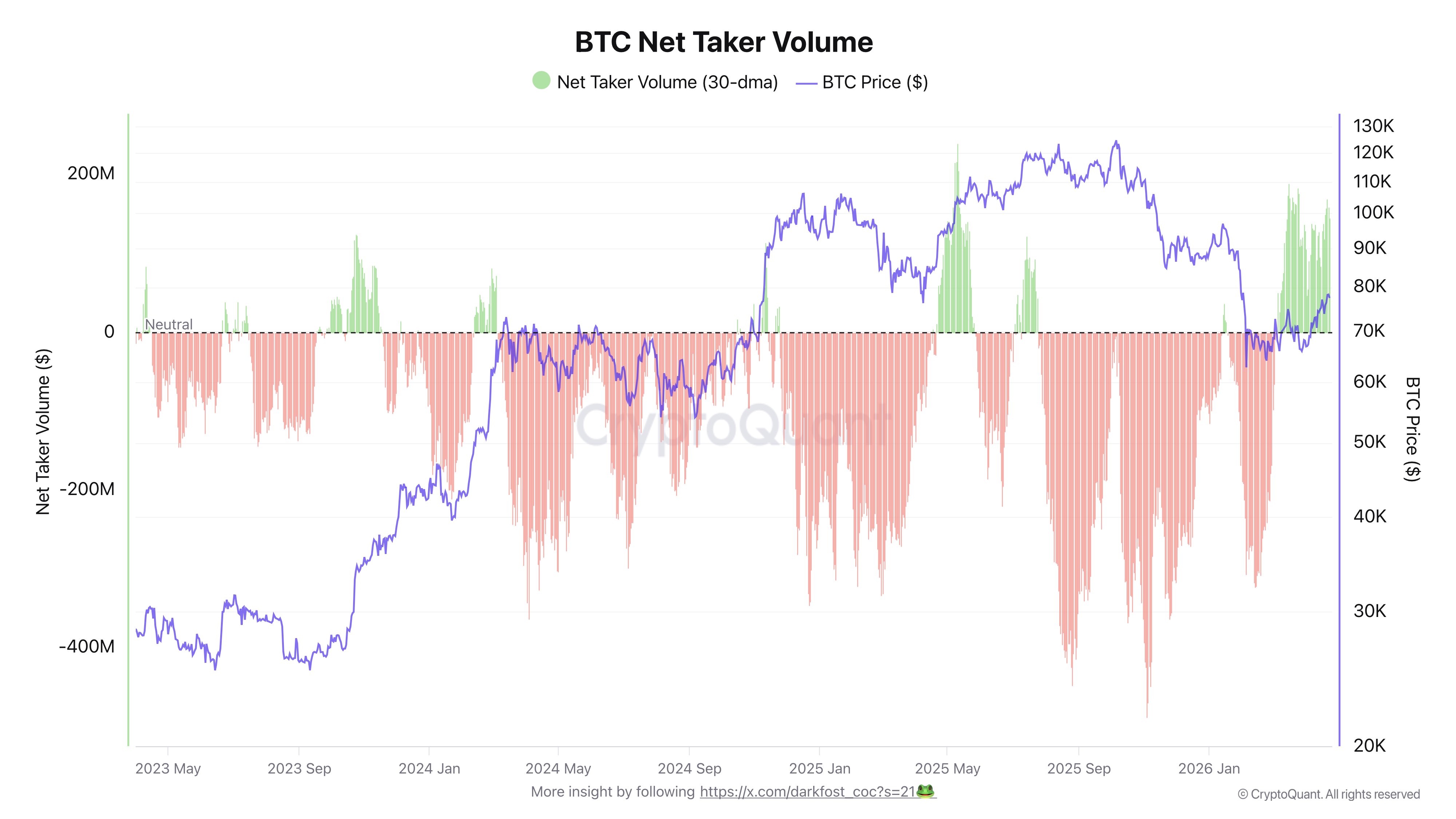
Source: @Darkfost_Coc

In what appears to be a fairly established pattern in this cycle, Darkfost noted that whenever the metric shifts from largely dominant selling pressure and extremely negative sentiment to renewed buying pressure from the bulls, the Bitcoin price has consistently reacted with an upside move. And this has been the case for the premier cryptocurrency since the first week in March.

Looking at the prolonged duration and strength of the buy volume, Darkfost said investors could expect the current Bitcoin trend to continue for the foreseeable future, potentially pushing the price toward the $80,000 target. However, it is important to tread with caution, as the $80,000 region has proven to be a significant level of resistance over the past few days.

Bitcoin Price At A Glance

As of this writing, the price of BTC stands at around $77,508, reflecting no significant movement in the past 24 hours.

The price of BTC on the daily timeframe | Source: BTCUSDT chart on TradingView


Related Questions

QWhat is the primary driver behind Bitcoin's recent rally above $79,000, according to on-chain analysis?

AThe primary driver behind Bitcoin's recent rally is the demand in the perpetual futures market, rather than the spot market.

QWhat does a positive Net Taker Volume metric indicate in the Bitcoin derivatives market?

AA positive Net Taker Volume metric indicates that buying volume exceeds selling volume, signifying that bulls are dominating the market.

QWhat is the current value of the smoothed Net Taker Volume metric, and for how long has it remained positive?

AThe smoothed Net Taker Volume metric stands at around $145 million and has remained positive for nearly two months, since March 7.

QAccording to the analyst Darkfost, what has been the price reaction when the Net Taker Volume shifts from selling to buying pressure?

AAccording to Darkfost, whenever the metric shifts from dominant selling pressure to renewed buying pressure, the Bitcoin price has consistently reacted with an upside move.

QWhat is the current price of Bitcoin and what key resistance level is mentioned as a challenge for further gains?

AThe current price of Bitcoin is around $77,508, and the $80,000 region is mentioned as a significant level of resistance that has proven challenging to break.

Related Reads

Making AI Products Is No Longer the Hard Part; Being Seen Is: Developers, Web3, and Chinese AI Opportunities at mu Shanghai

The article discusses the shifting challenges of AI entrepreneurship, based on insights from the mu Shanghai AI WEEK event in May 2026. As AI tools drastically lower the barrier to creating product prototypes, the core difficulty for startups has moved from "how to build" to "who to build for"—finding real users, sustainable business models, and community engagement. The event itself was structured as an extended, immersive developer community space rather than a traditional conference, attracting a global mix of participants (40% AI, 20-30% Web3). This format emphasized deep networking and collaborative creation over one-way presentations. A key observation is that with powerful models and coding assistants becoming ubiquitous, execution is less of a moat. The new scarce resource is judgment—identifying valuable, defensible scenarios where an application won't be quickly rendered obsolete by the next model update. This pushes competition downstream to distribution, user acquisition, and commercialization. Notably, many Web3 practitioners are migrating into AI, bringing with them expertise in community building, global collaboration, and grassroots marketing—skills highly relevant as AI apps fight for visibility. Meanwhile, opportunities in AI hardware, robotics, and embodied intelligence are seen as more durable, leveraging China's robust manufacturing and supply chain ecosystem as a key advantage. The article notes that major Chinese model companies (like MiniMax) are now actively competing for developer mindshare through community programs, hackathons, and improved tooling, recognizing developers as core users. Ultimately, the conclusion is that while AI simplifies building, the harder part of the journey is ensuring a product is truly needed, understood, and retained by its users.

marsbit4m ago

Making AI Products Is No Longer the Hard Part; Being Seen Is: Developers, Web3, and Chinese AI Opportunities at mu Shanghai

marsbit4m ago

Why is the RWA Boom Failing to Benefit DeFi?

The rapid growth of the tokenized real-world assets (RWA) market, now nearing $30 billion on-chain, has largely bypassed the DeFi ecosystem. Only about $2.47 billion is actively locked in DeFi protocols, indicating a penetration rate of just 9%. A major barrier is the "permissioned" architecture of most RWA products, like BlackRock's BUIDL fund, which are designed for institutional compliance. They require whitelisting, off-chain settlement, and strict investor accreditation, making them incompatible with open, permissionless DeFi applications like Aave or Uniswap. This is evident in categories like bonds/money market funds ($16.6B on-chain, $920M in DeFi) and tokenized equities ($2.7B on-chain, $78M in DeFi). Notable exceptions are private credit protocols (e.g., Maple Finance, Centrifuge) and assets like Ondo's USDY, which were designed from inception for DeFi composability, allowing them to be used freely as collateral. Morpho and Aave Horizon also demonstrate successful RWA lending integrations. However, industry reports (IOSCO, ECB) warn that growth may remain confined within traditional financial systems due to fragmented regulations, lack of unified standards, and inherent conflicts between DeFi's open logic and compliance requirements like minimum investments and fixed redemption windows. The RWA sector is effectively split into two markets: a compliant, permissioned on-chain finance market and a smaller DeFi-native market focused on composability. For DeFi penetration to rise significantly, asset issuers must prioritize designs that enable permissionless circulation from the start, moving away from models centered solely on institutional compliance.

marsbit24m ago

Why is the RWA Boom Failing to Benefit DeFi?

marsbit24m ago

Clarity Act Outlook: No Yield, No Payment

"Clear Act Outlook: No Yield, No Payment" analyzes the evolving U.S. regulatory landscape for stablecoins, focusing on the interplay between the proposed "Clarity Act" and the existing "Genius Act." The article argues that the Genius Act successfully fostered "payment stablecoins" by permitting tokenized assets like U.S. Treasuries as reserves. This created a structured market where stablecoin issuers (like USDC) must hold these reserves, often purchased as Tokenized Money Market Funds (TMMFs) from giants like BlackRock. These TMMFs are primarily B2B products, ensuring user-facing stablecoins remain non-interest-bearing and used primarily for payments. The upcoming Clarity Act is seen as the next phase, aiming to restrict passive yield on stablecoins. Its goal is to dismantle the arbitrage advantage of offshore stablecoins like USDT by redirecting Treasury demand towards compliant, U.S.-sanctioned TMMFs. For on-chain and compliant offshore dollars, this creates new pressure: they must spur adoption and utility to generate yield, as simple Treasury staking may be restricted. This indirectly promotes dollar circulation and sustained Treasury purchases. Ultimately, the analysis posits that U.S. regulation seeks to create a new dollar distribution model. By separating payment function from yield generation and anchoring both to U.S. debt instruments, it aims to embed the dollar and Treasury demand into the global crypto economy, managing yields through sanctioned intermediaries while leaving room for DeFi and cross-border arbitrage.

marsbit53m ago

Clarity Act Outlook: No Yield, No Payment

marsbit53m ago

Trading

Spot
Futures

Hot Articles

What is $BITCOIN

DIGITAL GOLD ($BITCOIN): A Comprehensive Analysis Introduction to DIGITAL GOLD ($BITCOIN) DIGITAL GOLD ($BITCOIN) is a blockchain-based project operating on the Solana network, which aims to combine the characteristics of traditional precious metals with the innovation of decentralized technologies. While it shares a name with Bitcoin, often referred to as “digital gold” due to its perception as a store of value, DIGITAL GOLD is a separate token designed to create a unique ecosystem within the Web3 landscape. Its goal is to position itself as a viable alternative digital asset, although specifics regarding its applications and functionalities are still developing. What is DIGITAL GOLD ($BITCOIN)? DIGITAL GOLD ($BITCOIN) is a cryptocurrency token explicitly designed for use on the Solana blockchain. In contrast to Bitcoin, which provides a widely recognized value storage role, this token appears to focus on broader applications and characteristics. Notable aspects include: Blockchain Infrastructure: The token is built on the Solana blockchain, known for its capacity to handle high-speed and low-cost transactions. Supply Dynamics: DIGITAL GOLD has a maximum supply capped at 100 quadrillion tokens (100P $BITCOIN), although details regarding its circulating supply are currently undisclosed. Utility: While precise functionalities are not explicitly outlined, there are indications that the token could be utilized for various applications, potentially involving decentralized applications (dApps) or asset tokenization strategies. Who is the Creator of DIGITAL GOLD ($BITCOIN)? At present, the identity of the creators and development team behind DIGITAL GOLD ($BITCOIN) remains unknown. This situation is typical among many innovative projects within the blockchain space, particularly those aligning with decentralized finance and meme coin phenomena. While such anonymity may foster a community-driven culture, it intensifies concerns about governance and accountability. Who are the Investors of DIGITAL GOLD ($BITCOIN)? The available information indicates that DIGITAL GOLD ($BITCOIN) does not have any known institutional backers or prominent venture capital investments. The project seems to operate on a peer-to-peer model focused on community support and adoption rather than traditional funding routes. Its activity and liquidity are primarily situated on decentralized exchanges (DEXs), such as PumpSwap, rather than established centralized trading platforms, further highlighting its grassroots approach. How DIGITAL GOLD ($BITCOIN) Works The operational mechanics of DIGITAL GOLD ($BITCOIN) can be elaborated on based on its blockchain design and network attributes: Consensus Mechanism: By leveraging Solana’s unique proof-of-history (PoH) combined with a proof-of-stake (PoS) model, the project ensures efficient transaction validation contributing to the network's high performance. Tokenomics: While specific deflationary mechanisms have not been extensively detailed, the vast maximum token supply implies that it may cater to microtransactions or niche use cases that are still to be defined. Interoperability: There exists the potential for integration with Solana’s broader ecosystem, including various decentralized finance (DeFi) platforms. However, the details regarding specific integrations remain unspecified. Timeline of Key Events Here is a timeline that highlights significant milestones concerning DIGITAL GOLD ($BITCOIN): 2023: The initial deployment of the token occurs on the Solana blockchain, marked by its contract address. 2024: DIGITAL GOLD gains visibility as it becomes available for trading on decentralized exchanges like PumpSwap, allowing users to trade it against SOL. 2025: The project witnesses sporadic trading activity and potential interest in community-led engagements, although no noteworthy partnerships or technical advancements have been documented as of yet. Critical Analysis Strengths Scalability: The underlying Solana infrastructure supports high transaction volumes, which could enhance the utility of $BITCOIN in various transaction scenarios. Accessibility: The potential low trading price per token could attract retail investors, facilitating wider participation due to fractional ownership opportunities. Risks Lack of Transparency: The absence of publicly known backers, developers, or an audit process may yield skepticism regarding the project's sustainability and trustworthiness. Market Volatility: The trading activity is heavily reliant on speculative behavior, which can result in significant price volatility and uncertainty for investors. Conclusion DIGITAL GOLD ($BITCOIN) emerges as an intriguing yet ambiguous project within the rapidly evolving Solana ecosystem. While it attempts to leverage the “digital gold” narrative, its departure from Bitcoin's established role as a store of value underscores the need for a clearer differentiation of its intended utility and governance structure. Future acceptance and adoption will likely depend on addressing the current opacity and defining its operational and economic strategies more explicitly. Note: This report encompasses synthesised information available as of October 2023, and developments may have transpired beyond the research period.

363 Total ViewsPublished 2025.05.13Updated 2025.05.13

What is $BITCOIN

Discussions

Welcome to the HTX Community. Here, you can stay informed about the latest platform developments and gain access to professional market insights. Users' opinions on the price of BTC (BTC) are presented below.

活动图片














