In last week's report, we clearly indicated that the market was in a bull trap zone, advised investors not to blindly chase rallies and add positions, and maintained our bearish trend judgment. This week's market movement provided clear validation—Bitcoin failed to effectively break through the resistance zone and subsequently showed a clear pullback, with the bearish logic continuing to hold.
The following will present this week's market forecast, operational strategy suggestions, and a review of last week's trade execution to help readers grasp the direction and make precise decisions in a complex market.
Core Summary of the Trading Weekly Report:
• HYPE Short-term Trading Results: Completed one short-term long trade (1x leverage) last week, successfully achieving a return of approximately 4.41%. (Details in Part Two)
• BTC Short-term Trading Results: Completed one short-term short trade (1x leverage) last week, successfully achieving a return of approximately 5.37%. (Details in Part Four)
• HYPE This Week's Forecast and Operational Strategy: See Parts One and Two for details.
• BTC Price Trend Forecast and Medium & Short-term Operational Strategies: See Parts Three and Four for details.
• Core View Validation: Bitcoin remained in a bearish trend structure last week, with the price action fully aligning with our forecast; the bull trap warning was effectively realized.
一、HYPE Prediction and Operational Strategy
1、Core View This Week:
Based on the current structure, we judge that the current hourly-level downward adjustment initiated from the high on the 19th of March (near endpoint 27) is likely to end soon. Subsequent price action needs to be observed to see if the price can effectively break away from the束缚 (restraint) of Central Range C to confirm if the adjustment is truly over. If it can break out effectively, the signal for trend continuation will become clearer. It is expected that the probability of wide-range fluctuations is high this week, and operations should remain flexible.
2、HYPE Upside Risk Warning:
It must be specifically pointed out that although HYPE's price action has independence, it still cannot completely detach from Bitcoin's macro environment. If Bitcoin's subsequent price action shows a significant adjustment, it might dampen HYPE's rebound momentum. Investors must remain vigilant and prepare risk contingency plans.
3、Operational Strategy This Week:
Utilize 30% of the position, set stop-loss points, and look for "spread" opportunities based on support and resistance levels. (Using the 30-minute/60-minute chart as the operation cycle). Operations should be light and flexible, strictly adhering to stop-loss discipline.
二、HYPE Last Week's Structure Analysis and Short-term Trade Review
1、HYPE Market Dynamics and Investment Opportunity Continuous Tracking
Since late February, we have continuously tracked and analyzed HYPE. Each previous judgment has been effectively validated by market movements. A specific review is as follows:
• February 23rd Weekly Review: First提示 (hinted) that HYPE might be entering an investment window, pointed out that the行情 (market situation) was in a Wave II correction phase, and predicted that it was expected to initiate a Wave III main upward行情 subsequently.
• March 3rd Weekly Review: Determined that the low of $25.60 on February 24th could be the starting point of Wave III, confirming the potential location for a trend reversal.
• March 9th Weekly Review: Pointed out that the price had effectively broken through multiple moving average resistances on the daily chart, subsequently entering a retracement and consolidation phase, expecting a rapid rise after its conclusion.
• March 16th Weekly Review: Pointed out that the行情 was in a Wave III trend and was constructing an upward central range (i.e., Central Range B). Predicted that after completion, the probability of wide-range fluctuations was high.
2、HYPE Daily Level Structure Overview: (Based on price action after January 21st)
The current HYPE daily chart clearly shows a three-wave推进 (advancing) pattern, with the characteristics of each sub-wave as follows:
• Wave I (Impulse Wave): From the January 21st low of $20.46 to the February 3rd high of $38.41, lasting 14 days, with a maximum increase of 87.73%, showing strong driving force.
• Wave II (Corrective Wave): From the February 3rd high of $38.41 to the February 24th low of $25.60, lasting 20 days, with a maximum decline of 33.35%, a normal retracement range.
• Wave III (Main Wave): From the February 24th low of $25.60 to the present, the行情 has run for 27 days, with a maximum increase of 71.02%. The main upward trend is still continuing, with good structural integrity.
3、HYPE Hourly Level Detailed Structure: (Based on price action after March 16th)
HYPE_60 Minute K-Line Chart
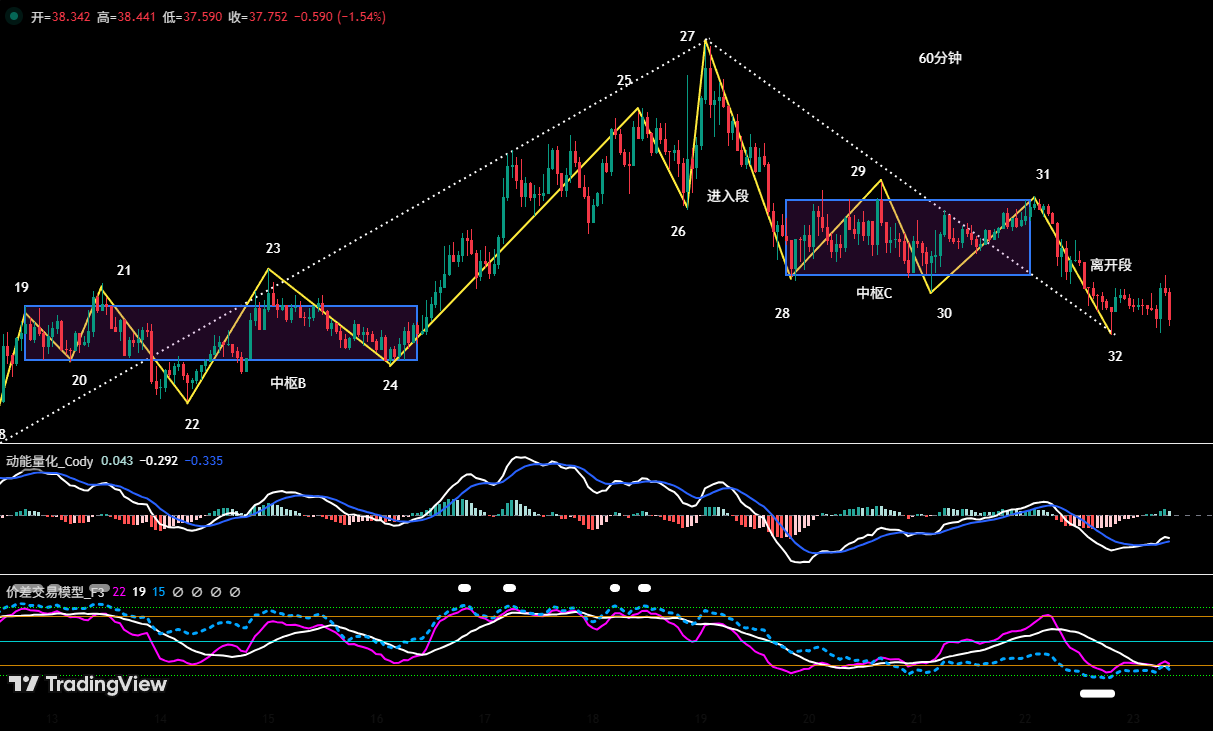
Figure One
• HYPE Hourly Level Structure Review: As shown in the figure, the price was constructing an upward central range (i.e., Central Range B) between the 9th and the latter part of the 15th, and it was接近 (approaching) completion, overall rhythm符合 (conforming to) our previous prediction.
• HYPE Hourly Level Internal Structure Division: (03.16~03.22)
a、As shown in (Figure One), starting from endpoint 24, the previously constructed upward central range (i.e., Central Range B) has been confirmed as complete. Subsequently, the行情 evolved into a complex structure consisting of 8 segments: 24-25, 25-26, 26-27, 27-28, 28-29, 29-30, 30-31, 31-32. As of the time of analysis, segment 31-32 was running, with a relatively clear structural hierarchy.
b、Segments 24-25, 25-26, 26-27 form an upward structure, with a relatively clear direction.
c、Segments 27-28, 28-29, 29-30, 30-31, 31-32 form an adjustment structure, with the adjustment process showing obvious震荡收敛 (oscillating convergence) characteristics.
d、Among them, segments 28-29, 29-30, 30-31 overlap with each other,共同构建 (jointly constructing) a downward central range (i.e., Central Range C), which is the core interval of this adjustment.
4、HYPE Short-term Trade Review (1x Leverage): (03.16~03.22)
Last week, based on交易 signals from our self-built spread trading model and momentum量化 (quantitative) model, combined with the prediction of the upward structure, we completed one short-term (long) operation, successfully profiting 4.41%. The execution process strictly followed the plan.
• HYPE Short-term Trade Details Summary: (Leverage×1)

• Opening Decision: This opening decision was based on the prediction of trend continuation after the completion of upward Central Range B. The specific trigger signal was the price effectively breaking through the central range's upper rail resistance (approx. $38.54), and both the spread and momentum quantitative models发出 (issuing) bullish共振 (resonance) signals. The叠加 (superimposition) of multiple bases significantly improved the reliability of the entry timing. Accordingly, we executed a 30% long position at $38.73.
• Closing Decision: Based on the spread quantitative model issuing a top bearish signal, forming a technical共振 with the K-line "strong top分型 (fenxing)" combination signal, the top characteristics were clear. Therefore, we executed a closing operation near $40.44, taking the profit.
• Trade Summary: This operation successfully profited approximately 4.41%. The entry and exit points were effectively supported by model signals, indicating high strategy execution quality.
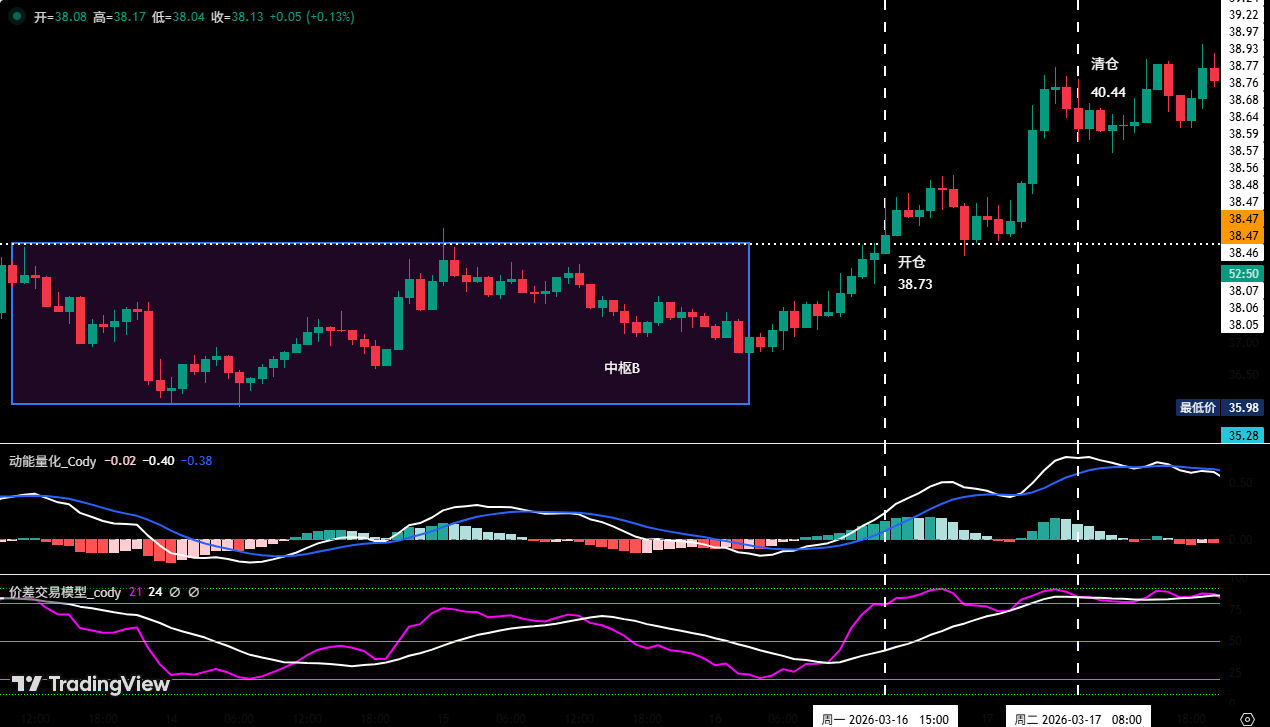
Figure Two
三、This Week's BTC Prediction and Operational Strategy (03.23~03.29)
1、Bitcoin Predicted Structure Analysis (Based on price action after the February 6th low)
Using Bitcoin's 4-hour chart as the analysis周期 (cycle):
• Maintain the previous core research framework: The upward行情 initiated from the February 6th low (approx. $60,000) is, in nature, a oversold rebound within the large-level C-wave adjustment, specifically the C-2 wave. The rebound nature determines its limited upside space, followed by a C-3 wave adjustment行情.
• Current Structure Interpretation: In the 4-hour analysis cycle, the short-term upward structure formed from the February 24th low has been broken. The防守 (defensive) capability of the bulls at key positions has significantly weakened. If the current support cannot be recovered subsequently, it may further test the lower rail of the upward channel formed since the rebound from the February 6th low. Once this position is lost, the probability that the C-2 wave rebound ended near the recent high of $76,000, as we previously analyzed, will significantly increase. The market may then test the $60,000关口 (level) again downward, at which time market pressure will明显加重 (significantly increase). Overall, the market remains dominated by a bearish trend structure.
• C-3 Wave Establishment Condition: If the Bitcoin price falls below the February 6th low (approx. $60,000), the C-3 adjustment wave is established. At that time, downward targets will be reopened, and operational预案 (contingency plans) must be prepared in advance.
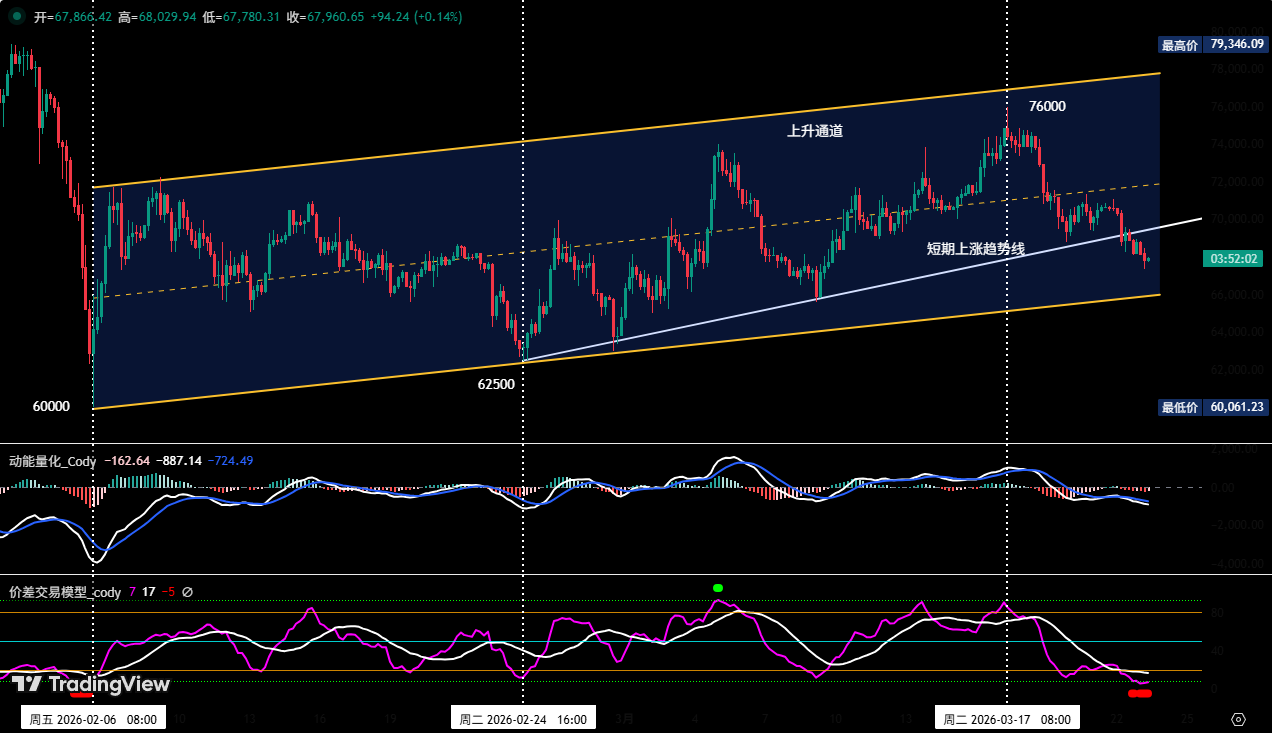
Figure Three
2、This Week's Forecast View:
Maintain the震荡调整 (oscillating adjustment) pattern. Focus on observing the battle between bulls and bears near the channel's lower rail (from the February 6th low). The volume changes and price reaction at this position will be important basis for judging the subsequent direction.
3、Core Resistance Levels:
• First Resistance Zone: $69,500~$71,500 area (previous震荡 (consolidation) range, main resistance band for short-term rebound)
• Second Resistance Zone: $74,500~$76,000 area (near the November 2025 low, an important reference level for medium-term bearish strategies)
4、Core Support Levels:
• First Support Level: $65,000~$66,000 area (previous important support area)
• Second Support Level: $60,000~$62,500 area (near the February 6th low, a break below would further strengthen the bearish structure)
• Third Support Level: Near $57,400 (an important technical reference level below)
5、This Week's Operational Strategy (Excluding the impact of突发消息 (sudden news)):
1 Medium-term Strategy:
Bitcoin Daily K-Line Chart: (Position Monitoring Model)
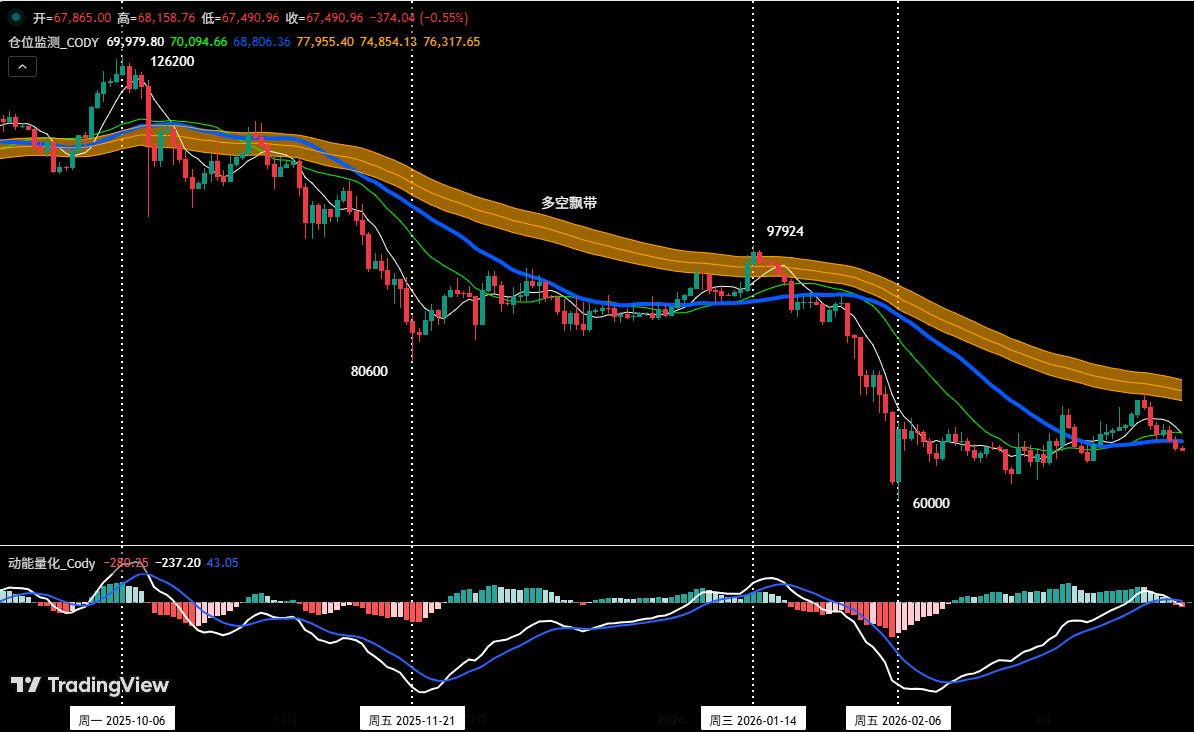
Figure Four
The Position Monitoring Model shows: The coin price is currently below the Bull-Bear Ribbon (yellow), and the bearish structure continues to hold. According to strategy rules, we continue to hold the 60% short position established at $89,000 (January 28th). The medium-term direction remains unchanged.
• If the coin price反弹 (rebounds) and effectively breaks through $74,500, reduce the medium-term position to 40% to lower risk exposure.
• If the coin price反弹 and effectively breaks through and stabilizes above the Bull-Bear Ribbon, clear all medium-term positions. Adjust the strategy according to the trend.
2 Short-term Strategy:
Utilize 30% of the position, set stop-loss points, and look for "spread" opportunities based on support and resistance levels. (Using the 30-minute/60-minute chart as the operation cycle). Short-term operations must strictly execute stop-loss discipline to avoid significant losses from small mistakes.
3 Short-term Contingency Plans A/B:
Since the medium-term market direction is bearish, the operational principle of "following the trend to go short" should be adhered to. To dynamically respond to the complex market evolution and combine with signals from our self-built trading models, we have formulated two short-term operational contingency plans, A and B, for live trading reference:
• Plan A: Sell on rallies encountering resistance.
Targeting scenarios where the rebound strength is limited and resistance levels are明显遇阻 (clearly encountered). Specific execution is as follows:
• Open Position: When the coin price rebounds to the $69,500~$71,500 area and triggers a resistance signal, combined with a model top signal, a 15% short position can be established.
• Add Position: If the coin price continues to rebound to the $74,500~$76,000 area and encounters resistance, an additional 15% short position can be added,布局 (positioning) in batches to control the average cost.
• Risk Control: Set the initial stop-loss for both short orders above $77,000, strictly executed with no flexibility.
• Close Position: When the coin price falls near important support levels, combined with model signals, gradually close positions to take profits, avoiding the risk of missing out by closing all at once.
• Plan B: Follow the trend breakout short order.
Targeting scenarios where the coin price continues to decline and breaks down structurally. Specific execution is as follows:
• Open Position: When the coin price持续调整 (continuously adjusts) and breaks below the channel's lower rail, then pulls back to this point but fails to hold, combined with a model top signal,顺势 (follow the trend) to establish a 30% short position, leveraging the momentum to扩大收益 (expand gains).
• Risk Control: Set the initial stop-loss for the short order about 2% above the entry price (i.e., entry price × 1.02), strictly controlling the maximum loss.
• Close Position: When falling to support levels combined with model signals, gradually close positions to take profits.
四、Bitcoin Short-term Trade Review (03.16~03.23)
1、Short-term Trade Review:
We strictly followed交易 signals from our self-built spread trading model and momentum quantitative model, combined with the market trend prediction, and completed one short-term (short) operation last week, achieving a trading profit of 5.37%, with complete execution discipline.
1 Bitcoin Short-term Trade Details Summary: (Leverage×1)

• Opening: When the coin price rebounded to near $76,000 and encountered resistance, the Spread Trading Model simultaneously triggered a strong top warning signal (green dot in the chart), forming a short-selling共振 with the Momentum Quantitative Model. The signals from the two models were highly consistent, indicating clear top pressure characteristics. Based on this signal叠加, we established a 30% short position at $74,246. The entry basis was sufficient.
• Closing: When the coin price fell to near $69,000 and stabilized, and the Spread Trading Model triggered a bottom warning signal,初步显现 (preliminarily showing) support characteristics, we therefore closed all positions near $70,257, timely realizing profits.
• Summary: This trade successfully profited approximately 5.37%. The short direction judgment was accurate, and both entry and exit were supported by model signals. The overall execution quality was good.
2、Medium-term Trade Review:
The medium-term strategy continues to advance steadily. We continue to hold the 60% short position established near $89,000 (January 28th). As of last week's close (closing price approx. $67,865), the profit is approximately 23.75%, with a maximum profit during the period reaching 32.58%. The medium-term position is overall performing well.
五、Special Note
Risk management is the foundation of stable trading profits. Please strictly adhere to the following execution discipline:
1. When opening a position: Immediately set the initial stop-loss level.
2. When profit reaches 1%: Move the stop-loss to the entry cost price (breakeven point), ensuring capital safety.
3. When profit reaches 2%: Move the stop-loss to the position of 1% profit.
4. Continuous tracking: Thereafter, for every additional 1% profit the coin price makes, move the stop-loss同步 (synchronously) by 1%, dynamically protecting and locking in profits.
Financial markets change rapidly. All market analysis and trading strategies require dynamic adjustment. All views, analytical models, and operational strategies involved in this article are derived from personal technical analysis, intended solely for personal trading log purposes, and do not constitute any investment advice or operational basis. The market involves risks, investment requires caution. Please do not make decisions based on this.