Bitcoin Braces For Quantum Shock — Inside Two Radical New Rescue Plans

bitcoinistPublished on 2026-04-10Last updated on 2026-04-10

Abstract

The Bitcoin community is actively developing solutions to counter the future threat of quantum computers capable of breaking its current cryptography (ECDSA/Schnorr). Two primary proposals have emerged. The first, from Olaoluwa Osuntokun and Tim Ruffing, involves a "Taproot kill-switch" combined with a zk-STARK proof. This method would let users prove ownership of their coins from a vulnerable Taproot address without revealing their private keys, providing an escape hatch if a quantum-defense soft fork disables normal key-based spending. The second proposal, from Avihu Mordechai Levy, is called Quantum Safe Bitcoin (QSB). It uses Lamport-style one-time signatures and a new RIPEMD-160-based proof-of-work puzzle to make individual transactions quantum-safe today, without any changes to Bitcoin's base protocol. However, it is currently expensive and inefficient, costing hundreds of dollars per transaction. The debate has shifted from whether quantum is a threat to how to manage the migration. The community is split between solutions that aim to rescue the entire UTXO set and those who believe non-migrated coins should expire to preserve Bitcoin's monetary integrity.

Multiple devs and founders have been talking publicly about concrete post‐quantum paths for Bitcoin. Two different proposals have caught the crypto world’s attention.

Bitcoin’s Net-Watchers Start Building Their Blackwall

The ticking clock marking 2029 as the possible “deadline” for quantum computers to be able to break Bitcoin and Ethereum’s cryptography has made devs roll up their sleaves and get to work.

The recent spike of the Bitcoin quantum-panic or “quantum FUD” (fear, uncertainty and doubt) has moved on from the initial chaos that ensued following Google’s “doomsday” whitepaper to a race against an enemy that doesn’t yet exist. In the past days, two Bitcoin devs landed at different proposals aimed to protect Bitcoin from the future threat of quantum attacks.

One of them consists in a “Taproot kill‐switch + zk‐proof recovery” path for existing UTXOs (Unspent Transaction Outputs). The other is a QSB (Quantum Safe Bitcoin), a transaction‐level construction that makes individual spends quantum‐safe today without any soft fork (rule changes that stay compatible with old software).

Both approaches assume Shor‐style quantum computers (quantum computers based on Shor’s algorithm) will nuke the math behind Bitcoin’s current signatures (ECDSA/Schnorr), but they differ on how much of Bitcoin needs to change: consensus rules vs user‐level tooling.

Let’s examine both proposals closely.

Solution #1

The first solution comes from Olaoluwa Osuntokun, co‐founder and CTO of Lightning Labs (the main company building the Lightning Network implementation) and Tim Ruffing, co‐author and contributor on Schnorr/Taproot, multisignature schemes like MuSig2 and a maintainer of Bitcoin’s core elliptic‐curve library.

On a post made on the social media X on April 8, Osuntokun resurfaced Ruffing’s July 2025 whitepaper on Bitcoin’s post-quantum security in order to propose a solution for one of the problems presented in the paper: “to create a variant of seed-lifting that doesn’t reveal the wallet’s master secret”. He called this “zk-STARK proof”.

In plain language, Osuntokun’s tool creates a special cryptographic proof (the zk‐STARK) that lets you prove you really have the original wallet secret behind a given Taproot address, and that you used the standard wallet rules to get from that secret to this address. They crucial aspect of the zk-STARK proof is that it does this without ever revealing the secret itself, or any private keys, to anyone.

If, in the future, Bitcoin does a quantum‐defense soft fork that disables normal key‐based spends, many BIP‐86 Taproot wallets could be stuck and unable to move coins. With this proof, those users get an extra “escape hatch”: they can prove ownership of their Taproot coins via the seed‐derivation proof and move funds in a new, quantum‐safe way, even though the old key‐spend path is turned off.

He discussed all the technicalities behind this on the Bitcoin dev mailing list.

The solution has found acceptance, and it’s been generally received very well in the crypto community.

Solution #2

The second, and more polemic solution, comes from Avihu Mordechai Levy, a cryptography engineer at StarkWare who works on zero‐knowledge proofs and STARKs. His whitepaper, published yesterday, shows how to make individual Bitcoin transactions quantum‐safe today, using Lamport‐style one‐time signatures plus a “hash‐to‐signature” proof‐of‐work puzzle, with zero changes to Bitcoin’s base protocol.

QSB replaces the old signature‐size PoW (which quantum attacks could completely break by finding tiny ECDSA r‐values) with a RIPEMD‐160‐based puzzle that only relies on hash pre‐image resistance, which is merely weakened, not destroyed, by Grover’s algorithm (quantum tech).

Again in plain language, what QSB does is it throws away the old “make the signature tiny” proof‐of‐work trick, because a strong quantum computer could cheat that by exploiting the elliptic‐curve math. Instead, QSB uses a new puzzle built on the RIPEMD‐160 hash function. Breaking a hash like that is extremely hard, even with a quantum computer.

QSB fits in legacy script limits and gives around 118‐bit post‐quantum pre‐image security. However, it costs hundreds of dollars in off‐chain GPU work per transaction and requires non‐standard bare scripts mined via private relay services. This is why many are calling QSB a “last resort” or even a “whale-grade band-aid”.

A Philosophical Split

The community is no longer arguing if quantum breaks ECDSA/Schnorr, but how to stage an orderly migration. Let’s remember that the creator of Bitcoin, Satoshi Nakamoto himself, assured in 2010 that a gradual transition to post-quantum, stronger technology, was possible for Bitcoin.
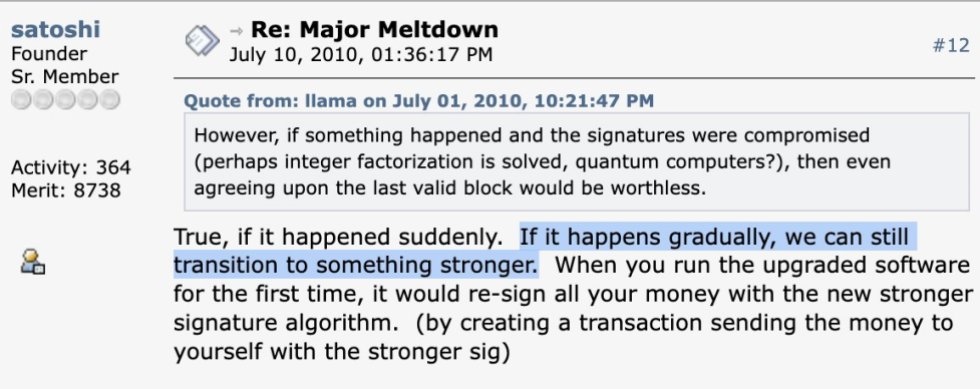
A post from Satoshi Nakamoto regarding the quantum threat for Bitcoin. Source: Bitcoin Magazine on X.

Taproot‐based recovery tries to protect the entire UTXO set with minimal value destruction, whereas some prominent voices still argue non‐migrated coins should simply expire rather than be “rescue” in weird ways, to preserve Bitcoin’s monetary story.
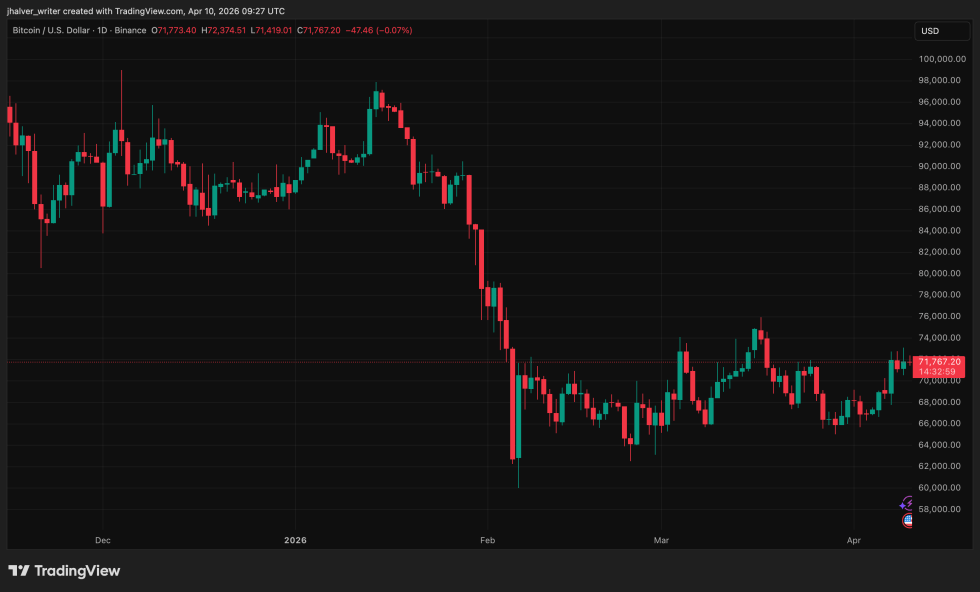
At the moment of writing, BTC trades for the high $71ks on the daily chart. Source: BTCUSD on Tradingview.

Cover image from Perplexity. BTCUSD chart from Tradingview.

Related Questions

QWhat is the main threat that Bitcoin developers are preparing for with these new proposals?

ABitcoin developers are preparing for the threat of quantum computers, specifically Shor-style quantum computers that could break Bitcoin's current ECDSA/Schnorr signature cryptography, potentially by 2029.

QWho proposed the first solution involving a 'zk-STARK proof' and what is its primary function?

AThe first solution was proposed by Olaoluwa Osuntokun of Lightning Labs and Tim Ruffing. Its primary function is to create a zk-STARK proof that allows users to prove ownership of their Taproot coins without revealing their private keys, providing an 'escape hatch' to move funds if a quantum-defense soft fork disables normal key-based spends.

QWhat does the QSB (Quantum Safe Bitcoin) solution replace to achieve quantum safety, and what is a major drawback of this approach?

AThe QSB solution replaces the old signature-size proof-of-work with a new RIPEMD-160-based hash pre-image puzzle. A major drawback is that it is extremely inefficient, costing hundreds of dollars in off-chain GPU work per transaction and requiring non-standard bare scripts mined via private relay services.

QAccording to the article, what did Bitcoin creator Satoshi Nakamoto say about the quantum threat in 2010?

AIn 2010, Satoshi Nakamoto assured that a gradual transition to post-quantum, stronger technology was possible for Bitcoin.

QWhat is the key philosophical difference between the two proposed solutions for Bitcoin's quantum resistance?

AThe key philosophical difference is in how much of Bitcoin needs to change. The Taproot-based recovery solution aims to protect the entire UTXO set with minimal value destruction through a potential soft fork (consensus rule changes), while the QSB solution is a transaction-level construction that makes individual spends quantum-safe today without any changes to Bitcoin's base protocol (user-level tooling).

Related Reads

Goldman Sachs Bows Down, Bitcoin Finally Breaks Through the Gates of Wall Street

Wall Street giants, including Goldman Sachs, Morgan Stanley, Charles Schwab, and the New York Stock Exchange, have reversed their long-standing opposition to Bitcoin and are now actively embracing it. After years of dismissing Bitcoin as a scam, a bubble, or a tool for illicit activities, these institutions are launching Bitcoin ETFs, enabling spot trading, and building dedicated crypto infrastructure. Goldman Sachs, which once called Bitcoin a "fraud tool," is now offering Bitcoin ETFs. Morgan Stanley, which internally banned the term "cryptocurrency," has launched its largest-ever ETF backed by Bitcoin. Charles Schwab has opened spot crypto trading for its retail clients, integrating Bitcoin alongside traditional assets. The NYSE is building robust infrastructure to support digital assets, signaling a long-term commitment. This dramatic shift is driven not by a change in ideology but by economic necessity. As Bitcoin repeatedly survived market crashes and grew into a multi-trillion-dollar asset class, ignoring it became too costly. Wall Street’s business model relies on capturing fees, and Bitcoin’s rise represented a massive wealth transfer occurring outside their ecosystem. The fear of missing out (FOMO) and client demand forced these institutions to capitulate. The article frames this as a historic surrender to Bitcoin’s mathematical inevitability. Unlike the trust-based traditional financial system, Bitcoin operates on decentralized, transparent, and unchangeable rules. Its scarcity and resilience make it a hedge against fiat currency devaluation and systemic risk. The narrative has flipped: not holding Bitcoin is now seen as the greater risk. The author concludes that Bitcoin has not been co-opted by Wall Street; instead, it has co-opted Wall Street, marking a fundamental shift in the global financial architecture.

marsbit32m ago

Goldman Sachs Bows Down, Bitcoin Finally Breaks Through the Gates of Wall Street

marsbit32m ago

Trading

Spot
Futures

Hot Articles

What is $BITCOIN

DIGITAL GOLD ($BITCOIN): A Comprehensive Analysis Introduction to DIGITAL GOLD ($BITCOIN) DIGITAL GOLD ($BITCOIN) is a blockchain-based project operating on the Solana network, which aims to combine the characteristics of traditional precious metals with the innovation of decentralized technologies. While it shares a name with Bitcoin, often referred to as “digital gold” due to its perception as a store of value, DIGITAL GOLD is a separate token designed to create a unique ecosystem within the Web3 landscape. Its goal is to position itself as a viable alternative digital asset, although specifics regarding its applications and functionalities are still developing. What is DIGITAL GOLD ($BITCOIN)? DIGITAL GOLD ($BITCOIN) is a cryptocurrency token explicitly designed for use on the Solana blockchain. In contrast to Bitcoin, which provides a widely recognized value storage role, this token appears to focus on broader applications and characteristics. Notable aspects include: Blockchain Infrastructure: The token is built on the Solana blockchain, known for its capacity to handle high-speed and low-cost transactions. Supply Dynamics: DIGITAL GOLD has a maximum supply capped at 100 quadrillion tokens (100P $BITCOIN), although details regarding its circulating supply are currently undisclosed. Utility: While precise functionalities are not explicitly outlined, there are indications that the token could be utilized for various applications, potentially involving decentralized applications (dApps) or asset tokenization strategies. Who is the Creator of DIGITAL GOLD ($BITCOIN)? At present, the identity of the creators and development team behind DIGITAL GOLD ($BITCOIN) remains unknown. This situation is typical among many innovative projects within the blockchain space, particularly those aligning with decentralized finance and meme coin phenomena. While such anonymity may foster a community-driven culture, it intensifies concerns about governance and accountability. Who are the Investors of DIGITAL GOLD ($BITCOIN)? The available information indicates that DIGITAL GOLD ($BITCOIN) does not have any known institutional backers or prominent venture capital investments. The project seems to operate on a peer-to-peer model focused on community support and adoption rather than traditional funding routes. Its activity and liquidity are primarily situated on decentralized exchanges (DEXs), such as PumpSwap, rather than established centralized trading platforms, further highlighting its grassroots approach. How DIGITAL GOLD ($BITCOIN) Works The operational mechanics of DIGITAL GOLD ($BITCOIN) can be elaborated on based on its blockchain design and network attributes: Consensus Mechanism: By leveraging Solana’s unique proof-of-history (PoH) combined with a proof-of-stake (PoS) model, the project ensures efficient transaction validation contributing to the network's high performance. Tokenomics: While specific deflationary mechanisms have not been extensively detailed, the vast maximum token supply implies that it may cater to microtransactions or niche use cases that are still to be defined. Interoperability: There exists the potential for integration with Solana’s broader ecosystem, including various decentralized finance (DeFi) platforms. However, the details regarding specific integrations remain unspecified. Timeline of Key Events Here is a timeline that highlights significant milestones concerning DIGITAL GOLD ($BITCOIN): 2023: The initial deployment of the token occurs on the Solana blockchain, marked by its contract address. 2024: DIGITAL GOLD gains visibility as it becomes available for trading on decentralized exchanges like PumpSwap, allowing users to trade it against SOL. 2025: The project witnesses sporadic trading activity and potential interest in community-led engagements, although no noteworthy partnerships or technical advancements have been documented as of yet. Critical Analysis Strengths Scalability: The underlying Solana infrastructure supports high transaction volumes, which could enhance the utility of $BITCOIN in various transaction scenarios. Accessibility: The potential low trading price per token could attract retail investors, facilitating wider participation due to fractional ownership opportunities. Risks Lack of Transparency: The absence of publicly known backers, developers, or an audit process may yield skepticism regarding the project's sustainability and trustworthiness. Market Volatility: The trading activity is heavily reliant on speculative behavior, which can result in significant price volatility and uncertainty for investors. Conclusion DIGITAL GOLD ($BITCOIN) emerges as an intriguing yet ambiguous project within the rapidly evolving Solana ecosystem. While it attempts to leverage the “digital gold” narrative, its departure from Bitcoin's established role as a store of value underscores the need for a clearer differentiation of its intended utility and governance structure. Future acceptance and adoption will likely depend on addressing the current opacity and defining its operational and economic strategies more explicitly. Note: This report encompasses synthesised information available as of October 2023, and developments may have transpired beyond the research period.

363 Total ViewsPublished 2025.05.13Updated 2025.05.13

What is $BITCOIN

Discussions

Welcome to the HTX Community. Here, you can stay informed about the latest platform developments and gain access to professional market insights. Users' opinions on the price of BTC (BTC) are presented below.

活动图片















