Bitcoin Adoption In West Virginia Sets A New Regional Benchmark

bitcoinistPublished on 2026-01-18Last updated on 2026-01-18

Abstract

West Virginia is emerging as a regional leader in Bitcoin adoption, driven by growing public literacy and legislative support. The state introduced Senate Bill 143, the Inflation Protection Act of 2026, which permits the state treasury to allocate up to 10% of public funds into Bitcoin and certain precious metals. The bill specifically targets BTC due to its market capitalization requirements and aims to hedge against inflation. Institutional analysts project a bullish outlook for Bitcoin, with average 2026 price targets around $150,000. Long-term forecasts, such as VanEck’s estimate of $2.9 million by 2050, suggest sustained growth, though prediction markets remain more conservative. This legislative and economic momentum reflects a shift from speculative interest to broader acceptance of Bitcoin as a tool for financial resilience.

Bitcoin literacy and community growth are accelerating in West Virginia, and it’s starting to reshape how communities across the state engage with digital finance. What was once viewed as a niche interest among tech enthusiasts is now gaining traction across broader segments of the state’s population. As residents become more curious about digital assets, conversations are shifting from speculation to understanding how BTC works and what it could mean for personal and regional economic resilience.

Bitcoin As A Tool For Regional Economic Growth

West Virginia has been making headlines in the Bitcoin space recently, particularly with fresh legislative moves as of January 2026. MartyParty revealed on X that the biggest current development is Senator Bill 143 (SB143), which was introduced this week by State Senator Chris Rose.

This is officially titled the Inflation Protection Act of 2026, which would allow the state’s Board of Treasury Investment to allocate up to 10% of public funds into precious metals like gold, silver, and platinum. The bill requires any qualifying digital asset to have maintained an average market capitalization of at least $750 billion over the prior year, which qualifies only BTC. In addition, the bill also allows for regulated stablecoins, but only the US federal or state regulators can approve the assets.
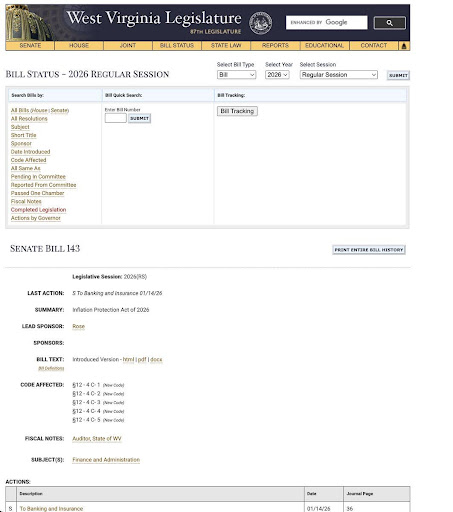
Source: Senator Bill 143 from MartyParty on X

However, the bill frames this as a hedge against inflation and currency depreciation, and empowering the state treasurer to invest in BTC without directly naming it in most of the statute. Although the purpose section explicitly mentions empowering investment in gold, silver, and BTC. These assets would need to be made through qualified custodians, ETFs, or other secure frameworks.

What Pension Funds And Endowments Think About Bitcoin

The Bitcoin price prediction by funds indicates a bullish outlook for 2026. CryptoRank.io has mentioned that the institutional analysts are pricing in a bullish scenario for BTC in 2026. The average target across the forecasts shown is around $150,000 per BTC, implying roughly 75% upside from current levels.

At the same time, longer-term valuation models assume a more gradual growth path. Popular asset manager VanEck predicts BTC could reach approximately $2.9 million by 2050, which equates to around 15% annualized growth broadly in line with the BTC historical long-term performance as a macro asset.

In contrast to institutional forecasts, prediction markets maintain a more conservative outlook. On Polymarket, the pricing base-case range between $110,000 to $130,000. This consensus could shift toward the institutional targets if spot ETF inflows remain strong and if the US regulatory uncertainty continues to decline, including initiatives such as the Blockchain Regulatory Certainty Act.

BTC trading at $95,118 on the 1D chart | Source: BTCUSDT on Tradingview.com

Related Questions

QWhat is the name and purpose of the bill introduced in West Virginia that relates to Bitcoin?

AThe bill is called the Inflation Protection Act of 2026 (SB143). Its purpose is to allow the state’s Board of Treasury Investment to allocate up to 10% of public funds into precious metals and qualifying digital assets, specifically Bitcoin, as a hedge against inflation and currency depreciation.

QWhat specific criteria must a digital asset meet to be eligible for investment under West Virginia's SB143 bill?

ATo qualify, a digital asset must have maintained an average market capitalization of at least $750 billion over the prior year. This criterion currently qualifies only Bitcoin.

QAccording to institutional analysts, what is the average Bitcoin price prediction for 2026?

AAccording to institutional analysts, the average Bitcoin price prediction for 2026 is around $150,000 per BTC.

QHow does asset manager VanEck predict Bitcoin's price will perform by the year 2050?

AAsset manager VanEck predicts that Bitcoin could reach approximately $2.9 million by 2050, which equates to around 15% annualized growth.

QWhat is the more conservative price range for Bitcoin in 2026 according to prediction markets like Polymarket?

AOn prediction markets like Polymarket, the base-case price range for Bitcoin in 2026 is between $110,000 to $130,000.

Related Reads

Can a Hair Dryer Earn $34,000? Deciphering the Reflexivity Paradox in Prediction Markets

An individual manipulated a weather sensor at Paris Charles de Gaulle Airport with a portable heat source, causing a Polymarket weather market to settle at 22°C and earning $34,000. This incident highlights a fundamental issue in prediction markets: when a market aims to reflect reality, it also incentivizes participants to influence that reality. Prediction markets operate on two layers: platform rules (what outcome counts as a win) and data sources (what actually happened). While most focus on rules, the real vulnerability lies in the data source. If reality is recorded through a specific source, influencing that source directly affects market settlement. The article categorizes markets by their vulnerability: 1. **Single-point physical data sources** (e.g., weather stations): Easily manipulated through physical interference. 2. **Insider information markets** (e.g., MrBeast video details): Insiders like team members use non-public information to trade. Kalshi fined a剪辑师 $20,000 for insider trading. 3. **Actor-manipulated markets** (e.g., Andrew Tate’s tweet counts): The subject of the market can control the outcome. Evidence suggests Tate’sociated accounts coordinated to profit. 4. **Individual-action markets** (e.g., WNBA disruptions): A single person can execute an event to profit from their pre-placed bets. Kalshi and Polymarket handle these issues differently. Kalshi enforces strict KYC, publicly penalizes insider trading, and reports to regulators. Polymarket, with its anonymous wallet-based system, has historically been more permissive, arguing that insider information improves market accuracy. However, it cooperated with authorities in the "Van Dyke case," where a user traded on classified government information. The core paradox is reflexivity: prediction markets are designed to discover truth, but their financial incentives can distort reality. The more valuable a prediction becomes, the more likely participants are to influence the event itself. The market ceases to be a mirror of reality and instead shapes it.

marsbit46m ago

Can a Hair Dryer Earn $34,000? Deciphering the Reflexivity Paradox in Prediction Markets

marsbit46m ago

First Day Review of "Musk's WeChat" XChat: Even Worse Than Expected

Elon Musk's much-anticipated "WeChat-like" app, XChat, has officially launched after multiple delays. The initial review reveals a product that falls short of expectations, offering an experience largely similar to X Platform's (formerly Twitter) direct messages, despite being marketed as an encrypted communication tool. Key observations from the first-day test include: 1. The app's promoted "end-to-end encryption" and its claimed relation to Bitcoin's architecture were criticized by experts as a superficial attempt to capitalize on crypto buzz, with no real technical connection. 2. Musk's vision of an ad-free "secure communication system" is technically met, but only because the app is currently extremely basic, featuring only a single chat interface. 3. A promised anti-screenshot feature appears inconsistent; it works in X Platform group chats but fails within the XChat app itself, where screenshots still capture avatars. 4. The app supports 45 languages and has a 16+ age rating, indicating a broader tolerance for content compared to WeChat's 13+ rating. 5. A puzzling login process requires users to verify the email associated with their X account. 6. The touted encryption" feels minimal in practice, with its presence only indicated by a simple "Encrypted - Yes" label on messages. 7. Disappearing message timers for groups can be set from 5 minutes to 4 weeks, with the timer starting upon being read by a user. 8. Group invite links are shared with X Platform groups. 9. Group size limits are planned to be increased, aiming for 1000 members, a move that has drawn user criticism. 10. The app offers 8 different colored icons, and its chat bubbles are notably similar to WeChat's. Message deletion options mimic Telegram's. Crucially, many pre-announced features like importing X contacts, integrating Grok AI, X Money payments, and Cashtags are not yet available. The initial release is seen as a bare-bones and underwhelming first step.

Odaily星球日报1h ago

First Day Review of "Musk's WeChat" XChat: Even Worse Than Expected

Odaily星球日报1h ago

Trading

Spot
Futures

Hot Articles

What is $BITCOIN

DIGITAL GOLD ($BITCOIN): A Comprehensive Analysis Introduction to DIGITAL GOLD ($BITCOIN) DIGITAL GOLD ($BITCOIN) is a blockchain-based project operating on the Solana network, which aims to combine the characteristics of traditional precious metals with the innovation of decentralized technologies. While it shares a name with Bitcoin, often referred to as “digital gold” due to its perception as a store of value, DIGITAL GOLD is a separate token designed to create a unique ecosystem within the Web3 landscape. Its goal is to position itself as a viable alternative digital asset, although specifics regarding its applications and functionalities are still developing. What is DIGITAL GOLD ($BITCOIN)? DIGITAL GOLD ($BITCOIN) is a cryptocurrency token explicitly designed for use on the Solana blockchain. In contrast to Bitcoin, which provides a widely recognized value storage role, this token appears to focus on broader applications and characteristics. Notable aspects include: Blockchain Infrastructure: The token is built on the Solana blockchain, known for its capacity to handle high-speed and low-cost transactions. Supply Dynamics: DIGITAL GOLD has a maximum supply capped at 100 quadrillion tokens (100P $BITCOIN), although details regarding its circulating supply are currently undisclosed. Utility: While precise functionalities are not explicitly outlined, there are indications that the token could be utilized for various applications, potentially involving decentralized applications (dApps) or asset tokenization strategies. Who is the Creator of DIGITAL GOLD ($BITCOIN)? At present, the identity of the creators and development team behind DIGITAL GOLD ($BITCOIN) remains unknown. This situation is typical among many innovative projects within the blockchain space, particularly those aligning with decentralized finance and meme coin phenomena. While such anonymity may foster a community-driven culture, it intensifies concerns about governance and accountability. Who are the Investors of DIGITAL GOLD ($BITCOIN)? The available information indicates that DIGITAL GOLD ($BITCOIN) does not have any known institutional backers or prominent venture capital investments. The project seems to operate on a peer-to-peer model focused on community support and adoption rather than traditional funding routes. Its activity and liquidity are primarily situated on decentralized exchanges (DEXs), such as PumpSwap, rather than established centralized trading platforms, further highlighting its grassroots approach. How DIGITAL GOLD ($BITCOIN) Works The operational mechanics of DIGITAL GOLD ($BITCOIN) can be elaborated on based on its blockchain design and network attributes: Consensus Mechanism: By leveraging Solana’s unique proof-of-history (PoH) combined with a proof-of-stake (PoS) model, the project ensures efficient transaction validation contributing to the network's high performance. Tokenomics: While specific deflationary mechanisms have not been extensively detailed, the vast maximum token supply implies that it may cater to microtransactions or niche use cases that are still to be defined. Interoperability: There exists the potential for integration with Solana’s broader ecosystem, including various decentralized finance (DeFi) platforms. However, the details regarding specific integrations remain unspecified. Timeline of Key Events Here is a timeline that highlights significant milestones concerning DIGITAL GOLD ($BITCOIN): 2023: The initial deployment of the token occurs on the Solana blockchain, marked by its contract address. 2024: DIGITAL GOLD gains visibility as it becomes available for trading on decentralized exchanges like PumpSwap, allowing users to trade it against SOL. 2025: The project witnesses sporadic trading activity and potential interest in community-led engagements, although no noteworthy partnerships or technical advancements have been documented as of yet. Critical Analysis Strengths Scalability: The underlying Solana infrastructure supports high transaction volumes, which could enhance the utility of $BITCOIN in various transaction scenarios. Accessibility: The potential low trading price per token could attract retail investors, facilitating wider participation due to fractional ownership opportunities. Risks Lack of Transparency: The absence of publicly known backers, developers, or an audit process may yield skepticism regarding the project's sustainability and trustworthiness. Market Volatility: The trading activity is heavily reliant on speculative behavior, which can result in significant price volatility and uncertainty for investors. Conclusion DIGITAL GOLD ($BITCOIN) emerges as an intriguing yet ambiguous project within the rapidly evolving Solana ecosystem. While it attempts to leverage the “digital gold” narrative, its departure from Bitcoin's established role as a store of value underscores the need for a clearer differentiation of its intended utility and governance structure. Future acceptance and adoption will likely depend on addressing the current opacity and defining its operational and economic strategies more explicitly. Note: This report encompasses synthesised information available as of October 2023, and developments may have transpired beyond the research period.

363 Total ViewsPublished 2025.05.13Updated 2025.05.13

What is $BITCOIN

Discussions

Welcome to the HTX Community. Here, you can stay informed about the latest platform developments and gain access to professional market insights. Users' opinions on the price of BTC (BTC) are presented below.

活动图片















