Binance hints at stock perps push to join global tokenized equities race

cointelegraphPublished on 2025-12-12Last updated on 2025-12-12

Abstract

Crypto exchange Binance is preparing to introduce stock trading capabilities, as indicated by recent API updates that include endpoints for signing “TradFi-Perps” agreements and checking trading session schedules. This suggests Binance may soon offer perpetual futures for stocks, operating in traditional market hours rather than 24/7. The move follows Binance’s short-lived 2021 attempt at tokenized stocks, which was halted due to regulatory scrutiny. This development aligns with a broader industry trend toward tokenized equities, with players like Coinbase also entering the space. However, the growth of tokenized stock trading—both on centralized and DeFi platforms—has drawn mixed reactions. Some traditional finance entities, like Citadel Securities and the World Federation of Exchanges, have called for stricter regulation, while others, including Nasdaq and the SEC, appear more supportive, viewing tokenization as a positive innovation for markets.

Crypto exchange Binance has added new features to its application programming interface (API), indicating that the platform is preparing to introduce stock trading capabilities.

Binance’s changelog notes that on Dec. 11, the exchange introduced three new API endpoints, one of which — with a URL including stock/contract — allows users to “sign [a] TradFi-Perps agreement contract.” The two other endpoints introduced on the same day allow users to query “trading session schedules for a one-week period” or “current trading session information.”

Together, this information suggests that Binance is introducing perpetual futures trading on its platform. The existing trading schedule endpoints also suggest trading will likely occur in sessions, as in traditional finance, rather than following crypto’s 24/7 nature.

This follows Binance’s launch of tokenized stocks in 2021, in a relatively short-lived initiative. Following their announcement in late April, Binance halted tokenized stock sales just months later in mid-July 2021 after immediately attracting the attention of regulators.

Binance acknowledged Cointelegraph’s request for comment, but had not responded by publication.
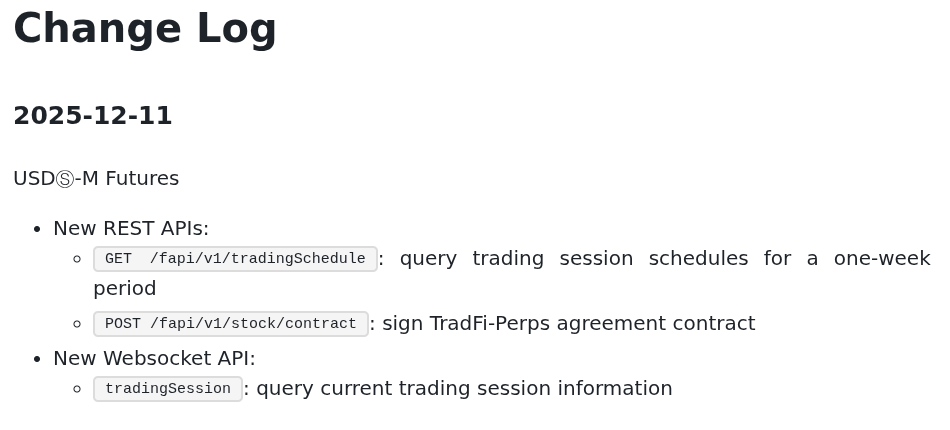
Binance API change log. Source: Binance

Related: Ondo wins Liechtenstein approval to offer tokenized stocks in Europe

Tokenized stocks are all the rage

Binance’s initiative follows a series of similar efforts by players in both traditional and crypto finance, taking stock tokenization out of the fringes of finance. Friday reports indicate that top US-based crypto exchange Coinbase is days away from unveiling its push into tokenized stocks and prediction markets.

However, not everyone is enthusiastic about how stock tokenization is being rolled out. Market maker Citadel Securities caused uproar earlier this month when it recommended that the US Securities and Exchange Commission tighten regulations on tokenized stock trading on decentralized finance (DeFi) platforms.

According to the market maker, DeFi developers, smart-contract coders, and self-custody wallet providers should not be given “broad exemptive relief” for offering trading of tokenized US equities. Citadel argued that DeFi platforms likely fall under the definitions of an “exchange” or “broker-dealer” and should be regulated under securities law.

It also claimed that allowing those platforms to operate free from regulations “would create two separate regulatory regimes for the trading of the same security.” The World Federation of Exchanges (WFE) also argued in late November that the SEC shouldn’t grant broad regulatory relief to companies launching tokenized stock offerings.

The WFE said tokenization “is likely a natural evolution in capital markets” and that it was “pro-innovation.”Still, the organization argued that it “must be done in a responsible way that does not put investors or market integrity at risk.”

The comments follow tokenized stocks making their way not only to centralized crypto exchanges, but also to the DeFi ecosystem. At the end of June, more than 60 tokenized stocks launched on Solana-based DeFi platforms as well as crypto exchanges Kraken and Bybit.

Related: Robinhood tokenizes nearly 500 US stocks, ETFs on Arbitrum for EU users

Not all of traditional finance sees an issue

Other traditional finance players appeared to follow the “if you can’t beat them, join them” approach to the issue.

Last month, Nasdaq’s head of digital assets strategy, Matt Savarese, said the stock exchange is making SEC approval of its proposal to offer tokenized versions of stocks listed on the exchange a top priority.

The race intensified after the SEC was reported to be developing a plan to allow blockchain-registered versions of stocks to trade on cryptocurrency exchanges by the end of September.

SEC Chair Paul Atkins recently described tokenization as an “innovation” the agency should seek to advance, not restrict. The SEC issued a “no-action” letter Thursday to a subsidiary of the Depository Trust and Clearing Corporation that specializes in tokenizing securities, indicating that the regulator intends to allow the company to offer a new securities market tokenization service.


Related Reads

a16z: AI's 'Amnesia', Can Continuous Learning Cure It?

The article "a16z: AI's 'Amnesia' – Can Continual Learning Cure It?" explores the limitations of current large language models (LLMs), which, like the protagonist in the film *Memento*, are trapped in a perpetual present—unable to form new memories after training. While methods like in-context learning (ICL), retrieval-augmented generation (RAG), and external scaffolding (e.g., chat history, prompts) provide temporary solutions, they fail to enable true internalization of new knowledge. The authors argue that compression—the core of learning during training—is halted at deployment, preventing models from generalizing, discovering novel solutions (e.g., mathematical proofs), or handling adversarial scenarios. The piece introduces *continual learning* as a critical research direction to address this, categorizing approaches into three paths: 1. **Context**: Scaling external memory via longer context windows, multi-agent systems, and smarter retrieval. 2. **Modules**: Using pluggable adapters or external memory layers for specialization without full retraining. 3. **Weights**: Enabling parameter updates through sparse training, test-time training, meta-learning, distillation, and reinforcement learning from feedback. Challenges include catastrophic forgetting, safety risks, and auditability, but overcoming these could unlock models that learn iteratively from experience. The conclusion emphasizes that while context-based methods are effective, true breakthroughs require models to compress new information into weights post-deployment, moving from mere retrieval to genuine learning.

marsbit1h ago

a16z: AI's 'Amnesia', Can Continuous Learning Cure It?

marsbit1h ago

Can a Hair Dryer Earn $34,000? Deciphering the Reflexivity Paradox in Prediction Markets

An individual manipulated a weather sensor at Paris Charles de Gaulle Airport with a portable heat source, causing a Polymarket weather market to settle at 22°C and earning $34,000. This incident highlights a fundamental issue in prediction markets: when a market aims to reflect reality, it also incentivizes participants to influence that reality. Prediction markets operate on two layers: platform rules (what outcome counts as a win) and data sources (what actually happened). While most focus on rules, the real vulnerability lies in the data source. If reality is recorded through a specific source, influencing that source directly affects market settlement. The article categorizes markets by their vulnerability: 1. **Single-point physical data sources** (e.g., weather stations): Easily manipulated through physical interference. 2. **Insider information markets** (e.g., MrBeast video details): Insiders like team members use non-public information to trade. Kalshi fined a剪辑师 $20,000 for insider trading. 3. **Actor-manipulated markets** (e.g., Andrew Tate’s tweet counts): The subject of the market can control the outcome. Evidence suggests Tate’sociated accounts coordinated to profit. 4. **Individual-action markets** (e.g., WNBA disruptions): A single person can execute an event to profit from their pre-placed bets. Kalshi and Polymarket handle these issues differently. Kalshi enforces strict KYC, publicly penalizes insider trading, and reports to regulators. Polymarket, with its anonymous wallet-based system, has historically been more permissive, arguing that insider information improves market accuracy. However, it cooperated with authorities in the "Van Dyke case," where a user traded on classified government information. The core paradox is reflexivity: prediction markets are designed to discover truth, but their financial incentives can distort reality. The more valuable a prediction becomes, the more likely participants are to influence the event itself. The market ceases to be a mirror of reality and instead shapes it.

marsbit2h ago

Can a Hair Dryer Earn $34,000? Deciphering the Reflexivity Paradox in Prediction Markets

marsbit2h ago

Trading

Spot
Futures

Hot Articles

How to Buy PUSH

Welcome to HTX.com! We've made purchasing Push Protocol (PUSH) simple and convenient. Follow our step-by-step guide to embark on your crypto journey.Step 1: Create Your HTX AccountUse your email or phone number to sign up for a free account on HTX. Experience a hassle-free registration journey and unlock all features.Get My AccountStep 2: Go to Buy Crypto and Choose Your Payment MethodCredit/Debit Card: Use your Visa or Mastercard to buy Push Protocol (PUSH) instantly.Balance: Use funds from your HTX account balance to trade seamlessly.Third Parties: We've added popular payment methods such as Google Pay and Apple Pay to enhance convenience.P2P: Trade directly with other users on HTX.Over-the-Counter (OTC): We offer tailor-made services and competitive exchange rates for traders.Step 3: Store Your Push Protocol (PUSH)After purchasing your Push Protocol (PUSH), store it in your HTX account. Alternatively, you can send it elsewhere via blockchain transfer or use it to trade other cryptocurrencies.Step 4: Trade Push Protocol (PUSH)Easily trade Push Protocol (PUSH) on HTX's spot market. Simply access your account, select your trading pair, execute your trades, and monitor in real-time. We offer a user-friendly experience for both beginners and seasoned traders.

3.3k Total ViewsPublished 2024.03.29Updated 2025.04.02

How to Buy PUSH

Discussions

Welcome to the HTX Community. Here, you can stay informed about the latest platform developments and gain access to professional market insights. Users' opinions on the price of PUSH (PUSH) are presented below.

活动图片