Bear Market Script: Which Act Is Your 'Faith' Experiencing?

marsbitPublished on 2026-03-05Last updated on 2026-03-05

Abstract

The article "Bear Market Script: Which Act Is Your 'Faith' Experiencing?" by TVBee analyzes the typical stages of a cryptocurrency bear market, using Bitcoin (BTC) and Tether (USDT) market capitalization as key indicators. It identifies 3-4 phases: 1. **Reaction Phase (Faith Intact)**: BTC declines while USDT rises, indicating some investors still hold hope. 2. **Confirmation Phase (Faith Collapses)**: BTC may fall or stagnate, and USDT decreases, confirming the bear market as capital exits. 3. **Accumulation Phase (Faith Consolidates)**: BTC may drop or trade sideways, but USDT rises again, suggesting stronger believers are preparing to re-enter. 4. **Final Panic Phase (Black Swan)**: A optional phase where both BTC and USDT fall sharply due to extreme events (e.g., 2022’s Luna collapse). The author suggests the current market (early 2026) is likely in Phase 2, driven by geopolitical tensions like the Iran conflict. The duration of this phase depends on external factors such as Trump administration policies, monetary changes, and potential black swan events. Ideal entry points for investors are during Phase 3 (USDT rising) or in the recovery phase (right-side entry), where USDT growth and BTC stabilization signal a market rebound. The analysis notes that bear markets are evolving—Phase 1 is shortening, but Phase 2 remains unpredictable due to external shocks. Caution and patience are advised.

Author: TVBee

The 3-4 Stages of a Bear Market Experience

Bear Market Stage 1: Reaction Phase (Faith Remains)

⬩Approx. Dec 16, 2017 ~ Oct 08, 2018

⬩Approx. Nov 07, 2021 ~ May 12, 2022

⬩Suspected Oct 06, 2025 ~ Jan 06, 2026

In this stage, BTC is falling, but the market cap of USDT is rising.

Funds flowing out of crypto are still accumulating partly in USDT; some people likely hold illusions about the market trend. This is the market's reaction phase to the bear market, the stage where faith still remains.
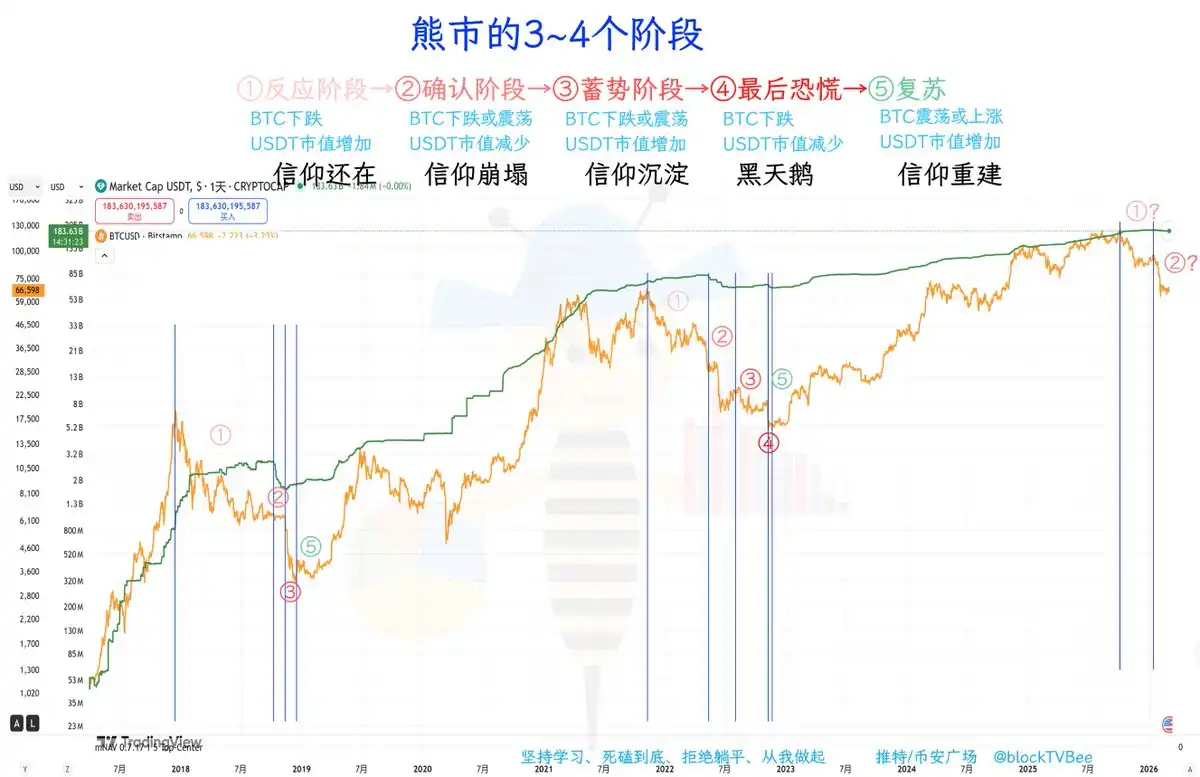
It is suspected that Oct 06, 2025 ~ Jan 06, 2026 completed this stage.

Bear Market Stage 2: Confirmation Phase (Faith Collapses)

⬩Approx. Oct 08, 2018 ~ Nov 14, 2018

⬩Approx. May 12, 2022 ~ Aug 04, 2022

⬩Suspected Jan 06, 2026 ~ ?

In this stage, BTC may be falling or moving sideways, but the market cap of USDT is decreasing.

Funds flowing out of crypto are now exiting USDT; the market confirms the bear market, and capital begins to exit as the main trend. This is also the stage where faith collapses.

2018 had no major negative events, so BTC moved mainly sideways, while 2022 had Luna + Three Arrows, so BTC fell primarily.

It is suspected that Jan 06, 2026 began entering this stage, with the USDT market cap starting to decrease, and the market beginning to question BTC, its digital gold properties, believing BTC will fall to the 30k range......

However, there are currently no signs that Stage 2 has ended.

Bear Market Stage 3: Accumulation Phase (Faith Sediments)

⬩Approx. Nov 14, 2018 ~ Dec 15, 2018

⬩Approx. Aug 04, 2022 ~ Nov 09, 2022

In this stage, BTC may be falling or moving sideways, but the market cap of USDT is increasing.

In 2018, because the previous phase was sideways, this phase was a decline. In 2022, the previous phase was primarily a decline, so this phase first fell and then moved mainly sideways.

Either funds from selling BTC are no longer primarily exiting, or capital is entering, causing the USDT market cap to increase. The weakest believers have already left, while the steadfast believers begin holding U or injecting capital, accumulating and waiting. Market faith also enters a sedimentation stage.

Bear Market Stage 4: Final Panic (Black Swan)

⬩Approx. Nov 09, 2022 ~ Nov 22, 2022

In this stage, BTC is falling, and the USDT market cap is also decreasing.

This is the final panic stage, mainly influenced by a black swan event. 2018 did not have this stage.

Recovery

After BTC bottoms out, it may gradually move upward or oscillate at the bottom. However, the USDT market cap increases. This is a stage of market recovery and faith rebuilding.

When to Buy the Dip

The earliest should be in Stage 3, when the USDT market cap is rising, using partial positions to buy the dip in batches.

The best buying opportunity, the phase where BTC crashes and the USDT market cap falls, may not necessarily occur; 2018 did not have this phase.

For retail investors, a more ideal buying range might be on the right side, i.e., the recovery stage. This stage features sustained growth in the USDT market cap, and BTC has experienced a bottom and shows signs of stabilization or even upward movement.

Final Thoughts

By comparison, it can be seen that each cycle's Stage 1 is getting shorter, because the market is reacting to the bear market faster and faster.

However, Stage 2 has not gotten shorter. Stage 2 may be related to the impact of negative events. The first half of 2018 had no negative events; it even had the mainnet launches of EOS and Tron. In 2022, the Luna crash followed by Three Arrows bankruptcy made this cycle's Stage 2 longer and the decline greater.

We are most likely already in Stage 2 now; the USDT market cap is decreasing, and the current negative is the Iran conflict. It is still uncertain when this negative will end.

Price-wise, Brother Bee believes the impact of the conflict on liquidity is relatively weak, but US stocks have a correction demand, so the current situation might be between the 2018 and 2022 Stage 2, possibly a downward. Of course, the certainty of this guess is not high; the uncertainties around Trump and Iran are quite significant.

In terms of cycles, Brother Bee's speculation is that around the time of Trump's visit to China, the geopolitical negatives might end. Because Trump's visit to China would mean that regarding countries like Iran, Trump already holds sufficient negotiation chips.

However, whether black swans will appear during the process of communication and coordination between the two sides is unknown. Furthermore, there are subsequent key events like Wash's inauguration and Japan's interest rate hike.

Therefore, when Stage 2 will end still requires continued observation. The first opportunity to buy the dip still requires patience, waiting for the USDT market cap to resume its rise after experiencing a decline. Since USDT's current use is not limited to crypto trading, the changes in its market cap this cycle might be less obvious. Thus, it's also necessary to consider factors like geopolitics and monetary policy.


Related Questions

QWhat are the main stages of a bear market according to the article, and what characterizes each stage?

AThe article outlines 3-4 stages: 1. Reaction Stage (Faith Remains): BTC falls, but USDT market cap rises as some funds remain hopeful. 2. Confirmation Stage (Faith Collapses): BTC may fall or stagnate, USDT market cap decreases as funds exit, confirming the bear market. 3. Accumulation Stage (Faith Sediments): BTC may fall or stagnate, but USDT market cap increases as weak holders leave and strong holders accumulate. 4. Final Panic Stage (Black Swan, not present in 2018): BTC falls sharply with USDT market cap decreasing due to a black swan event.

QBased on the historical patterns described, when did the author suggest the 'Reaction Stage' of the current bear market (circa 2025-2026) likely began and ended?

AThe author suggested the Reaction Stage for the current cycle疑似 (suspectedly) began around October 6, 2025, and ended around January 6, 2026.

QWhat is the key on-chain metric the author uses to identify the transition between bear market stages, particularly between Stage 1 and Stage 2?

AThe key on-chain metric is the market capitalization of USDT. A rising USDT market cap characterizes Stage 1, while a decreasing USDT market cap signals the transition into Stage 2.

QAccording to the author, what is the earliest recommended time for investors to consider buying the dip (accumulating assets) in a bear market?

AThe earliest recommended time to start accumulating is during Stage 3 (the Accumulation Stage), when the USDT market cap is increasing. The author advises using a portion of capital to buy in batches at this stage.

QWhat are some of the specific geopolitical and economic events mentioned as potential factors prolonging the current 'Confirmation Stage' (Stage 2)?

AThe events mentioned are the Iran conflict, potential U.S. stock market correction, uncertainty surrounding former President Trump's actions (including a potential visit to China), the upcoming term of Fed Chair Waller, and a potential interest rate hike by Japan.

Related Reads

Lowering Expectations for BTC's Next Bull Market

The author, Alex Xu, explains his decision to significantly reduce his Bitcoin holdings (from full to ~30% of his portfolio) during the current bull cycle, citing a lowered long-term outlook for BTC's price appreciation in the next cycle. He outlines six key reasons for this reduced expectation: 1. **Diminished Growth Drivers:** The narrative of exponential user adoption has largely played out with institutional ETF adoption. The next major growth phase—adoption by sovereign national reserves or central banks—seems unlikely in the near future. 2. **Personal Opportunity Cost:** More attractive investment opportunities have emerged in other assets, such as undervalued companies. 3. **Industry-Wide Contraction:** The broader crypto industry is struggling, with most Web3 business models (SocialFi, GameFi, DePIN) failing. This overall萧条 (depression) reduces the fundamental demand and consensus for Bitcoin. 4. **Strain on Major Buyer:** MicroStrategy, a major corporate buyer of BTC, faces rising financing expenses for its debt, which could slow its purchasing rate and create significant marginal pressure on the market. 5. **Increased Competition from Gold:** The emergence of "tokenized gold" has closed the functional gap (portability, divisibility) between physical gold and Bitcoin, offering a strong competitor in the non-sovereign store-of-value space. 6. **Security Budget Concerns:** The block reward halving continues to exacerbate the long-standing issue of funding Bitcoin's network security, with new fee source explorations like Ordinals and L2s largely failing. The author's decision to hold a significant (though reduced) position reflects a cautious, not bearish, outlook. He remains open to increasing his exposure if the fundamental reasons for his skepticism change or if new positive catalysts emerge.

marsbit37m ago

Lowering Expectations for BTC's Next Bull Market

marsbit37m ago

Can Iran 'Control' the Strait of Hormuz?

Iran has announced a comprehensive plan to assert control over the strategic Strait of Hormuz, a critical global oil shipping chokepoint. The proposed measures include requiring all vessels to obtain Iranian permission for passage, imposing fees for security, environmental protection, and navigation management—preferably paid in Iranian rials—and absolutely banning Israeli ships. Vessels from countries deemed hostile by Iran’s top security bodies may also be barred. Analysts suggest Iran’s motives are multifaceted: increasing pressure on the U.S. and Israel by leveraging control over oil transit to influence global prices and inflation; creating a new revenue stream, potentially exceeding $7.7 billion annually, to counter Western sanctions and support postwar reconstruction; and using transit permissions as bargaining chips in future negotiations, notably with the U.S. However, the plan faces significant practical and diplomatic challenges. Enforcing comprehensive interception and fee collection in the busy waterway, patrolled by international military forces, would be difficult. The U.S. has already countering with a blockade of Iranian ports and threats to intercept any ship paying fees, potentially strangling Iran’s oil exports and fee revenue. Broad international opposition, led by European and Gulf states, and legal controversies further complicate implementation. The proposal may ultimately serve more as a negotiating tactic than a feasible policy, with its execution remaining highly uncertain.

marsbit1h ago

Can Iran 'Control' the Strait of Hormuz?

marsbit1h ago

Trading

Spot
Futures

Hot Articles

How to Buy 4

Welcome to HTX.com! We've made purchasing 4 (4) simple and convenient. Follow our step-by-step guide to embark on your crypto journey.Step 1: Create Your HTX AccountUse your email or phone number to sign up for a free account on HTX. Experience a hassle-free registration journey and unlock all features.Get My AccountStep 2: Go to Buy Crypto and Choose Your Payment MethodCredit/Debit Card: Use your Visa or Mastercard to buy 4 (4) instantly.Balance: Use funds from your HTX account balance to trade seamlessly.Third Parties: We've added popular payment methods such as Google Pay and Apple Pay to enhance convenience.P2P: Trade directly with other users on HTX.Over-the-Counter (OTC): We offer tailor-made services and competitive exchange rates for traders.Step 3: Store Your 4 (4)After purchasing your 4 (4), store it in your HTX account. Alternatively, you can send it elsewhere via blockchain transfer or use it to trade other cryptocurrencies.Step 4: Trade 4 (4)Easily trade 4 (4) on HTX's spot market. Simply access your account, select your trading pair, execute your trades, and monitor in real-time. We offer a user-friendly experience for both beginners and seasoned traders.

3.7k Total ViewsPublished 2025.10.20Updated 2025.10.29

How to Buy 4

Discussions

Welcome to the HTX Community. Here, you can stay informed about the latest platform developments and gain access to professional market insights. Users' opinions on the price of 4 (4) are presented below.

活动图片