Banks Need CLARITY Act More Than Crypto – Former CFTC Chair Explains Why

bitcoinistPublished on 2026-03-10Last updated on 2026-03-10

Abstract

Former CFTC Chairman Chris Giancarlo argues that US banks need the regulatory clarity provided by the CLARITY Act more than the crypto industry does. He states that without clear rules, banks' general counsels are preventing large investments in new technology, risking that US institutions fall behind global counterparts. In contrast, the crypto industry, composed of risk-takers, will continue to build and innovate in other jurisdictions if necessary. Giancarlo believes the odds of the stalled bill passing are 60-40, noting it has become a political issue pitting Republicans against Democrats and TradFi against DeFi. He warns that if the legislation fails, agencies like the SEC and CFTC will likely establish temporary rules, but this won't provide the long-term certainty that banks require to modernize.

US banks may need regulatory clarity more than the crypto industry, a former Commodity Futures Trading Commission (CFTC) chief said, arguing they risk falling behind the rest of the world.

Regulatory Uncertainty Could Leave US Banks Behind

On Sunday, Chris Giancarlo, former chairman of the CFTC, discussed the significant policy reversal under the Trump administration that has been driving crypto innovation in the US, including the highly anticipated market structure bill.

In an interview for Scott Melker’s The Wolf Of All Streets podcast, the ex-CFTC chief affirmed that landmark stablecoin legislation enacted last July, the GENIUS Act, was “the appetizer” for crypto regulation, while the market structure bill, also known as the CLARITY Act, represents the main dish but has become the “hard part.”

For context, the CLARITY Act has been stalled for nearly two months after the Senate Banking Committee published its bill draft in mid-January. Multiple policies, including key restrictions for stablecoin issuers, were criticized by crypto leaders, leading to a prolonged fight between banks and the digital assets industry.

Giancarlo affirmed that banks need regulatory clarity more than the crypto industry, arguing that they will be hesitant to invest in new technology without clear rules, and their systems will be superseded.

The banks, however, can’t afford regulatory uncertainty. Their general counselors are telling their boards, you can’t invest billions of dollars in this (...) unless you’ve got regulatory certainty. (...) The banks need this clarity because they need to build this. They need to be in the forefront, not in the rear guard of this innovation.

On the contrary, the crypto industry will continue to build and innovate in other jurisdictions. “They are risk-takers. They’re going to build it here, or they’re going to build it abroad,” the former CFTC chairman asserted.

If the CLARITY Act isn’t passed, Giancarlo believes the leaders of financial regulatory agencies, such as the Securities and Exchange Commission (SEC) and CFTC, will likely establish the necessary rules to oversee the sector.

“They won’t have the support of legislation that makes it work forever or at least into the next presidential cycle, but it’ll make it work for now. Now, does that give the industry the certainty they want? No. And who needs that certainty more than the banks? Crypto doesn’t need it. They were building even under the whip hand of Gary Gensler,” he added.

Are The Odds In Crypto Regulation’s Favor?

Giancarlo emphasized that the digital assets legislation has become a political issue, with Republicans opposing Democrats, and traditional finance (TradFi) opposing decentralized finance (DeFi) and new technologies.

The ex-CFTC chief also noted that the challenges of the regulatory timing, asserting that “If we could not be in a worse time, we’re in an election year.” During this period, politicians’ focus is on the upcoming mid-term elections, he detailed, and “everything that takes place in Washington (...) is all about swaying the voters for the elections.”

Last month, Treasury Secretary Scott Bessent urged lawmakers to pass the stalled bill this spring. He acknowledged the efforts of a bipartisan working group to advance the legislation, emphasizing that Democrats are open to collaborating with Republicans.

He also warned that the chances of reaching a deal could crumble if Democrats gain control of the House of Representatives in November, given the Biden administration’s stringent regulations on the industry.

Despite the delay, Giancarlo believes the odds are 60-40 in favor of passing the legislation, arguing that there’s “a lot of good in the bill for all sides” and its importance is recognized by all parties.

“I think there’s a recognition that this is the new architecture of finance and America, our financial institutions are the world’s dominant financial institutions. We need to modernize that. We need to adopt this technology,” he concluded.
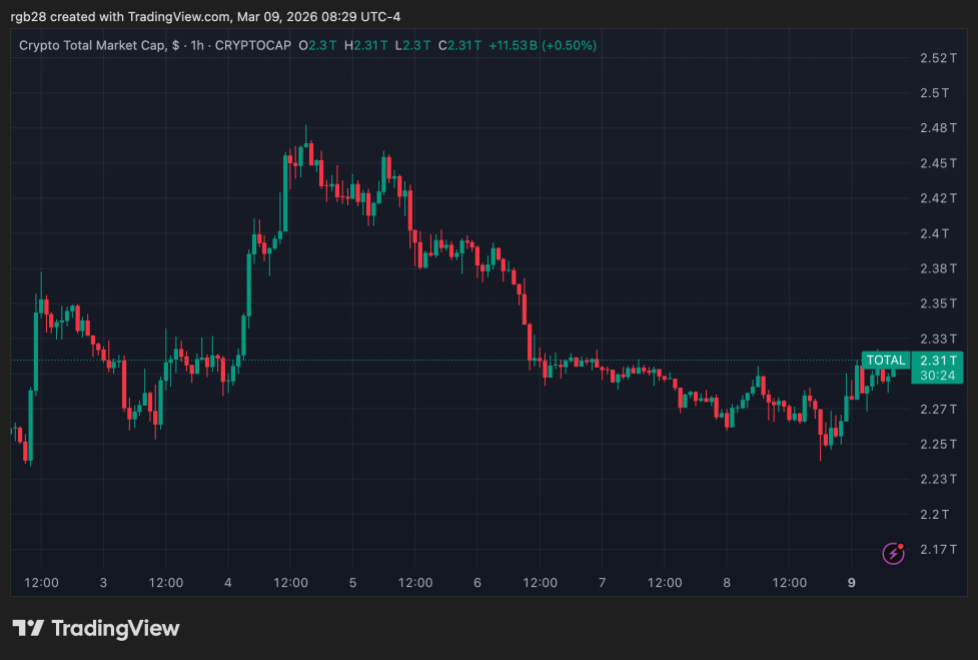
The total crypto market capitalization is at $2.31 trillion in the one-week chart. Source: TOTAL on TradingView


Related Questions

QAccording to the former CFTC chair, why do US banks need regulatory clarity more than the crypto industry?

ABecause their general counsels advise that they cannot invest billions of dollars in new technology without regulatory certainty, and they risk having their systems superseded and falling behind the rest of the world.

QWhat are the two key pieces of legislation mentioned, and how does the former CFTC chairman describe their relationship?

AThe two key pieces are the GENIUS Act and the CLARITY Act. He describes the GENIUS Act as 'the appetizer' for crypto regulation, while the CLARITY Act (market structure bill) represents 'the main dish' but is the 'hard part.'

QWhat does Chris Giancarlo believe will happen if the CLARITY Act is not passed by Congress?

AHe believes that financial regulatory agencies like the SEC and CFTC will likely establish the necessary rules to oversee the sector, but this will not provide the long-term certainty that the industry, particularly banks, desires.

QWhy is the current timing particularly challenging period for passing crypto regulation, according to the article?

ABecause it is an election year, where politicians' focus is on swaying voters for the upcoming mid-term elections, making it a difficult time to pass significant legislation.

QWhat odds does Giancarlo give for the CLARITY Act eventually being passed, and what is his reasoning?

AHe gives 60-40 odds in favor of passing the legislation, reasoning that there is 'a lot of good in the bill for all sides' and a recognition that modernizing financial architecture with this technology is necessary for the US to maintain its dominant position.

Related Reads

Why Bitcoin Holds Above $64,000 After Fed's Hard Pause

**Bitcoin Stabilizes Near $64,000 Following Hawkish Fed Pause** The cryptocurrency market, led by Bitcoin, remained stable around $64,000 despite a volatile reaction to the latest U.S. Federal Reserve meeting. The Fed paused interest rates but signaled a hawkish stance, with three committee members voting for an increase—the highest dissent since 2016. This limits risk appetite but hasn't triggered panic selling. Key market highlights include Bitcoin ETFs seeing a net inflow of $32.1 million, breaking a streak of outflows, while Ethereum ETFs experienced outflows of $18.65 million. Liquidations affected about 90,000 traders. Technically, Bitcoin finds support around $63,000-$63,500, with major resistance near $66,000. While its price is about 49% below its all-time high, institutional demand via ETFs and the absence of mass capitulation support a potential recovery scenario in the second half of the year. Major altcoins showed mixed movements, with Solana attracting capital while Ethereum faced selling pressure despite strong on-chain metrics like a growing staking queue. Regulatory news took a pause as the U.S. Senate delayed the CLARITY Act vote until at least autumn. For the final trading day of July, U.S. inflation and consumer spending data will be crucial. Bitcoin's key levels to watch are $63,000 support and $66,000 resistance. Sustained ETF inflows and Bitcoin holding above $63,000 are seen as positive signs for a potential market recovery later in the year.

cryptonews.ru3h ago

Why Bitcoin Holds Above $64,000 After Fed's Hard Pause

cryptonews.ru3h ago

Trading

Spot
活动图片




