US banks may need regulatory clarity more than the crypto industry, a former Commodity Futures Trading Commission (CFTC) chief said, arguing they risk falling behind the rest of the world.
Regulatory Uncertainty Could Leave US Banks Behind
On Sunday, Chris Giancarlo, former chairman of the CFTC, discussed the significant policy reversal under the Trump administration that has been driving crypto innovation in the US, including the highly anticipated market structure bill.
In an interview for Scott Melker’s The Wolf Of All Streets podcast, the ex-CFTC chief affirmed that landmark stablecoin legislation enacted last July, the GENIUS Act, was “the appetizer” for crypto regulation, while the market structure bill, also known as the CLARITY Act, represents the main dish but has become the “hard part.”
For context, the CLARITY Act has been stalled for nearly two months after the Senate Banking Committee published its bill draft in mid-January. Multiple policies, including key restrictions for stablecoin issuers, were criticized by crypto leaders, leading to a prolonged fight between banks and the digital assets industry.
Giancarlo affirmed that banks need regulatory clarity more than the crypto industry, arguing that they will be hesitant to invest in new technology without clear rules, and their systems will be superseded.
The banks, however, can’t afford regulatory uncertainty. Their general counselors are telling their boards, you can’t invest billions of dollars in this (...) unless you’ve got regulatory certainty. (...) The banks need this clarity because they need to build this. They need to be in the forefront, not in the rear guard of this innovation.
On the contrary, the crypto industry will continue to build and innovate in other jurisdictions. “They are risk-takers. They’re going to build it here, or they’re going to build it abroad,” the former CFTC chairman asserted.
If the CLARITY Act isn’t passed, Giancarlo believes the leaders of financial regulatory agencies, such as the Securities and Exchange Commission (SEC) and CFTC, will likely establish the necessary rules to oversee the sector.
“They won’t have the support of legislation that makes it work forever or at least into the next presidential cycle, but it’ll make it work for now. Now, does that give the industry the certainty they want? No. And who needs that certainty more than the banks? Crypto doesn’t need it. They were building even under the whip hand of Gary Gensler,” he added.
Are The Odds In Crypto Regulation’s Favor?
Giancarlo emphasized that the digital assets legislation has become a political issue, with Republicans opposing Democrats, and traditional finance (TradFi) opposing decentralized finance (DeFi) and new technologies.
The ex-CFTC chief also noted that the challenges of the regulatory timing, asserting that “If we could not be in a worse time, we’re in an election year.” During this period, politicians’ focus is on the upcoming mid-term elections, he detailed, and “everything that takes place in Washington (...) is all about swaying the voters for the elections.”
Last month, Treasury Secretary Scott Bessent urged lawmakers to pass the stalled bill this spring. He acknowledged the efforts of a bipartisan working group to advance the legislation, emphasizing that Democrats are open to collaborating with Republicans.
He also warned that the chances of reaching a deal could crumble if Democrats gain control of the House of Representatives in November, given the Biden administration’s stringent regulations on the industry.
Despite the delay, Giancarlo believes the odds are 60-40 in favor of passing the legislation, arguing that there’s “a lot of good in the bill for all sides” and its importance is recognized by all parties.
“I think there’s a recognition that this is the new architecture of finance and America, our financial institutions are the world’s dominant financial institutions. We need to modernize that. We need to adopt this technology,” he concluded.
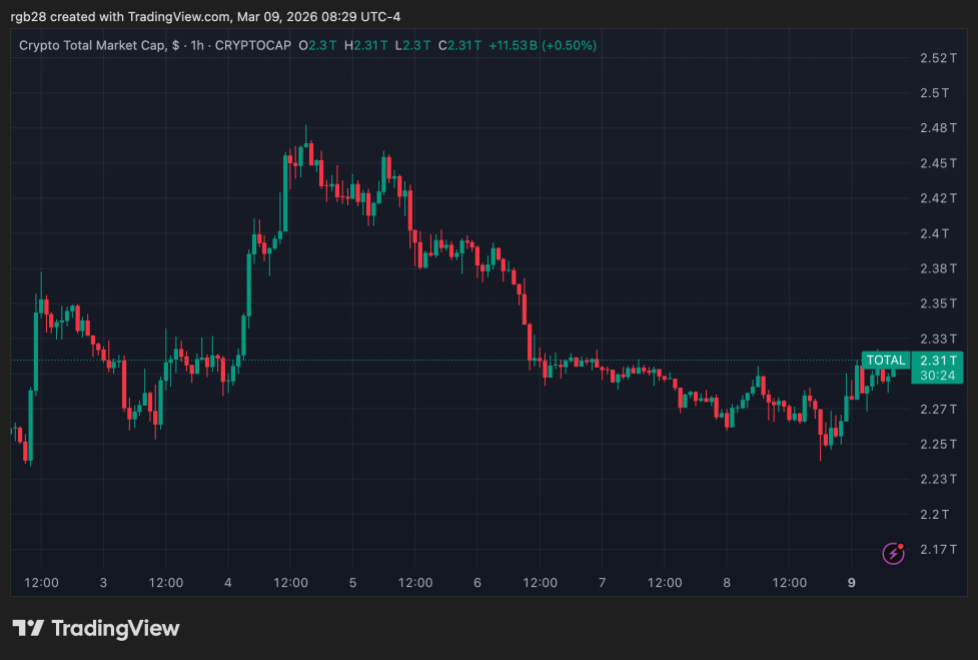
The total crypto market capitalization is at $2.31 trillion in the one-week chart. Source: TOTAL on TradingView