Banks’ Concerns Over Stablecoin Interest Payments Are ‘Totally Absurd’, Circle CEO Says

bitcoinistPublished on 2026-01-23Last updated on 2026-01-23

Abstract

Circle CEO Jeremy Allaire dismissed banking industry concerns over interest payments on stablecoins as "totally absurd," arguing that fears of massive deposit flight are unfounded. Speaking at the World Economic Forum, he compared stablecoin rewards to other common financial products like credit cards, emphasizing their role in customer engagement rather than systemic risk. Allaire countered bank claims that stablecoins could drain up to $6 trillion in deposits, noting that similar concerns emerged with money market funds yet lending continued unaffected. He highlighted the shift toward private credit and capital markets, asserting that stablecoins should function as safe, regulated cash instruments while lending evolves independently through new models.

The CEO of stablecoin issuer Circle has weighed in on the importance of stablecoin rewards and why he believes the banking industry’s concerns about interest payments on these assets are “absurd.”

Circle CEO Rejects Banks’ Stablecoin Fears

Speaking at the World Economic Forum (WEF) in Davos, Circle’s CEO, Jeremy Allaire, discussed banks’ growing concerns that paying interest on stablecoins poses a threat to the industry, calling the deposit flight narrative “totally absurd.”

The banking sector has expressed concerns about stablecoin rewards, arguing that interest payments will distort market dynamics and affect credit creation. In the US, banks have heavily criticized the GENIUS Act, claiming that it has loopholes that could pose risks to the financial system.

The executive rejected the sector’s general arguments, citing historical and practical reasons. He asserted that this exact argument has been historically used when new financial products, such as government money market funds, have emerged.

Notably, Bank of America CEO Brian Moynihan recently compared the digital assets to money market mutual funds, which require reserves to be held in short-term instruments, such as US Treasuries, reducing lending capacity in the system.

The executive told investors that the banking sector, small- and medium-sized businesses in particular, could face significant challenges if the US Congress does not prohibit interest-bearing stablecoins, as up to $6 trillion in deposits, or 30% to 35% of all US commercial bank deposits, could flow out of the banking system and into the stablecoin sector.

However, Allaire pointed out that, despite institutions claiming that financial products would “draw all the deposit base,” their growth has not “stopped the ability for lending to happen.”

The importance Of Rewards

Circle’s CEO also argued that stablecoins should not be singled out when rewards for other financial products exist and contribute to the system. “Those rewards (...) exist in every balance that you have with a credit card that you use. They exist around so many other financial products and services that we have,” he detailed.

“These rewards are actually very important,” Allaire continued. “They help with stickiness, they help with customer traction. They are not themselves like these huge monetary policy dampers.”

Most importantly, he pointed out that lending is moving away from the risk-taking of banks, with “a huge amount of lending is moving towards private credit.”

He cited a Wednesday WEF panel, in which a capital markets participant highlighted how the vast majority of GDP growth in the United States was “formed by capital market formation around junk bonds.”

“So private credit issuing junk bonds, capitalizing the build out of the American technology advancements, not bank credit,” the executive added.

Previously, Coinbase Institute shared a similar argument, affirming that “credit is evolving, not shrinking. Lending is shifting to private credit, fintech, and DeFi channels that don’t depend on deposits. Liquidity moves—it doesn’t vanish.”

Allaire concluded that “we want stablecoin money to be cash instrument money, prudentially supervised, very, very safe money. And then I think what we want to do is we want to build models for lending that build on top of stablecoins.”
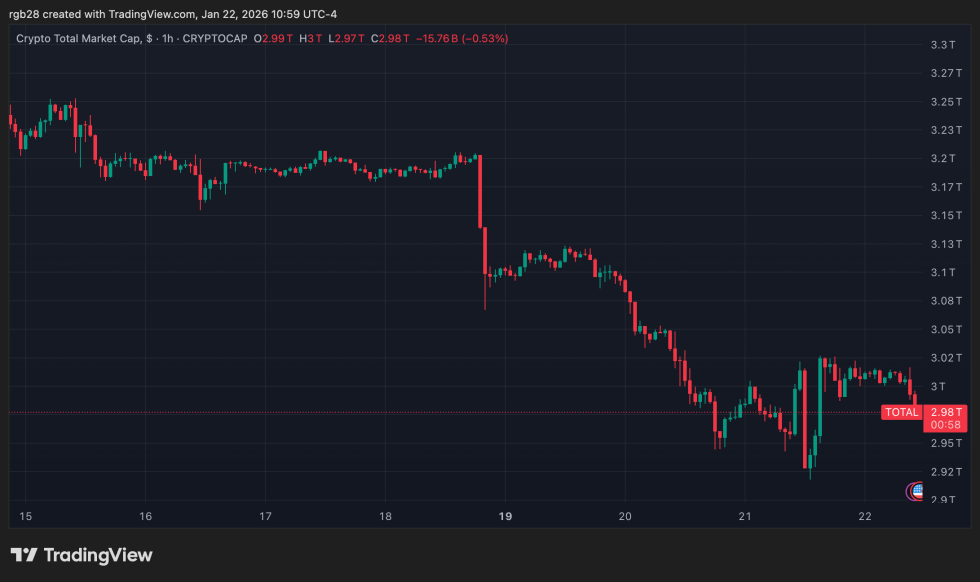
The total crypto market capitalization is at $2.98 trillion in the one-week chart. Source: TOTAL on TradingView


Related Questions

QWhat is Circle CEO Jeremy Allaire's view on banks' concerns about interest payments on stablecoins?

AJeremy Allaire calls the banking industry's concerns about interest payments on stablecoins 'totally absurd' and rejects the narrative that they pose a threat to the industry or will cause significant deposit flight.

QAccording to the banking sector, what risk does the GENIUS Act pose?

ABanks have criticized the GENIUS Act, claiming it has loopholes that could distort market dynamics, affect credit creation, and pose risks to the overall financial system.

QWhat historical financial product does Allaire compare stablecoins to when refuting the banks' arguments?

AAllaire compares stablecoins to government money market funds, which also faced similar criticisms when they emerged, yet their growth did not stop the ability for lending to happen.

QHow much in bank deposits could potentially flow into the stablecoin sector according to the concerns raised by bank executives?

ABank executives warned that up to $6 trillion in deposits, or 30% to 35% of all US commercial bank deposits, could flow out of the banking system and into the stablecoin sector if interest-bearing stablecoins are not prohibited.

QWhere does Jeremy Allaire argue that lending is increasingly moving towards?

AAllaire argues that a huge amount of lending is moving away from traditional banks and towards private credit, fintech, and DeFi channels, citing the growth of the junk bond market as an example of capital formation that doesn't rely on bank credit.

Related Reads

$292 Million KelpDAO Cross-Chain Bridge Hack: Who Should Foot the Bill?

On April 18, 2026, an attacker stole 116,500 rsETH (worth ~$292M) from KelpDAO’s cross-chain bridge in 46 minutes—the largest DeFi exploit of 2026. The stolen assets were deposited into Aave V3 as collateral, causing $177–200M in bad debt and triggering a cascade of losses across nine DeFi protocols. Aave’s TVL dropped by ~$6B overnight. This legal analysis argues that KelpDAO and LayerZero Labs share concurrent liability, with fault apportioned 60%/40%. KelpDAO negligently configured its bridge with a 1-of-1 decentralized verifier network (DVN)—a single point of failure—despite LayerZero’s explicit recommendation of a 2-of-3 setup. LayerZero, which operated the compromised DVN, failed to secure its RPC infrastructure against a known poisoning attack vector. Both protocols’ terms of service cap liability at $200 (KelpDAO) or $50 (LayerZero), but these limits are likely unenforceable due to unconscionability, gross negligence exceptions, and potential securities law invalidation (if rsETH is deemed a security under the Howey test). Aave’s governance also faces fiduciary duty claims for raising rsETH’s loan-to-value ratio to 93%—far above competitors’ 72–75%—without adequately assessing bridge risks, amplifying the systemic fallout. Practical recovery targets include LayerZero Labs (a registered Canadian entity), KelpDAO’s founders, auditors, and identifiable Aave governance delegates. The incident underscores escalating legal risks for DeFi protocols, infrastructure providers, and governance participants.

marsbit36m ago

$292 Million KelpDAO Cross-Chain Bridge Hack: Who Should Foot the Bill?

marsbit36m ago

Insider Trading in War: 5 People Involved, the Highest Earner Was Arrested

On April 24, the U.S. Department of Justice arrested U.S. Army Special Forces Staff Sergeant Gannon Ken Van Dyke for insider trading related to the capture of Venezuelan President Nicolás Maduro on January 3. Van Dyke allegedly profited over $400,000 by placing bets on a prediction market, Polymarket, using insider knowledge of the covert operation. According to the indictment, Van Dyke registered an account (0x31a5) on December 26 and made a series of bets predicting Maduro’s capture and U.S. military involvement in Venezuela. He withdrew most of his funds on the day of the operation and attempted to obscure his tracks by transferring assets through crypto and brokerage accounts. This case marks the first time the DOJ has prosecuted insider trading on Polymarket. PolyBeats had previously identified five suspicious accounts, including Van Dyke’s—the highest earner—in January. The other accounts, with profits ranging from $34,000 to $145,000, remain under unofficial scrutiny but have not been charged. Their lower profits, indirect access to information, and unclear legal boundaries may complicate prosecution. Polymarket has since strengthened its market integrity rules, explicitly prohibiting trading based on confidential or insider information. Van Dyke’s arrest, nearly four months after his trades, signals increased regulatory attention and the persistent traceability of blockchain-based transactions.

marsbit38m ago

Insider Trading in War: 5 People Involved, the Highest Earner Was Arrested

marsbit38m ago

Bitwise: Bullish on Bitcoin's Performance in the Second Half of the Year, AI and Regulation Will Spark a New Altcoin Season

Bitwise CIO Matt Hougan and Research Lead Ryan Rasmussen express strong bullish sentiment on Bitcoin's long-term prospects, suggesting that its $1 million price target may be too conservative. They argue Bitcoin serves a dual role: as digital gold and a potential global settlement asset, especially amid declining trust in traditional monetary systems. Despite a weak Q1 2026 where nearly all crypto assets and prices saw double-digit declines, the analysts remain optimistic due to strong forward-looking catalysts, including institutional adoption via Bitcoin ETFs from major firms like Morgan Stanley and Goldman Sachs. Geopolitical instability, such as Iran’s mention of using Bitcoin for international payments, increases the value of Bitcoin’s “out-of-the-money call option” as a non-political, global settlement currency. This enhances its appeal beyond a mere store of value. . Additionally, Hougan highlights that a clearer regulatory token framework under current SEC leadership, combined with AI efficiency gains and high-performance blockchains, could fuel a new “altseason” by late 2026. This may lead to a wave of legitimate, value-capturing token projects, unlike the earlier ICO boom. . Bitwise also announced an Avalanche ETF, citing its unique architecture and rapid growth in real-world asset (RWA) tokenization, which has surged 10x to nearly $30 billion in two years. The firm believes Layer 1 blockchains are still early in their growth cycle, with significant potential ahead.

marsbit1h ago

Bitwise: Bullish on Bitcoin's Performance in the Second Half of the Year, AI and Regulation Will Spark a New Altcoin Season

marsbit1h ago

Trading

Spot
Futures
活动图片




