Banking Lobby Digs In Against Landmark Crypto Bill as $SUBBD Gains Ground

bitcoinistPublished on 2026-02-11Last updated on 2026-02-11

Abstract

A powerful banking coalition, including the ABA and BPI, is lobbying against the landmark FIT21 crypto bill, claiming it creates regulatory gaps and risks, despite its aim to provide clearer rules. This resistance highlights a power struggle, as traditional finance sees crypto and DeFi as threats to its dominance. The resulting regulatory uncertainty is pushing users toward decentralized alternatives. This centralization problem extends beyond finance to the $191B content creation industry, where high fees and platform control are common. SUBBD Token ($SUBBD) emerges as a Web3 solution, offering creators decentralized earnings through subscriptions, NFTs, and AI tools, while giving fans participation via token-gated content and staking. The project's presale has raised over $1.4 million, signaling strong interest in a decentralized model for creators. With a fixed 20% APY for staking, it incentivizes early adoption. Regulatory gridlock may ironically fuel SUBBD's growth, as users seek transparent, fair platforms outside traditional control.

As Washington grapples with regulating digital assets, a powerful banking coalition just drew a line in the sand against the landmark Financial Innovation and Technology for the 21st Century Act (FIT21). It’s a move that highlights the growing schism between traditional finance and crypto, a conflict that’s inadvertently pushing users toward projects operating completely outside the old guard’s control.

The banking groups involved did release a statement after the meeting, despite not moving forward, but it didn’t outline the next steps.

In a recent letter to Senate leadership, the American Bankers Association (ABA) and the Bank Policy Institute (BPI), among others, urged lawmakers to kill the bill, even after it passed the House with surprising bipartisan support. Why the pushback? They claim FIT21 would create regulatory gaps, undermine existing securities laws, and expose consumers to undue risk. The bill itself is designed to do the opposite: establish a clearer framework for digital assets by finally delineating the jurisdictions of the SEC and CFTC.

Let’s be clear: this resistance isn’t just about policy. It’s about power. The banking sector sees the burgeoning crypto ecosystem, especially stablecoins and DeFi, as a direct threat to its long-held dominance over finance.

By lobbying against regulatory clarity, they perpetuate the very uncertainty that stifles mainstream adoption. And the second-order effect? It pushes innovation and user interest right into the arms of decentralized platforms that promise to bypass the gatekeepers altogether. While titans debate, builders build.

SUBBD Emerges as an Answer to Centralized Control

This battle in Washington underscores a problem that goes way beyond finance: the pitfalls of centralization. Sound familiar? The same dynamics, exorbitant fees, censorship, and arbitrary rule changes, plaguing traditional banking, are just as rampant in the $191B content creation industry. Platforms like YouTube, Twitch, and OnlyFans can slash creator earnings with fees as high as 70%, all while holding the power of sudden de-platforming over their heads.

This is the exact friction point that SUBBD Token ($SUBBD) was built to solve. It’s a Web3-native alternative that merges a decentralized ethos with powerful AI tools, aiming to become the ultimate hub for the modern creator.

The platform tackles the industry’s biggest pain points head-on, offering creators multiple ways to earn, from subscriptions and tipping to NFT sales, all within a transparent ecosystem on Ethereum.

What most coverage misses is the parallel here. The banking lobby fears disintermediation, and frankly, the creator economy is more than ready for it. SUBBD’s entire architecture is designed to hand power back to the user. It integrates an AI Personal Assistant for automating fan interactions, AI voice cloning, and even the ability to launch fully AI-driven influencers.
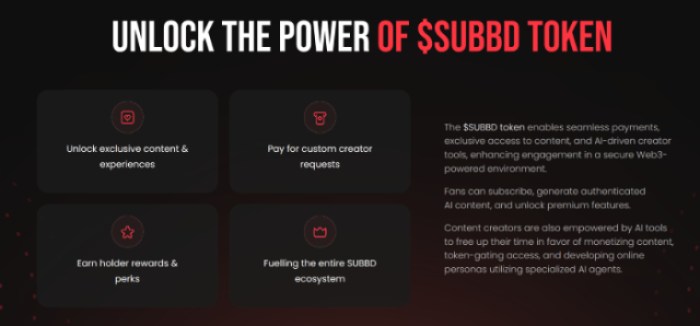
For fans, the platform isn’t just about consumption; it’s about participation through token-gated content and staking rewards. It creates a symbiotic economy where both sides win, without a middleman taking an outrageous cut.

CHECK OUT THE $SUBBD TOKEN ON ITS PRESALE PAGE

Presale Momentum Signals a Shift in Creator and Fan Sentiment

The market’s appetite for a decentralized fix is becoming undeniable. The ongoing SUBBD Token presale has already pulled in over $1.4 mwith tokens priced at just $0.057495. That kind of early-stage funding isn’t just noise; it’s a clear signal that people believe the creator economy is ripe for a shakeup.

Investors aren’t just buying a token; they’re buying into a whole new model for content ownership. The project’s staking mechanism, which offers a fixed 20% APY for the first year, gives an immediate incentive to get involved.

Stakers get access to exclusive content, livestreams, and other perks, transforming them from passive consumers into active participants. The risk? Well, like any new platform, it all comes down to achieving critical mass, attracting enough great creators and dedicated fans to make the ecosystem thrive.

Ironically, the regulatory gridlock in the U.S. might just be SUBBD’s biggest catalyst. As legacy institutions fight tooth and nail to preserve the status quo, they’re inadvertently making the best possible case for platforms that are transparent and fair by design.

The traction in SUBBD’s presale says it all: creators and users aren’t waiting for permission from Washington or Wall Street anymore. They’re just building a better system themselves. Join the SUBBD Token presale here.

BUY YOUR $SUBBD HERE

This article is for informational purposes only and should not be considered financial advice. All investments in cryptocurrency carry inherent risks, and you should conduct your own research.


Related Questions

QWhat is the main argument made by the banking lobby (ABA and BPI) against the FIT21 Act?

AThe banking lobby argues that the FIT21 Act would create regulatory gaps, undermine existing securities laws, and expose consumers to undue risk.

QAccording to the article, what is the core problem that SUBBD Token ($SUBBD) aims to solve in the content creation industry?

ASUBBD Token aims to solve the problems of exorbitant fees (as high as 70%), censorship, and the risk of sudden de-platforming that creators face on centralized platforms like YouTube and OnlyFans.

QWhat are some of the key AI tools integrated into the SUBBD platform for creators?

AThe SUBBD platform integrates an AI Personal Assistant for automating fan interactions, AI voice cloning, and the ability to launch fully AI-driven influencers.

QHow does the SUBBD platform's staking mechanism work to incentivize users?

AThe staking mechanism offers a fixed 20% APY for the first year, and stakers gain access to exclusive content, livestreams, and other perks, turning them into active participants.

QWhat does the article suggest is the 'second-order effect' of the lobbying efforts against crypto regulation?

AThe second-order effect is that it pushes innovation and user interest toward decentralized platforms that operate outside of traditional financial control, as these platforms promise to bypass the gatekeepers altogether.

Related Reads

Stuck Polymarket: The Real Test After Riding the Traffic Boom Has Arrived

Polymarket, a leading prediction market platform, is facing significant technical challenges as its growth outpaces its current infrastructure on Polygon. Users are experiencing laggy transactions, unresponsive orders, and delayed confirmations, severely impacting the trading experience. In response, DeFi Engineering VP Josh Stevens outlined a comprehensive engineering overhaul. The plan includes reducing on-chain data delays, fixing order cancellation issues, rebuilding the central limit order book (CLOB), improving website performance, and developing a unified SDK and API. A major revelation was the ongoing "chain migration," indicating a potential move away from Polygon. The core issue is that Polymarket has evolved from a simple prediction market into a high-frequency trading platform, making Polygon's limitations—such as block space, gas fees, and block time—a ceiling for further growth. The migration is not just a simple chain switch but a fundamental rebuild of its trading system to support more complex products like perpetual contracts (Perps). This announcement has sparked competition among chains like Solana, Sui, and Algorand, all vying to host Polymarket. For Polygon, losing this key application, which contributes significantly to its gas fee revenue, would be a major setback. The real test for Polymarket is no longer attracting users but proving it can provide a stable, reliable trading environment that retains them.

Odaily星球日报27m ago

Stuck Polymarket: The Real Test After Riding the Traffic Boom Has Arrived

Odaily星球日报27m ago

Lowering Expectations for BTC's Next Bull Market

The author, Alex Xu, explains his decision to significantly reduce his Bitcoin holdings (from full to ~30% of his portfolio) during the current bull cycle, citing a lowered long-term outlook for BTC's price appreciation in the next cycle. He outlines six key reasons for this reduced expectation: 1. **Diminished Growth Drivers:** The narrative of exponential user adoption has largely played out with institutional ETF adoption. The next major growth phase—adoption by sovereign national reserves or central banks—seems unlikely in the near future. 2. **Personal Opportunity Cost:** More attractive investment opportunities have emerged in other assets, such as undervalued companies. 3. **Industry-Wide Contraction:** The broader crypto industry is struggling, with most Web3 business models (SocialFi, GameFi, DePIN) failing. This overall萧条 (depression) reduces the fundamental demand and consensus for Bitcoin. 4. **Strain on Major Buyer:** MicroStrategy, a major corporate buyer of BTC, faces rising financing expenses for its debt, which could slow its purchasing rate and create significant marginal pressure on the market. 5. **Increased Competition from Gold:** The emergence of "tokenized gold" has closed the functional gap (portability, divisibility) between physical gold and Bitcoin, offering a strong competitor in the non-sovereign store-of-value space. 6. **Security Budget Concerns:** The block reward halving continues to exacerbate the long-standing issue of funding Bitcoin's network security, with new fee source explorations like Ordinals and L2s largely failing. The author's decision to hold a significant (though reduced) position reflects a cautious, not bearish, outlook. He remains open to increasing his exposure if the fundamental reasons for his skepticism change or if new positive catalysts emerge.

marsbit1h ago

Lowering Expectations for BTC's Next Bull Market

marsbit1h ago

Can Iran 'Control' the Strait of Hormuz?

Iran has announced a comprehensive plan to assert control over the strategic Strait of Hormuz, a critical global oil shipping chokepoint. The proposed measures include requiring all vessels to obtain Iranian permission for passage, imposing fees for security, environmental protection, and navigation management—preferably paid in Iranian rials—and absolutely banning Israeli ships. Vessels from countries deemed hostile by Iran’s top security bodies may also be barred. Analysts suggest Iran’s motives are multifaceted: increasing pressure on the U.S. and Israel by leveraging control over oil transit to influence global prices and inflation; creating a new revenue stream, potentially exceeding $7.7 billion annually, to counter Western sanctions and support postwar reconstruction; and using transit permissions as bargaining chips in future negotiations, notably with the U.S. However, the plan faces significant practical and diplomatic challenges. Enforcing comprehensive interception and fee collection in the busy waterway, patrolled by international military forces, would be difficult. The U.S. has already countering with a blockade of Iranian ports and threats to intercept any ship paying fees, potentially strangling Iran’s oil exports and fee revenue. Broad international opposition, led by European and Gulf states, and legal controversies further complicate implementation. The proposal may ultimately serve more as a negotiating tactic than a feasible policy, with its execution remaining highly uncertain.

marsbit2h ago

Can Iran 'Control' the Strait of Hormuz?

marsbit2h ago

Trading

Spot
Futures
活动图片




