Bank Of America CEO Issues $6T Stablecoin Rewards Warning As Regulatory Debate Heats Up

bitcoinistPublished on 2026-01-16Last updated on 2026-01-16

Abstract

Bank of America CEO Brian Moynihan has issued a warning that up to $6 trillion in deposits could leave the US banking system for the stablecoin sector if proposed crypto legislation allows interest payments on such tokens. He stated this could reduce banks' lending capacity and increase borrowing costs, particularly harming small and medium-sized businesses. The warning comes amid heated debate over the new market structure bill, which has faced criticism from both banking associations and crypto industry leaders. Coinbase CEO Brian Armstrong expressed strong opposition, arguing the bill would be worse than the status quo by effectively banning stablecoin rewards and restricting key crypto sectors. Due to significant backlash, the Senate Banking Committee has postponed the bill's markup to further review.

The CEO of Bank of America has warned that trillions of dollars could flee from bank deposits to the stablecoin sector if the upcoming crypto market structure bill allows interest payments on the tokens.

Banking System Could Face $6 Trillion Problem

On Wednesday, Bank of America CEO Brian Moynihan told investors that the banking industry could face significant challenges if the US Congress does not prohibit interest-bearing stablecoins.

During its Q4 earnings call, the executive affirmed that up to $6 trillion in deposits, around 30% to 35% of all US commercial bank deposits, could flow out of the banking system and into the stablecoin sector, citing Treasury Department studies.

The banking sector has heavily criticized the US’s landmark stablecoin legislation, the GENIUS Act, for months, claiming that it has loopholes that could pose risks to the financial system. Notably, the crypto framework prohibits interest payments on the holding or use of payment-purpose stablecoins but only addresses issuers.

Multiple banking associations across the US sent a joint letter to the Senate Banking Committee urging Congress to amend the law to include digital asset exchanges, brokers, dealers, and related entities.

According to the call’s transcript, Moynihan compared the digital assets to money market mutual funds, which require reserves to be held in short-term instruments, such as US Treasuries, thereby reducing lending capacity in the system.

That is the bigger concern that we’ve all expressed to Congress as they think about this, if you move it outside the system, you’ll reduce the lending capacity of banks. (...) And if you take out deposits, (...) they’re either not going to be able to loan or they’re going to have to get wholesale funding and that wholesale funding will come at a cost that will increase the cost of borrowing.

The CEO asserted that Bank of America would not be affected by this issue, as the institution would be able to “meet customer demand, whatever may surface.” However, he noted that it would particularly hurt small- and medium-sized businesses, as they’re “largely lent to end consumers by the banking industry.”

Stablecoin Rewards Debate Intensifies

Moynihan’s remarks come amid the Senate’s struggles with the long-awaited market structure bill. The recently shared draft, which was scheduled for a markup today, has raised concerns among crypto industry leaders, who have outlined multiple problems with the bill.

Coinbase’s CEO, Brian Armstrong, took to X to share his disappointment with the legislation, affirming that “this version would be materially worse than the current status quo. We’d rather have no bill than a bad bill.”

He affirmed that, after reviewing the bill’s draft, Coinbase could not support it in its current state, arguing that there were “too many issues.” Among the problems, he noted the de facto ban on tokenized equities, crucial DeFi prohibitions, the “erosion” of the Commodity Futures Trading Commission (CFTC)’s authority, and the policies regarding the payment of interests on stablecoins.

As reported by Bitcoinist, this version of the market structure bill introduced key restrictions for stablecoin issuers. Under the proposed changes, issuers would be able to offer rewards for specific actions, such as account openings and cashback.

However, they are prohibited from offering interest payments to passive token holders. To Armstrong, this “would kill rewards on stablecoins,” and allow banks to “ban their competition.”

Amid the intensified backlash, Senate Banking Committee Chairman Tim Scott announced on Wednesday that the bill’s markup had been postponed to “deliver clear rules of the road that protect consumers, strengthen our national security, and ensure the future of finance is built in the United States.”
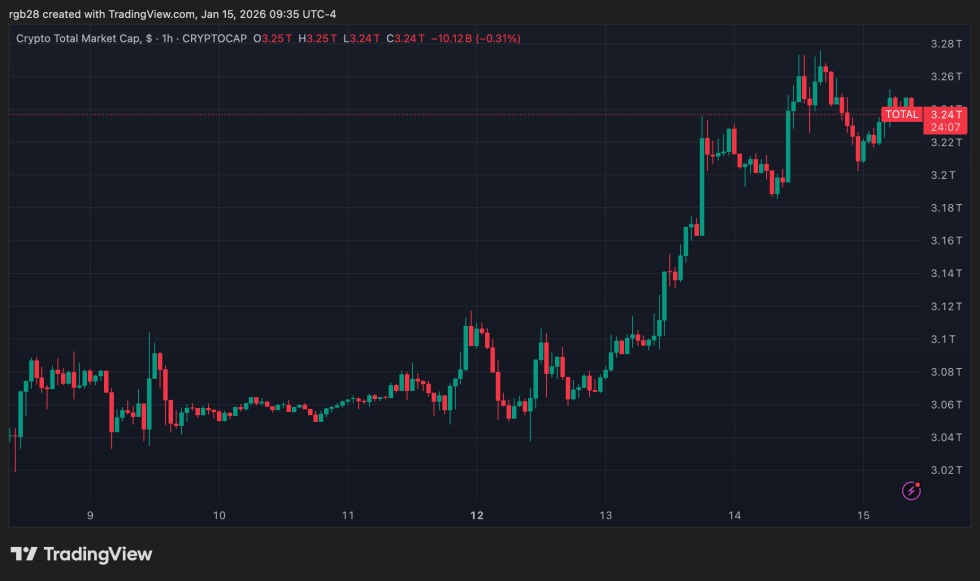
The total crypto market capitalization is at $3.24 trillion in the one-week chart. Source: TOTAL on TradingView

Related Questions

QWhat is the main concern expressed by Bank of America CEO Brian Moynihan regarding the proposed stablecoin legislation?

ABrian Moynihan's main concern is that if the upcoming crypto market structure bill allows interest payments on stablecoins, up to $6 trillion in bank deposits could flee the banking system and move into the stablecoin sector, which would significantly reduce the lending capacity of banks and increase the cost of borrowing.

QAccording to the article, what specific percentage of US commercial bank deposits does the $6 trillion figure represent?

AThe $6 trillion figure represents approximately 30% to 35% of all US commercial bank deposits.

QWhy does the banking industry criticize the GENIUS Act, the US's landmark stablecoin legislation?

AThe banking industry criticizes the GENIUS Act for having loopholes that could pose risks to the financial system. They claim it only addresses issuers in its ban on interest for payment-purpose stablecoins and does not extend this prohibition to digital asset exchanges, brokers, dealers, and related entities.

QWhat was Coinbase CEO Brian Armstrong's reaction to the draft of the market structure bill?

ABrian Armstrong expressed strong disappointment, stating that the bill in its current state would be 'materially worse than the current status quo' and that Coinbase could not support it due to 'too many issues.' He stated, 'We’d rather have no bill than a bad bill.'

QWhat was the reason given for the postponement of the bill's markup by Senate Banking Committee Chairman Tim Scott?

ASenate Banking Committee Chairman Tim Scott announced the postponement in order to 'deliver clear rules of the road that protect consumers, strengthen our national security, and ensure the future of finance is built in the United States.'

Related Reads

Trading

Spot
Futures

Hot Articles

What is $BANK

Bank AI: A Revolutionary Step in the Future of Banking Introduction In an era marked by rapid advancements in technology, Bank AI stands at the intersection of artificial intelligence (AI) and banking services. This innovative project seeks to redefine the financial landscape, enhancing operational efficiency, security measures, and customer experiences through the power of AI. As we embark on this exploration of Bank AI, we will delve into what the project entails, its operational dynamics, its historical context, and significant milestones. What is Bank AI? At its core, Bank AI represents a transformative initiative aimed at integrating artificial intelligence into various banking operations. This project harnesses the capabilities of AI to automate processes, improve risk management protocols, and enhance customer interaction through personalised services. The primary objectives of Bank AI include: Automation of Banking Functions: By leveraging AI technologies, Bank AI aims to automate routine tasks, reducing the burden on human resources and enhancing efficiency. Enhanced Risk Management: The project utilises AI algorithms to predict and identify risks, thereby fortifying security measures against fraud and other threats. Personalisation of Banking Services: Bank AI focuses on offering tailored financial products and services by analysing customer data and behaviours. Improving Customer Experience: The implementation of AI-driven solutions, such as chatbots and virtual assistants, aims to provide users with more human-like interactions, revolutionising the way customers engage with banks. With these goals, Bank AI positions itself as a crucial player in rendering banking more efficient, secure, and user-centric. Who is the Creator of Bank AI? Details regarding the creator of Bank AI remain unknown. As such, no specific individual or organisation has been identified in the available information. The anonymity surrounding the project's inception raises questions but does not detract from its ambitious vision and objectives. Who are the Investors of Bank AI? Similar to the project's creator, specific information regarding the investors or supporting organisations of Bank AI has not been disclosed. Without this information, it is challenging to outline the financial backing and institutional support that might be propelling the project forward. Nevertheless, the importance of having a robust investment foundation is pivotal for sustaining development in such an innovative field. How Does Bank AI Work? Bank AI operates on several innovative fronts, focusing on unique factors that differentiate it from traditional banking frameworks. Below are key operational features: Automation: By applying machine learning algorithms, Bank AI automates various manual processes within banks. This results in reduced operational costs and allows human workers to redirect their efforts towards more strategic activities. Advanced Risk Management: The integration of AI into risk management practices equips banks with tools to accurately predict potential threats such as fraud, ensuring that customer information and assets remain secure. Tailored Financial Recommendations: Through continuous learning from customer interactions, the AI systems develop a nuanced understanding of user needs, enabling them to offer tailored advice on financial decisions. Enhanced Customer Interactions: Utilizing chatbots and virtual assistants powered by AI, Bank AI enables a more engaging customer experience, allowing users to have their queries resolved quickly, thus reducing wait times and improving satisfaction levels. Together, these operational features position Bank AI as a pioneer in the banking sector, establishing new benchmarks for service delivery and operational excellence. Timeline of Bank AI Understanding the trajectory of Bank AI requires a look at its historical context. Below is a timeline highlighting important milestones and developments: Early 2010s: The conceptualisation of AI integration into banking services began to gain attention as banking institutions recognised the potential benefits. 2018: A marked increase in the implementation of AI technologies occurred when banks started using AI tools like chatbots for basic customer service and risk management systems for improved security handling. 2023: The sophistication of AI continued to advance, with generative AI being introduced for more complex tasks such as document processing and real-time investment analysis. This year marked a significant leap in the capabilities afforded to banks by AI technology. 2024-Current Status: As of this year, Bank AI is on an upward trajectory, with ongoing research and developments poised to further enhance capabilities in banking operations. Continued exploration of AI applications hints at exciting developments yet to come. Key Points About Bank AI Integration of AI in Banking: Bank AI focuses on adopting artificial intelligence to streamline banking processes and improve user experiences. Automation and Risk Management Focus: The project strongly emphasises these areas, aiming to shift the burden of routine tasks while enhancing security frameworks through predictive analytics. Personalised Banking Solutions: By harnessing customer data, Bank AI enables tailored banking services that cater to individual user needs. Commitment to Development: Bank AI remains committed to ongoing research and development efforts, ensuring its adaptability and ongoing relevance as technology continues to evolve. Conclusion In summary, Bank AI exemplifies a crucial step forward in the banking industry, leveraging artificial intelligence to reshape operational paradigms, enhance security, and promote customer satisfaction. Despite gaps in information surrounding the creator and investors, the clear objectives and functional mechanisms of Bank AI provide a strong foundation for its ongoing evolution. As AI technology continues to advance and merge with the banking sector, Bank AI is well-positioned to significantly impact the future of financial services, enhancing the way we understand and interact with banking.

152 Total ViewsPublished 2024.04.06Updated 2024.12.03

What is $BANK

Discussions

Welcome to the HTX Community. Here, you can stay informed about the latest platform developments and gain access to professional market insights. Users' opinions on the price of BANK (BANK) are presented below.

活动图片