Anthropic Refuses Access to China's Think Tank for Most Powerful AI Model Mythos, Intensifying US-China AI Competition

marsbitPublished on 2026-05-13Last updated on 2026-05-13

Abstract

Anthropic rejects Chinese think tank request for access to its most advanced AI model, Claude Mythos, escalating US-China AI competition. The request was made informally at a Carnegie Endowment meeting in Singapore, prompting concern within the U.S. National Security Council. Mythos, released in April 2026 under the "Project Glasswing" initiative, is described as "digital weapon-grade" technology for its unprecedented ability to discover zero-day vulnerabilities. Access is limited to about 40 US and UK entities in cybersecurity, finance, and tech, with China explicitly excluded as an "adversarial nation." While the official Chinese response has been muted, the incident highlights China's exclusion from cutting-edge AI defense tools despite its critical infrastructure running on software Mythos can analyze. The Chinese cybersecurity market anticipates massive growth and domestic model development, but a significant capability gap remains. The event coincides with internal Trump administration debates on pre-release AI model security assessments and an upcoming presidential visit to China, where AI dialogue is expected. Analysts caution that past US-China AI safety talks have seen China more focused on information gathering than substantive collaboration.

Author: Claude, Deep Tide TechFlow

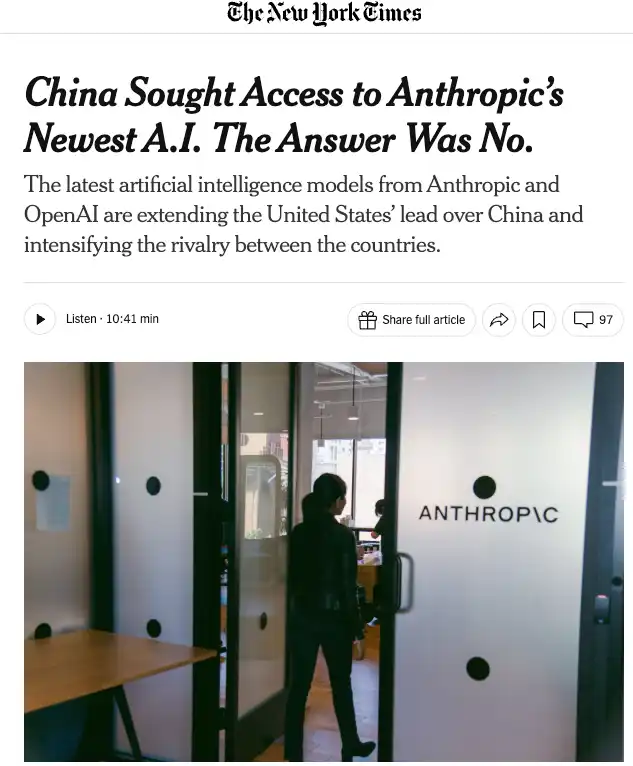
Deep Tide Intro: According to a May 12 report by *The New York Times*, at a closed-door meeting organized by the Carnegie Endowment for International Peace in Singapore last month, a representative from a Chinese think tank requested that Anthropic grant access to the Claude Mythos model. The request was refused on the spot.

The incident subsequently reached the White House, triggering high alert within the U.S. National Security Council.

Mythos is the most powerful AI model released by Anthropic in April this year. Its offensive and defensive capabilities in the cybersecurity field are seen as "digital weapon-grade" technology. It is currently accessible to only about 40 U.S. and U.K. institutions. This event occurred as the Trump administration is brewing an executive order on AI regulation. He will also lead a business delegation to China this week to discuss AI-related issues.
A closed-door conversation in Singapore is becoming the latest flashpoint in the US-China AI competition.

According to *The New York Times* on May 12, at a non-public meeting organized by the Carnegie Endowment for International Peace in Singapore last month, a Chinese think tank representative approached Anthropic officials during a break and made a request: hoping the company would relax its policy to allow Chinese access to its newest and most powerful AI model, Claude Mythos.

Anthropic refused on the spot.

This was not a formal diplomatic request from the Chinese government. However, according to reports from multiple media outlets, the incident triggered high alert from officials in the Trump administration's National Security Council (NSC) upon reaching Washington, seen as another signal of China's continued pressure in the AI field.

Mythos: A 'Digital Weapon' with Capabilities Far Surpassing Predecessors, Restrictively Released

To understand the weight of this event, one must look at Mythos itself.

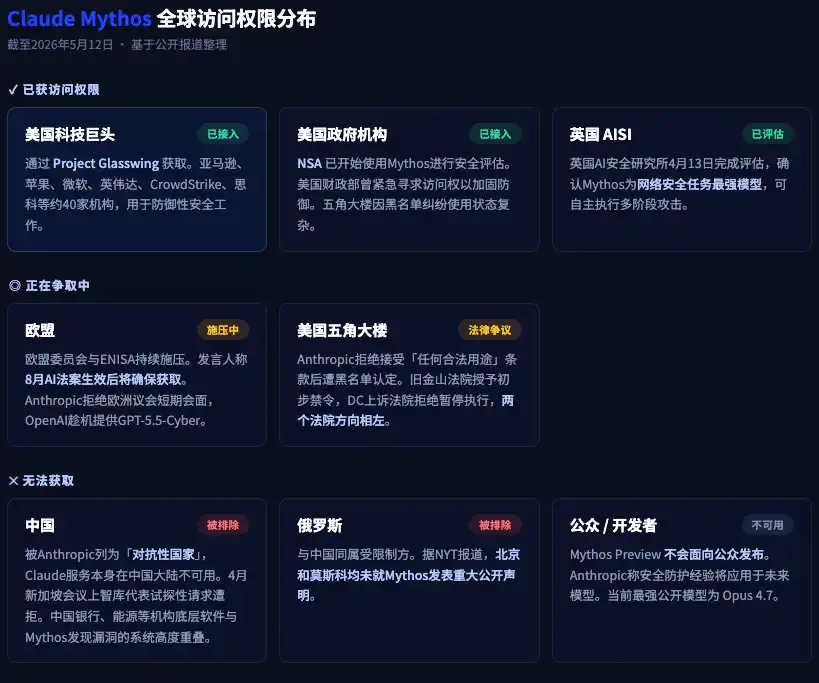
Claude Mythos Preview was officially released on April 7, 2026, but not to the public. Anthropic limited its access within a framework called the "Project Glasswing" cybersecurity defense initiative, granting access to only about 40 institutions. Partners include Amazon, Apple, Microsoft, CrowdStrike, Cisco, Nvidia, JPMorgan Chase, and the Linux Foundation.

According to Anthropic's official blog and a TechCrunch report on April 7, during internal testing, Mythos autonomously discovered thousands of zero-day vulnerabilities (i.e., security flaws previously unknown to developers), covering all major operating systems and mainstream browsers. Some vulnerabilities had existed for up to 27 years. In cybersecurity evaluations like CyberGym, Mythos's performance significantly surpassed the previous-generation model Claude Opus 4.6. Its validation score on SWE-bench reached 93.9%, compared to Opus 4.6's 80.8%.

China Excluded, Labeled an 'Adversarial Nation'

Anthropic lists China as an "adversarial nation." Its services are generally unavailable in mainland China, and the restricted release of Mythos explicitly excludes Chinese institutions.

According to a three-part series in *South China Morning Post* from late April to early May, China's reaction to the Mythos incident presents a complex picture. The official level has been relatively restrained, with no major public statements or strong responses. Some within China's AI community even questioned whether Anthropic was using security risks as a marketing gimmick to restrict model access to U.S. companies.
However, reactions within the cybersecurity industry have been starkly different. After the release of Mythos, stock prices of Chinese cybersecurity listed companies like Qi An Xin Group, Sangfor Technologies, and 360 Security Technology rose for several consecutive days, as markets anticipated accelerated demand for AI-driven cybersecurity.

IDC China Senior Research Manager Austin Zhao, in an interview with *SCMP*, stated that a Chinese model at the Mythos level "will definitely appear," but currently, the overall capabilities of domestic cybersecurity models are "still far from Mythos." However, the capabilities of Chinese models are also improving rapidly, a trend deemed irreversible. IDC predicts the scale of China's AI cybersecurity industry will grow from 1.58 billion yuan in 2025 to 59.35 billion yuan (approx. $8.7 billion) in 2030, an increase of over 37 times.

The practical dilemma is that the underlying software running in many Chinese banks, energy companies, and government agencies overlaps heavily with the systems where Mythos discovered vulnerabilities. But currently, China has no seat at this defense-upgraded table.

White House Alert and Policy Game: Executive Order Brewing, Trump Visiting China This Week

The alert triggered by the Singapore closed-door meeting adds to a series of larger policy games.

According to a May 11 report by *The Washington Post*, sharp disagreements have emerged within the Trump administration regarding AI regulation. On one hand, national security officials (including the NSA and the Office of the Director of National Intelligence) are pushing for security assessments of AI models by intelligence agencies before public release. On the other hand, the Commerce Department system prefers to keep the assessment authority within its own jurisdiction. White House National Economic Council Director Kevin Hassett revealed in a Fox Business interview last week that the government is studying the issuance of an executive order to provide a clear roadmap for the safety assessment process of AI models, similar to the FDA's pre-market review mechanism for drugs.

Simultaneously, Trump is scheduled to visit China this week, with AI-related issues expected to be on the agenda.

According to an Axios report on May 12, U.S. officials expressed hope to "use the leaders' meeting to open a dialogue, to see if a communication channel for AI affairs should be established." However, Melanie Hart, Senior Director of the Global China Hub at the Atlantic Council, cautioned that during the Biden administration, China mainly "collected U.S. information, rather than seriously discussing AI safeguards" in AI safety dialogues, and those attending the talks were often Foreign Ministry officials lacking AI technical expertise.
Related Questions

QWhat is Claude Mythos and why is it considered a significant model by Anthropic?

AClaude Mythos is Anthropic's latest and most powerful AI model, released in April 2026. It is considered significant due to its exceptional capabilities in the cybersecurity field, where it has demonstrated the ability to autonomously discover thousands of previously unknown zero-day vulnerabilities across major operating systems and browsers. Its performance in cybersecurity benchmarks far surpasses previous models like Claude Opus 4.6. Because of this advanced defensive (and potentially offensive) capability, it is sometimes referred to as 'digital weapon-grade' technology.

QWhat was the specific request made by the Chinese think tank representative at the Singapore meeting, and what was the response?

AAt a closed-door meeting organized by the Carnegie Endowment for International Peace in Singapore, a representative from a Chinese think tank asked Anthropic officials to grant Chinese access to its Claude Mythos AI model. Anthropic officials rejected the request on the spot.

QHow did the US government react to the news of the request and its rejection?

AThe news of the request and its rejection was relayed to Washington, where it triggered a high level of alert within the US National Security Council (NSC) under the Trump administration. US officials viewed the incident as another signal of China's continued pressure in the AI domain.

QWhat is Project Glasswing and which entities have access to Mythos?

AProject Glasswing is a cybersecurity defense initiative framework within which Anthropic has released the Claude Mythos Preview. Access to the model is highly restricted, granted only to approximately 40 US and UK-based institutions. These partners include major technology and financial companies such as Amazon, Apple, Microsoft, CrowdStrike, Cisco, Nvidia, JPMorgan Chase, and the Linux Foundation.

QWhat is the broader context of US-China AI competition mentioned in the article, particularly regarding upcoming diplomatic and policy events?

AThe incident occurs against a backdrop of escalating US-China AI competition and policy formulation. Domestically, the Trump administration is reportedly drafting an executive order to establish an AI regulatory framework, including potential pre-release security reviews akin to FDA drug approvals. Internationally, President Trump is scheduled to visit China this week, where AI-related issues are expected to be on the agenda. US officials hope to establish communication channels on AI matters, though past experiences suggest such dialogues have been challenging.

Related Reads

Must-Watch Events Next Week|CLARITY Act Could Face Senate Vote; SpaceX, Circle to Report Earnings (8.3-8.9)

**Summary: Key Events and Developments to Watch (August 3-9)** The upcoming week is marked by significant financial disclosures, key legislative deadlines, and notable product updates. **Major Financial Events:** Several companies are scheduled to release their Q2 2026 earnings. American Bitcoin (ABTC) will report on August 3, followed by SpaceX and Hut 8 Mining Corp. on August 4, and Circle on August 5. Notably, a significant portion of SpaceX shares (up to 12% of total shares) will be unlocked on August 6 following their earnings release. **Key Legislative Deadline:** The U.S. Senate faces an August 7 deadline to secure 60 votes for the CLARITY Act, a bipartisan bill aiming to establish a federal regulatory framework for cryptocurrencies. The Senate may hold a full vote on the bill during the week. **Economic Data:** The U.S. July Non-Farm Payrolls report will be released on August 7, providing crucial labor market data. **Technology & Product Updates:** * **Shutdowns:** DeFi portfolio tracker Zapper and wallet app Ctrl Wallet will cease operations on August 3. * **Upgrades:** LayerZero will deprecate its v1 relayers on August 3. XRP Ledger's new version 3.3.0, featuring five new functions, is expected next week. * **AI:** Elon Musk announced that the advanced Grok 4.6 AI model is set for release around August 7. * **Bitcoin:** The BIP-110 forced signaling for a potential Bitcoin network change is scheduled to begin around August 8. **Other Notable Events:** Chinese robotics firm Unitree Tech has set its preliminary price inquiry for its IPO for August 5. South Korean exchange Upbit will delist AQT and AERGO tokens on August 3.

marsbit1h ago

Must-Watch Events Next Week|CLARITY Act Could Face Senate Vote; SpaceX, Circle to Report Earnings (8.3-8.9)

marsbit1h ago

Stocks Are Plummeting More Sharply Than Cryptocurrencies. Where Has the Money Gone?

Stock Markets Plunge Deeper Than Cryptocurrencies: Where Did the Money Go? In late July, Seoul's Kospi index triggered circuit breakers for two consecutive days, plummeting over 40% from its June high. The collapse was led by heavyweight stocks like SK Hynix, whose record profits still disappointed investors, and devastating leveraged ETFs, with one major product losing over 83% of its value. This signaled a global, forced deleveraging targeting the most crowded trades. Interestingly, while stocks exhibited extreme volatility akin to crypto markets, Bitcoin rose nearly 15% in July after a prior steep drop. Analysis shows the money fleeing equities did not flow into Bitcoin. Instead, Bitcoin had already absorbed its sell-off in May-June, when U.S. spot Bitcoin ETFs saw historic outflows. The true safe-haven beneficiary was gold, whose price rose over 20% year-on-year, highlighting a decoupling between Bitcoin and gold as "digital gold." The sell-off was a targeted unwinding of leveraged positions in tech and semiconductors, accelerated by broker-dealer risk management and shifts in the AI narrative, including new competition from Chinese memory chipmakers. The retreat path was clear: from high-valuation tech stocks to cash and U.S. Treasuries, then to gold. For Bitcoin to attract sustained institutional inflows, conditions like eased global liquidity pressure, a "soft-landing" Fed rate cut, and U.S. regulatory clarity via legislation like the stalled CLARITY Act are needed. Currently, Bitcoin is not a safe haven but an already-cleared asset. Its low correlation with tech stocks, however, makes it a potential diversification play for institutional portfolios once the storm passes. The money isn't here yet, but the positioning is underway.

marsbit1h ago

Stocks Are Plummeting More Sharply Than Cryptocurrencies. Where Has the Money Gone?

marsbit1h ago

In Conversation with Ray Dalio: We Are Currently in an AI Bubble, with 1% of My Portfolio in Bitcoin

Ray Dalio, founder of Bridgewater Associates, warns in an interview that the current AI boom shows classic bubble characteristics, which could lead to significant economic downturns as seen in past cycles like 1929 or 2000. He explains that speculative enthusiasm, fueled by debt and overvaluation, often precedes a crash when rising rates or taxation force asset sales, causing widespread losses and recession. Dalio also outlines his "Big Cycle" theory, describing an approximate 80-year pattern where widening wealth gaps, massive government deficits, and shifting geopolitical power (like China's rise) create internal conflict and global instability. He emphasizes that we are in a late-cycle, transitional phase where traditional powers like the US and UK face decline. For personal wealth protection, Dalio advises diversification beyond cash into assets like stocks, bonds, real estate, and particularly gold, which he prefers over Bitcoin. While he holds about 1% of his portfolio in Bitcoin as a non-printable hard asset, he views gold as more secure from technological or governmental threats. Regarding AI's impact, Dalio believes it will disproportionately benefit capital owners, worsening inequality by replacing both physical and cognitive labor. He suggests that human intuition and emotional intelligence, combined with AI, will be key for future workers. On taxation, Dalio argues that wealth taxes are impractical and risk triggering asset sell-offs, reducing productive investment. He points to the UK as a cautionary example of debt, low productivity, and political strife. Geopolitically, Dalio foresees a more regionalized world, with the US showing weakness in prolonged conflicts like with Iran, akin to past imperial declines. The ideal outcome, he suggests, is coexisting powerful blocs (e.g., Americas, China-Asia Pacific) without major war.

marsbit5h ago

In Conversation with Ray Dalio: We Are Currently in an AI Bubble, with 1% of My Portfolio in Bitcoin

marsbit5h ago

Trading

Spot
活动图片





