Anthropic Refuses Access to China's Think Tank for Most Powerful AI Model Mythos, Intensifying US-China AI Competition

marsbitPublished on 2026-05-13Last updated on 2026-05-13

Abstract

Anthropic rejects Chinese think tank request for access to its most advanced AI model, Claude Mythos, escalating US-China AI competition. The request was made informally at a Carnegie Endowment meeting in Singapore, prompting concern within the U.S. National Security Council. Mythos, released in April 2026 under the "Project Glasswing" initiative, is described as "digital weapon-grade" technology for its unprecedented ability to discover zero-day vulnerabilities. Access is limited to about 40 US and UK entities in cybersecurity, finance, and tech, with China explicitly excluded as an "adversarial nation." While the official Chinese response has been muted, the incident highlights China's exclusion from cutting-edge AI defense tools despite its critical infrastructure running on software Mythos can analyze. The Chinese cybersecurity market anticipates massive growth and domestic model development, but a significant capability gap remains. The event coincides with internal Trump administration debates on pre-release AI model security assessments and an upcoming presidential visit to China, where AI dialogue is expected. Analysts caution that past US-China AI safety talks have seen China more focused on information gathering than substantive collaboration.

Author: Claude, Deep Tide TechFlow

Deep Tide Intro: According to a May 12 report by *The New York Times*, at a closed-door meeting organized by the Carnegie Endowment for International Peace in Singapore last month, a representative from a Chinese think tank requested that Anthropic grant access to the Claude Mythos model. The request was refused on the spot.

The incident subsequently reached the White House, triggering high alert within the U.S. National Security Council.

Mythos is the most powerful AI model released by Anthropic in April this year. Its offensive and defensive capabilities in the cybersecurity field are seen as "digital weapon-grade" technology. It is currently accessible to only about 40 U.S. and U.K. institutions. This event occurred as the Trump administration is brewing an executive order on AI regulation. He will also lead a business delegation to China this week to discuss AI-related issues.
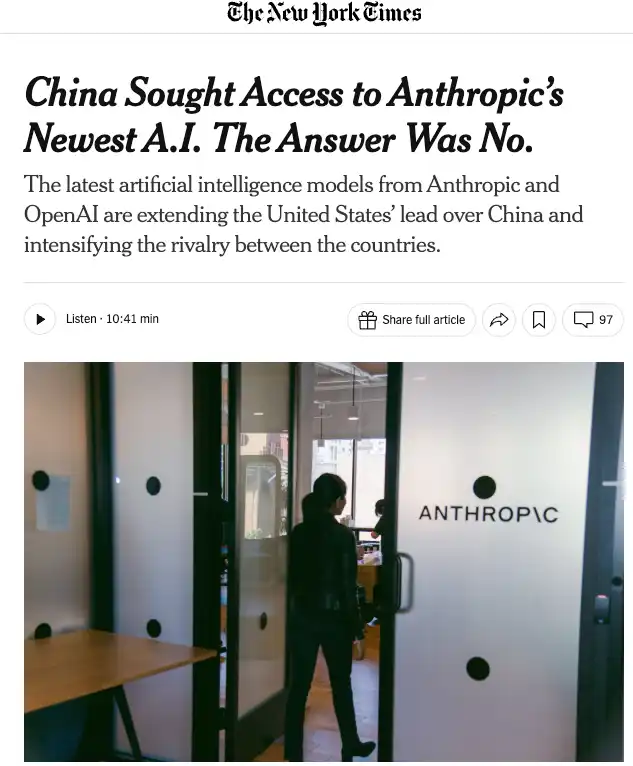
A closed-door conversation in Singapore is becoming the latest flashpoint in the US-China AI competition.

According to *The New York Times* on May 12, at a non-public meeting organized by the Carnegie Endowment for International Peace in Singapore last month, a Chinese think tank representative approached Anthropic officials during a break and made a request: hoping the company would relax its policy to allow Chinese access to its newest and most powerful AI model, Claude Mythos.

Anthropic refused on the spot.

This was not a formal diplomatic request from the Chinese government. However, according to reports from multiple media outlets, the incident triggered high alert from officials in the Trump administration's National Security Council (NSC) upon reaching Washington, seen as another signal of China's continued pressure in the AI field.

Mythos: A 'Digital Weapon' with Capabilities Far Surpassing Predecessors, Restrictively Released

To understand the weight of this event, one must look at Mythos itself.

Claude Mythos Preview was officially released on April 7, 2026, but not to the public. Anthropic limited its access within a framework called the "Project Glasswing" cybersecurity defense initiative, granting access to only about 40 institutions. Partners include Amazon, Apple, Microsoft, CrowdStrike, Cisco, Nvidia, JPMorgan Chase, and the Linux Foundation.

According to Anthropic's official blog and a TechCrunch report on April 7, during internal testing, Mythos autonomously discovered thousands of zero-day vulnerabilities (i.e., security flaws previously unknown to developers), covering all major operating systems and mainstream browsers. Some vulnerabilities had existed for up to 27 years. In cybersecurity evaluations like CyberGym, Mythos's performance significantly surpassed the previous-generation model Claude Opus 4.6. Its validation score on SWE-bench reached 93.9%, compared to Opus 4.6's 80.8%.

China Excluded, Labeled an 'Adversarial Nation'

Anthropic lists China as an "adversarial nation." Its services are generally unavailable in mainland China, and the restricted release of Mythos explicitly excludes Chinese institutions.

According to a three-part series in *South China Morning Post* from late April to early May, China's reaction to the Mythos incident presents a complex picture. The official level has been relatively restrained, with no major public statements or strong responses. Some within China's AI community even questioned whether Anthropic was using security risks as a marketing gimmick to restrict model access to U.S. companies.
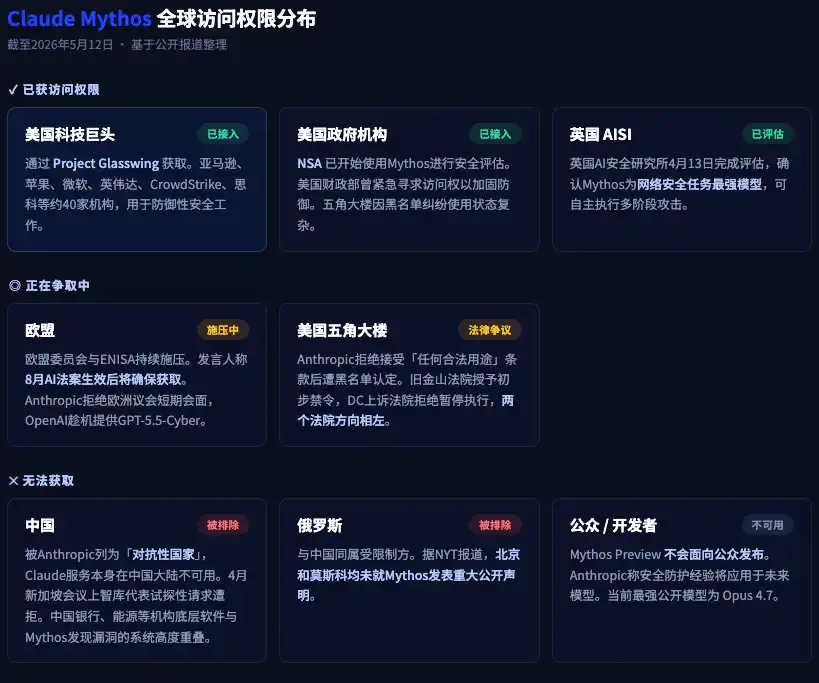
However, reactions within the cybersecurity industry have been starkly different. After the release of Mythos, stock prices of Chinese cybersecurity listed companies like Qi An Xin Group, Sangfor Technologies, and 360 Security Technology rose for several consecutive days, as markets anticipated accelerated demand for AI-driven cybersecurity.

IDC China Senior Research Manager Austin Zhao, in an interview with *SCMP*, stated that a Chinese model at the Mythos level "will definitely appear," but currently, the overall capabilities of domestic cybersecurity models are "still far from Mythos." However, the capabilities of Chinese models are also improving rapidly, a trend deemed irreversible. IDC predicts the scale of China's AI cybersecurity industry will grow from 1.58 billion yuan in 2025 to 59.35 billion yuan (approx. $8.7 billion) in 2030, an increase of over 37 times.

The practical dilemma is that the underlying software running in many Chinese banks, energy companies, and government agencies overlaps heavily with the systems where Mythos discovered vulnerabilities. But currently, China has no seat at this defense-upgraded table.

White House Alert and Policy Game: Executive Order Brewing, Trump Visiting China This Week

The alert triggered by the Singapore closed-door meeting adds to a series of larger policy games.

According to a May 11 report by *The Washington Post*, sharp disagreements have emerged within the Trump administration regarding AI regulation. On one hand, national security officials (including the NSA and the Office of the Director of National Intelligence) are pushing for security assessments of AI models by intelligence agencies before public release. On the other hand, the Commerce Department system prefers to keep the assessment authority within its own jurisdiction. White House National Economic Council Director Kevin Hassett revealed in a Fox Business interview last week that the government is studying the issuance of an executive order to provide a clear roadmap for the safety assessment process of AI models, similar to the FDA's pre-market review mechanism for drugs.

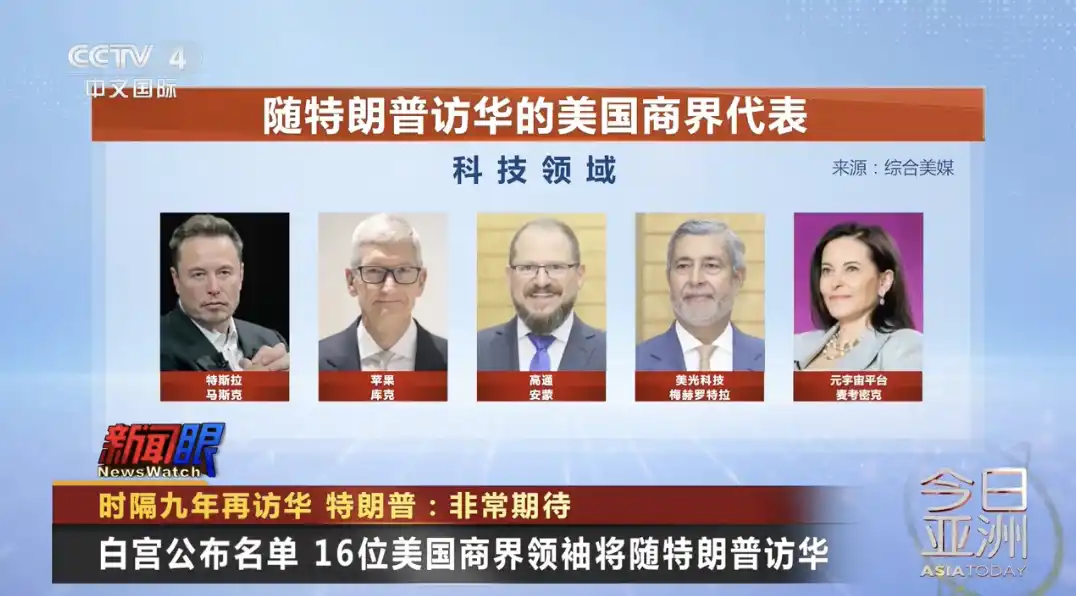
Simultaneously, Trump is scheduled to visit China this week, with AI-related issues expected to be on the agenda.

According to an Axios report on May 12, U.S. officials expressed hope to "use the leaders' meeting to open a dialogue, to see if a communication channel for AI affairs should be established." However, Melanie Hart, Senior Director of the Global China Hub at the Atlantic Council, cautioned that during the Biden administration, China mainly "collected U.S. information, rather than seriously discussing AI safeguards" in AI safety dialogues, and those attending the talks were often Foreign Ministry officials lacking AI technical expertise.
Related Questions

QWhat is Claude Mythos and why is it considered a significant model by Anthropic?

AClaude Mythos is Anthropic's latest and most powerful AI model, released in April 2026. It is considered significant due to its exceptional capabilities in the cybersecurity field, where it has demonstrated the ability to autonomously discover thousands of previously unknown zero-day vulnerabilities across major operating systems and browsers. Its performance in cybersecurity benchmarks far surpasses previous models like Claude Opus 4.6. Because of this advanced defensive (and potentially offensive) capability, it is sometimes referred to as 'digital weapon-grade' technology.

QWhat was the specific request made by the Chinese think tank representative at the Singapore meeting, and what was the response?

AAt a closed-door meeting organized by the Carnegie Endowment for International Peace in Singapore, a representative from a Chinese think tank asked Anthropic officials to grant Chinese access to its Claude Mythos AI model. Anthropic officials rejected the request on the spot.

QHow did the US government react to the news of the request and its rejection?

AThe news of the request and its rejection was relayed to Washington, where it triggered a high level of alert within the US National Security Council (NSC) under the Trump administration. US officials viewed the incident as another signal of China's continued pressure in the AI domain.

QWhat is Project Glasswing and which entities have access to Mythos?

AProject Glasswing is a cybersecurity defense initiative framework within which Anthropic has released the Claude Mythos Preview. Access to the model is highly restricted, granted only to approximately 40 US and UK-based institutions. These partners include major technology and financial companies such as Amazon, Apple, Microsoft, CrowdStrike, Cisco, Nvidia, JPMorgan Chase, and the Linux Foundation.

QWhat is the broader context of US-China AI competition mentioned in the article, particularly regarding upcoming diplomatic and policy events?

AThe incident occurs against a backdrop of escalating US-China AI competition and policy formulation. Domestically, the Trump administration is reportedly drafting an executive order to establish an AI regulatory framework, including potential pre-release security reviews akin to FDA drug approvals. Internationally, President Trump is scheduled to visit China this week, where AI-related issues are expected to be on the agenda. US officials hope to establish communication channels on AI matters, though past experiences suggest such dialogues have been challenging.

Related Reads

From South Korea to the United States: Blue-Collar Jobs Are Becoming Increasingly Popular, Thanks to AI

AI is reshaping the labor market's value proposition. The traditional four-year college degree is losing its appeal as a guaranteed career path, while skilled blue-collar trades like electricians, welders, and plumbers are experiencing historic demand and wage premiums. This shift is driven by dual pressures: AI's displacement of certain white-collar roles and a booming need for physical infrastructure and data center construction. Data confirms the trend. In the U.S., vocational school revenue surged, and a significant portion of recent layoffs are AI-related. Surveys show a majority of Gen Z adults plan to pursue blue-collar work, citing better job security against AI automation. Vocational education interest has exploded recently. Experts cite a psychological shift as younger generations seek tangible, AI-resistant careers and avoid high student debt. In many cases, salaries for skilled trades now match or exceed those requiring a bachelor's degree. In South Korea, semiconductor vocational high schools boast near-total employment, with graduates securing high-paying roles at companies like Samsung. The shortage is structural, exacerbated by a retiring baby boomer workforce and massive infrastructure projects. Companies like JPMorgan Chase, Meta, and Lowe's are investing heavily in training programs. However, overcoming historical stigma and a "perception gap" around trade careers remains a key challenge to closing the talent gap.

marsbit28m ago

From South Korea to the United States: Blue-Collar Jobs Are Becoming Increasingly Popular, Thanks to AI

marsbit28m ago

Qualcomm: AI Hype Subsides, When Will Smartphones Emerge from the Gloom?

Qualcomm reported its Q3 FY2026 results (ending June 2026), with revenue of $9.95B, down 4% YoY but above expectations. Gross margin declined to 53.1%, pressured by rising costs across manufacturing and memory. Key business segments showed mixed performance: Handset revenue fell 19.6% YoY to $5.09B, dragged by an 11% decline in non-Apple Android shipments and weaker high-end mix. Conversely, Automotive revenue surged 61% to $1.59B, and IoT grew 9% to $1.83B. Core operating profit dropped 41% YoY due to margin compression and higher expenses. Management's Q4 FY2026 guidance projects revenue of $9.7B-$10.5B, in line with consensus, but Non-GAAP EPS guidance of $2.05-$2.25 fell short of expectations. Amidst persistent weakness in its core handset market, Qualcomm is pursuing growth in AI, focusing on Edge AI (smartphones, PCs, automotive) and Data Center AI. Its data center strategy includes four pillars: AI accelerators (e.g., AI200), commercial CPUs (Dragonfly C1000), custom silicon, and connectivity solutions. While these initiatives initially boosted its stock, concerns over AI capital expenditure sustainability have since erased those gains. The company targets $5B in data center revenue for FY2027 and $15B for FY2029. The report concludes that with the traditional handset business still under pressure, the data center opportunity is currently viewed as a longer-term option, and a more conservative valuation based on core operations may be warranted until AI contributions materialize.

marsbit32m ago

Qualcomm: AI Hype Subsides, When Will Smartphones Emerge from the Gloom?

marsbit32m ago

From TPU to Self-Evolving Agents: How Jeff Dean Predicts the Next Step in AI

At the 2026 YC Startup School, Jeff Dean outlined his vision for AI's next phase, shifting focus from simply scaling models to building intelligent, autonomous systems. He believes AI's progress is no longer just about creating smarter models, but about integrating them into systems capable of long-term, iterative work, automated experimentation, and continuous learning. This evolution moves the competition from "who has the bigger model" to "who can best organize intelligence." Dean suggests AI capabilities are now comparable to a junior engineer, enabling the automation of complex workflows. However, the true challenge and opportunity lie in managing these AI "workers" at scale. He emphasizes the importance of **context engineering**—structuring tools, memory, and feedback loops—over raw model power. For startups, this means building deep expertise in niche domains where general models currently fail (near 0-1% success rates), leveraging proprietary data, specialized tools, and domain-specific evaluators. A recurring theme is re-examining fundamental constraints. Dean's past work, like moving Google's search index to memory or creating the TPU, stemmed from questioning outdated assumptions about hardware and cost. He sees similar inflection points today, particularly in **specialized inference hardware** to drastically reduce latency and energy consumption for real-time Agent operation. Notably, he points out that in modern AI systems, the dominant cost is often not computation but **data movement**. Reliable, long-running Agents require robust system design, borrowing concepts from distributed computing like checkpointing, state management, and parallel exploration to handle failures and maintain progress over days or weeks. As AI automates execution, the scarcest human skills will shift to **defining clear specifications**, **judging what problems are worth solving** (taste), and designing effective feedback loops. Ultimately, Dean's framework prioritizes understanding the problem deeply, identifying the true bottlenecks, and systematically building closed-loop systems where AI can not only perform tasks but also improve AI itself.

marsbit32m ago

From TPU to Self-Evolving Agents: How Jeff Dean Predicts the Next Step in AI

marsbit32m ago

Trading

Spot
活动图片





