Anthropic Employees Leave to Start a Business, Valued at $1 Billion, Also Focused on 'Recursive Self-Improvement'

marsbitPublished on 2026-06-26Last updated on 2026-06-26

Abstract

Former Anthropic employees Behnam Neyshabur and Harsh Mehta have founded a startup named Mirendil, securing $200 million in seed funding at a $1 billion valuation from investors including Andreessen Horowitz, Kleiner Perkins, and NVIDIA. The company, staffed by researchers from Anthropic, xAI, Google DeepMind, and OpenAI, aims to accelerate scientific discovery by focusing on "recursive self-improvement" for AI. Their vision, described as "AI for AI for Science," is to build a platform enabling research labs in fields like medicine and materials science to develop and iteratively improve their own specialized AI models, rather than relying on general-purpose models from large tech firms. Neyshabur argues this approach, involving AI that can optimize its own code under human supervision, is the fastest path to AI-accelerated science. The founders believe a market opportunity exists because major AI companies, while increasingly using AI to advance their own research, restrict external developers from using their models to train competing products. Mirendil plans to release its first models soon to gather early user feedback, with the goal of empowering thousands of labs to tackle critical scientific challenges.

Employees leaving Anthropic to start a business, securing $200 million in funding right from the start.

Recently, two prominent figures who left Anthropic — Behnam Neyshabur and Harsh Mehta — announced their entrepreneurial venture, founding a startup named Mirendil. Its vision is similar to Tian Yuandong's previously announced startup project, both aiming to create AI capable of self-evolution to accelerate human scientific progress. The technical approach is 'recursive self-improvement'.
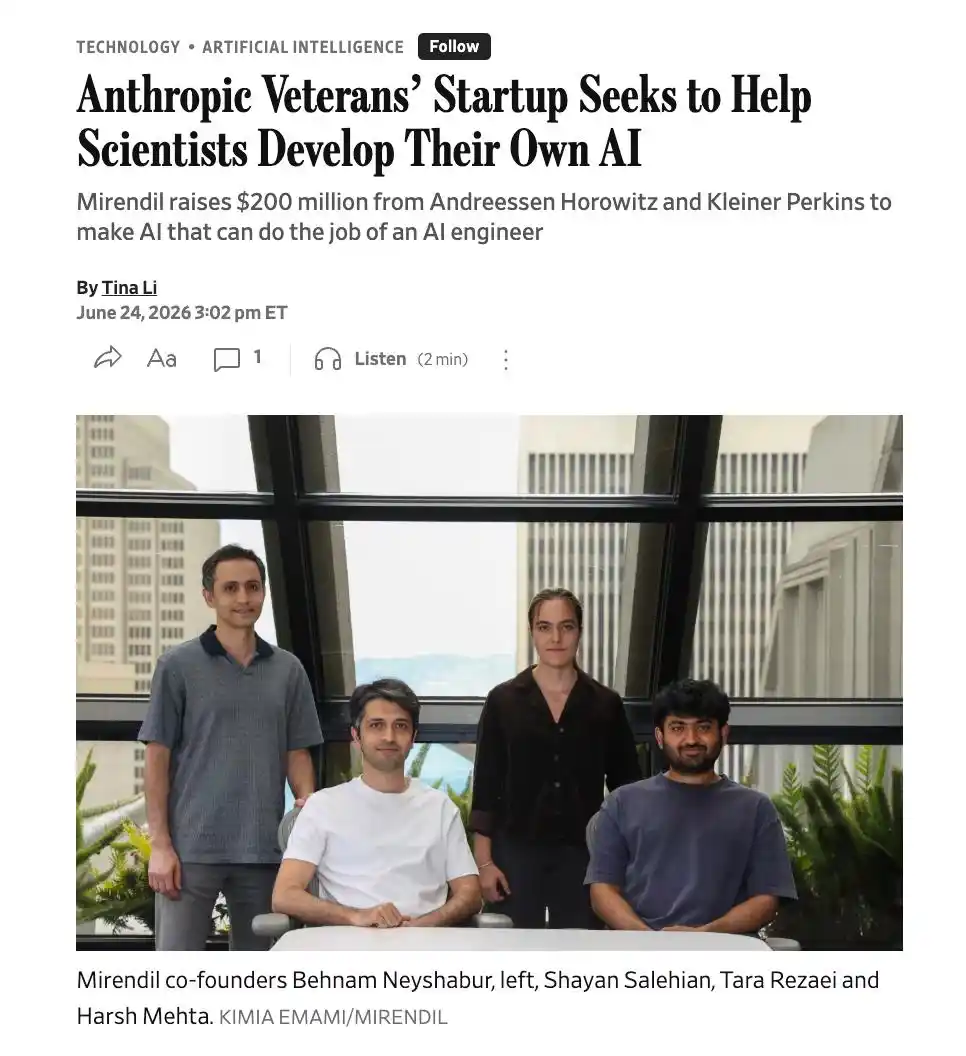
The company's founding team consists of 20 researchers and engineers from cutting-edge institutions like Anthropic, xAI, Google DeepMind, and OpenAI. They came together driven by a passion for science and a commitment to building technology that propels scientific advancement. The company name 'Mirendil' comes from 'The Lord of the Rings,' meaning 'Jewel-friend' in Elvish.

They raised $200 million in seed funding from venture capital firms Andreessen Horowitz, Kleiner Perkins, and NVIDIA. Post-funding, the company's valuation reached $1 billion, making it one of the AI startups with a notably high seed-round valuation in recent years.

Origin: An Unfamiliar Email,

A Seven-Year 'Partnership'

The founders' story begins in 2019.

At that time, Mehta was a regular researcher at Google, while Neyshabur had just joined Google and was already gaining some renown in academic circles for his in-depth research into the fundamental question of 'why AI models work' — as Mehta himself put it, 'he was already a bit of a star in the field.' Mehta mustered the courage to send him an unfamiliar email, and thus their connection began.

They were both passionate about 'using AI to accelerate scientific research' early on, but at the time, limited by model capabilities, this idea remained in the realm of imagination. It wasn't until late 2024 that both joined Anthropic, and in December 2025, shortly after the release of Claude Opus 4.5, they chose to leave to start their own company.

The release of Claude Opus 4.5 significantly enhanced AI Agents' ability to handle complex tasks. Perhaps it was this breakthrough that convinced them the timing was ripe.

Mission: Not 'AI for Science',

But 'AI for AI for Science'

Mirendil's positioning sounds a bit convoluted, but Neyshabur clarified it in one sentence: 'What we do is have AI help scientists build their own AI, rather than just directly using AI to assist science.'

In other words, their goal is to build a tool platform that allows research teams in various vertical fields like medicine and materials science to independently train and iterate their own specialized AI models — without relying on general-purpose models provided by major tech companies. An example they give is: helping researchers build a model to predict Alzheimer's disease risk.

This involves a more controversial technical path — Recursive Self-Improvement, which involves AI continuously optimizing its own code and capabilities. Neyshabur directly stated that this is the shortest path to 'AI-accelerated science,' while also believing it can be advanced safely under human supervision. 'I don't accept the argument that it can't be done; it's just a very difficult problem.'

Competition: Major Companies' Moats,

Precisely Mirendil's Opportunity

The logic behind Mirendil's ability to secure this funding is also quite clear.

Currently, major AI companies, including Anthropic, are increasingly using AI to accelerate their own research. According to Anthropic's disclosure, as of May this year, over 80% of its internal code was already written by Claude. However, at the same time, these major companies explicitly restrict external developers from using their models to train competitive products in their user agreements.

This 'for internal use only, not for lending' strategy, in the view of a16z investor Matt Bornstein, is just a normal reaction from major companies as 'rational economic actors.' But precisely because of this, a structural gap has emerged in the market, necessitating an independent company to take on this task.
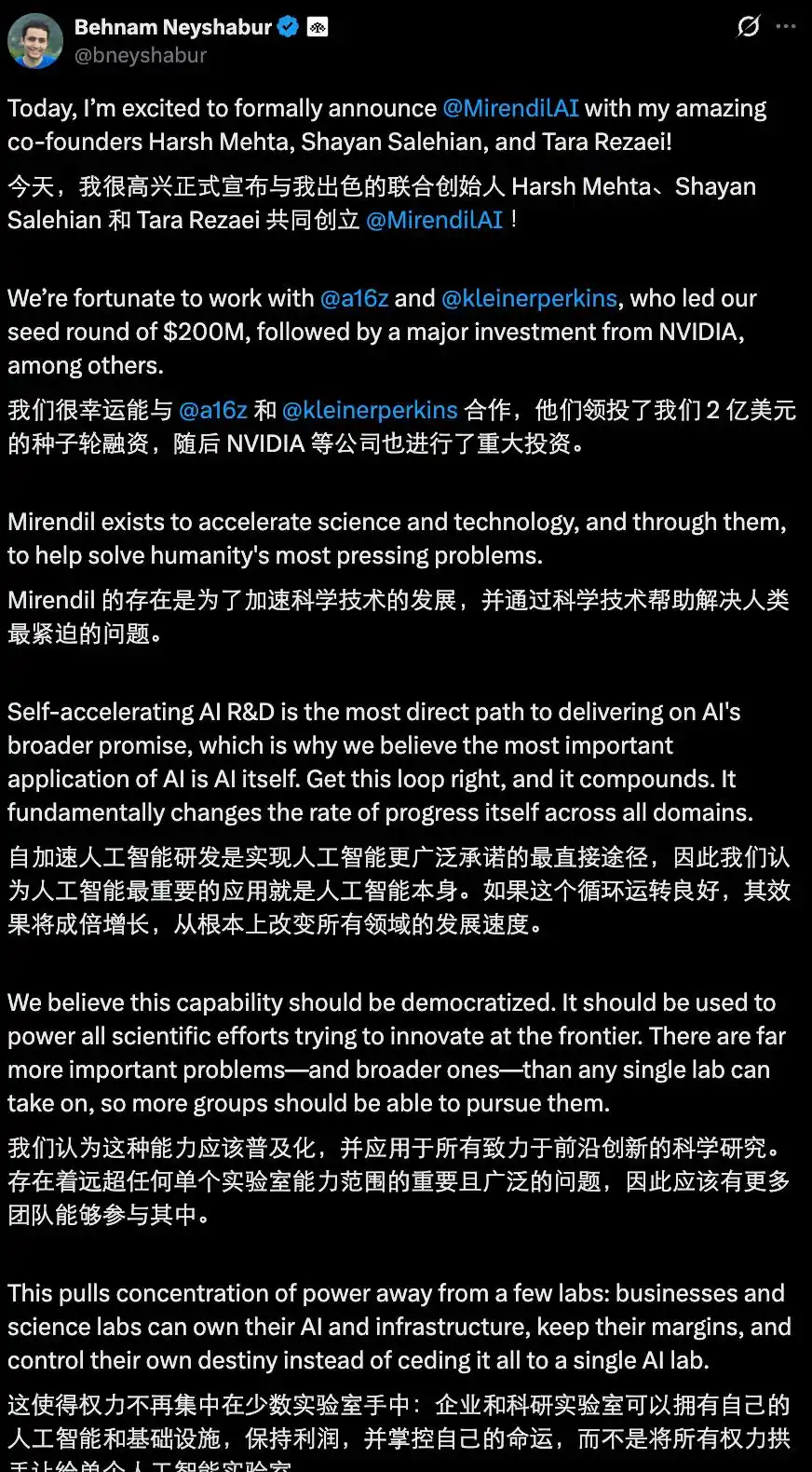
In addition to the two co-founders, Mirendil's core team includes Shayan Salehian, who was an early member at Musk's xAI, and Tara Rezaei, a graduate of MIT. The company currently has about 20 technical staff, with offices located in downtown San Francisco.

In the coming months, Mirendil plans to release its first model and product, gathering early feedback from users. Neyshabur's vision for this is: 'We hope that in the future, there will be thousands of labs in the world, each tackling the most important problems of our time. We want to be the force that empowers them.'

Reference Links:

https://x.com/bneyshabur/status/2069860934148079800

https://www.wsj.com/tech/ai/anthropic-veterans-startup-seeks-to-help-scientists-develop-their-own-ai-09e2f3e5?mod=author_content_page_1_pos_1

This article is from the WeChat public account 'Almost Human', author: Almost Human Editorial Department


Related Questions

QWhat is the name of the startup founded by former Anthropic employees, and what is its valuation?

AThe startup is named Mirendil, and its valuation is $1 billion after a $200 million seed funding round.

QWhat is the core technical vision or goal of the startup Mirendil?

AMirendil's core vision is to achieve 'recursive self-improvement' in AI, aiming to build AI that can self-evolve to accelerate scientific progress, specifically by creating tools for scientists to develop their own specialized AI models.

QHow do the founders of Mirendil view their approach compared to 'AI for Science'?

AThe founders describe their approach as 'AI for AI for Science'. They aim to create tools that enable scientists to build and iterate their own AI models, rather than just using existing AI to directly assist in scientific research.

QAccording to the article, why did the founders decide it was the right time to start this venture?

AThe founders believe the time is right because of significant advancements in AI capabilities, specifically mentioning the release of Claude Opus 4.5, which greatly enhanced AI agents' ability to handle complex tasks, making their vision more feasible.

QWhat market opportunity does the article identify for Mirendil, based on the strategies of major AI companies?

AThe article identifies a structural gap because major AI companies like Anthropic primarily use their AI to accelerate their own internal research and restrict external developers from using their models to train competitive products. This creates an opportunity for an independent company like Mirendil to provide such capabilities to the broader scientific community.

Related Reads

Margin Exhausted, "Brother Huang Li Cheng" Begins Selling Monkeys at a Loss

Taiwanese crypto whale "Machi Big Brother" Jeffrey Huang has been forced to sell his prized Bored Ape Yacht Club (BAYC) NFTs at significant losses to cover mounting losses from a highly leveraged ETH long position on Hyperliquid. Over the past month, Huang sold 34 BAYC NFTs for 326 ETH (approx. $514,000), realizing a loss of 399 ETH (approx. $631,000). The proceeds were transferred to Hyperliquid to replenish margin for his perpetual contract trades. One ape, BAYC #6057, bought for 76.84 ETH four years ago, was sold for just 7.65 ETH, a 90% loss in ETH terms. Huang began his high-leverage (25-40x) ETH long strategy in September 2025 when ETH was around $4,700. While his account once showed over $45 million in unrealized profit, the subsequent crash of ETH to the $1,600 range erased all gains. As of June 26, his cumulative losses on Hyperliquid reached $33.85 million, with over 335 liquidations earning him the community nickname "King of Liquidations." With conventional funds depleted, Huang's once-valuable NFT collection, which at its peak included around 200 BAYCs and was worth tens of millions, has become a lifeline. His remaining ~150 BAYCs, valued at roughly $1.6 million at current floor prices, provide only limited runway for his persistent high-stakes trading. Huang rose to prominence in crypto as a key figure in popularizing BAYC NFTs in Asia during the 2021 bull market. His pivot to perpetual contracts has now led to a cycle where his iconic "monkeys" are being sold to fund a failing trading strategy.

Foresight News36m ago

Margin Exhausted, "Brother Huang Li Cheng" Begins Selling Monkeys at a Loss

Foresight News36m ago

Quantum Computing Approaches "Q-Day": How Encryption Policy, Investment Logic, and Risk Management Are Reshaping the Landscape

Quantum Computing Nears 'Q-Day': Shaping Encryption Policy, Investment Logic, and Risk Management Quantum technology is increasingly intersecting with cryptocurrency policy and cybersecurity discussions as the potential 'Q-Day'—when quantum computers could break current encryption—approaches. While summer brings fast-paced crypto market dynamics, new U.S. legislation, and AI debates, the emerging dimension is how quantum advancements will reshape the digital asset landscape. The next phase of crypto investment is being shaped by two converging forces: clearer regulatory frameworks and cryptographic evolution driven by quantum computing. Investors stand to benefit from reduced uncertainty, but must also recognize that quantum readiness is becoming a core risk factor. Public blockchains rely on cryptography for security, and sufficiently advanced quantum machines could undermine these foundations. This does not mean imminent network collapse, but investors can no longer dismiss the timeline as irrelevant. Key questions now include whether projects have identified their cryptographic dependencies, formulated migration plans to post-quantum cryptography, and established governance for upgrades. For policymakers, the link is clear. Effective crypto policy must look beyond token classification and disclosure to address the underlying infrastructure. As stablecoins, tokenized assets, and blockchain payments integrate deeper into finance, cryptographic resilience becomes a systemic issue. Failure to prepare could lead to investor losses, operational failures, and legal disputes. Policy should encourage risk disclosure, require major intermediaries to maintain upgrade and response plans, and foster coordination across the ecosystem—rather than impose a single technical fix. The sustainability of cryptocurrencies will increasingly depend on their security infrastructure's ability to adapt to these accelerating technological pressures.

Foresight News1h ago

Quantum Computing Approaches "Q-Day": How Encryption Policy, Investment Logic, and Risk Management Are Reshaping the Landscape

Foresight News1h ago

Bitcoin's Five-Wave Adjustment Nears End, Opportunities Emerge in HYPE Support Zone | Invited Analysis

**Bitcoin's Five-Wave Adjustment Nears End, HYPE Support Zone Presents Opportunity | Guest Analysis** This week, Bitcoin (BTC) is in the final stage of a five-wave corrective structure. The formation of 'Endpoint 44' is key: a level above $58,110 suggests a high probability of a technical rebound, leading likely to wide-range consolidation. A break below $58,110 without bullish divergence warrants caution for further downside. Mid-term bearish positions are maintained at 20%, with 30% of capital reserved for short-term scalping opportunities based on predefined support/resistance levels and three scenario-based plans (A/B/C). Simultaneously, HYPE has entered the 55-56 segment of its own five-wave correction from its $76.94 high. If 'Endpoint 56' forms above the prior low (Endpoint 54), creating a double-bottom pattern, a rebound is significantly likely. A light long position (under 30% allocation) can be considered upon stabilization in the support zone. Last week's BTC short-term strategy, guided by proprietary quantitative models, successfully executed two short trades (1x leverage), yielding a total return of approximately 6.21%. The market move validated the prior weekly forecast of a retest towards the $59,100 support. **Core Trading Views Summary:** * **BTC:** Focus on the formation of 'Endpoint 44'. A scenario above $58,110 allows for tentative longs. Key resistances: $60,900-$62,300, ~$65,500, $67,300-$69,500. Key supports: ~$58,100, ~$55,000. * **HYPE:** Monitor the final position of 'Endpoint 56'. Key resistances: ~$65.5, ~$71.5. Key supports: ~$58.5, $52-$54 zone. Strategy favors buying on dips upon stabilization in support areas with confirmed model signals, with strict position control. **Risk Disclaimer:** Financial markets are volatile. All analysis, models, and strategies herein are based on personal technical analysis for journaling purposes only, not investment advice. Trade at your own risk.

Odaily星球日报1h ago

Bitcoin's Five-Wave Adjustment Nears End, Opportunities Emerge in HYPE Support Zone | Invited Analysis

Odaily星球日报1h ago

Trading

Spot
活动图片