Analyzing if AAVE could target $92 after breaking KEY support

ambcryptoPublished on 2026-03-29Last updated on 2026-03-29

Abstract

AAVE breached the $100 support level amid a broader market decline, falling to a three-week low of $96 and trading at $97 at press time, down 7.7% daily. The market cap dropped by over $200 million. The altcoin fell below its short-term moving averages, reflecting strong bearish pressure. Market participants turned bearish, with the Bulls vs. Bears indicator turning negative after over a month of positivity. Exchange data showed a net inflow of tokens, indicating selling dominance, and the Exchange Supply Ratio hit a monthly high of 0.137. The RSI dropped to 34, nearing oversold conditions, suggesting continued seller control. If bearish momentum persists, AAVE could decline toward $92. A rebound would require reclaiming $100 and key moving averages at $107 and $110; otherwise, the downtrend may continue.

Aave [AAVE] breached the $100 support level amid a broader market slip and fell to a three-week low of $96. In fact, at press time, AAVE traded at $97, down 7.7% on the daily charts, while the market cap fell by over $200 million.

In doing so, the altcoin fell below its short-term Moving Averages (MA), the 9- and 21-day MAs, reflecting strong downside pressure.

AAVE drops below $100

As the crypto market retraced, AAVE market participants turned bearish and began exiting the market aggressively, thereby strengthening downside momentum.

In fact, the Bulls vs. Bears indicator turned negative after being positive for more than a month. When this metric turns negative, it suggests that sellers have dominated the market and displaced buyers.
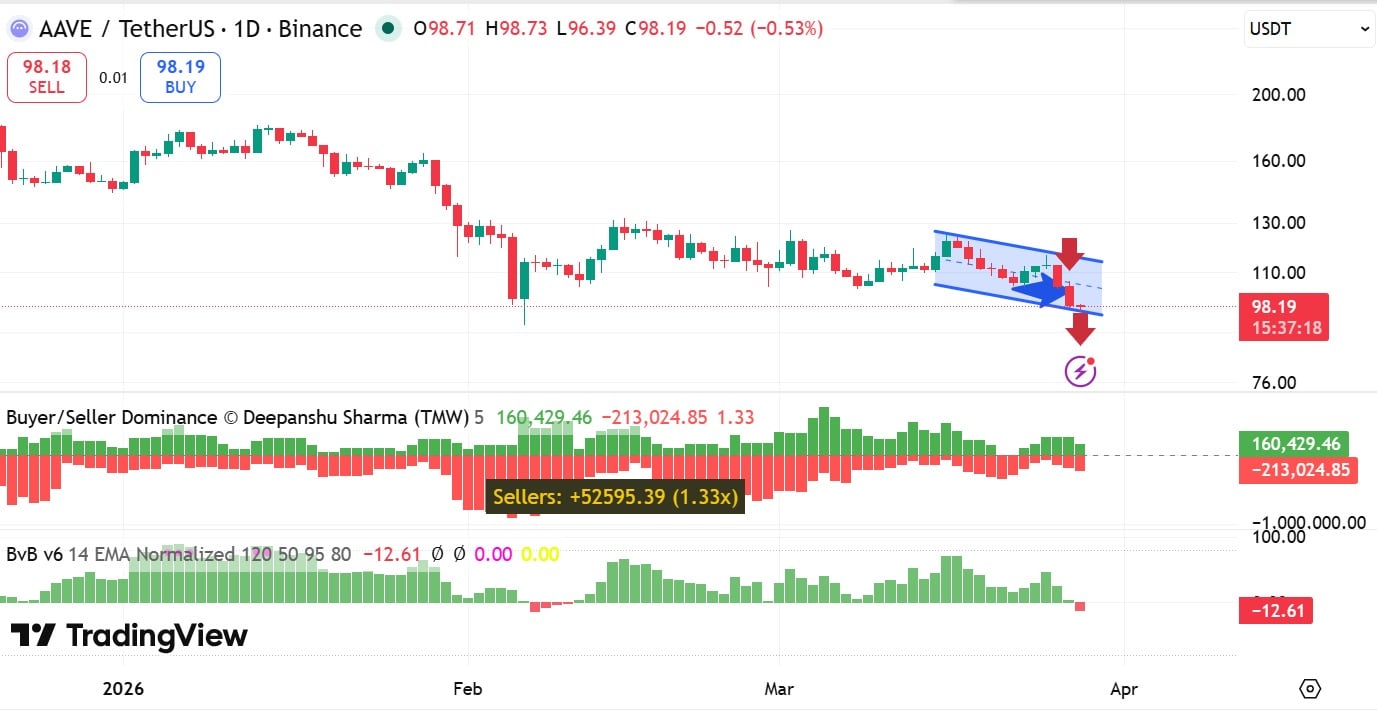
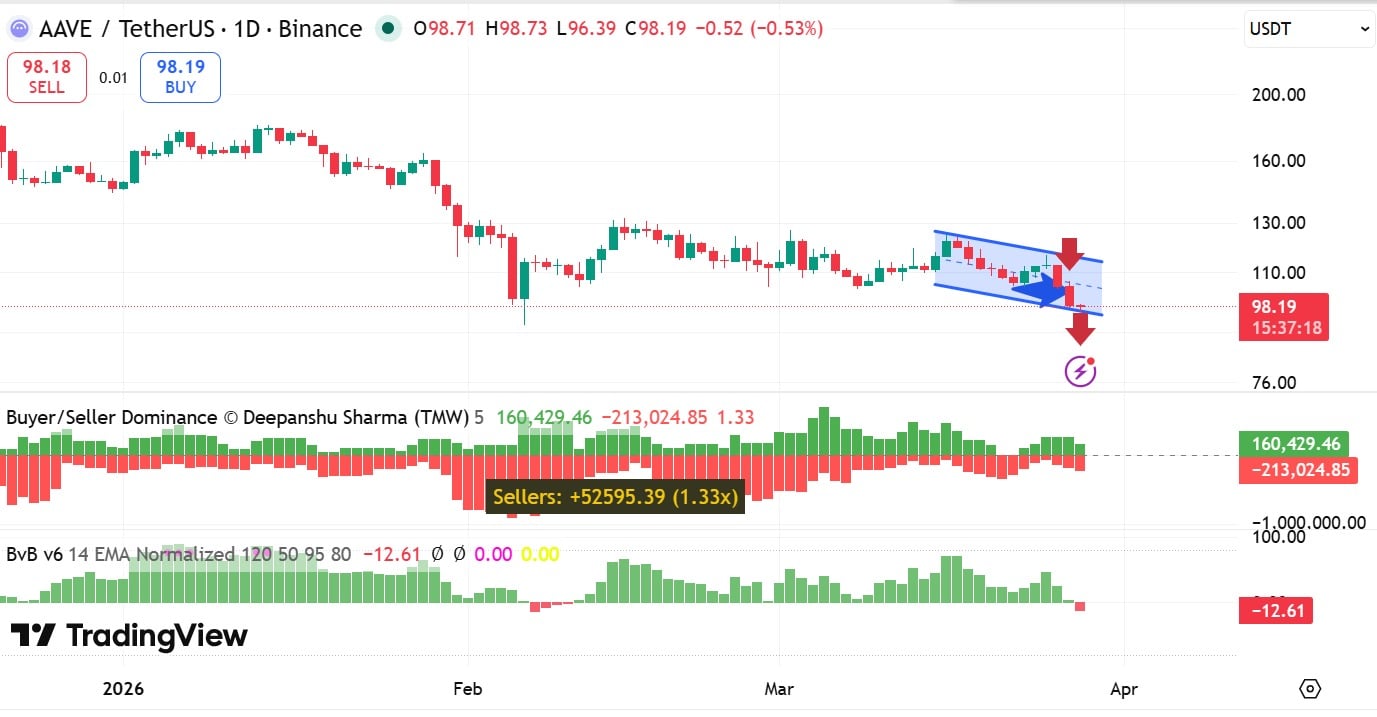
Source: TradingView

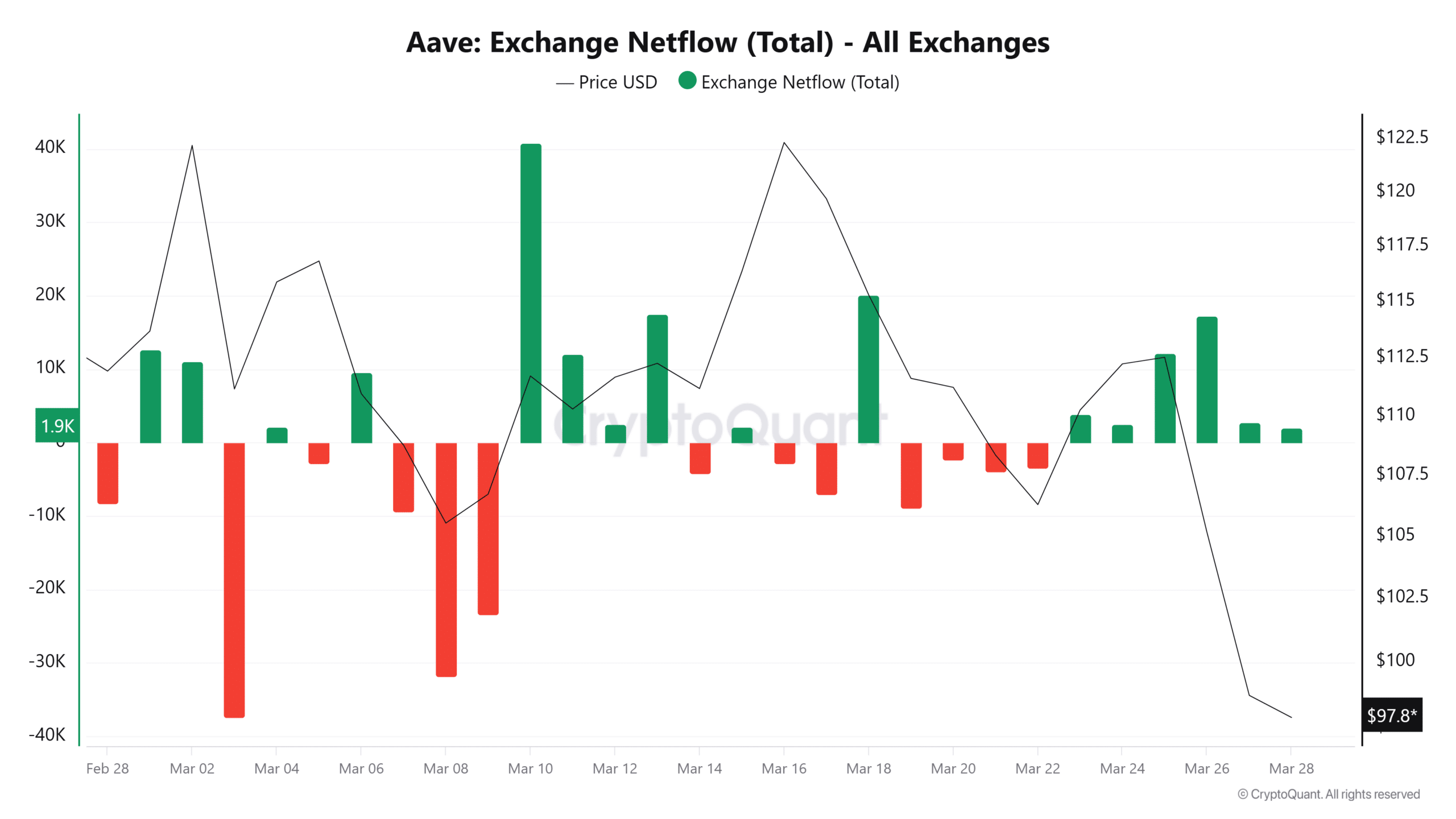
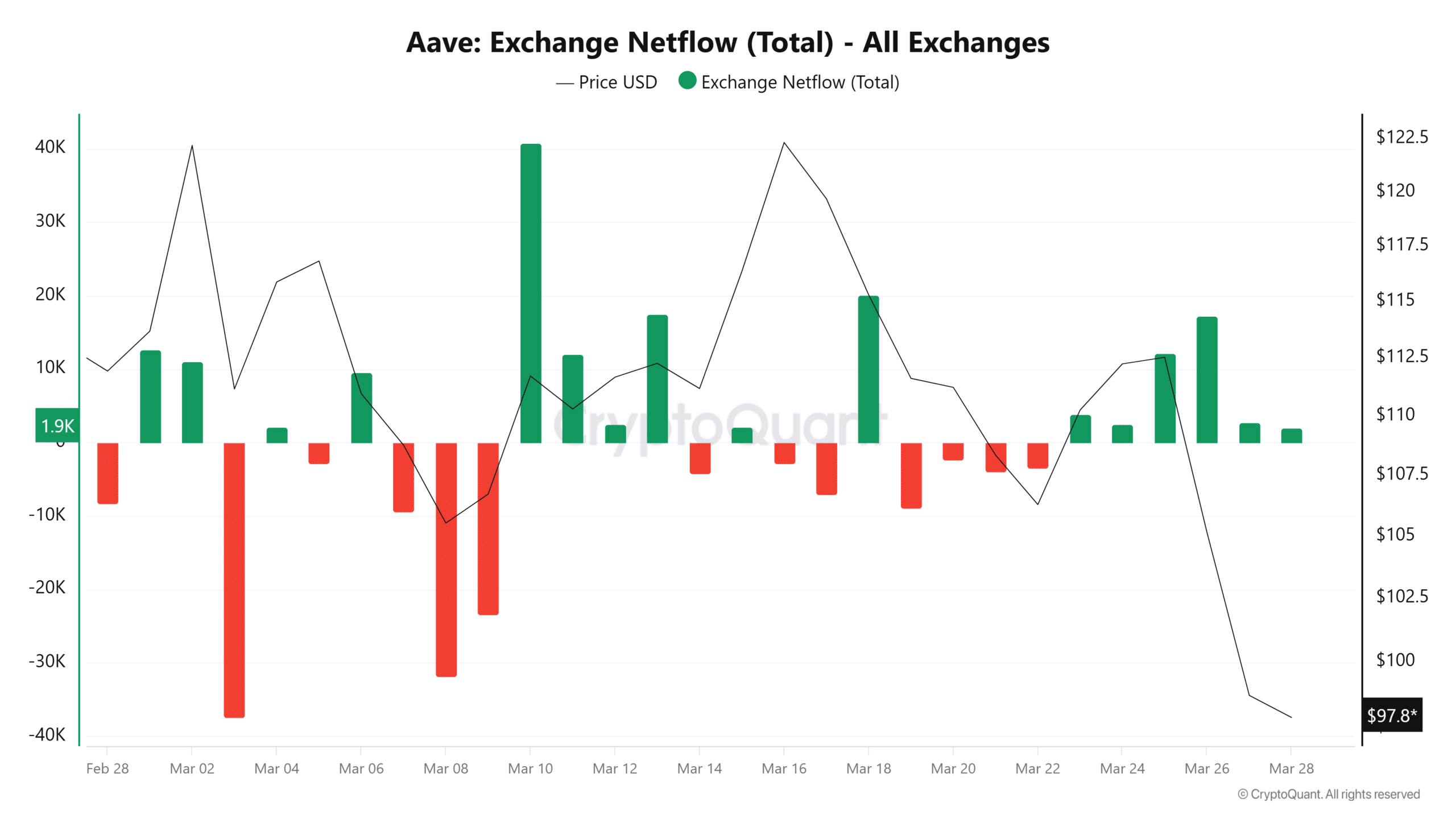
Furthermore, exchange activities echoed this seller dominance. According to CryptoQuant data, 79k AAVE tokens flowed into exchanges, compared to 74k flowing out.
Source: CryptoQuant

Thus, the altcoin’s Netflow extended its hold within the positive zone for the sixth day, suggesting that sellers have had a strong dominance over the market.

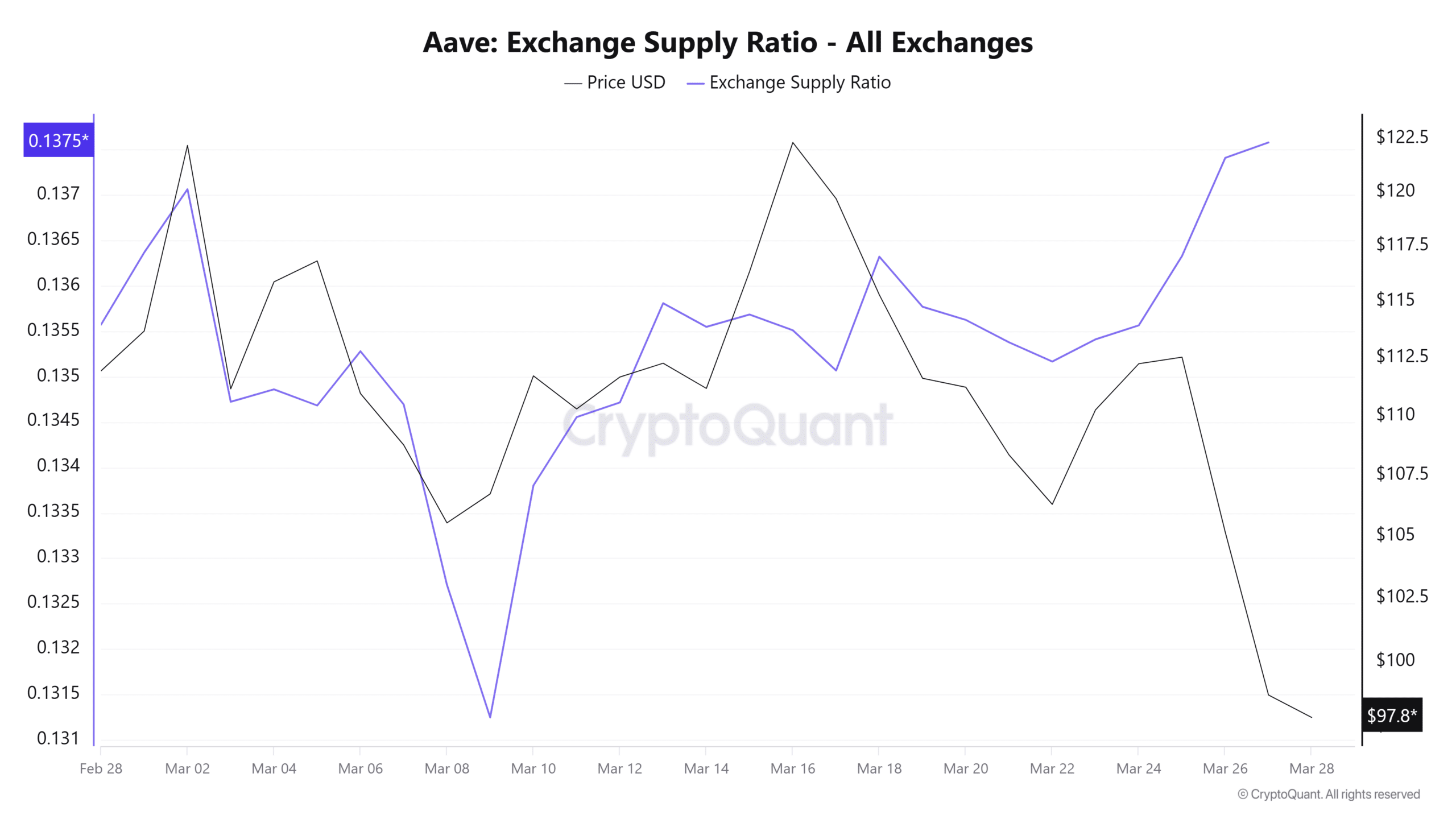
As a result, the altcoin’s Exchange Supply Ratio jumped to a monthly high of 0.137 as of writing, indicating increased selling activity. Often, such a jump in ESR reduces scarcity, thus increasing the supply available for immediate sale.
Source: CryptoQuant

Such a setup on exchanges has preceded strong downward momentum for the asset, leading to lower prices.

What momentum indicators suggest

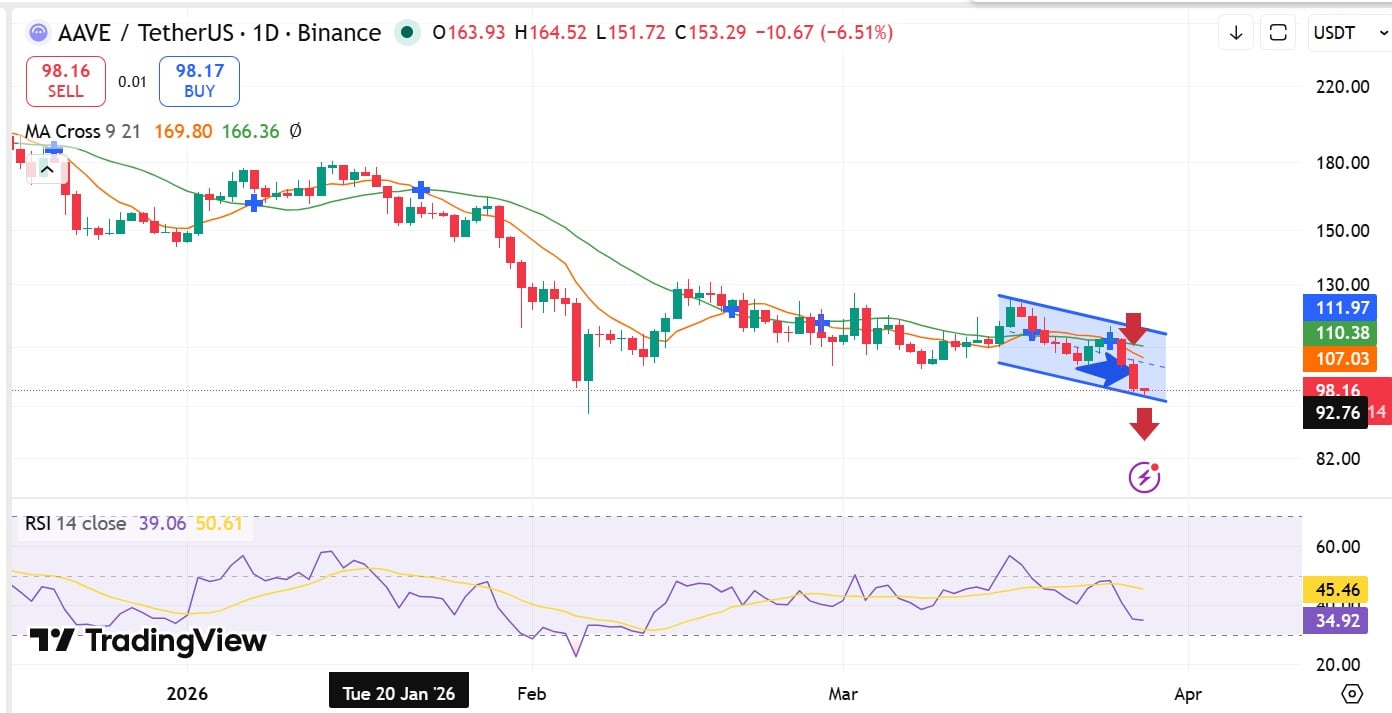
AAVE has experienced strong downward momentum and breached a key support level, with sellers significantly outpacing buyers. Since then, the altcoin’s Relative Strength Index (RSI) dropped deeper into bearish territory, falling to 34 at press time.

With RSI nearing oversold territory, this suggests sellers’ control of the market, while buyers have largely stepped back. Traditionally, such market conditions have strengthened downward momentum, typically resulting in lower prices.
Source: TradingView

Therefore, if sellers continue to overrun the market with little resistance, AAVE is likely to slide towards $92 before attempting another leg up.

However, if the market cools down and bulls reclaim $100, the altcoin could set the ground for a rebound. But for a significant trend reversal, bulls need to flip $100 and reclaim the 9- and 21-day MAs at $107 and $110, respectively.

Failure to do so will see the altcoin enter an extended bearish streak, with a likelihood of staying below $100.


Final Summary

  • Aave dropped 7.7%, breaching $100 and dropping to a three-week low of $96.
  • AAVE faced intense selling pressure, with bears outpacing bulls, strengthening downside risk.

Related Questions

QWhat key support level did AAVE breach, and what was its price at the time of writing?

AAAVE breached the $100 support level and was trading at $97 at the time of writing.

QWhat does the Bulls vs. Bears indicator turning negative suggest about the AAVE market?

AIt suggests that sellers have dominated the market and displaced buyers, indicating strong bearish sentiment.

QAccording to the data, how did the Netflow and Exchange Supply Ratio (ESR) metrics reflect selling pressure?

AThe Netflow was positive for the sixth day, and the Exchange Supply Ratio jumped to a monthly high of 0.137, both indicating increased selling activity and dominance by sellers.

QWhat does the RSI value of 34 at press time imply for AAVE's price momentum?

AAn RSI of 34 suggests that the market is nearing oversold territory, with sellers in control and strong downward momentum, which could lead to lower prices.

QWhat are the two potential price scenarios for AAVE mentioned in the article?

AIf sellers continue to dominate, AAVE could slide towards $92. If bulls reclaim $100, it could set the stage for a rebound, but a significant reversal requires flipping $100 and reclaiming the 9- and 21-day MAs at $107 and $110.

Related Reads

Can a Hair Dryer Earn $34,000? Deciphering the Reflexivity Paradox in Prediction Markets

An individual manipulated a weather sensor at Paris Charles de Gaulle Airport with a portable heat source, causing a Polymarket weather market to settle at 22°C and earning $34,000. This incident highlights a fundamental issue in prediction markets: when a market aims to reflect reality, it also incentivizes participants to influence that reality. Prediction markets operate on two layers: platform rules (what outcome counts as a win) and data sources (what actually happened). While most focus on rules, the real vulnerability lies in the data source. If reality is recorded through a specific source, influencing that source directly affects market settlement. The article categorizes markets by their vulnerability: 1. **Single-point physical data sources** (e.g., weather stations): Easily manipulated through physical interference. 2. **Insider information markets** (e.g., MrBeast video details): Insiders like team members use non-public information to trade. Kalshi fined a剪辑师 $20,000 for insider trading. 3. **Actor-manipulated markets** (e.g., Andrew Tate’s tweet counts): The subject of the market can control the outcome. Evidence suggests Tate’sociated accounts coordinated to profit. 4. **Individual-action markets** (e.g., WNBA disruptions): A single person can execute an event to profit from their pre-placed bets. Kalshi and Polymarket handle these issues differently. Kalshi enforces strict KYC, publicly penalizes insider trading, and reports to regulators. Polymarket, with its anonymous wallet-based system, has historically been more permissive, arguing that insider information improves market accuracy. However, it cooperated with authorities in the "Van Dyke case," where a user traded on classified government information. The core paradox is reflexivity: prediction markets are designed to discover truth, but their financial incentives can distort reality. The more valuable a prediction becomes, the more likely participants are to influence the event itself. The market ceases to be a mirror of reality and instead shapes it.

marsbit15m ago

Can a Hair Dryer Earn $34,000? Deciphering the Reflexivity Paradox in Prediction Markets

marsbit15m ago

First Day Review of "Musk's WeChat" XChat: Even Worse Than Expected

Elon Musk's much-anticipated "WeChat-like" app, XChat, has officially launched after multiple delays. The initial review reveals a product that falls short of expectations, offering an experience largely similar to X Platform's (formerly Twitter) direct messages, despite being marketed as an encrypted communication tool. Key observations from the first-day test include: 1. The app's promoted "end-to-end encryption" and its claimed relation to Bitcoin's architecture were criticized by experts as a superficial attempt to capitalize on crypto buzz, with no real technical connection. 2. Musk's vision of an ad-free "secure communication system" is technically met, but only because the app is currently extremely basic, featuring only a single chat interface. 3. A promised anti-screenshot feature appears inconsistent; it works in X Platform group chats but fails within the XChat app itself, where screenshots still capture avatars. 4. The app supports 45 languages and has a 16+ age rating, indicating a broader tolerance for content compared to WeChat's 13+ rating. 5. A puzzling login process requires users to verify the email associated with their X account. 6. The touted encryption" feels minimal in practice, with its presence only indicated by a simple "Encrypted - Yes" label on messages. 7. Disappearing message timers for groups can be set from 5 minutes to 4 weeks, with the timer starting upon being read by a user. 8. Group invite links are shared with X Platform groups. 9. Group size limits are planned to be increased, aiming for 1000 members, a move that has drawn user criticism. 10. The app offers 8 different colored icons, and its chat bubbles are notably similar to WeChat's. Message deletion options mimic Telegram's. Crucially, many pre-announced features like importing X contacts, integrating Grok AI, X Money payments, and Cashtags are not yet available. The initial release is seen as a bare-bones and underwhelming first step.

Odaily星球日报1h ago

First Day Review of "Musk's WeChat" XChat: Even Worse Than Expected

Odaily星球日报1h ago

Trading

Spot
Futures
活动图片





